July 4th, 2026
ChatGPT SEO Tools vs Dedicated AI SEO Platforms: Which Wins for Content Teams?
 WD
WDWarren Day
You got the pressure: more content, better rankings, consistent traffic. So you search for "chatgpt seo tools," hoping for some clever, cost-effective DIY solution. You've seen the promises, just connect a few APIs, write some prompts, and watch the organic traffic flow.
It feels like the modern, engineering-led approach to content marketing.
But that DIY path has a hidden cost. The real question isn't which tool to use. It's whether you want to spend your time managing a precarious stack of APIs and plugins, or actually scaling your organic traffic with predictable, automated workflows.
SEO in 2026 isn't a single-channel game anymore. You're not just optimizing for Google's ten blue links. You're competing for visibility in Google's AI Overviews (showing up in 15-58% of searches), ChatGPT's answers (over 60% of AI search traffic), and a dozen other generative engines.
The strategic choice for content teams isn't ChatGPT vs. a dedicated platform. It's between manually gluing together a brittle DIY workflow and adopting a fully integrated automation platform like Spectre that handles the entire SEO content lifecycle.
One path leaves you as the system integrator, forever debugging prompts, verifying facts, stitching data between tools. The other lets you focus on strategy while the platform handles research, writing, optimization, and publishing at scale.
I've built both types of systems. For over 15 years as a senior engineer and technical founder, I've worked inside large media companies where SEO systems drive millions in revenue, and I've run my own agency helping B2B SaaS companies build content engines.
The DIY approach seems cheaper on paper. But it rarely accounts for the hours spent fact-checking AI hallucinations (47.1% of marketers face inaccuracies weekly) or the opportunity cost of not scaling faster.
This article is a clear, data-driven comparison across five decision axes: content accuracy and hallucination risk, AI search visibility, true workflow efficiency, scalability and integration fragility, and security compliance. We'll move past feature lists and look at the actual trade-offs teams face when choosing their AI SEO infrastructure.
You'll get a scenario-based framework to figure out whether your team should build a custom stack, buy a point solution, or adopt an integrated platform like Spectre. Let's start by defining what we're actually comparing.
H2: First, Let's Define the Contenders
Before comparing performance, we need to understand what we're actually evaluating. Searching "chatgpt seo tools" typically leads to two distinct approaches, but there's a third that sidesteps the problems of both. Each one represents a fundamentally different way of building your content engine.
H3: Contender 1: The DIY ChatGPT-Centric Stack
This is what most teams picture first: use ChatGPT Plus or the API as your core writing engine, then manually stitch together everything else. You might use ChatGPT's plugin ecosystem (over 1,039 plugins were available by early 2024, per browsercat.com) alongside Surfer SEO for content grading, SEMrush for keyword data, and Grammarly for editing.
The appeal is obvious, flexibility, and a low entry cost on paper. You can prompt-engineer a first draft in minutes.
The reality, at least from what I've seen in agency and startup environments, is that this becomes a pile of disconnected parts. You're managing multiple subscriptions, copying data between windows, and maintaining a fragile workflow that breaks the moment any component changes its API or pricing.
H3: Contender 2: The Dedicated AI SEO Platform
These are specialized tools like Surfer AI, MarketMuse, or Semrush's Writing Assistant. They give you real, useful data, content scores based on top-ranking pages, keyword gap analysis, optimization recommendations. (Aquarium Store Depot achieved a 7× traffic increase using Surfer AI, Source: surferseo.com.)
Their strength is specialization. That's also their problem.
They typically focus on one part of the workflow, usually content grading or strategy, while research, drafting, and publishing stay manual. You get good intelligence but you're still responsible for executing across multiple platforms. It's a better silo inside a larger manual process.
H3: Contender 3 (Our Product): Spectre, Integrated Automation
We built Spectre to solve the fragmentation problem in the first two approaches. It's not another AI writing tool or a content grader, it's a complete AI-powered SEO content workflow engine.
Spectre automates the entire lifecycle: it researches keywords using DataForSEO's live search data, writes optimized articles tuned for both traditional SEO and AI search visibility, scores them against ranking factors, and publishes directly to your CMS. The orchestration that teams normally handle with spreadsheets, manual prompts, and copy-paste workflows just... disappears.
The difference isn't a feature checklist. It's the removal of manual stitching entirely.
Instead of gluing together ChatGPT, Surfer, and your publishing platform, you define a content strategy and Spectre executes it as an automated pipeline. That shifts the focus from tool configuration to strategic output, from building systems to scaling results.
H2: Decision Axis 1: Content Accuracy & Hallucination Risk
The first decision axis isn't about features or speed. It's about trust.
When AI-generated content contains factual errors, it doesn't just waste time. It damages brand credibility and creates lasting SEO harm through incorrect citations and broken user journeys.
ChatGPT's fundamental weakness here is structural: no built-in fact-checking, no live access to search data. You're asking a language model to recall information from its training data, which may be outdated or just wrong. A LinkedIn analysis of over 11,000 ChatGPT-generated links for B2B executive prompts found that 31% were hallucinated, completely fabricated or incorrectly attributed. Nearly one in three references in your content could be wrong. Source
The operational cost compounds fast. A 2025 study found that 47.1% of marketers encounter AI inaccuracies multiple times per week, with more than 70% spending one to five hours weekly on fact-checking alone. That's a hidden tax that never shows up in "cost per article" calculations.
Worse: 36.5% of marketers admit hallucinated content has made it to publication. Source
Dedicated chatgpt seo tools like Surfer and MarketMuse offer some protection by grading content against top-ranking SERP data. They'll flag missing entities or topics that competitors cover, which gives you a factual baseline to work from.
But this is still reactive. You're shown what's missing, then you manually verify and correct. A guardrail, not a guarantee.
Here's where Spectre's approach differs. We built systematic verification into the content pipeline from the start, not bolted on afterward. When Spectre researches a topic, it cross-references multiple structured data sources, live SERP analysis, verified entity databases, before generating anything. The checking includes:
- Source validation against current search results and structured data
- Entity consistency checks to prevent contradictory statements
- Citation verification before any reference is included
- Automated fact-checking against established knowledge bases
Most teams discover this too late: hallucination risk isn't just wrong dates or names. It's entire sections built on outdated SERP features, references to products that no longer exist, arguments based on competitor claims that changed after the model's training cutoff.
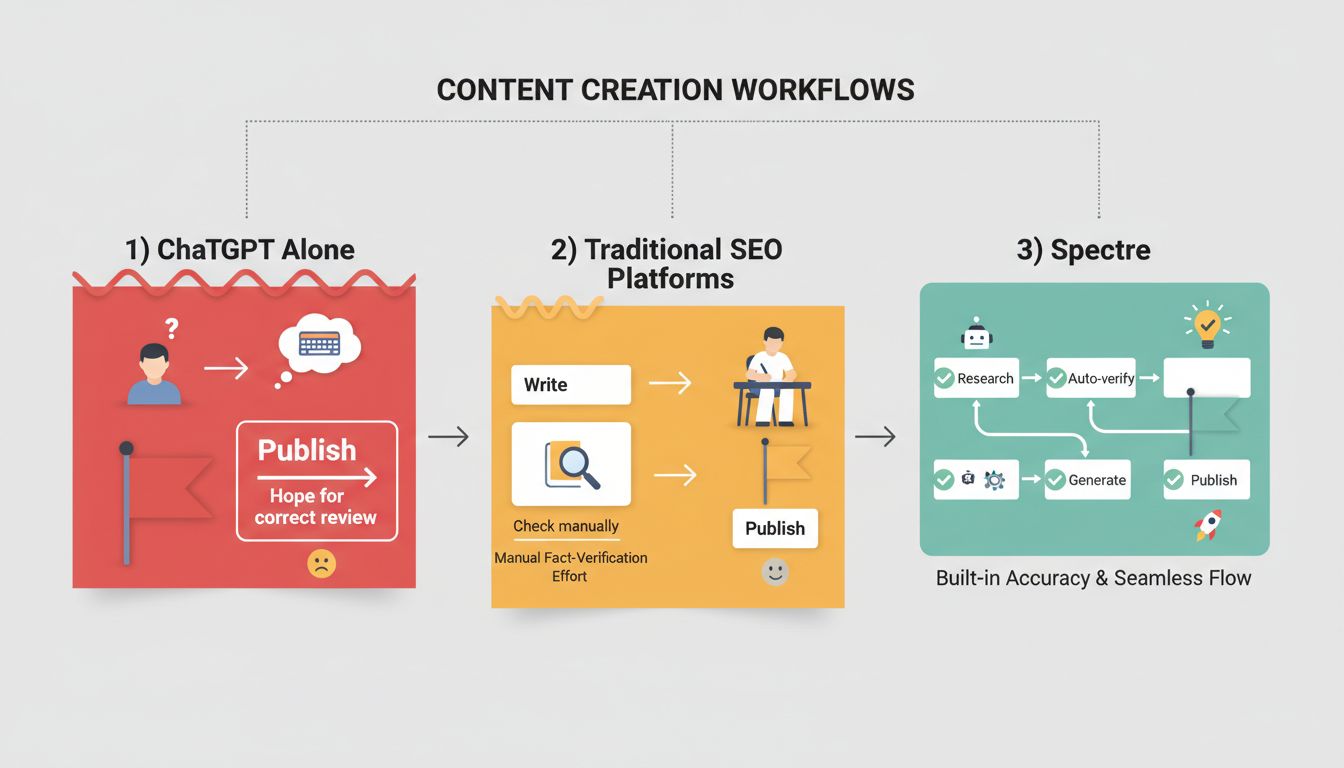
With ChatGPT alone, you're publishing first and hoping someone catches errors in review. With traditional SEO platforms, you're manually verifying against their data. With Spectre, verification happens automatically during research and generation, accuracy is built into the process, not added as a review step.
This matters because Google's E-E-A-T framework explicitly rewards accuracy and trustworthiness. Content with factual errors doesn't just fail to convert. It actively harms your domain's authority over time.
The question is whether you want to spend hours every week as a human fact-checker, or build a system that minimizes hallucinations before they happen.
H2: Decision Axis 2: AI Search Visibility (AEO/GEO)
If you're still only tracking Google rankings, you're already behind.
ChatGPT alone commands over 60% of AI search traffic [Source: sedestral.com]. Google AI Overviews show up in anywhere from 15% to 58% of searches depending on the vertical [Source: cited.so]. When an AI engine generates an answer, it pulls from a curated set of sources. If your content isn't in that citation pool, you're invisible to a fast-growing segment of search traffic, regardless of your page-one ranking.
Here's the core problem with using ChatGPT to optimize for ChatGPT.
You can craft prompts asking it to cite sources. But there's no native tooling to track if, when, or how your content is actually being sourced. It's like trying to improve your Google ranking without access to Search Console. A 2024 LinkedIn analysis of 11,000 ChatGPT-generated links found 31% were hallucinated [Source: linkedin.com]. You're trying to game a black box with no feedback loop.
Dedicated AEO/GEO platforms like OptimizeGEO or Sight AI give you the visibility dashboard that chatgpt seo tools don't offer natively. They'll show your current citation score across AI engines, track competitor mentions, highlight which prompts are generating answers.
Useful. But largely passive.
Knowing your visibility score is a 42 out of 100 doesn't tell you how to get to 60. You're handed a report card without the curriculum. You still have to manually reverse-engineer why certain content gets cited, then rewrite your library to match those patterns.
Spectre is built to close that gap. The AI doesn't just write content, it's trained to structure content specifically for AI retrieval. Clear Q&A patterns, entity-rich headings, schema-ready markup. The stuff answer engines are actually built to favor.
More importantly, the publishing pipeline tracks citation signals. When we detect a piece is being sourced by ChatGPT or Perplexity, we analyze the exact phrasing and context of that citation, then apply those patterns to future content automatically.
With a manual ChatGPT workflow or a passive monitoring platform, you're playing catch-up after the fact. With Spectre, optimization is built into the generation cycle. You're not just hoping your content gets cited. You're engineering it to be citation-ready from draft one.
AI search now represents 30% of total interactions [Source: sedestral.com]. That's not a rounding error in your traffic strategy.
H2: Decision Axis 3: Workflow Efficiency & True TCO
The real cost isn't the subscription fee. It's the hours.
A cheap tool that requires constant babysitting isn't cheap. It's a disguised salary expense.
Most teams look at a $20 ChatGPT Plus subscription and think they've found a bargain. They're measuring the wrong thing. The true cost is the hours spent crafting prompts, verifying facts in other tabs, manually copying content into a CMS, and checking performance across disconnected dashboards.
That fragmented workflow creates cognitive load that slows everything down.
H3: A Real-World Comparison: Building 40 Articles
Compare three approaches to producing 40 articles per month, a realistic target for a growth-focused team.
The DIY ChatGPT Stack A typical setup uses ChatGPT for drafting, Semrush for keyword research ($129/mo), Surfer SEO for grading ($129/mo), and Grammarly for editing ($30/mo). On paper, that's $338 per month plus your ChatGPT subscription [Source: roastweb.com].
The hidden cost is the workflow: 8+ manual steps requiring constant context switching. You're prompting, researching, grading, editing, fact-checking (where 47.1% of marketers encounter AI inaccuracies multiple times weekly), formatting, publishing, then tracking results somewhere else entirely.
That's not a content engine. It's a fragile Rube Goldberg machine that depends on your uninterrupted attention.
Dedicated SEO Platforms Tools like Semrush or Surfer AI combine research and grading into one interface, which cuts some of the tab-switching. You might get the workflow down to 4-5 steps: research, brief creation, AI drafting within the platform, manual review, manual publishing.
The sticker price is higher, but you save some labor. The problem is you're still manually moving content between systems, scheduling publications, and checking performance in yet another dashboard. The automation stops the moment content leaves their platform.
Spectre's Full-Cycle Automation
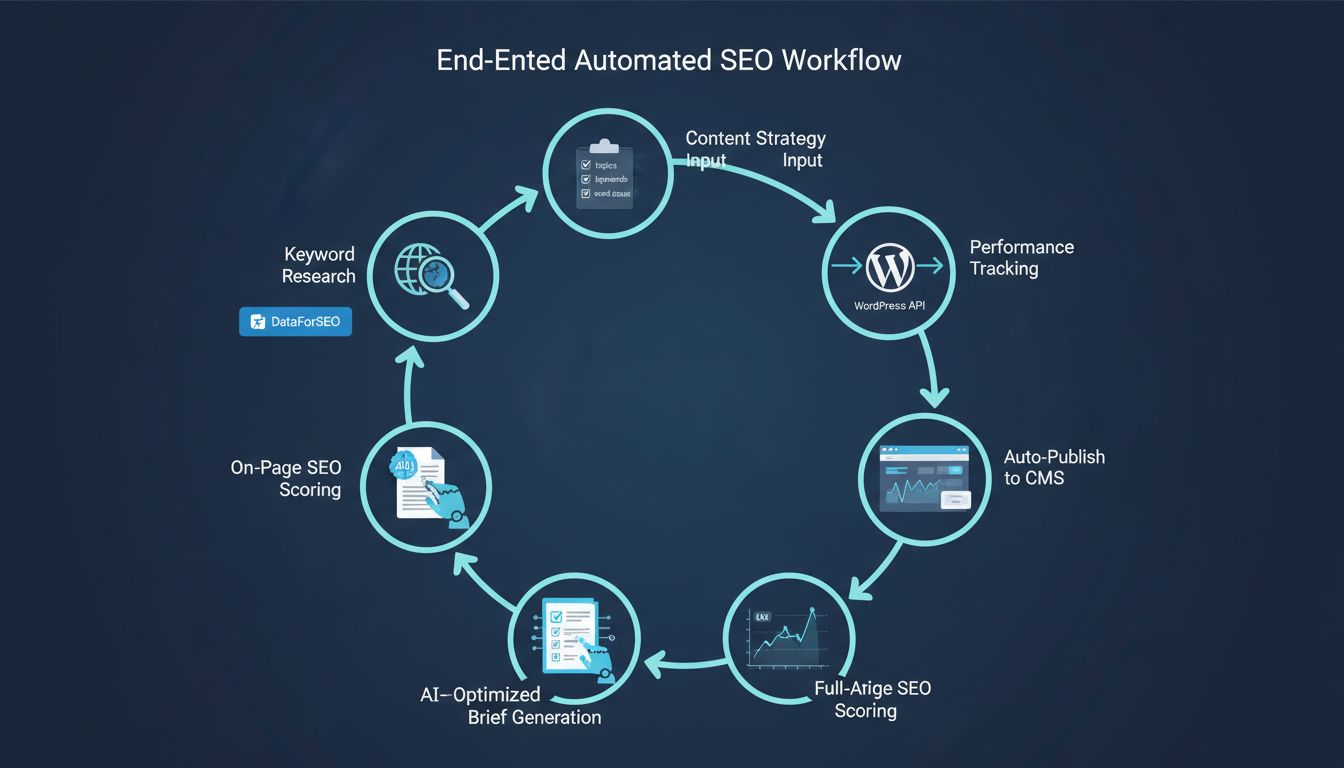
Our approach eliminates the handoffs entirely. You define a content strategy, topics, keywords, target word counts, publishing schedule. From there, Spectre handles the cycle: identifying keyword opportunities via DataForSEO integration, generating AI-optimised briefs, creating fully-researched articles, applying on-page SEO scoring, and publishing directly to WordPress or your CMS on schedule.
Performance tracking is built in. Nothing falls out of the pipeline.
The difference isn't just speed, it's focus. Instead of spending 14.2 hours per week on manual SEO tasks, your team can strategise, edit for brand voice, and analyse what's working. The ROI shifts from "cost per article" to "strategic output per team member."
When you account for the fully-loaded cost of a marketer's time, salary, benefits, overhead, automating the production pipeline isn't an expense. It's a multiplier. One that lets your team operate at a scale previously reserved for enterprises with dedicated content operations staff.
The most expensive tool isn't the one with the highest monthly fee. It's the one that eats the most of your team's attention while delivering fragmented results.
Integrated systems that handle the entire lifecycle aren't a nice-to-have. They're the only way to escape the treadmill that chatgpt seo tools, used in isolation, will keep you on indefinitely.
H2: Decision Axis 4: Scalability, Integration & Fragility
Going from ten posts to a hundred is where things fall apart. The cracks that were manageable at small scale become actual problems.
The Achilles Heel of DIY: Brittle Integrations
A ChatGPT-plus-plugins workflow is a house of cards. You're depending on OpenAI's API stability, third-party plugin developers staying on top of compatibility, and custom scripts you wrote to push content into your CMS.
When any one link breaks, and they do, your entire production pipeline stops.
I've spent more hours than I'd like to admit debugging Python scripts that suddenly stopped publishing to WordPress because of a core update or an authentication change. That's not a marketing workflow. It's a systems administration job.
The RoastWeb example stack producing 40 articles monthly looks impressive until you realize someone has to maintain four separate integrations, monitor API usage, and handle errors every time Surfer's output format shifts.
Dedicated Platforms: Powerful, Yet Often Siloed
Most chatgpt seo tools are great at one thing and stop there. Surfer AI generates optimized content, but you still copy-paste it into your CMS. MarketMuse identifies content gaps, but executing those briefs is still manual.
That creates a new bottleneck: the export-import dance between your optimization tool and your publishing system.
For teams producing at scale, that manual handoff eats hours every week and introduces formatting errors, broken images, and inconsistent metadata. It's like having a world-class manufacturing line that still requires someone to manually load every finished product onto the delivery truck.
Spectre's End-to-End Integration: The Managed Service Advantage
We built Spectre to cut out these fragility points entirely. It's not just another tool in the chain, it is the chain, with maintained native integrations to WordPress, Webflow, and other CMS platforms via our API.
Keyword research from DataForSEO flows directly into AI article generation, which publishes automatically to your site with proper meta tags, images, and internal linking.
No plugins to break. No scripts to maintain. No manual exports.
When you need fifty articles on a new topic cluster, you define the parameters once and the whole pipeline runs without anyone touching it. The time your team gets back from manual publishing and integration maintenance goes toward strategy, promotion, and figuring out what's actually working.
H2: Decision Axis 5: Security, Compliance & Future-Proofing
This is where the DIY approach with chatgpt seo tools gets genuinely dangerous.
ChatGPT operates in a compliance grey area. As of July 2025, OpenAI hadn't secured a formal GDPR certification for ChatGPT, despite stating the product was built with compliance in mind (source: alumio.com). When your team pastes sensitive keyword data, customer information, or proprietary strategy into a prompt, that's going to a third-party system with opaque data handling policies.
This isn't theoretical risk. A 2025 Metomic survey found 69% of organisations cited AI-powered data leaks as their top security concern, with nearly half having no AI-specific security controls. Every prompt containing "Q4 product roadmap keywords" or "customer churn analysis" is a potential compliance incident.
Dedicated SEO platforms address this directly. Platforms like OptimizeGEO advertise ISO 27001, SOC 2, and GDPR compliance as core features, with data processing agreements and audit trails built in. These aren't marketing bullet points, they're contractual obligations that matter for healthcare, finance, and any business handling regulated data.
The trade-off is cost. Enterprise compliance comes with enterprise pricing, starting at $4,999/month for OptimizeGEO's enterprise tier.
We built Spectre to bridge that gap.
Enterprise-grade security without the enterprise price tag. Our platform processes all data through encrypted pipelines, never stores sensitive prompts in third-party AI systems, and keeps clear data ownership boundaries. Unlike ChatGPT, where your prompts contribute to model training by default, Spectre keeps your proprietary keyword strategy and content plans yours alone.
When you're scaling content across multiple products or regulated verticals, security isn't a nice-to-have. It's the foundation everything else depends on.
H2: The Verdict: Which SEO Tooling Path is Right for Your Team?
After breaking down the five decision axes, the choice gets pretty clear. It's less about which tool has the best feature list and more about which approach fits where your team actually is right now.
If you're a solo founder or bootstrap team with deep technical skills, the DIY chatgpt seo tools stack gives you flexibility upfront. You can piece together Semrush for research, the ChatGPT API for drafting, and various plugins for whatever gaps remain. The monthly cost looks lower on paper, but you're trading cash for your own time, time spent debugging integrations, fact-checking hallucinations, and managing a fragile workflow. Worth knowing: according to Neil Patel's research, 47.1% of marketers run into AI inaccuracies every week. That time adds up fast.
If you're a marketing team hitting scaling bottlenecks, a dedicated platform like Surfer SEO or MarketMuse gets you to faster drafts and better-optimized articles without much setup. The problem is they're still point solutions. You'll still need separate systems for keyword research, publishing, and tracking AI visibility, which means the fragmentation never really goes away.
For the growth-focused B2B SaaS founder or agency leader, the answer is integrated automation. This is the exact problem we built Spectre to solve. When your goal is scaling organic traffic without scaling headcount to match, you need a system that handles the whole lifecycle: automated keyword research from DataForSEO, AI-powered content generation optimized for both traditional SERPs and AI overviews, and direct publishing to your CMS. The 14.2 hours per week saved by SEO automation compounds much faster when the entire workflow is connected, not just individual pieces of it.
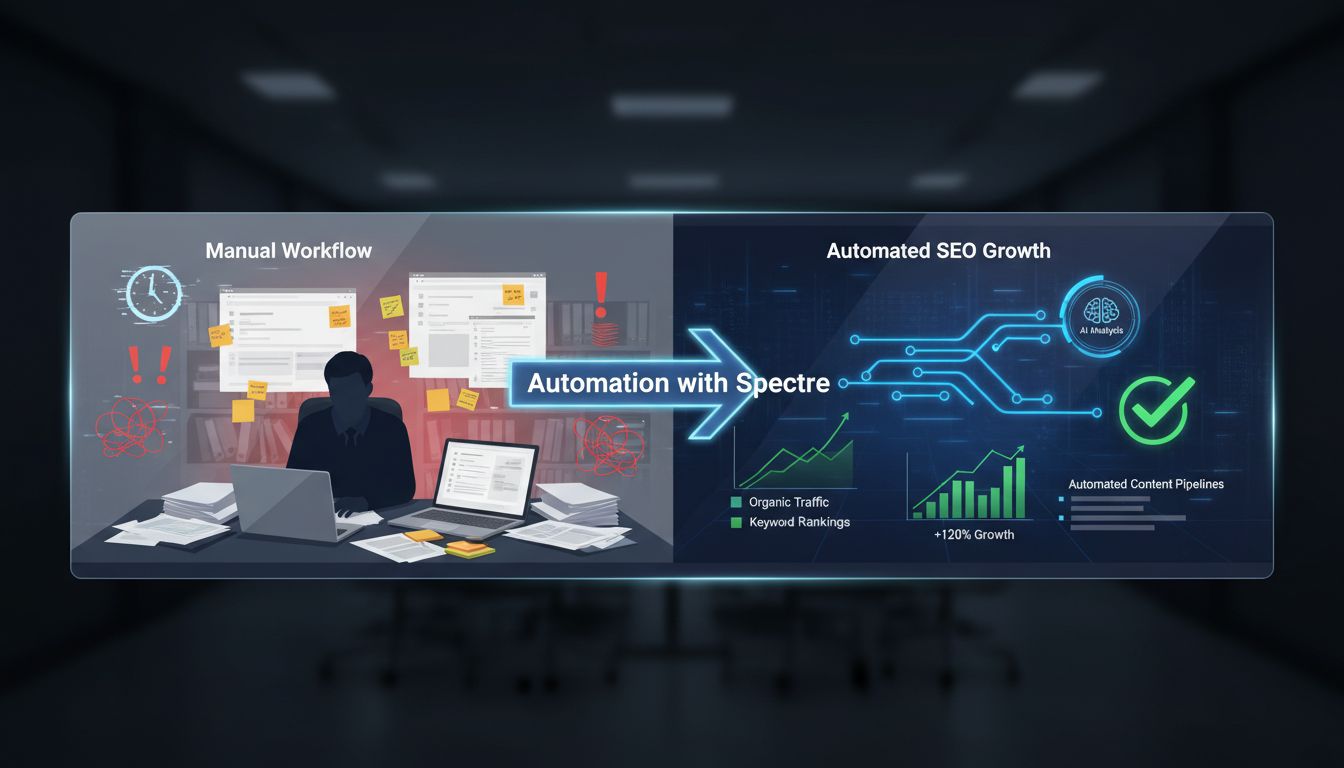
The right choice isn't the tool with the most features. It's the one that removes the most friction so you can stay focused on strategy. For teams under pressure to deliver consistent SEO results at scale, an integrated platform like Spectre turns content from a manual production bottleneck into something that actually compounds.
H2: Common Mistakes Teams Make When Adopting AI SEO (And How to Avoid Them)
What goes wrong when teams actually try to use AI for SEO? Usually the same four things, in the same order.
Mistake 1: Treating AI Output as Final Draft
The most dangerous assumption is that ChatGPT or another LLM produces something ready to publish. According to Neil Patel's AI hallucination study, 47.1% of marketers run into AI inaccuracies multiple times a week, and spend 1-5 hours weekly just fact-checking. I've seen workflows where entire articles went live with hallucinated statistics and wrong technical claims. Brand credibility takes a while to rebuild after that.
Remedy: Never publish AI output without human verification. We built Spectre to integrate fact-checking against live data sources and flag potential inaccuracies before content ever reaches your CMS, a mandatory human-in-the-loop, not an optional one.
Mistake 2: Ignoring AI Search Visibility (AEO/GEO)
Teams optimize hard for Google rankings and then stay completely invisible in ChatGPT, Perplexity, and AI Overviews, which now show up in 15-58% of searches. That's a real blind spot, and it's growing.
Remedy: Track your visibility across AI engines, not just traditional SERPs. You need structured content with clear entity definitions and source attribution, signals that work differently from traditional SEO. Look for chatgpt seo tools and platforms that monitor citations and give you specific guidance for AI answer engines.
Mistake 3: Underestimating Integration & Maintenance Costs
The DIY approach looks cheaper until you count the engineering hours spent connecting APIs, debugging broken workflows, and maintaining custom integrations. That $338/month stack quietly becomes a $3,000/month problem once developer time is in the picture.
Remedy: Calculate true total cost of ownership, including maintenance and opportunity cost. For most teams, a managed platform with native CMS integrations and automated pipelines is cheaper long-term. The 14+ hours weekly saved on manual processes according to nextgrowth.ai can go toward strategy instead.
Mistake 4: Chasing Volume Over Quality
AI makes it easy to produce content at scale, which tempts teams to just... produce more of it. The result is thin, generic articles that don't rank and don't convert because they never actually address what the user wanted.
Remedy: Use AI to add depth, not just output. Fewer topics covered well beats many topics covered badly. Platforms like Spectre analyze SERP features and user intent to guide content structure, so each piece serves a real ranking purpose rather than just filling a calendar.
The pattern across all four mistakes is the same: treating AI as a content generator instead of part of a strategic system. The tools that work are the ones that enforce good practices, not just faster ones.
Conclusion
Most teams pick the wrong AI SEO solution because they're comparing sticker prices instead of actual outcomes. The DIY stack looks cheap until you're three months in and two engineers deep.
Dedicated platforms are specialized tools. Integrated automation is closer to a system that just runs. For teams trying to scale traffic without hiring five more people, the operational fragility of a DIY approach tends to catch up fast.
A full-function platform like Spectre handles the entire lifecycle from research to publish. That's not a feature list pitch, it's just fewer things that can break.
The broader shift happening with chatgpt seo tools and AI search isn't humans vs. AI. It's whether your team is spending time on strategy and analysis, or spending it on manual work a reliable system could be doing instead.
Offload the repetitive stuff. Free up the people.
Tired of juggling a dozen tools? Try Spectre and see how much of your workflow can be automated.
Frequently Asked Questions
Can you do SEO with ChatGPT?
Yes, but with limits.
ChatGPT handles specific tasks fine, brainstorming outlines, writing meta descriptions, rewriting existing copy. What it can't do is access live search data, verify its own accuracy, or plug into your tracking setup automatically.
Think of it as an assistant that needs supervision. Every output needs validation, and it only works when it's part of a larger workflow that includes real keyword research and actual performance data.
Is SEO dead or evolving in 2026?
Evolving. Not dying.
The core stuff, understanding intent, creating content people actually want, building authority, none of that went away. What changed is where you need to show up.
You're now optimizing for traditional Google results and AI-driven surfaces like ChatGPT answers and Google AI Overviews, which are showing up in a significant percentage of searches [Source: digitalapplied.com]. That's a different game than running a checklist. It needs more sophisticated tooling and tighter integration across your whole content system.
Which AI tool is best for SEO?
Depends on your team.
A DIY ChatGPT-plus-plugins setup works if you like building things and don't mind maintaining them. Dedicated platforms like Surfer or MarketMuse go deep on content optimization, but they assume you have specialist resources to actually run them.
For founders and content teams trying to scale organic traffic without assembling a complex tech stack, an integrated automation platform like Spectre, one that handles everything from keyword research to publishing, tends to be the more realistic path to sustainable growth.
What is the equivalent of SEO for ChatGPT?
It goes by two names: AI Engine Optimization (AEO) or Generative Engine Optimization (GEO).
The goal is getting your content cited as a source inside AI-generated answers, Google AI Overviews, ChatGPT responses, that kind of thing. The tactics involve structuring content around clear authoritative answers, using schema markup like FAQPage or HowTo, and building out real topical depth.
It's a different objective than ranking. You're not competing for position ten on a results page. You're trying to be the material the AI pulls from when it answers a question.
Are AI SEO tools worth it?
Yes, but think of it as a force multiplier, not just another software line item.
Tools that save 14+ hours per week [Source: nextgrowth.ai] have a real labor ROI. More than that, the right platform lets you scale content production at a pace that's just not possible manually, which means capturing keyword opportunities before competitors even notice them.
The value isn't the content volume. It's the compounding effect on traffic over time.