June 11th, 2026
Best SEO Tools for Agencies: Top Picks for Scaling Content Production
 WD
WDWarren Day
If your agency's content output is bottlenecked by manual research, drafting, and publishing, you're not just losing time. You're leaving revenue on the table.
Every hour spent moving data between platforms is an hour you can't bill. Every piece of content sitting in a Google Doc is a missed ranking opportunity. The best SEO tools for agencies fix the throughput problem, not just add more metrics to stare at.
Most reviews obsess over feature lists. We're looking at something more practical: which platforms actually automate the journey from keyword to published, ranking article, and which ones slash your cost per piece.
The enterprise SEO market is projected to reach $58 billion by 2035 [Source: MarketResearchFuture]. The agencies capturing that budget are the ones who've turned content production into a system.
This list cuts through the noise. We've looked at the top SEO tools, from data giants like Semrush (yes, including Semrush pricing) and Ahrefs to specialists like Surfer, through one lens: operational efficiency. You'll get a clear breakdown of each tool's role in a scaling workflow, its real impact on time-to-publish, and where the friction hides.
The top pick is Spectre, the integrated engine we built specifically to bridge the gap between research and publishable content. Whether you're looking at the best paid seo tools, seo tools ai, the best seo tools for small businesses, or ai tools for seo optimization, this list covers it. And if you're just getting started, there's something here on the best seo tools for beginners and seo software tools free options too.
The goal is simple: find the stack that turns your content operation from a cost centre into something that actually drives revenue.
How We Chose: The 3 Agency Scalability Criteria
What actually separates the best SEO tools for agencies from the rest of the top SEO tools list? It's not feature count.
Most SEO tool comparisons get stuck on data depth. For agencies scaling content production, that's the wrong question. Your bottleneck isn't finding more keywords. It's getting quality articles from research to published post efficiently, across multiple clients, without everything falling apart.
We scored every tool on this list against three criteria. These aren't nice-to-haves. They're what determines whether a tool actually helps you scale or just adds another tab to manage.
Criterion 1: Time-to-Publish Reduction
This isn't just about writing speed. It's about collapsing the entire workflow, research, briefing, drafting, optimization, publishing, into the fewest possible manual steps.
A Stackmatix test found integrated AI workflows cut total time per article from 10 hours to 3.25 hours. That's a 68% reduction. The number that matters is calendar days from keyword identified to article live. Not words per minute.
Criterion 2: Seamless API & Publishing Automation
Data without action is just overhead.
A lot of tools offer APIs, but hidden limits kill your automation at scale. Semrush's API has a default monthly limit of 10,000 requests, and if you're running multi-client automation, you'll hit that ceiling fast. The real win is a platform that doesn't just surface insights but acts on them, pushing optimized content directly to your CMS. No copy-paste. Teams using integrated automation save an average of 12 hours per week.
Criterion 3: Multi-Client Cost Efficiency
Don't just look at the monthly subscription price.
Calculate your actual cost per published piece: tool license fees per seat, plus the labor cost of every manual step between raw data and a live page. A "cheap" tool that needs three hours of human bridging work per article gets expensive fast. The goal is a cost that's low, predictable, and doesn't spike every time you onboard a new client.
Every tool in this top 10 SEO tools breakdown gets scored against all three. Whether you're evaluating the best paid SEO tools, comparing seo tools ai options, researching the best seo tools for small business, or just starting out with seo software tools free options, these criteria apply. The best ones hold up across all three axes, and that's how content stops being a cost center and starts running like a real system.
Summary Table: Top SEO Tools for Scaling Agencies at a Glance
Here's how the leading platforms stack up against the three scalability criteria that actually matter for agency throughput.
| Tool | Best For | Time-to-Publish | Automation & API | Multi-Client Efficiency | Starting Price |
|---|---|---|---|---|---|
| Spectre | Agencies automating content from keyword to publish | Excellent | Excellent (Integrated pipeline) | Excellent (Unified dashboard) | Custom quote |
| Semrush | Deep keyword & competitor data | Good | Good (10k API limit/month) Source: developer.semrush.com | Good (Project-based) | $499.95/mo |
| Ahrefs | Backlink analysis & domain authority | Good | Good (Unit-based API) | Good | $129/mo |
| Surfer SEO | On-page content optimization | Good | Limited | Limited | $59/mo |
| Clearscope | Editorial quality control | Limited | Limited | Limited | $129/mo |
| Botify | Enterprise technical SEO audits | Good | Good (AI agents) | Excellent (Enterprise) | ~$30k+/yr |
Ratings are based on our agency scalability framework: throughput, automation, and multi-client efficiency.
For teams where content velocity directly impacts revenue, an integrated engine like Spectre, one that cuts out manual handoffs, is the clear winner across the best seo tools for agencies, best paid seo tools, and seo tools ai categories. Whether you're building a full seo tools list or just comparing top seo tools for specific use cases, this is what the numbers say.
1. Spectre: The All-in-One AI Content Engine
Best for agencies that need to scale content production across multiple clients without linearly increasing headcount or juggling a dozen disconnected tools.
Here's the actual problem Spectre solves: your team is doing the same manual handoff five times a day. Keywords in Semrush, optimization in Surfer, publishing in WordPress. Every switch costs time, and time is what agencies sell.
Spectre collapses that into one pipeline. Keyword research, AI drafting, on-page optimisation, and CMS publishing all happen in the same place. No swivel-chair. No copy-pasting between tabs.
That's where the 67% time reduction comes from. HubSpot research puts average production time dropping from 8.2 hours to 2.7 hours when AI handles the full workflow. For an agency, that's the gap between 10 articles a week and 30, with the same team.
Multi-client management is built in, not patched together. You're running all client sites, brands, and content calendars from one dashboard. You're not buying duplicate seats on four platforms or hitting a monthly API ceiling right when a campaign starts picking up.
The trade-offs are real, though. Spectre is focused on content production and publishing. If deep backlink prospecting is your bread and butter, you'd still pair it with something like Ahrefs. And if your team has a custom workflow baked across five tools already, switching requires an actual process change, not just a login.
The payoff is more output, less overhead, and a cleaner path into the enterprise SEO market (projected at $58.29 billion). For teams evaluating the best seo tools for agencies or building out a broader seo tools list, Spectre sits at the top of the seo tools ai category for one reason: it's a production system, not another data dashboard.
2. Semrush: The Data Powerhouse with Scaling Friction
Best for agencies that need deep competitive intelligence and keyword gap analysis, but require a separate content engine to turn insights into published articles.
Semrush is the industry standard for keyword research, position tracking, and competitor analysis. Traffic Analytics and Keyword Gap give you real visibility into what competitors are doing, which makes it genuinely useful for strategic planning and client reporting. For a lot of agencies, it's the first tool they buy when building out a top seo tools stack.
The friction shows up when you try to scale content production. The data stops at recommendations.
You're still manually exporting keywords, building a brief somewhere else, drafting, optimizing (usually in Surfer), and then publishing. Every one of those is a handoff point, and handoff points kill throughput. The API doesn't help either, 10,000 requests per month sounds like a lot until you're managing a dozen client projects programmatically and you hit the ceiling mid-campaign.
semrush pricing adds overhead on top of that. The Business plan starts at $499.95/month, and scaling team access across multiple clients gets expensive fast. You're paying for a dataset, not a publishing pipeline.
The best way to think about it: Semrush tells you what to go after. It's genuinely one of the best seo tools for competitive intelligence. But it doesn't do anything with that answer. For agencies evaluating best paid seo tools or putting together a broader seo tools list, Semrush pairs well with a content engine like Spectre, feed the keyword gaps and opportunities in, let Spectre handle the research, writing, and publishing on the other end.
It's the strategic layer. You still need an operational one.
3. Ahrefs: The Authority & Backlink Specialist
Best for agencies running dedicated link-building campaigns or conducting deep technical audits, who already have a separate content production engine in place.
If Semrush is the intelligence agency, Ahrefs is the forensic lab. It's the undisputed standard for backlink analysis, competitor link profiling, and granular technical site audit data. Site Explorer, Backlink Gap, Content Explorer, the level of detail you get is hard to match anywhere else in the top seo tools space.
For understanding why a site has authority, nothing else comes close.
Where it falls short for scaling agencies is actually the same reason it's so good at its specialty: it does one thing exceptionally well. Ahrefs has zero involvement in content creation, optimization, or publishing. It's a world-class data source, not a workflow tool. You get unparalleled visibility into the link graph, but you're manually bridging the gap from that insight to a published article.
There's also the API situation. Unlike a flat-rate platform, Ahrefs uses a unit-based pricing model for API v3, and costs get unpredictable fast once you start automating at scale. For anyone putting together a serious seo tools list or evaluating best seo tools for agencies, that's worth knowing upfront.
It's a surgeon's scalpel. Incredibly sharp for dissecting authority and links, but it won't help you produce content at volume.
For agencies whose main bottleneck is content throughput, Ahrefs alone solves the wrong problem. It belongs in the stack alongside tools that handle the publishing side. On its own, it's one of the best paid seo tools available... for a very specific job.
4. Surfer SEO & Clearscope: The Optimization Checkpoint
Best for agencies with established editorial teams that need a rigorous, final quality gate before publishing, especially when working with human writers.
These tools do one specific job: grade your draft against the top-ranking pages on Google. Surfer SEO gives you a real-time content score based on SERP analysis. Clearscope runs detailed reports on topical relevance and keyword coverage.
The results aren't bad either. Surfer's own case study shows a 677% increase in organic traffic for an event organiser. Clearscope helped Webflow hit a 130% boost in non-branded SEO traffic.
The value here is the objective benchmark. For junior writers or agencies managing freelancers, that creates a consistent quality standard, concrete targets for word count, heading structure, semantic relevance. No gut feel required.
The problem is the workflow friction.
You research in Semrush, draft in Google Docs, paste into Surfer or Clearscope, get a score, edit, re-check. When you're producing dozens of pieces a week, that loop becomes a real bottleneck. And the process stops at a grade, there's no publishing integration, so you're still manually moving everything to your CMS.
For agencies that care about throughput, these tools add another subscription cost and a manual step. They solve for quality assurance, not scale.
That's actually why we built Spectre to bake SERP-based optimization directly into the drafting phase. You get a publish-ready article without the copy-paste-grade-edit loop.
5. Botify & BrightEdge: The Enterprise Audit Suites
Best for large consultancies serving enterprise clients where technical SEO audits are the primary deliverable, not content volume.
These are the platforms you'll encounter when pitching Fortune 500 companies. Deep technical crawling, log file analysis, sophisticated analytics, well beyond what you get from the best SEO tools like Ahrefs or Semrush.
Botify was named a Strong Performer in the Forrester Wave (Q3 2025) and specialises in enterprise-scale crawling and AI assistants [Source: businesswire.com]. BrightEdge's Data Cube justifies its custom, six-figure contracts on analytics depth alone.
For the right client, the numbers back it up. A Botify client like Singtel saw a 19% uplift in organic traffic post-implementation [Source: botify.com]. At enterprise scale, that ROI covers the cost, which runs anywhere from $30,000 to over $400,000 annually [Source: vendr.com].
These tools solve massive, complex problems: crawl budget, indexation, site-wide technical risk. Real stuff, if that's your problem.
For a 5-50 person agency focused on scaling content production, it almost certainly isn't.
The cost alone wrecks any viable cost-per-published-piece calculation. There's no content creation engine inside either platform, they add nothing to your throughput. And the implementation overhead requires dedicated technical resources, which pulls focus from the thing that actually grows the business: producing and publishing more articles.
They're brilliant diagnostic suites. Just for a problem most scaling agencies don't have.
Common Agency Tool Stack Mistakes That Kill Scalability
I've watched agencies burn six-figure budgets on tool stacks that looked impressive and quietly killed their growth. The mistakes aren't usually about picking bad software. They're about not understanding how tools interact once you're actually operating at scale.
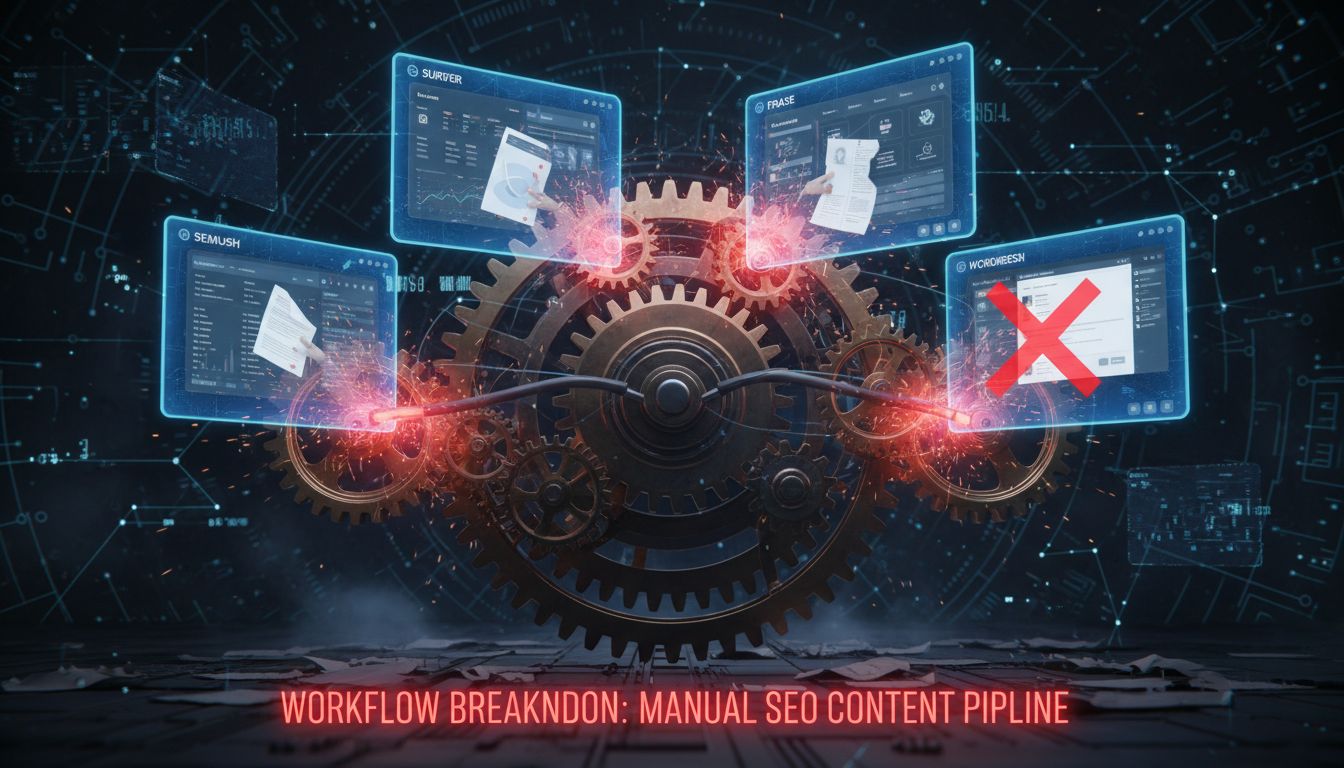
Chasing features over throughput. Patching together "best-in-class" tools, Semrush for research, Surfer for optimization, Frase for briefs, WordPress for publishing, sounds smart until you're manually moving content between four disconnected systems. The subscriptions aren't the real cost. The labor to keep it all stitched together is.
Each handoff introduces friction. And friction compounds.
Ignoring API and automation limits. Semrush's default 10,000 monthly request cap will sneak up on you [Source: developer.semrush.com/api/introduction/semrush-api-overview]. Same with Ahrefs' API unit costs. If your workflow depends on programmatic access, budget for enterprise API tiers from day one, not after you've already hit the wall.
Underestimating the seat tax. A content strategist might need logins in Semrush, Clearscope, and your project management tool. That's three recurring charges before they've written a single word. It adds up fast and quietly eats your margins. Look for platforms with unified team and client management wherever you can find them.
Over-relying on AI without oversight. AI-generated content still needs human editing, for brand voice, accuracy, and anything that requires actual judgment [Source: getharvest.com/blog/ai-changing-seo-agencies-2025]. I've seen agencies publish factually shaky, generic content because they automated the entire pipeline and assumed the output was fine. It usually isn't.
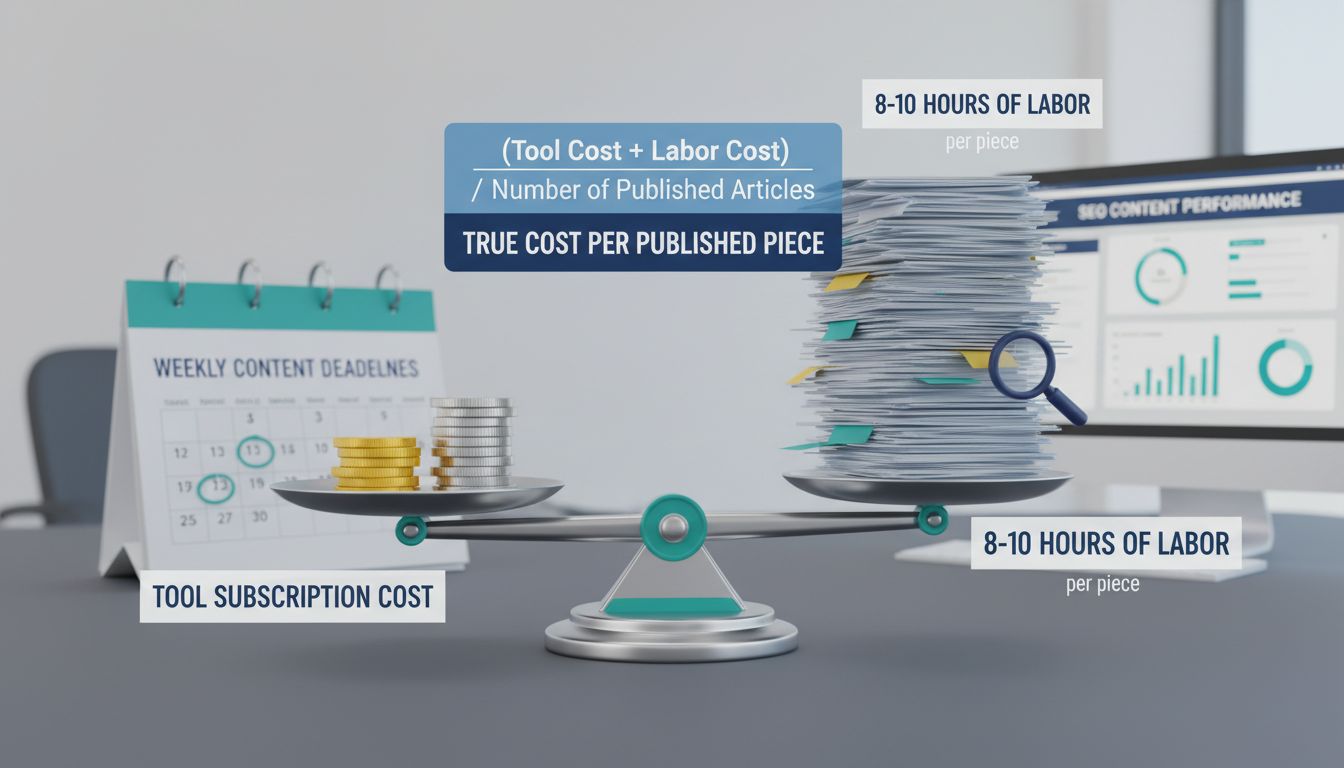
Not calculating true cost per published piece. The only number that actually matters: (Tool Monthly Cost + Estimated Labor Hours × Hourly Rate) / Number of Published Pieces. Most agencies just look at the software subscription and ignore the 8-10 hours of human labor baked into each article. A cheap tool with high labor overhead is more expensive than a pricier one that automates most of the work.
Neglecting privacy and compliance. Tools that collect visitor data without proper GDPR/CCPA consent create real liability, for your agency and your clients. In regulated markets, this isn't just an ethical consideration. It's a commercial one.
Positioning Your Agency for the Future: Trends & The 80/20 Rule
The gap between insight and published content is where most agencies bleed out.
Two trends are shaping what comes next, and if you're not paying attention to both, you're going to feel it.
Trend 1: The Rise of the Integrated AI Content Engine. Stitching together Semrush, Surfer, and a separate drafting tool is becoming a liability. The agencies winning are using platforms that handle keyword-to-publish in one workflow, like Spectre. Five logins, five context switches, five points of failure, it's not a stack, it's a liability.
Trend 2: API-First & Headless CMS Integration. As clients migrate to headless CMSs like Contentful or Kontent.ai, your tools need real APIs for direct publishing. Teams using integrated automation save around 12 hours per week. That's not optional at scale.
Which brings us to the 80/20 Rule for Scaling Agencies.
Spend 80% of your effort building a repeatable content engine, the system that produces predictable output without heroics. The other 20% goes to high-touch strategy and custom client work. Your primary tool needs to carry that 80%.
Is SEO dead? No. It's just not what it was in 2018.
The fundamentals, intent, authority, structure, still matter. But execution is increasingly automated. The agencies treating SEO as an ai tools for seo optimization problem are moving faster than the ones still treating it as a manual research exercise.
Can ChatGPT replace an actual SEO platform? No. It's a component, not a workflow. Real SEO requires intent analysis, competitive research, content structuring, and publishing in sequence. A raw language model doesn't give you that.
Nothing is replacing SEO. It's integrating with AI, social search, and answer engines. The demand for quality, discoverable content is higher than it's ever been.
Your agency's edge won't come from having more data. It'll come from having the most efficient engine to turn that data into ranked pages.
Conclusion
Most agencies are drowning in tool sprawl. The fix isn't more data, it's fewer handoffs and a stack that actually ships content.
The real number to track isn't your licensing spend. It's cost per published piece, including the labour. Once you do that math, a lot of expensive "best seo tools" subscriptions start looking pretty questionable.
For growing agencies, Spectre is the most direct answer to that problem. Keyword to published post, one workflow. Among the best seo tools for agencies, it's the closest thing to a true production engine rather than a research dashboard.
Tools like Ahrefs for backlink analysis or Botify for enterprise audits still have a place. But they're additions to a working content engine, not a substitute for having one.
So the actual next step is this: calculate your true cost per published piece. Then trial Spectre. If you have specific gaps, deep backlink work, enterprise technical audits, layer Ahrefs or Botify in on top of that.
But get the engine running first.
Frequently Asked Questions
What is the best SEO tool for an agency?
There's no single answer, it depends on where you're actually losing time.
If content production is the bottleneck, you want an integrated AI content engine like Spectre that takes you from keyword to published article in one workflow. If you need deep backlink analysis on top of that, layer in a specialist like Ahrefs. But your foundation should be something built for throughput, not just research.
How can I scale my SEO agency efficiently?
Automate the content production lifecycle. That's it.
Find your biggest time sink, research, writing, optimization, whatever it is, and find tools that collapse those steps into one workflow. Then calculate your true "cost per published piece" (software plus labor) and optimize against that number. Cheaper subscriptions aren't the answer. Fewer manual steps are.
Is SEO dead in 2026?
No. It's changing, not dying.
AI answer engines and shifting user behavior mean the tactics look different now. But the core idea is the same: create intent-matching content that earns visibility. The agencies winning in 2026 are the ones using ai tools for seo optimization like Spectre to execute that at a scale that wasn't possible before.
Can ChatGPT do my SEO?
It's a component, not a strategy.
ChatGPT can help with drafting and ideation. It cannot do keyword research, analyze SERP competition, optimize for E-E-A-T signals, or push content to your CMS. Think of it as a writing assistant inside a larger automated workflow, useful for execution, not sufficient on its own.
Should I use multiple 'best-in-class' SEO tools or one all-in-one platform?
A stack of best seo tools stitched together usually sounds better than it works.
You get workflow friction, surprise API costs, and integration headaches that slow everything down. For growth-focused agencies, an all-in-one production platform like Spectre, with maybe one specialist tool for high-value needs like link building, is almost always faster and cheaper in practice than managing five separate subscriptions.