March 8th, 2026
Content Creation Software for AI-Generated SEO Articles: Quality Control in 2026
 WD
WDWarren Day
You've scaled your AI content production, but your traffic hasn't.
You're publishing more than ever, yet each piece feels like a lottery ticket. A few might rank, but most vanish into the void. The problem isn't the AI. It's the lack of a factory-grade quality control system.
I've watched this pattern repeat across dozens of B2B SaaS companies. Teams adopt content creation software, celebrate the speed gains, then quietly panic three months later when organic traffic stays flat. The AI writes fast, sure. But it also hallucinates facts, dilutes brand voice, and produces the kind of generic analysis that Google (and now ChatGPT, Perplexity, and Gemini) actively ignore.
More content is being created than ever, but less of it is being seen. Zero-click searches jumped from 56% to 69% between January 2024 and May 2025. Search has shifted from rewarding volume to rewarding authority, and AI search engines are even more ruthless about citing only the most credible sources.
Here's what changed in 2026: The best content creation software isn't defined by how much it writes anymore. It's about how intelligently it controls for quality. The winners integrate fact-checking via RAG, compliance guardrails, AI search optimization, and enterprise governance. They transform raw AI output into authoritative, ranking-ready content instead of just cranking out words.
This article delivers a three-tiered quality control framework and a concrete SLA you can use to evaluate any tool before you buy.
Beyond the Click: Why Quality Control Is Your New SEO Superpower in 2026
I spent six months last year watching our AI content operation pump out 200+ articles per month while organic traffic went nowhere. We'd automated everything. Keyword research, outline generation, image selection. The output looked professional enough.
It just didn't work.
This is where every growth team lands in 2026: more content doesn't mean more traffic. It means more noise. Search engines, both traditional and AI-powered, have gotten brutal about filtering it out.
The battlefield looks completely different now. You're not optimizing for one algorithm anymore. You're competing across traditional SERPs and AI search simultaneously. ChatGPT, Gemini, Perplexity, Google's AI Overviews. Zero-click searches jumped from 56% to 69% in just one year. Most searches never leave the results page now. An AI agent either answers the question directly or doesn't, and it may or may not bother citing you.
Here's what changed: traffic comes from citations, not clicks. When ChatGPT fields a query about "best practices for SaaS onboarding," it either references your article or it doesn't. There's no page two. No "good enough to rank #8." You're either the authoritative source the AI trusts, or you're invisible.
AI agents don't skim. They parse structure, verify facts against known sources, evaluate expertise signals. Google's algorithms do the same, just weighted differently. Both lean heavily on E-E-A-T: experience, expertise, authoritativeness, trustworthiness. Poor quality doesn't rank lower anymore. It gets filtered out before human eyes ever see it.
The solution isn't writing less or ditching AI entirely.
It's implementing a three-tiered quality control framework (pre-writing, during-writing, and post-writing defenses) that transforms your content creation software from a word factory into something that actually ranks.
The 2026 AI Content Quality Control Framework: A Three-Tiered Defense
Most content teams treat quality control like airport security. A checkpoint at the end that slows everything down. I've watched companies hire editors to "fix" AI drafts, only to burn out their team trying to polish fundamentally flawed content.

The framework that actually works isn't a gate at the end. It's three layers of defense built into your workflow, each catching different failure modes before they compound.
Tier 1: Pre-Writing Strategic Guardrails (The "What" and "Why")
Your content creation software should kill bad ideas before they consume resources. This tier prevents the most expensive mistake: producing well-written content about the wrong topic.
Topic Selection & Authority Mapping
MarketMuse changed how I think about topic selection. Instead of chasing individual keywords, it models your entire topical authority against competitors. You see exactly where you have credibility to write and where you're just adding noise.
The software builds a proprietary topic model of your domain, then scores every potential article idea against it. A low score means you lack the supporting content infrastructure to rank. No amount of optimization will fix that. A high score means you have the cluster depth to compete.
This prevents the classic AI content trap: publishing 50 articles on adjacent topics without the connective tissue that signals expertise to both Google and AI answer engines.
Intent-First Briefing
Frase and Clearscope don't just hand you keywords. They reverse-engineer what's already winning by analyzing the top 20 results, extracting the questions answered, the depth of coverage, and the semantic relationships that define comprehensive content.
When I generate a brief in Frase, I'm not guessing what to include. The software shows me the specific subtopics, related entities, and question clusters that top-ranking content addresses. More importantly, it shows me what AI assistants are pulling from those pages when they generate answers.
Most teams skip ahead here and lose. They feed a keyword into their AI writer and hope for the best. But without a data-driven brief that accounts for both traditional search intent and AI citation patterns, you're building on sand.
Competitive Differentiation Mandate
Here's the contrarian part: your brief should include a requirement that cannot be automated.
A unique data point from your analytics. A customer quote from your support tickets. An expert opinion from your product team. 97% of companies now have a review process for AI content, but most are checking grammar and tone. The real quality gate is mandating original insight at the brief stage. If your brief doesn't specify what makes this piece different from the AI-generated content your competitors are publishing, your editor can't save it later.
This is how you satisfy E-E-A-T before a single word is written. The brief should answer: whose experience are we sharing, what expertise are we demonstrating, and why should anyone trust this over the 40 other AI-generated articles on the same topic?
Tier 2: During-Creation Tactical Precision (The "How")
This is where your content creation software earns its cost. Tier 2 controls prevent the AI from inventing facts, plagiarizing competitors, or producing generic sludge that dilutes your brand.
Factuality via RAG
RAG (Retrieval-Augmented Generation) sounds technical but the concept is simple: give the AI source documents to reference instead of letting it improvise from training data.
Claude Enterprise demonstrates this perfectly. When you're working within a large context window and approaching the limit, it automatically switches to RAG mode. Instead of hallucinating or refusing to continue, it retrieves relevant information from your uploaded knowledge base and cites exactly where each claim comes from.
This is the difference between "AI says your product does X" and "according to your January 2026 product documentation, your product does X." One is a liability. The other is auditable content you can publish with confidence.
For teams without enterprise AI budgets, the principle still applies. Your content creation software should allow you to upload source material (product docs, research reports, previous high-performing content) and require the AI to ground its output in those sources.
Originality & Plagiarism Checks
I've seen AI writers produce paragraphs that are 85% identical to a competitor's page. Not because the AI was trained to plagiarize, but because both the AI and the competitor optimized for the same SERP patterns.
Outranking includes plagiarism checking on certain plans for exactly this reason. Before your first draft moves to review, it should pass through Copyscape or Originality.ai. This isn't about catching intentional theft. It's about catching accidental duplication that happens when AI optimizes too aggressively for ranking patterns.
The check should be automatic, not optional. If your content creation software doesn't integrate this, you're adding a manual step that will get skipped under deadline pressure.
E-E-A-T Injection Process
This is where most AI content fails silently.
The draft is coherent, well-structured, and keyword-optimized. It's also indistinguishable from 500 other articles because it lacks the signals of genuine expertise. Your during-creation process needs a step for adding proprietary insights. I use a simple checklist: Does this draft include at least one data point our competitors don't have access to? Does it reference a specific customer outcome? Does it challenge a common assumption with evidence?
These elements can't be generated by prompting alone. They require pulling from your CRM, your analytics, your support tickets, or your subject matter experts. The software should have a workflow that pauses for this injection, a required field for "unique insight source" before the draft is marked complete.
Brand Voice Adherence
Jasper's brand voice guides exist because inconsistent tone is a quality failure that compounds over time. When you publish 50 articles that sound like they were written by different people, you train your audience not to trust your brand.
Your content creation software should maintain a voice profile built from your best-performing content. Every output should be scored against that profile before it leaves the draft stage. This isn't about sounding corporate. It's about sounding like you, consistently.
Tier 3: Post-Writing Editorial & Technical Audit (The "Polish")
The final tier catches what automation misses. This is where human judgment and technical readiness converge.
The Non-Negotiable Human Review
Even with perfect briefs and RAG-powered drafting, an editor needs to verify logical flow and add the connective tissue that makes content persuasive. The AI might correctly state five benefits, but a human recognizes which one should lead because it addresses the primary objection.
This isn't about fixing grammar. It's about ensuring the argument structure makes sense, the examples are relevant to your audience, and the piece delivers on the promise of the headline. Software can check for keyword density. Only a human can check for whether the content is actually useful.
Technical SEO & AI Crawler Readiness
Your content might be brilliant, but if it's buried in JavaScript that AI crawlers can't execute, it's invisible to ChatGPT and Perplexity.
Most AI agents don't render JavaScript. They need clean, plain-text HTML. The post-writing audit should verify page speed, confirm schema markup is eligible and correctly implemented, and ensure the content is accessible as static HTML. This is where many teams lose AI visibility despite having citation-worthy content.
AI Visibility (GEO) Scoring
Surfer's AI Tracker and Frase's GEO score represent the future of content measurement. They predict how likely your content is to be cited by AI assistants before you publish.
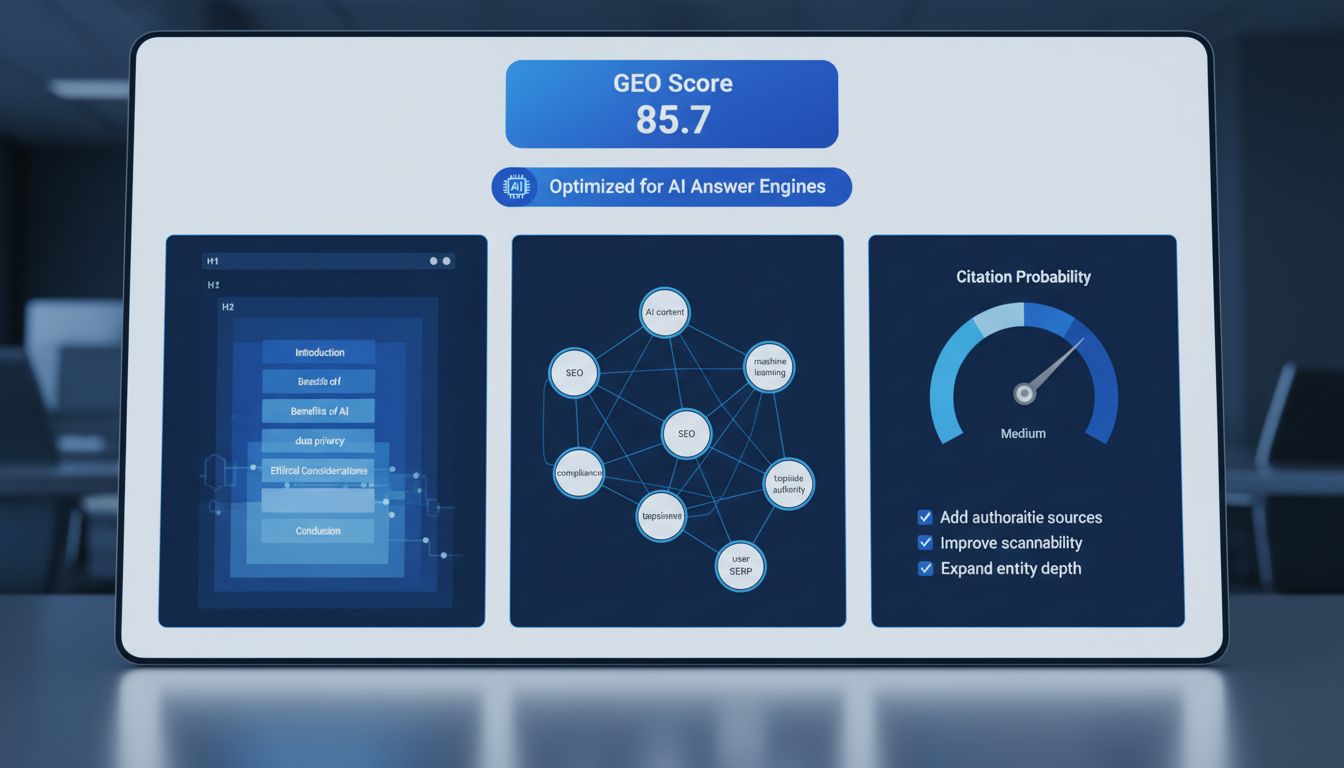
Frase's GEO score analyzes your content structure, citation patterns, and entity coverage to estimate citation probability. If the score is low, you know to add more authoritative sources, restructure for scannability, or increase depth on key entities before going live.
This is the post-writing equivalent of checking your traditional SEO score, except you're optimizing for AI answer engines that will drive an increasing share of your visibility.
Legal & Compliance Check
The EU AI Act requires disclosure for AI-generated content designed to appear human-made. The FTC requires disclosure for AI in advertising. These aren't hypothetical future regulations. They're in effect now.
Your post-writing checklist should include a compliance verification step. Does this content require an AI disclosure? Have we met industry-specific requirements for our vertical? This is especially important for regulated industries like finance, healthcare, or legal services.
The right content creation software doesn't just help you write faster. It embeds these three tiers into your workflow so quality control becomes automatic, not aspirational.
Content Creation Software Deep Dive: The 2026 Contenders for Quality
I've tested most of the major platforms over the past year. The question isn't "which tool writes the best?" It's "which tool prevents the most failures before you publish?"
The market has split into four categories, each solving a different quality control problem. Your choice depends less on features and more on where your bottleneck actually lives.
Segment 1: The All-in-One Workhorse (For Integrated Workflows)
Solo founders and two-person marketing teams don't have time to stitch together five different tools. You need generation, optimization, and tracking in one place, even if each component isn't best-in-class.
Writesonic is the standout here. Beyond basic content generation, it includes GEO visibility tracking dashboards that monitor how often your content appears in ChatGPT, Gemini, and Perplexity responses. That's a feature most platforms charge separately for or don't offer at all. The built-in Surfer SEO integration means you can optimize drafts without leaving the platform. The plagiarism checker runs automatically. You're not getting enterprise-grade RAG or compliance features, but you're getting enough quality control to publish confidently.
Jasper AI takes a different approach with its Brand Voice system. Upload 10-15 samples of your best content, and it builds a voice profile that keeps every output consistent. The SEO Mode adds keyword targeting and meta optimization. The Business tier includes API access and team collaboration features.
The weakness? Both platforms still require human editorial review. The AI can drift into generic phrasing, and factual accuracy isn't guaranteed.
But for $49-99/month, you're getting 80% of what you need in a single subscription.
Best for: Founders wearing multiple hats, or small content teams (1-3 people) who value simplicity over specialization.
Segment 2: The SEO & GEO Specialist Integrator (For Performance Maximalists)
These aren't content generators. They're quality control layers you add on top of your generation tool. Think of them as the difference between spell-check and a professional editor.
Surfer SEO has become the industry standard for a reason. The Content Editor scores your draft in real-time against top-ranking competitors, flagging missing topics, weak structure, and keyword gaps. The AI Tracker monitors your visibility across AI answer engines, not just traditional search. Here's the stat that matters: Surfer reports that optimized pages are twice as likely to reach Google's top 10 within 30 days. I've seen similar results. Content I run through Surfer consistently outperforms content I don't.
Frase adds a GEO score that predicts how likely AI assistants are to cite your content. It analyzes SERP data, generates optimization briefs, and includes a "Content Opportunities" alert system that notifies you when rankings drop.
The AI Agent feature automates 80+ research and optimization tasks.
MarketMuse goes deeper into strategy. Its Content Score measures topical authority against a proprietary topic model. The ROI forecasting tool predicts which content investments will drive the most traffic. It's overkill for most teams, but if you're managing 50+ articles per month, the cluster analysis alone justifies the cost.
The trade-off? You're managing multiple subscriptions. Most teams use ChatGPT or Claude for drafting, then layer these tools for optimization. It's a "best-in-breed" stack that requires more setup but delivers measurably better results.
Best for: SEO managers, content leads at Series A-B companies, or agencies managing multiple clients who need defensible performance data.
Segment 3: The Enterprise Governance Platform (For Security & Auditability)
Once you hit Series B or operate in a regulated industry, your quality control requirements change. You need audit trails, compliance documentation, and security certifications, not just better writing.
Claude Enterprise is the only LLM platform I've tested with true enterprise governance baked in.
SOC 2 certification, SAML SSO, and role-based permissions are standard. The 500K-token context window (expanding to 1M) means you can feed it your entire content library and style guide without hitting limits. The RAG implementation is what sets it apart. When Claude approaches context limits, it automatically switches to retrieval mode, pulling verified information from your connected knowledge base. Every claim can be traced back to a source document. For legal, healthcare, or financial content, this auditability is non-negotiable.
Writer.com is built specifically for compliance-heavy environments. It's classified under the EU AI Act and includes built-in disclosure workflows for AI-generated content.
The governance dashboard tracks every edit, approval, and publication with full attribution.
Neither platform is cheap. Enterprise pricing starts at $30/user/month and scales based on usage and features. But if you're facing regulatory scrutiny or brand risk, the alternative is far more expensive.
Best for: Funded SaaS companies (Series A+), healthcare/fintech/legal verticals, or any team with dedicated compliance and security requirements.
Segment 4: The SMB Scalability Engine (For Volume with Guardrails)
Bootstrapped or seed-stage teams face a different challenge: you need to scale content production now, but you're operating on a tight budget. You can't afford enterprise tools, but you also can't afford to publish garbage.
Scalenut hits the sweet spot at $39/month. You get AI content generation, SEO optimization, GEO article features, keyword planning, and content audit tools in one package. The quality isn't enterprise-grade, but the built-in plagiarism checker and SEO scoring prevent obvious mistakes.
Outrank.so includes real-time SEO scoring (titles, headings, keyword density) and a plagiarism checker on paid plans.
The integrations with WordPress, Webflow, and Shopify mean you can publish directly from the platform. The downside? Outputs often get flagged by AI detection tools unless you edit heavily.
Narrato uses a character-based pricing model with plagiarism credits available on Pro and Business tiers. The collaboration features and API integrations make it viable for small teams managing multiple content streams.
The pattern across all three: they automate the repetitive quality checks (plagiarism, basic SEO, readability) but assume you'll handle the editorial layer.
That's a fair trade at this price point.
Best for: Bootstrapped startups, solo content operators, or early-stage teams (seed to Series A) prioritizing volume and cost efficiency.
Comparative Analysis Table
Here's how these tools stack up when you focus on quality control rather than feature count:
| Tool | Core QC Strength | Best For | Ideal Team Size | Price Range |
|---|---|---|---|---|
| Writesonic | Integrated GEO tracking + plagiarism checks | Solo operators needing one platform | 1-3 | $49-99/mo |
| Surfer SEO | Data-driven optimization + AI visibility | Performance-focused content teams | 3-10 | $99-199/mo |
| Claude Enterprise | RAG-powered factuality + compliance | Regulated industries, Series B+ | 10-50+ | Custom |
| Scalenut | Budget-friendly SEO + plagiarism guardrails | Bootstrapped startups scaling content | 1-5 | $39-79/mo |
Notice what's missing from this table: word count limits, template libraries, and "AI writing modes." Those features don't correlate with quality.
Security certifications, citation accuracy, and optimization velocity do.
The best content creation software for your team is the one that fixes your specific quality failure mode, whether that's factual errors, SEO gaps, compliance risk, or budget constraints.
Common AI Content Pitfalls and How Your Software Should Prevent Them
I've seen teams publish hundreds of AI articles only to discover they've built a liability, not an asset. The failure patterns are predictable. What separates effective content creation software from expensive text generators is how deliberately it prevents these specific disasters.
Pitfall 1: The Generic, Brandless Voice
Your AI churns out 1,500 words that could've been written by anyone, for anyone. The tone is "professional yet approachable" (translation: forgettable). The examples are abstract. The insights are Wikipedia-level.
The damage compounds slowly. Readers bounce. Competitors who sound human win the backlinks. Your domain authority stagnates because nothing is worth citing.
Your software needs trainable brand voice, not a style guide PDF you upload once and pray. Jasper's brand voice engine learns from your existing content corpus and enforces terminology, sentence patterns, even humor style. The alternative is hiring an editor to rewrite every piece, which defeats the economics of AI entirely.
Pitfall 2: Factual Errors & Plagiarism
Last quarter, a SaaS company I advised published a comparison post with outdated pricing for three competitors. Their sales team spent two weeks fielding confused leads.
Google doesn't penalize "AI content," but it absolutely penalizes wrong content.
Plagiarism is the silent killer. Your AI paraphrases a competitor's proprietary framework just enough to pass a basic scan, and six months later you're facing a DMCA takedown that nukes your best-performing page.
Your content creation software must enforce factual verification before publication. Claude Enterprise's RAG architecture grounds outputs in your verified source documents. If it's not in your knowledge base, the AI can't assert it as fact. For plagiarism, integrated checkers like those in Outranking should be mandatory, not optional add-ons. If your workflow doesn't include this gate, you're gambling with your domain's reputation.
Pitfall 3: Ignoring Search & Agent Intent
You optimize for "content marketing strategy" and write 2,000 words on theory. But the actual SERP shows templates, checklists, and step-by-step guides. Your perfectly optimized essay ranks on page three because you answered the wrong question.
AI Overviews make this worse. ChatGPT and Perplexity cite content that directly answers the query with structured, scannable information.
Abstract thought leadership gets ignored.
Effective software solves this before you write a word. Frase's content briefs analyze both traditional SERP results and AI Overview patterns, showing you exactly what format and depth the query demands. Clearscope does similar SERP analysis but focuses on semantic completeness. If your tool generates an outline without checking what's actually ranking and getting cited, you're building content in a vacuum.
Pitfall 4: Content Decay & Static Publishing
You publish, it ranks, you move on. Six months later, competitors update their posts with 2026 data, and you drop from position 3 to 11 without noticing until the traffic's gone.
AI content decays faster than human-written pieces because everyone's publishing at volume now. The half-life of a ranking is shrinking.
Your software needs to alert you when existing content is slipping. Frase's "Content Opportunities" feature flags ranking drops and suggests refresh triggers. MarketMuse's inventory monitoring does the same. The quality control process doesn't end at publication. It needs a maintenance loop, or you're running on a content treadmill where every gain is temporary.
Pitfall 5: Compliance Oversight
The EU AI Act now requires disclosure when AI-generated content is designed to appear human-created. The FTC requires disclosure for AI-generated endorsements and advertising.
Most teams have no systematic way to track which content needs labels.
One missed disclosure on a product comparison could trigger regulatory action. One AI-generated testimonial could mean FTC fines. Enterprise platforms like Writer.com include compliance workflows specifically for AI Act obligations: automatic flagging, disclosure templates, audit trails. If your content creation software doesn't have governance features, you need a manual checklist in your publication SLA. This isn't optional anymore. It's a legal requirement in major markets, and ignorance won't hold up as a defense.
From Creation to Citation: Optimizing for AI Search (GEO) in 2026
The game changed when I realized we were optimizing for the wrong outcome. We'd been chasing rankings when we should have been chasing citations.
When ChatGPT or Perplexity answers a user query, they don't link to the top 10 results. They synthesize information and cite sources. If your content isn't structured to be cited, you're invisible in this new layer of search, even if you rank well in traditional SERPs.
AI agents don't execute JavaScript. They crawl plain HTML, extract text, and move on. Your fancy interactive charts? Invisible. Your accordion-hidden FAQ content? Might as well not exist. AI search bots need accessible, plain-text content structured for machine parsing, not human delight.
This is where your content creation software's GEO features matter. Frase now provides a GEO score that predicts citation likelihood. Surfer's AI Tracker monitors whether your pages appear in ChatGPT responses, AI Overviews, Gemini, and Perplexity. These aren't vanity metrics. They're early indicators of a traffic channel that grew 527% year-over-year in 2024-2025.
The citable block pattern is your tactical blueprint. Each major section should contain a self-contained, factual answer marked by a descriptive H2 or H3. Think of it as a mini-article within your article: a clear question or topic, followed by a direct answer in the first sentence, then supporting detail in 2-4 short paragraphs. Use bullet points for steps, numbered lists for rankings, and plain-text tables for data comparisons. AI systems love structured data they can parse and attribute.
Your content creation software should flag sections that lack these citation-friendly patterns. If it doesn't, you're building a citation workflow manually, and that doesn't scale when you're publishing 50 articles a month.
The mindset shift: you're not writing for readers who click through. You're writing to become the authoritative source that AI systems quote when they answer questions in your domain.
Implementing Your 2026 AI Content Quality SLA (Service Level Agreement)
The frameworks and tools mean nothing without enforcement.
I built this SLA after publishing 200+ articles and realizing we had no consistent standard for what "ready to publish" actually meant. We'd have one editor approve something that another would reject outright. The goalposts moved with whoever was reviewing that day.
This isn't a policy document that lives in a folder. It's the operational contract between your content creation software, your team, and your brand. Here's what actually gets checked before anything goes live.
Pre-Publish SLA: Quality Gate
- RAG source verification complete (minimum 3 authoritative sources cited)
- Plagiarism check passed (Copyscape or Originality.ai score <10%)
- Brand voice alignment confirmed (tone analyzer or human spot-check)
- Factual claims validated against source material
- Technical readability score met (Grade 8-10 reading level)
Publish SLA: Editorial Sign-Off
- Human editor approval (never publish raw AI output)
- Technical SEO checklist complete (meta tags, schema, internal links)
- GEO optimization score threshold met (Frase GEO score >70, if applicable)
- Compliance disclosure added (EU AI Act, FTC requirements where relevant)
- AI detection review passed (not to avoid detection, but to ensure human value-add)
Post-Publish SLA: Performance Monitoring
- AI visibility tracking active (zero-click searches now represent 69% of queries; monitor citations in ChatGPT, Perplexity, Gemini)
- 30-day performance review (traffic, rankings, AI citations)
- 90-day content refresh trigger (if rankings drop >5 positions or AI visibility declines)
- Quarterly content audit (identify decay signals, update outdated statistics)
The SLA transforms your three-tiered framework from theory into daily practice. Print it. Share it with your team. Make it the standard every piece of content must clear before it earns your domain's authority.
Without this contract, you're just hoping for quality. With it, you're engineering it.
Conclusion
The AI content creation software market will hit $2.76 billion this year [Source: grandresearchstore.com], but most of that spend won't move the needle.
Why? Because teams are still buying for speed when they should be buying for control. I've watched this play out dozens of times: a company scales from 10 to 100 articles per month using AI, traffic stays flat, and leadership starts questioning the investment. The problem was never the volume. It was the absence of systematic quality enforcement.
The three-tiered framework I've outlined isn't theoretical. Pre-writing research and RAG grounding, during-writing optimization and compliance guardrails, post-writing fact-checking and GEO scoring. It's the operational difference between AI content that ranks and AI content that disappears into the index graveyard.
Your content creation software choice should be dictated by one question: which platform lets me enforce this framework without adding three manual review steps? The tools exist. The methods work. What's missing is the commitment to treat quality control as your primary scaling lever, not an afterthought.
Start with your SLA. Audit your next five AI pieces against it. Fix the gaps in your toolchain. That's how you turn AI from a cost center into a growth engine.
Frequently Asked Questions
Which software is best for content creation?
There isn't one. The best tool depends on what you're actually trying to control for.
If you're generating SEO content for B2B SaaS, you need a stack, not a single app. A generator (Claude, ChatGPT Plus), an optimization layer (Surfer SEO, Frase), and verification tools (plagiarism checker, fact-checker). The best content creation software is whichever one enforces your quality SLA at every stage. Speed doesn't matter if the output fails your standards.
What tools do I need to be a content creator?
Four components, minimum.
A quality-focused AI generator (Claude Enterprise, ChatGPT Plus). An SEO/GEO optimization tool (Surfer, Frase, Clearscope). A plagiarism and fact-checking system (Copyscape, Originality.ai). And a project management framework to enforce your three-tiered quality checklist. The exact tools scale with your team size and budget. Solo operators can start with an all-in-one like Scalenut or Writesonic, while larger teams benefit from specialized tools at each stage.
How do I start content creation for beginners?
Process before software. Always.
Define your niche and target audience first, then build a three-tiered quality control checklist covering pre-writing (research, briefs), during creation (fact-checking, brand voice), and post-writing (plagiarism scan, SEO score, human edit). Choose content creation software that supports this workflow. Tools like Jasper, Frase, or Scalenut offer end-to-end features for beginners. Never publish raw AI output. The edit layer is where you add the unique insight and expertise that drives rankings.
What is replacing CapCut?
For written AI content, the question isn't about tool replacement. It's about metric replacement.
Traditional keyword rankings are being supplemented by citation performance in AI Overviews, ChatGPT responses, and Perplexity answers [Source: surferseo.com]. Tools like Surfer's AI Tracker and Frase's GEO score are the new analytics dashboards, measuring whether AI search engines cite your content as authoritative, not just whether you rank on page one.
Do content creators use CapCut?
CapCut is for video editing, but the principle applies to AI-written articles: raw output needs post-production.
Raw AI text is your "uncut footage." Usable but unpublishable without editing. Content creation software with integrated quality controls (plagiarism checks, SEO scoring, brand voice alignment) is your editing suite, transforming drafts into professional, citation-ready content. 97% of companies run a review process on AI content for exactly this reason [Source: ahrefs.com].
What are 5 niches commonly used by influencers?
Influencer niches like fashion and gaming don't translate to B2B SaaS content strategy.
For SaaS growth, high-performing content niches are: use-case deep dives (solving specific customer problems), integration tutorials (technical how-tos), competitive comparison guides (vs. pages with original analysis), industry trend analysis with proprietary data, and founder/leadership storytelling that demonstrates expertise. These align with E-E-A-T signals and answer commercial search intent, which is what drives qualified traffic and conversions.