March 22nd, 2026
Scaling Topical Authority: How Content Creation Software Builds SEO Topic Clusters in 2026
 WD
WDWarren Day
You know topical authority drives organic growth. You've mapped out topic clusters. But your team can't publish fast enough to fill them, and your "authority" sits in a spreadsheet instead of search results.
The bottleneck isn't strategy. It's execution.
Google doesn't rank individual pages in isolation anymore. It looks at your entire topic footprint. Sites with comprehensive topic clusters pull significantly more organic traffic, but most teams can't produce enough content to actually compete. Your two-person team cranking out one article per week? That won't build the density needed to own a topic in 2026. Not even close.
The answer isn't hiring five more writers.
It's rethinking how you produce content through content creation software and smart automation. The companies dominating SEO right now aren't outwriting everyone else. They're out-systematizing them.
Look, this isn't about replacing humans with AI. It's about building a system where AI handles research, drafting, and optimization while your team focuses on strategy, quality control, and the editorial decisions that actually make your brand different. Software takes the grunt work. Humans make it good.
Scaling topical authority in 2026 means orchestrating a connected software ecosystem that automates discovery, creation, and reinforcement of topic clusters. When you get this right, content stops being a cost center and starts being a predictable growth engine.
This guide walks through a three-phase blueprint: Plan (data-driven cluster discovery), Build (human-in-the-loop creation at scale), and Scale (measurement and reinforcement). You'll leave with a prioritized software stack, a workflow your team can actually execute, and metrics that prove ROI to executives who need to see numbers.
Why Topic Clusters Alone Won't Scale Your SEO in 2026
You've read the case studies. Websites implementing topic clusters see a 43% average increase in organic traffic compared to those that don't. So you mapped a few pillar pages, assigned writers to cover subtopics, and waited for the rankings to compound.
Three months later, you've published twelve articles. Traffic moved 8%. Your team is exhausted, and you're nowhere close to owning a topic.
Here's the problem: topic clusters work, but manual execution doesn't scale. The math is brutal. To establish real topical authority (the measurable share of traffic and rankings across an entire subject), you need comprehensive coverage of dozens of subtopics, consistent internal linking, regular updates, and semantic depth that signals expertise to both search engines and AI systems. One writer producing two articles per week would need six months to cover a single mid-sized cluster. By then, your competitors have moved on and Google's algorithm has shifted twice.
Topical authority isn't about publishing a pillar page and calling it done. It's about demonstrating depth through interconnected content that covers a subject from every angle a searcher might approach it.
Success is measured by Topic Share (your percentage of organic visibility across all queries within a topic area), not individual keyword rankings. When AI models synthesize answers, they cite sources with comprehensive, structured coverage. Isolated articles don't make the cut.
The manual scaling bottleneck is economic as much as operational. AI-generated content costs roughly 4.7× less than human-written content ($131 versus $611 per article on average). But the real advantage isn't cost. It's the ability to produce the volume and consistency required for authority while keeping humans focused on strategy, fact-checking, and editorial judgment.
This is where modern content creation software becomes necessary. Not as a replacement for your team, but as the orchestration layer that connects research, creation, optimization, and measurement into a repeatable system.
The 3-Phase Scaling Blueprint:
-
Plan – Data-Driven Cluster Discovery: Use semantic clustering and SERP analysis to map comprehensive topic coverage, identify gaps, and prioritize based on difficulty and business value.
-
Build – The Human-in-the-Loop Creation Engine: Deploy AI for research, drafting, and optimization while humans own strategy, quality control, and the final editorial layer that establishes E-E-A-T.
-
Scale – Measure & Attribute Impact: Track Topic Share, cluster-level rankings, SERP feature presence, and AI citations to prove ROI and identify which clusters drive pipeline.
The rest of this guide breaks down each phase with specific tools, workflows, and metrics your team can implement this quarter.
Phase 1: Plan – Data-Driven Cluster Discovery
Your spreadsheet has 3,000 keywords. Now what?
Manual grouping turns into guesswork at scale. You'll miss semantic relationships, duplicate efforts across similar queries, and waste budget on clusters that won't move the needle. This is where content creation software earns its keep by automating the discovery work that would otherwise take your team weeks.
The goal of Phase 1 is simple: transform raw keyword data into a prioritized cluster map that tells your team exactly what to build, in what order, and why. No more debates about "which topic should we cover next." The software makes the call based on data.
Tool Spotlight: Semrush & MarketMuse for Cluster Mapping
Start with competitive intelligence. Semrush's Organic Topics report shows you which topic clusters your competitors already own and, more importantly, where they're vulnerable. Enter three direct competitors, and the tool surfaces the semantic territory they've claimed versus the gaps they've left open.
From there, Keyword Strategy Builder does the heavy lifting. Feed it your seed keyword list and it automatically groups related queries into visual cluster maps, complete with pillar suggestions and subtopic hierarchies. You're not manually sorting 3,000 rows anymore. The tool uses search intent patterns and SERP overlap to group keywords into coherent clusters that reflect how Google actually understands topics.
MarketMuse takes a different angle. It crawls your existing site inventory, builds a quantitative map of your current topical coverage, and identifies exactly where you're thin. The platform scores your content alignment against competitors and flags which supporting articles you're missing.
Export the cluster recommendations as CSV, and you have a production-ready brief list. Both tools integrate into your workflow via exports. Drop those CSVs into your project management system or feed them directly into AI writing platforms for brief generation.
From Keywords to Topics: The Semantic Shift
Here's what changed: modern keyword clustering doesn't rely on exact-match grouping anymore. Tools now use transformer embeddings (the same technology behind ChatGPT) to understand semantic relationships between queries. "CRM software for sales teams" and "best sales automation platforms" might share zero words, but they occupy the same semantic space.
This matters because it prevents keyword cannibalization before it starts.
When your content creation software groups keywords by meaning rather than string matching, you're building distinct content pieces that each own a clear semantic concept. No more accidentally publishing three articles that all target the same user intent. Some platforms layer in LLM-based topic naming to automatically label each cluster with human-readable themes. Instead of "Cluster_47," you get "Sales Team Onboarding Workflows," a label your writers can immediately understand and execute against.
Prioritizing Clusters for Business Impact
Not every cluster deserves equal attention. Score each one using three filters:
Traffic potential: What's the combined monthly search volume across all keywords in this cluster? Tools like Ahrefs and Semrush surface this automatically in their clustering interfaces.
Conversion relevance: Does this topic map to a stage in your buyer journey? Clusters around "how to choose [category]" signal high purchase intent. Clusters around "what is [concept]" are awareness-stage and convert later.
Right to win: Do you have genuine domain expertise here, or are you chasing traffic in a category where you have no competitive advantage? Run a content gap analysis to see if competitors with similar domain authority have already saturated this space.
Focus your first sprint on medium-difficulty clusters where you have clear expertise. Build authority there before expanding into more competitive territory.
Output: The Actionable Cluster Map
By the end of Phase 1, you should have a spreadsheet (or Airtable base, or Notion database) with:
- 5–10 prioritized pillar topics
- 20–50 supporting subtopics per pillar
- Traffic estimates and difficulty scores for each
- Assignment to specific sprints or quarters
This isn't a content calendar yet. It's the strategic blueprint that feeds your creation engine. The next phase turns this map into published assets.
Phase 2: Build – The Human-in-the-Loop Creation Engine

Your cluster map is ready. The strategic blueprint exists. Now you need to turn 50 subtopic ideas into 50 published assets without burning out your team or sacrificing quality.
This is where most content programs stall. You either hand everything to AI and publish garbage, or you hand everything to humans and watch costs spiral while output crawls.
The answer isn't choosing one over the other. Build a system where each does what it's best at.
AI handles the grunt work: research synthesis, structural outlining, first-draft generation. Humans own the strategy: brand voice, fact verification, competitive positioning, and the final editorial decision. 94% of companies review their AI-generated content before publishing, and for good reason. The review gate is where generic output becomes authoritative content.
But review alone isn't a system. You need defined handoffs, automated quality checks, and a CMS that acts as the orchestrator.
Step-by-Step: The Content Assembly Line
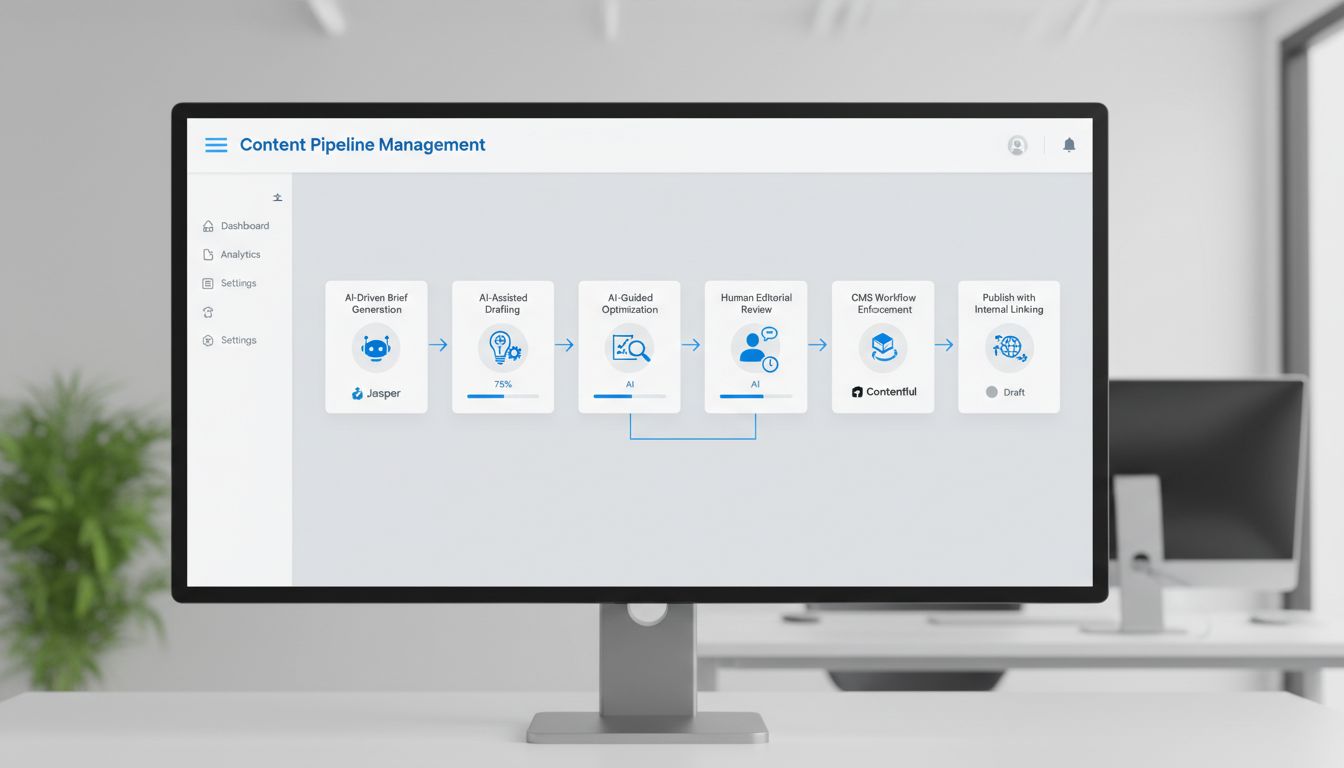
Here's the operational workflow that turns your cluster blueprint into published authority:
1. Generate the cluster brief (AI-driven)
Your planning tools, Semrush Keyword Strategy Builder, MarketMuse, or Frase, export structured briefs for each subtopic. These briefs include target keywords, semantic entities, competitor gap analysis, and suggested H2/H3 structures. No human needs to spend 90 minutes per brief doing this manually.
2. Create outline and first draft (AI-assisted)
Feed the brief into your content creation software. Jasper's Bulk Create can process CSV uploads and generate dozens of drafts in parallel. Writesonic's AI Writer 6.0 pairs keyword research with automated drafting and competitor analysis. Copy.ai's Super Agents apply your brand guidelines to ensure consistency across high-volume output.
The goal here isn't perfection. You want a structured starting point that's 70% complete. AI drafts give your team a foundation to edit, not a blank page to fill.
3. Optimize against topic coverage scores (AI-guided)
Before human review, run drafts through optimization editors. Frase's Topic Score and Surfer's Content Editor score have documented correlation with ranking outcomes, Surfer reports an 89% correlation between its score and ranking performance.
These tools highlight missing semantic entities, suggest internal links to existing cluster pages, and flag thin sections. Treat the score as a diagnostic, not a mandate. A 75/100 score with strong strategic positioning beats a 95/100 score that reads like a keyword-stuffed Wikipedia clone every time.
4. Human editorial review and strategy injection (human-owned)
This is the non-negotiable step. Your editor or subject-matter expert reviews for:
- Factual accuracy: AI hallucinates. Verify claims, especially statistics and technical details.
- Brand voice: Does this sound like your company, or like every other SaaS blog?
- Competitive angle: What's the contrarian or surprising insight that makes this worth reading?
- Strategic CTAs: Are you guiding the reader toward the next cluster page or a conversion point?
This step typically takes 30-45 minutes per article when you're editing a solid draft, versus 3-4 hours writing from scratch. That's where the efficiency gain actually happens.
5. CMS workflow gates and automation triggers (system-enforced)
Your CMS isn't just where content lives. It's the governance layer that prevents quality erosion at scale.
Contentful's Workflows app enforces status-based gates: drafts can't skip review, and unoptimized metadata blocks publication. Sanity's AI Agent Actions audit documents for missing internal links or incomplete schema markup before they go live.
Set up automations for repetitive tasks: trigger AI translation when a post moves to "Approved," refresh meta descriptions when traffic drops, or sync optimization scores via webhook from Frase or Surfer directly into your CMS fields.
6. Publish with internal linking reinforcement (automated + human QA)
Before hitting publish, confirm bidirectional links between cluster pages and the pillar. Tools like Writesonic and Frase suggest internal links during drafting, but your CMS should enforce this structurally.
Simple checklist: Does this cluster page link to the pillar? Does the pillar link back?
This workflow prevents the two most common failure modes: publishing un-reviewed AI content (which violates Google's spam policies against pages that add no value) and creating orphaned content that doesn't reinforce your topical authority.
Beyond Drafting: AI Agents & Playbooks for Scale
Once your baseline workflow is stable, the next efficiency unlock comes from codifying repeatable tasks into AI agents and playbooks.
Jasper's Agents let you create custom workflows, "Generate a comparison blog post from two competitor product pages" or "Turn this webinar transcript into three cluster articles." You define the inputs, the transformation logic, and the output format once, then run it on demand.
WRITER's Playbooks and Routines go further by chaining multiple steps: extract key points from a research report, generate a draft, apply brand voice guidelines, create social snippets, and export everything to your CMS. Copy.ai's Super Agents do similar orchestration, with 95+ language support if you're scaling internationally.
These tools aren't just faster. They're more consistent. A playbook applies the same quality standards to article 1 and article 50. A human editor working on article 50 at 4pm on Friday is a different person than the one who edited article 1 on Monday morning.
The reality is that AI workflows can cut content production time by 60–80%, enabling teams to produce 3–5× more content while maintaining quality. But only if you build the system correctly, with humans in the decision-making loop and software handling execution.
Your creation engine is now running. The next question is: how do you choose the right tools to power it?
Choosing Your 2026 Stack: A Goal-Based Software Guide
Every vendor claims their content creation software will "transform your SEO." Most won't.
The difference between a tool that collects dust and one that actually compounds authority comes down to fit. You need capabilities that match your actual workflow constraints, not a feature list that sounds impressive in a sales demo.
Stop evaluating tools by how many checkboxes they tick. Start with your bottleneck: Is it ideation? Draft quality? Review cycles taking forever? Integration gaps forcing manual copy-paste hell? Your stack should solve the constraint that's actually blocking scale, not the one that looks good on a procurement form.
Tool Comparison Matrix
Here's how the leading platforms stack up across the dimensions that matter for authority-building:
| Platform | Scalability | Integration Depth | AI Features | Cost Model | Best For |
|---|---|---|---|---|---|
| Semrush | High (keyword clustering at scale) | Moderate (exports, API) | Keyword Strategy Builder, topic mapping | Tiered subscription ($139–$499/mo) | Research & cluster discovery |
| MarketMuse | High (site-wide audits) | Moderate (exports) | Topic modeling, gap analysis | Custom enterprise pricing | Strategic planning & authority measurement |
| Frase | Medium (per-article focus) | Good (WordPress, Google Docs) | Brief generation, content scoring | $15–$115/mo | Lean teams optimizing as they write |
| Writesonic | High (bulk generation) | Good (API, WordPress) | AI Writer 6.0, internal linking | $16–$499/mo | High-volume cluster execution |
| Jasper | Very High (bulk CSV, agents) | Excellent (SharePoint, connectors) | AI Agents, brand voice, recipes | $49–custom/mo | Scaling teams with distributed writers |
| Copy.ai | Very High (95+ languages) | Excellent (Zapier, API) | Super Agents, 100+ templates | $49–custom/mo | GTM teams needing funnel-wide content |
| WRITER | Enterprise-grade | Excellent (Knowledge Graph, API) | Agents, Playbooks, Routines | Custom enterprise | Compliance-heavy environments |
| Contentful | Enterprise CMS | Native (webhooks, automations) | Workflow automations, AI translation | $300+/mo | Governance & publishing control |
One clarification: free social media management tools can handle distribution once your authority content is live, but they don't build the semantic depth search engines reward. Your core stack investment goes to research, creation, and optimization, not scheduling tweets.
Lean teams (1-3 people) need speed without complexity. Writesonic or Copy.ai pair affordable AI generation with enough optimization to keep quality above the spam threshold. You'll manually handle workflow orchestration, but you avoid enterprise licensing costs.
Scaling teams (4-15 people) hit workflow chaos fast. Jasper's brand voice consistency and Frase's real-time scoring prevent the "every writer sounds different" problem. These platforms assume you're producing 20+ articles monthly and need repeatable quality, not one-off brilliance.
Enterprises (50+ people, compliance requirements) can't tolerate workflow gaps or brand risks. WRITER's Knowledge Graph governance and Contentful's approval gates make sure nothing ships without review. Conductor and BrightEdge operate at this tier too. Expect annual contracts starting mid-five-figures.
The real question: can your tools talk to each other?
A disconnected stack forces manual handoffs that kill velocity. Your ideal workflow looks like this: Semrush surfaces clusters, Jasper generates drafts from templates, Frase scores optimization, Contentful manages review and publishing. Each tool passes structured data to the next via API or export. When you're copy-pasting between platforms, you're hemorrhaging time and introducing errors.
Implementation Timeline & Getting Started
Stack setup takes 2-4 weeks if you're configuring integrations properly. Expect another 2-3 months before workflow automation shows measurable ROI in cost-per-article or time savings.
Don't boil the ocean. Pick one pilot cluster, ideally 8-12 articles around a commercial-intent topic. Run your full workflow on that cluster while your team still produces business-as-usual content.
Measure three things: time from brief to publish, cost per finished article, and ranking movement after 60 days.
If your pilot cluster ranks and your team didn't burn out, you've validated the workflow. Scale to two clusters next quarter, then four. If something broke, review bottlenecks, inconsistent quality, integration failures, fix it before expanding. Most teams that fail at scale skip this pilot discipline and commit to 100 articles before knowing if their process actually works.
Your software budget matters less than your workflow design. A $5,000/month stack that produces 50 authority-building articles beats a $500/month stack that produces 5 mediocre ones. Do the unit economics, then choose accordingly.
Phase 3: Scale & Measure – Turning Content into a Growth Asset
Publishing your first cluster feels productive. Proving it moved the needle is what unlocks budget for cluster two, three, and ten.
Most teams measure content success with vanity metrics, sessions, pageviews, rankings for individual keywords. Those numbers don't connect to topical authority or justify the investment in your content creation software stack. Your CFO doesn't care that "blog traffic is up." They care whether content is a predictable growth engine or an expensive experiment.
The final phase transforms your cluster program from a project into a system. You automate the reinforcement loops that compound authority over time, establish the metrics that actually correlate with business outcomes, and build the attribution model that secures next quarter's budget.
Automating the Authority Feedback Loop
Your cluster isn't finished when you hit publish.
Authority compounds through internal linking, the structural signal that tells search engines (and AI models) how your pages relate to each other. Manual linking doesn't scale. When you're publishing 20 articles per month across multiple clusters, remembering which pillar links to which subtopic becomes impossible. Your content creation software should handle this systematically.
Frase, Writesonic, and MarketMuse all surface internal linking opportunities as you write. They scan your existing content inventory, identify semantically related pages, and suggest anchor text that reinforces topical relationships. Writesonic's "smart internal linking" even flags orphaned pages, published content that isn't connected to your cluster architecture and therefore isn't contributing to authority.
Set a monthly automation: run a site crawl, identify new linking opportunities between pillar and cluster pages, and batch-update your posts. This isn't busywork. Sites that implement structured topic clusters see a 43% average increase in organic traffic specifically because this internal link density signals comprehensive coverage.
Your Topical Authority KPI Dashboard
Stop tracking rankings for individual keywords. Start tracking your share of the entire topic.
Topic Share is the percentage of total search volume for a topic cluster that lands on your domain. If "content marketing automation" generates 10,000 monthly searches across 50 related queries, and your pages capture 1,500 of those visits, your Topic Share is 15%. This single metric tells you whether you're building authority or just adding noise.
Track it monthly using Semrush's Organic Topics report. Filter by your target cluster, compare your visibility against competitors, and watch your share grow as you publish and interlink more cluster content.
Cluster Keyword Coverage measures how many of the keywords in your cluster map you actually rank for (top 20). If you mapped 40 subtopic keywords but only rank for 12, you have gaps. This metric guides your publishing priorities.
SERP Feature Presence counts how many of your cluster pages earn featured snippets, People Also Ask boxes, or citations in AI Overviews. These placements signal that search engines view you as a primary source for the topic.
Internal Link Density tracks the average number of internal links between your pillar and cluster pages. Healthy clusters have 3-5 bidirectional links per cluster page. Below that, you're not reinforcing the structure.
Cost Per Published Asset divides your total content spend (software, labor, review time) by articles published. This operational metric exposes inefficiencies in your workflow and justifies automation investments.
Pull these five metrics into a shared dashboard. Update monthly. Share with leadership quarterly.
Case Study: From Pilot to Predictable Growth
A Series B SaaS company used this exact framework to turn a skeptical leadership team into believers.
They started with one cluster: "customer onboarding software." Phase 1 mapped 35 subtopic keywords. Phase 2 produced a pillar page and 12 supporting articles over 90 days using Jasper for drafts and Frase for optimization. Phase 3 automated internal linking and tracked the KPI dashboard.

Results after three months: Topic Share grew from 4% to 19%. Eight cluster pages earned SERP features. Organic traffic to the cluster increased 156%, mirroring the B2B SaaS case studies where structured cluster programs delivered similar lifts.
They presented these numbers with one ask: budget to replicate the process across three more clusters. Leadership approved it in one meeting because the attribution was clear and the cost per asset had dropped 60% as the workflow matured.
That's the pilot-to-program path.
Pick your highest-value cluster. Run the three-phase blueprint for 90 days. Measure these five KPIs. Use the data to justify scaling. Repeat until you own your category's search landscape.
Common Pitfalls & How Your Software Stack Avoids Them
Every scaling attempt creates new failure modes. The difference between teams that build authority and teams that create SEO liabilities comes down to the safeguards built into their workflow.
Thin or duplicate content is the fastest way to trigger manual reviews. Google's spam policies explicitly prohibit AI-generated pages that add no value. Your CMS workflow gates prevent this by design. Contentful's approval automations and Sanity's role-based access controls ensure no draft reaches production without human sign-off. The review mandate isn't optional, it's architected into your publishing pipeline. When 94% of companies already review AI content before publishing, the question isn't whether to review, but whether your content creation software enforces it.
Keyword cannibalization happens when you skip semantic clustering. Two articles targeting "project management software" and "project management tools" will compete against each other unless your Phase 1 clustering caught the semantic overlap. Semrush's Keyword Strategy Builder and MarketMuse's topic modeling group these variants into a single pillar before you write a word. The software sees what manual spreadsheets miss, that these are the same search intent, not two opportunities.
E-E-A-T erosion is inevitable with unchecked AI output.
Raw model output lacks the expertise signals Google rewards. Your human-in-the-loop workflow from Phase 2 addresses this, but Brand Voice features in Jasper and Knowledge Graph controls in WRITER add another layer. These tools ground AI output in your documented expertise, reducing the generic tone that screams "unreviewed automation." The software doesn't replace editorial judgment, it extends your brand's voice across volume.
Broken internal linking undermines the entire cluster architecture. Pillar pages need bidirectional links to cluster pages to flow authority. Manual linking breaks down past 20 articles. Writesonic's smart internal linking suggestions and Frase's automated link recommendations solve this in Phase 3. The software audits your existing content, identifies linking opportunities, and can implement them in bulk. Your cluster's link equity flows where it should, not where someone remembered to add it.
Measurement failures kill momentum before you see ROI.
Teams tracking individual page rankings miss the cluster-level lift. Your Phase 3 KPI dashboard, Topic Share, cluster keyword coverage, SERP feature presence, makes cluster performance visible. When you can show stakeholders that your "project management" cluster now owns 23% of related queries (up from 7%), you get budget for the next cluster. The software doesn't just build authority, it proves you built it.
Conclusion
You already know topical authority matters. What you didn't have was the operational blueprint to build it predictably.
The three-phase workflow turns content creation software from a drafting tool into something that actually compounds value. When Semrush feeds semantic clusters into Frase briefs, when Jasper agents enforce brand voice at scale, when Contentful automations prevent SEO regressions, you're not just publishing faster. You're building a system where each cluster strengthens the ones that came before it.
Topic Share is your north star. Not individual rankings. Not traffic spikes.
The percentage of queries in a topic where your domain appears, that's the number that proves you own the conversation. And when you can walk into a stakeholder meeting and show 23% Topic Share in Q2 versus 7% in Q1, suddenly budget conversations get a lot easier.
The teams winning right now aren't creating more content. They're orchestrating connected software ecosystems that make authority scalable, measurable, and defensible. Data-driven cluster discovery, human-in-the-loop creation, and cluster-level measurement work together, not as separate steps but as a feedback loop where each phase informs the others.
Your next step: Block 30 minutes this week. Map your current workflow. Identify the single biggest bottleneck. Then choose the software layer that eliminates it.
Frequently Asked Questions
Which software is best for content creation?
Depends what's slowing you down right now. Small team trying to scale output? Writesonic or Jasper handle high-volume AI drafting with optimization built in. Enterprise team drowning in brand compliance? WRITER or BrightEdge give you the workflow structure and knowledge management to keep everyone aligned.
Go back to the comparison matrix earlier. Match your actual constraint (semantic clustering, bulk creation, CMS automation) to the platform that solves it. Don't pick based on features you'll never use.
What are the 5 C's of content creation?
The old-school framework (Content, Context, Channel, Customer, Conversion) still works conceptually, but content creation software has rewritten how you execute it.
Here's the 2026 version: Cluster (architecture-first planning), Creation (human-AI orchestration), Consistency (automated governance via CMS), Connection (strategic internal linking), and Credit (measurement and attribution at the cluster level). Every piece you publish should strengthen your topical authority, not just fill your content calendar.
What tools do I need as a content creator?
You need an ecosystem, not a toolbox full of disconnected apps.
Three layers matter: Discovery & Planning (Semrush, MarketMuse, or Ahrefs for cluster identification), Creation & Optimization (Frase, Writesonic, or Jasper for AI-assisted drafting and scoring), and Governance & Distribution (Contentful, Sanity, or Storyblok for workflow automation and publishing). Yes, free social media management tools help with distribution. But building real authority requires investment where it counts: the planning and creation layers where clusters actually get built.
What are 5 successful habits of a content creator?
Forget individual heroics. Modern content success runs on systems.
Five habits that actually move the needle: Think in clusters, not keywords (plan architecture before writing anything), operate from a centralized CMS dashboard (visibility prevents duplicate work), review AI output with a strategy lens (fact-check and align tone, not just grammar), measure Topic Share weekly (track cluster-level performance, not individual page ranks), and iterate based on cluster performance data (double down on what's building authority).
These habits transform content creation from a creative guessing game into something you can predict and scale.