July 16th, 2026
How to Build a B2B SaaS Content Marketing Strategy with AI
 WD
WDWarren Day
You're a marketing leader at a B2B SaaS company. You've been told to scale content. So you tried the obvious thing: pumped out AI blog posts, watched them get zero traction, and now you're staring at a domain rating in the 30s wondering if any of this actually works.
It does. Just not the way most people are doing it.
94% of SaaS marketing teams are using generative AI now. Most of them are failing because they're using it as a shortcut, not a system. A real b2b saas content marketing strategy in 2025 is built around Answer Engine Optimization, not the classic SEO playbook that assumes you already have domain authority.
This is a six-month roadmap.
It comes with governance checklists and a $400/month saas marketing tools stack built for lean teams, not the kind of budget the top 100 saas companies are throwing around. You'll go from low-impact AI experiments to a content pipeline that actually moves pipeline.
Before You Start: Prerequisites for a Successful AI Strategy
This isn't a magic wand. It's a production system. If you're looking for a "generate 100 blog posts overnight" button that drives qualified leads, you're in the wrong place. That approach fails every time, especially for SaaS companies with low domain authority.
Before you touch a single AI tool, you need four foundations in place. Non-negotiable.
1. A Solvable Problem & a Razor-Sharp ICP
Your SaaS product must solve a clear, specific problem. And your Ideal Customer Profile cannot be vague.
"Marketing managers" is useless. "Head of Marketing at a Series B B2B SaaS company (50-200 employees) who owns the content budget and is measured on pipeline from owned channels" is actionable.
That clarity is your single greatest lever. AI can't create relevance from a fuzzy target.
2. Modest but Dedicated Resources
You need two things: a budget and a human.
The budget is roughly $200-$400/month for a core stack: a research tool (like Ahrefs or Semrush), an on-page optimiser (like Surfer), and a drafting LLM (ChatGPT/Claude). Source: Forasoft
The human is someone, even part-time, who owns review, governance, and strategy. That's the critical path. AI-assisted workflows can cut blog production costs by 78%, but they can't be zero-human. The output is only as good as the input and the edit.
3. Commitment to Ironclad Governance
You will document an AI content policy, and you will enforce it.
As of 2024, only 34% of B2B marketing organisations had a documented, enforced policy. Source: The Starr Conspiracy. The other 66% are risking hallucinations, compliance violations, and brand damage.
Your policy covers disclosure, legal review gates for regulated topics, and a mandatory human review step before anything publishes.
4. A Realistic Timeline
This roadmap spans six months. You'll see the first signals, increased visibility in AI answer engines, within weeks if you execute Phase 1 and 2 correctly.
But measurable pipeline impact requires the full cycle. I've seen low-DR SaaS companies chase "quick wins" for a year and get nowhere.
If you have all four pieces, you're ready. If you're missing one, fix it first. Everything else in this guide, whether you're building a b2b saas content marketing strategy from scratch or refining what a b2b saas marketing agency handed you, is worthless without them. Same goes if you're working through a content marketing course or sitting on a content marketing certification with no ICP to apply it to. The top saas companies didn't scale content by skipping this step.
Phase 1: Lay the Strategic Foundation and Audit Your Landscape
Don't skip this phase. You're building a production system, not a pile of blog posts.
Month 1 is about going from vague to specific. Start with evidence.
Refine Your ICP Using AI-Synthesized Audience Signals
Stop guessing what your audience wants. You already have the data.
Export 50-100 recent sales call transcripts, scrape G2/Capterra reviews, collect social media sentiment from relevant LinkedIn groups or Reddit threads. Then feed that raw text into Claude or ChatGPT with a structured prompt.
Here's the exact one I use:
Based on the following data from sales calls, review sites, and social media, synthesize a detailed Ideal Customer Profile (ICP). Include:
- Their daily operational challenges
- Their preferred content formats (video, long-form guides, case studies)
- Their biggest objections during the buying process
- The specific language they use to describe their problems

Run this quarterly. The output is a living ICP document grounded in actual conversations, not marketing personas. This is how you catch the micro-signals that shape your pillar topics.
Conduct a Brutal Competitive Analysis of Top SaaS Companies
Pick 3-5 direct competitors and 2-3 top SaaS companies you actually admire. Open Ahrefs or Semrush. Don't just look at homepages.
- Export their top 50 pages by organic traffic.
- Cluster those URLs by topic to reverse-engineer their content pillars.
- Note their Domain Rating (DR) next to each cluster.
This tells you their structural strategy. A competitor with a DR of 75 ranking for "enterprise CRM software" is playing a completely different game than you are at DR 35.
Your goal isn't to copy them. It's to find the adjacent, lower-competition clusters they've ignored. Look for topics where they rank but get middling traffic (1k-5k monthly searches). That's where you can realistically compete, and where a solid b2b saas content marketing strategy does its best work.
Perform a Content Audit of Your Existing Assets
Run Screaming Frog on your domain. Export every blog post, landing page, and resource. Build a simple spreadsheet and tag each asset:
- Buyer's Journey Stage (Awareness, Consideration, Decision)
- Quality Score (1-5 based on depth, accuracy, and recency)
- Performance (Traffic, engagement)
The gap between this inventory and your ICP's actual needs is your content roadmap.
You'll probably find that 20% of your content drives 80% of results, and another 30% is outdated or irrelevant. That's normal. Now you know where to focus.
Outputs You Must Have at End of Month 1
Three documents. That's it.
- A documented, evidence-based ICP (not a guess).
- A competitive landscape map showing which content pillars drive traffic for others, and where your DR lets you compete.
- A complete inventory of your existing assets, tagged and ready for gap analysis.
Without this, you're building on assumptions. And assumptions are why most b2b saas content marketing strategy efforts stall out before they gain any traction, whether you're going it alone, working with a b2b saas marketing agency, or trying to apply whatever you picked up from a content marketing course or content marketing certification.
The top 100 saas companies didn't get there by skipping the audit. Neither will you.
Phase 2: Map Your AEO-First Pillar and Cluster Strategy
What's the goal for Month 2? Build your topic moat.
You can't compete with HubSpot or Salesforce for "sales software." You just can't. What you can do is dominate a narrow, specific problem your ICP actually has. Something like "how to forecast sales pipeline for a 10-person team in HubSpot." That's your defensible territory.
Shift How You Think About Keyword Research
Traditional saas marketing tools like Ahrefs will surface broad, high-volume terms you have no shot at ranking for. Ignore them.
Instead, use the "Questions" report in SEMrush or SparkToro to find what people are actually asking. 71% of B2B SaaS buyers now rely on AI chatbots for software research [Source: omnibound.ai]. Those buyers are typing "how to" and "what is" questions into Perplexity and ChatGPT, not search bars.
You want lower search volume, higher intent. That's the trade-off worth making.
Force multiplier: Use specialised AEO tools like Geneo or Spectre's content engine. These platforms surface which phrases and comparisons are being cited in AI-generated answers. They show you the conversational language of your market, not the sanitised keyword version of it.
Build Pillars Around Specific Problems
"Sales Pipeline Management for Startups" is useless. Too vague for AI to extract anything meaningful from.
"Configure Accurate HubSpot Sales Forecasting for Under 50 Employees" is a real pillar. It has a concrete problem, clear entity definitions, and an actionable scope. AI can work with that.
The difference sounds minor. It's not.
Map Your Supporting Cluster Content
Plan 5-10 supporting articles per pillar. Mix in listicles ("7 Top HubSpot Forecasting Dashboards"), how-tos ("How to Model Sales Velocity in HubSpot"), and comparisons ("HubSpot vs. Pipedrive Forecasting Tools").
Listicle-format content accounts for roughly 60% of AI-cited URLs [Source: revvgrowth.com]. That's not an accident. That structure gives AI assistants something extractable to point to.
What This Looks Like in Practice
Here's a concrete before/after.
Broad pillar: "Email Marketing Best Practices." Vague, crowded, skippable.
Narrow, AEO-first pillar: "Automate GDPR-Compliant Email Sequences for UK B2B SaaS Using Mailchimp." Supporting clusters: "GDPR Consent Fields in Mailchimp Templates", "Setting Up Double Opt-In for UK Leads", "Mailchimp vs. Sendinblue for GDPR Compliance."
Each piece answers a specific operational question someone might ask an AI assistant. That's the point.
This Actually Works
A B2B SaaS case study increased AI-referred trials from 575 to over 3,500 (6x) in seven weeks using this exact AEO approach [Source: discoveredlabs.com]. They didn't target "CRM software." They targeted a narrow implementation scenario for their specific ICP.
Low domain-rating sites can't win on authority. They win on specificity.
That's true whether you're running this yourself, working with a b2b saas marketing agency, studying for a content marketing certification, or working through a content marketing course. The top 100 saas companies have the DR to brute-force broad terms. You don't. So don't try. Become the definitive source for one niche problem, and AI systems will cite you because your content is the clearest, most structured answer available.
That's the b2b saas content marketing strategy behind a real topic moat.
Phase 3: Construct Your AI-Augmented Production Workflow
Months 3-4 goal: operationalise content creation. Build a repeatable pipeline that mirrors how top saas companies produce 8-12 posts/month with a lean team.
This is where strategy becomes execution.
The gap isn't access to saas marketing tools. It's integrating them into a workflow that actually functions. Most teams use ChatGPT for everything, then wonder why the output feels generic. You need a staged pipeline where each tool has a specific, defined role.
Follow this six-stage production chain. Each stage has a clear input, action, and output.
1. Research & Brief Creation
Action: Start with your pillar topic from Phase 2. Open your keyword research tool (Ahrefs or Semrush) and run a content gap analysis against the top 3 ranking pages. Export the keywords they rank for that you don't.
Why it matters: AI needs structured direction. A vague prompt yields vague content. Feed it a detailed brief with competitor insights and specific talking points.
Tool stack: Ahrefs/Semrush + Surfer Topics. Use Surfer's Topics feature to map relevant ideas and competitor content gaps straight into an outline. Data-driven structure, not a guess.
Common mistake: Skipping competitive analysis. If you don't know what the ranking pages cover, your AI draft will miss critical sections.
2. AI Draft Generation
Action: Copy your Surfer-generated outline into ChatGPT or Claude. Use a custom instruction prompt. Don't just say "write a blog post." Specify: "Act as a B2B SaaS marketing expert targeting [ICP]. Use the provided outline. Include 2-3 concrete examples from [your industry]. Cite specific tools like [your product] and [competitor]. Write in a direct, practitioner tone."
Why it matters: Custom instructions turn generic AI into a domain-specific writer. You're programming the tone, perspective, and depth.
Tool stack: ChatGPT Plus or Claude with saved custom instructions. I use Claude for analytical pieces, ChatGPT for faster narrative drafts.
Verification step: The first draft should follow your outline structure precisely. If it's veering off-topic, your prompt or source outline is weak.
3. Human Expert Review
Action: Paste the AI draft into a shared Google Doc. Assign it to your subject matter expert (SME), whether that's a product manager, solutions engineer, or founder. Their job isn't copy-editing. It's fact-checking and adding proprietary insights.
Why it matters: AI hallucinates. It will invent statistics, misrepresent features, and miss nuanced implementation details only your team knows. 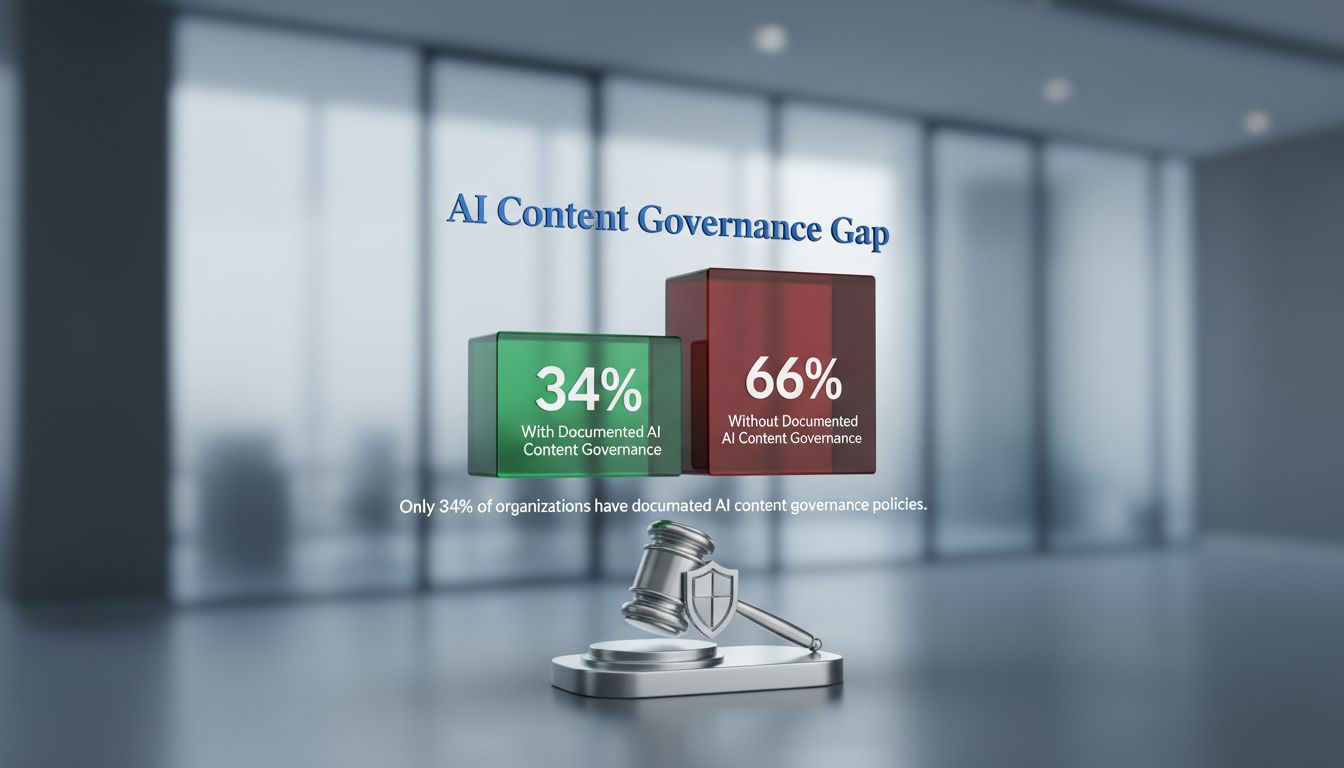
Only 34% of organisations had documented AI content governance, which is why most early AI content fails.
Tool stack: Google Docs with comment permissions. Use "Suggesting" mode so edits are tracked.
Critical step: The SME must add at least two "from the trenches" anecdotes or counterpoints. That's what makes the content non-generic.
4. SEO & AEO Optimization
Action: Take the human-reviewed draft and run it through an on-page optimiser like Surfer or NeuronWriter. These tools compare your content against top-ranking pages for your target keyword, scoring word count, header structure, and keyword density.
Why it matters: This is your AEO tuning. These tools analyse semantic relevance and entity coverage, which is exactly what AI answer engines evaluate when extracting information.
Tool stack: Surfer SEO or NeuronWriter. I prefer Surfer for its direct integration with the outline generation from stage 1.
Key adjustment: Don't blindly chase a "100% score." Use the recommendations to make sure you've covered all subtopics, but ignore suggestions that break narrative flow.
5. Compliance & Governance Check
Action: Before publishing, route the final draft through a lightweight governance tool like Slate or Writer Starter. These platforms check for brand voice consistency, flag potential compliance issues (like missing GDPR disclosures), and provide an audit trail.
Why it matters: This is your safety net. Common violations include missing AI disclosure per the EU AI Act and hallucinated testimonials. A governance check prevents legal and reputational risk.
Tool stack: Slate or Writer Starter for startups. Larger teams might use Templafy.
Non-negotiable: Every piece needs a brief, standardised disclosure about AI assistance in its creation.
6. Publish & Distribute
Action: Publish to your CMS. Use scheduling features or a tool like Spectre to automate publishing. Then immediately create distribution assets: a LinkedIn post thread, a Twitter summary, an email snippet for your newsletter.
Why it matters: Publishing is not the finish line. You need to signal to search and AI engines that new, relevant content exists.
Tool stack: Your CMS (WordPress, Webflow) + Spectre for automated publishing + a social scheduling tool.
Pro tip: Generate a "key takeaways" summary using ChatGPT specifically for social posts. Don't just link to the article.
This staged workflow reduces blog production costs by 78% and enables 8-12 quality posts per month versus 1-2 purely manual posts. AI-augmented B2B teams produce 4.2x more published assets per writer.
The verification metric is time-to-first-draft. If your AI-assisted draft requires a complete rewrite, your stage 1 (brief) or stage 2 (prompt) failed. A successful draft needs only factual augmentation and tone polish from the human reviewer.
Whether you're executing this yourself, building it out at a b2b saas marketing agency, or working through a content marketing course toward a content marketing certification, the process is the same. The top 100 saas companies have full content teams. The b2b saas content marketing strategy here is designed for teams that don't.
Your output should be a factory, not a craft workshop. Predictable inputs, quality-controlled stages, scalable output.
Build Your AI Content Stack: Tools Mapped to Your Workflow
What's the right way to build a tool stack? Don't buy tools. Build a system.
The biggest mistake I see is teams purchasing AI writing assistants before they have research and optimization infrastructure in place. You need tools that connect, creating a one-way workflow from discovery to published content.
Here's a small-team stack based on actual usage: a research tool like Ahrefs or Semrush ($129/month), an optimizer like Surfer ($89/month), and a drafting LLM like ChatGPT Plus (~$20/month). That's roughly $238/month total, which lands right in the $200–$400/month sweet spot.
| Tool Category | Example Tools | Primary Use Case | Phase | Estimated Cost |
|---|---|---|---|---|
| Research & SEO | Semrush, Ahrefs, SparkToro | Competitive analysis, keyword/AEO cluster discovery, backlink profiling | 1, 2 | $100–$250/month |
| Content Optimisation | Surfer, NeuronWriter, Frase | Topic mapping, SERP feature analysis, outline generation | 3 | $60–$120/month |
| Drafting & Ideation | ChatGPT Plus, Claude Pro, Jasper | First-draft generation, meta description variants, FAQ creation | 3 | $20–$80/month |
| Governance & Review | Slate, Writer Starter, Templafy | Brand voice enforcement, approval workflows, hallucination checks | 4, 6 | $50–$200/month |
| Repurposing & Amplification | Pictory, Beautiful.ai, HubSpot | Script-to-video conversion, presentation creation, multi-channel publishing | 5, 7 | $15–$100+/month |
Here's how the integration actually works. Export your keyword list from Ahrefs, import it into Surfer Topics to generate an outline with competitor gaps mapped, then use that structured outline as your ChatGPT prompt. Claude Pro is particularly good for metadata generation and factual accuracy, which is why it keeps coming up in SEO circles.
For mid-market or enterprise teams, the stack scales up. You might pair HubSpot Marketing Hub ($800+/month) with Semrush for integrated CRM tracking, or bring in something like Persado for motivation-driven messaging at scale.
The point is each tool has one job. Research feeds optimization, which feeds drafting, which feeds governance.
Choose saas marketing tools that connect. Not all-in-one platforms that lock you into workflows that are mediocre at everything.
Phase 4: Implement Your AI Content Governance Policy
Month 5 Goal: Protect your brand and ensure compliance. Governance is your moat's defensive wall.
Only 34% of organizations have a documented AI content governance policy [Source: The Starr Conspiracy]. That's your competitive advantage. The other 66% are risking fines, reputational damage, and hallucinated content going live.
You need to be in the 34%.
Start with this mandatory checklist. Print it, stick it to your monitor.
Mandatory AI Content Governance Checklist
-
AI Use Disclosure Statement: Add a clear statement at the end of any AI-assisted content. The EU AI Act requires this. Example: "This article was drafted using AI tools and reviewed by our editorial team for accuracy and compliance."
-
Legal Review Gate for Regulated Topics: 61% of AI content on regulated topics (finance, healthcare, legal) is routed through legal review [Source: The Starr Conspiracy]. Define your regulated topics upfront. Any draft touching them must stop at a designated legal/compliance reviewer before publication.
-
GDPR/CCPA Compliance Check: For any content capturing personal data (lead magnets, email sign-ups, webinar registrations), verify you have a lawful basis documented (GDPR) and opt-out mechanisms (CCPA). AI-generated landing pages miss this constantly.
-
Hallucination & Fact-Checking Procedure: Assign a human reviewer to verify every factual claim, statistic, and product assertion in AI drafts. Use a tool like Geneo for hallucination mitigation if you're scaling.
-
Brand Voice & Style Guardrails: Create a brand voice document LLMs can reference. Include banned phrases ("in today's fast-paced world"), mandatory terminology, and tone examples. Tools like Slate enforce this automatically.
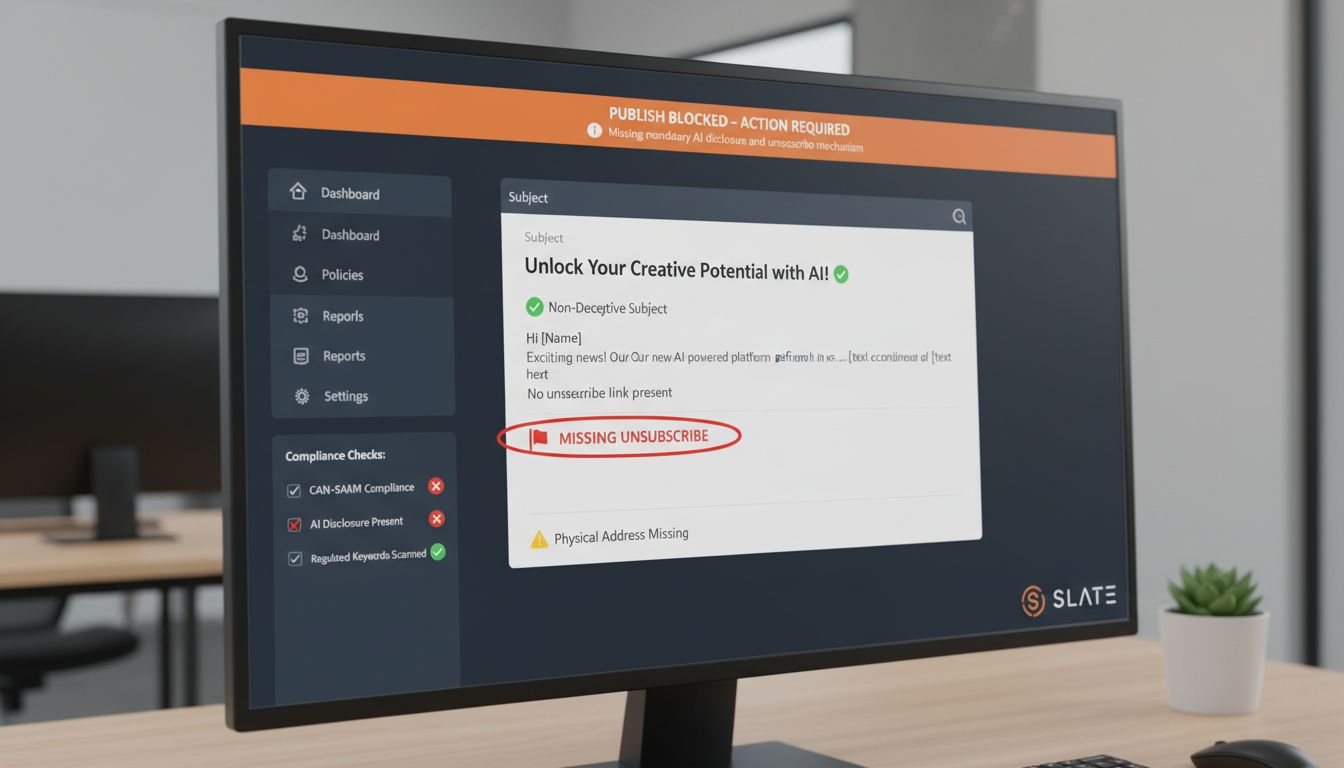
- CAN-SPAM Verification: For any AI-generated email sequence, check it includes a physical address, a clear unsubscribe link, and a non-deceptive subject line. Missing these triggers fines.
Implement technical gates. Use a lightweight governance tool like Slate or Writer Starter. Configure it to:
- Block publication if the AI disclosure statement is missing.
- Flag content containing regulated keywords (e.g., "HIPAA", "SEC", "GDPR") for legal review.
- Maintain an audit trail showing who reviewed, approved, and published each piece.
Here's a high-risk example worth walking through: your AI drafts an article on "AI for Healthcare Compliance."
- The draft hits your CMS. Slate automatically scans it, detects "HIPAA" and "patient data," and routes it to the "Legal Review" queue.
- Your compliance lead reviews. They fact-check claims about regulatory frameworks, add specific citations, and ensure the AI disclosure is present.
- The draft returns to the editor. They run a final brand voice check, then publish.
- The audit trail logs: AI generated → Legal reviewed (Jane Doe, 05/05/2026) → Editor approved (John Smith, 06/05/2026) → Published.
The consequences of skipping this aren't hypothetical. Missing the EU AI Act disclosure can lead to regulatory action. Hallucinated testimonials ("Customer X said...") destroy trust. AI-generated email sequences without unsubscribe links violate CAN-SPAM, and fines start at $16,000 per violation.
Governance isn't bureaucracy. It's what lets you scale without blowing up.
You built a factory in Phase 3. Now you install the safety guards. Every b2b saas content marketing strategy worth copying, from top saas companies to the firms behind every b2b saas marketing agency pitch deck, includes this layer. The ones that don't... you find out eventually.
Phase 5: Scale Through Systematic Repurposing
Most people publish a piece and move straight to the next topic. That's leaving most of the value on the table.
Month 6 Goal: Extract maximum value from every piece of content. You've built a factory. Now run it at capacity.
AI-augmented teams produce 6.4 derivative assets per pillar asset versus 2.1 pre-AI [Source: thestarrconspiracy.com/insights/benchmarks/ai-content-production-benchmarks-b2b-2024]. That multiplier is the whole game. The enemy is "one and done."
Start with your highest-performing pillar article, the one from Phase 2. Say it's something like "Configure Accurate HubSpot Sales Forecasting for SaaS Revenue Teams."
Run it through this repurposing chain:
- Generate a video script. Feed the article's key sections into Pictory or a similar tool. Instruct the AI: "Create a 3-minute explainer video script from this technical guide, focusing on the implementation steps." You'll get a narrated script ready for visualisation.
- Create a LinkedIn carousel. Use Beautiful.ai or Canva's AI design features. Ask it to distill the article into 5-7 slides, each with a single actionable insight and a visual. This becomes a standalone asset for your social team.
- Break it into a Twitter/X thread. Copy the article's subheadings and core data points into ChatGPT. Prompt: "Rewrite these points as a concise, engaging Twitter thread with a hook and a call-to-action." You'll have a thread drafted in minutes.
- Extract an email nurture snippet. Identify the most practical 'how-to' section. Use your LLM to adapt it: "Turn this configuration tutorial into a 300-word email for our 'Advanced CRM Tips' newsletter sequence."
- Build a webinar or slide deck foundation. Use the article's structure as your presentation outline. AI can summarise each section into slide notes and suggest supporting visuals.
Listicles and how-tos account for roughly 60% of AI-cited URLs [Source: revvgrowth.com/saas-content-marketing/content-marketing-for-llms]. So prioritise turning your successful articles into those formats across channels.
A single "Top 10 Forecasting Mistakes" article can become a video list, a social carousel, and an email series. That's the idea.
Automate the obvious parts. Use AI to summarise, generate visuals, and rewrite for platform tone. But keep human review for brand voice and factual accuracy, your Phase 4 governance gates apply here.
Then verify you're actually scaling. Build a simple dashboard in Notion or Airtable, track each pillar article, and list every derivative asset it spawned. Aim for that 6.4 multiplier. If you're sitting at 2 or 3 derivatives, the process isn't systematic enough yet.
You've already invested the research and writing effort. The extra 20% to repurpose gets you 80% more reach. That math works for every b2b saas content marketing strategy worth copying, from top 100 saas companies down to the scrappy startup that just finished their first content marketing course or content marketing certification and is figuring out what comes next.
The top saas companies don't get there by writing more. They get there by getting more out of what they've already written. Whether you're running this in-house or through a b2b saas marketing agency, the right saas marketing tools make the repurposing chain above less painful than it sounds.
Phase 6: Measure What Actually Matters for Pipeline
Stop measuring traffic. Start measuring pipeline.
Your north star metric: top-quartile SaaS marketing teams attribute 41% of qualified pipeline to owned channels (organic, content, AEO) combined. That's the number you're chasing.
Track both traditional and AI-driven KPIs in parallel:
Traditional SEO metrics:
- Organic traffic and keyword rankings
- Time on page and scroll depth
- Lead conversion rate from content
AI/AEO metrics:
- AEO citation performance (are you cited as a source?)
- AI-referred trials (tag visits with
utm_medium=ai) - Number of queries where your content is extracted
- Brand mentions in AI chat logs
Most teams fail at attribution. Fix it now.
- Tag every AI referral. Use UTM parameters like
utm_source=perplexityorutm_medium=ai_chat. Your analytics must separate AI traffic from Google. - Connect to your CRM. Make sure your Google Analytics 4 property feeds lead data into Salesforce or HubSpot. A lead that reads an AI-cited case study should be tagged
Lead Source: AI Content. - Review monthly. Which AEO clusters drove the most trials? Which high-traffic topics had zero conversions? Pivot your pillar strategy accordingly.
AEO visibility lifts can happen in 7-12 weeks. We've seen cases where AI-referred trials increased 6x in seven weeks. But systematic, reliable pipeline impact aligns with the 6-18 month roadmap you're already executing.
This applies whether you're running it in-house, through a b2b saas marketing agency, or you just wrapped a content marketing course or content marketing certification and are figuring out what to do with it. The b2b saas content marketing strategy doesn't change. Neither does what the top saas companies and top 100 saas companies actually track once they get serious about pipeline.
The right saas marketing tools make attribution less annoying. But the discipline of actually doing it is on you.
Measure what the business cares about: pipeline generated, not pages viewed.
Common Mistakes That Will Derail Your AI Strategy
Most teams don't fail because they skipped a step. They fail because they made one of these.
1. Operating without a documented AI governance policy. Only 34% of B2B marketing organizations have one (source: The Starr Conspiracy). That means 66% are flying blind on compliance, brand voice, and hallucination risk. Write your policy before you generate a single line of content.
2. Failing to route regulated-topic content through legal. For finance, healthcare, or legal content, 61% of organizations route AI drafts through legal review. The other 39% are taking on real liability. If your SaaS touches regulated data like GDPR, HIPAA, or SOC 2, your workflow needs a mandatory compliance gate before anything gets published.
3. Omitting mandatory AI disclosures. The EU AI Act requires disclosure of AI-generated content. GDPR demands a lawful basis for processing training data. CCPA requires opt-out mechanisms. Missing these isn't an oversight, it's a compliance violation that can trigger fines. Document your AI use and data handling.
4. Publishing unreviewed AI drafts. First-generation AI drafts consistently have brand-voice drift and factual hallucinations. You need a human subject-matter expert review gate in your workflow. No exceptions. The cost of correcting a public hallucination is way higher than the time you "saved" by skipping the review.
5. Scaling low-quality, mass-produced pages. Google penalizes scaled-abuse content, not AI itself. Churning out thousands of thin, templated pages to game rankings is a reliable way to earn a manual or algorithmic penalty. Depth, not breadth.
6. Missing CAN-SPAM infrastructure in AI email sequences. If you're using AI to generate email nurture sequences, you still need a clear unsubscribe mechanism and a physical postal address. Automation doesn't exempt you from email marketing law.
7. Over-relying on paid channels while neglecting AEO. Paid acquisition's share of pipeline has fallen as owned channels have grown (source: Omnibound). If you're still pouring budget into ads while treating content as an afterthought, you're funding a leaky bucket. AEO is your moat, and it applies whether you're a solo marketer who just finished a content marketing course or content marketing certification, or you're running b2b saas content marketing strategy inside one of the top 100 saas companies.
8. Treating AI as a replacement, not an augmentation. The most successful teams produce 4.2x more assets by augmenting human writers with AI, not replacing them (source: The Starr Conspiracy). Use AI for research, drafting, and optimization. Keep humans in the loop for strategy, editing, and final approval. That's how the top saas companies actually run it, and what any decent b2b saas marketing agency will tell you when you ask about saas marketing tools and workflows.
When to Consider a B2B SaaS Marketing Agency or a Formal Course
This roadmap covers a lot. Not every team has the bandwidth to run all of it internally, and that's fine. The question is just: what kind of help do you actually need?
Hire a b2b saas marketing agency when you need to move faster than your team can. Maybe you don't have internal SEO or AEO expertise. Maybe you're in a regulated sector like finance or healthcare and compliance adds real complexity. An agency runs the whole roadmap for you, from audit to measurement. Mid-market AEO programmes typically run $75K–$150K annually (source: Xander Marketing). You're paying for speed and expertise you can't build overnight.
Enroll in a content marketing course when you have time to learn but no real strategic foundation yet. This is for the marketing manager or founder who needs frameworks, not just tool tutorials. Something like "The SaaS Content Marketing Mastery" or CXL's offerings will walk you through building a b2b saas content marketing strategy from scratch, auditing competitors, mapping clusters. You'll still need to execute it yourself, but you'll avoid the expensive strategic mistakes. A content marketing certification is also worth considering if you need to build internal credibility alongside the skills.
That said, courses don't execute for you, and agencies aren't cheap. There's a third path.
Where does Spectre fit? It's for teams that want to keep strategic control but need to stop doing everything by hand. Spectre handles the production pipeline for Phases 2 through 4: keyword clustering, AEO-optimised brief generation, compliant drafting. You set the strategy and approve the final output. Spectre automates the rest.
It's what self-reliant teams use when they understand their domain but can't justify hiring a b2b saas marketing agency or spending six months on a content marketing course. It's also how smaller teams inside top 100 saas companies and top saas companies punch above their weight using saas marketing tools that actually fit into their workflow.
Conclusion
This isn't speculation. It's the system I've built and watched work across dozens of B2B SaaS companies. [Source: omnibound.ai/blog/b2b-saas-marketing-statistics]
The only viable AI content strategy for teams with limited domain authority combines a phased six-month roadmap, an AEO-first topic architecture, and tight governance. That's it.
Stop chasing high-volume keywords you can't win. Build your topic moat around the specific problems your product solves, structured for AI extraction.
Use AI to amplify your team's expertise and efficiency. Not as a replacement for thinking. Measure what actually matters: how AEO citations translate to AI-referred trials, not vanity traffic. [Source: discoveredlabs.com/case-studies/b2b-saas-4x-ai-referred-trials-aeo-strategy]
Now go execute. Start Phase 1 this week. Document your ICP, find your competitive gaps.
If you want to scale production without sacrificing quality, Spectre automates the research, writing, and publishing pipeline we've outlined here. It's how teams building a b2b saas content marketing strategy keep moving without doing everything by hand, and it's what smaller teams inside top saas companies and top 100 saas companies use to compete with bigger budgets using saas marketing tools that actually fit their workflow.
AI is a production system. Not a magic wand.