July 12th, 2026
Best SEO Agency Tools: Top Picks for Scaling AI Content Production
 WD
WDWarren Day
Your agency's content operation has a bottleneck you can't hire your way out of.
All of digital agencies have adopted AI at this point, but 84% still feel like they're falling behind. The tool isn't the problem. The workflow is.
Right now you're pulling keyword data from Ahrefs, briefing writers in Google Docs, running drafts through Surfer, then copying everything into WordPress by hand. For one client, that's annoying. For five, it falls apart. The scaling wall is real, and AI alone hasn't fixed it because AI alone doesn't eliminate the handoffs between steps.
I built Spectre from inside this exact problem. As a technical founder who's worked across startups, scale-ups, and large media companies, I've watched editorial teams, SEO strategists, and engineers fail to build content engines that actually rank at scale. Not because of bad writing or bad keyword research. Because of friction between steps.
This article evaluates the best SEO agency tools through one lens: how well they automate the full workflow from research to publish. Not the best writing assistant in isolation. Not the deepest SERP analyzer. The platforms that connect these pieces into a pipeline you can actually run across multiple client workspaces.
Most tool roundups get this wrong. They compare individual features, "this one has a better content grader, that one has cheaper credits", without addressing operational reality. Your real cost isn't the subscription price. It's the hours spent copying data between tabs, the context-switching tax on your team, and the headache of keeping five client brands from sounding identical.
We'll start with five agency-grade criteria that matter more than any feature list: workflow automation, multi-client governance, true cost-per-article, integration depth, and hallucination mitigation. These aren't theoretical. They're what I actually look at when helping agencies build their tech stack.
Then we run the numbers. What does an article really cost once you factor in tool subscriptions, editing time, and project management overhead? AI-assisted creation can cut production from 9-13 hours down to 75-90 minutes, but only if the tools are properly integrated. A disconnected stack can make things slower than before.
The core of this guide is a ranked list of tools that work for scaling agencies. Spectre leads as the only platform built specifically for end-to-end agency content automation, our top pick because it's designed to cut out the manual handoffs that choke growth. We'll cover how it handles keyword clustering, brief generation, AI writing, and direct publishing, and why we built it to solve the workflow problems other tools ignore.
We'll also look at strategic alternatives for specific situations:
- Surfer SEO + Jasper AI for teams who want granular, human-in-the-loop control over every optimization detail.
- CapstonAI for agencies focused on AI visibility tracking and WordPress automation.
- MarketMuse for enterprise content strategy and white-labeling needs.
- A shortlist of best-in-class point solutions if you'd rather build your own integrated stack.
Each evaluation is practical. What does the tool do uniquely well, who is it actually for, and what are its real weaknesses from an agency operator's perspective. No tool works for every situation. Some are actively wrong for yours.
There's also a full section on the non-negotiable stuff: governance, fact-checking, and hallucination mitigation. When you're producing content at scale for multiple brands, inaccuracies and brand voice drift aren't minor inconveniences. We'll go through the concrete processes and tool features that prevent these failures.
We'll also cover the mistakes agencies make when adopting AI SEO tools. Underestimating subscription costs, overlooking integration requirements, these turn promising investments into operational problems fast.
This guide comes from the intersection of software engineering and SEO, which is a perspective most content on this topic misses entirely. I don't just configure these tools. I build the systems that automate them. That means we'll get into why certain architectural choices matter, how to measure real ROI beyond vanity metrics, and what actually moves rankings at scale.
If you're responsible for scaling content production across multiple clients and you're tired of the manual grind, this is the framework. We'll start with the criteria that separate agency-grade tools from the consumer-grade versions of the same thing.
How We Chose: The 5 Agency-Grade Criteria That Matter More Than Feature Lists
Most "best SEO tools" lists are written for individual marketers, not agencies managing multiple clients. They focus on feature checkboxes while ignoring the real bottlenecks: manual handoffs between systems, client data isolation, and hidden operational costs.
After building Spectre and consulting with dozens of agencies hitting scaling walls, I distilled five non-negotiable criteria that separate agency-grade platforms from consumer tools. If you're evaluating AI content tools for your agency, this is your scoring rubric.
1. Workflow Automation: Manual Handoffs Eliminated
Count how many times content moves between tools. Consumer tools might automate writing but leave you copying keywords from Ahrefs, pasting into a brief, then manually publishing to WordPress.
Agency-grade tools connect research → briefing → generation → optimization → publishing in one flow. Each manual step you eliminate saves roughly 15 minutes per article. That's 5 hours saved on a 20-article client.
2. Multi-Client Governance & Brand Isolation
Can you separate client data, brand voices, and user permissions cleanly? Generic tools force awkward workarounds: separate logins, manual style guide application, or worse, mixing client content.
Proper agency platforms have workspaces with role-based access, audit logs, and independent brand voice training that doesn't leak between clients.
3. Integration Depth, Not Just API Availability
An API checkbox means nothing if your team has to build and maintain custom connectors. Look for native CMS publishing (WordPress, Webflow, Shopify), direct SERP tool connections (Ahrefs, Semrush), and pre-built editorial workflow hooks.
Zero engineering effort. That's the bar.
4. True Cost-Per-Article Efficiency
Subscription price is the tip of the iceberg. The real number is: tool cost + human review time + integration maintenance + client onboarding.
A $300/month AI plan producing 20 articles has a $15 tool cost per article, but total costs reach $75–$90 once labor is included [Source: trysight.ai]. Agency tools should cut the human time component significantly.
5. AI Visibility Tracking & Factuality Governance
Traditional SEO tracking stops at Google. With AI Overviews reducing position 1 CTR by 9.4 points, you need visibility across ChatGPT, Perplexity, and Gemini responses too.
Equally critical: hallucination mitigation. Leading models now report rates around 0.7–0.8%, but without proper citation workflows and fact-checking systems, you're risking client reputation damage [Source: rankprompt.com].
These aren't theoretical concerns. They're what separates the best seo agency tools from everything else, not feature counts, but workflow elimination, client safety, and predictable economics. Whether you're looking at the best paid seo tools or trying to find the best free seo tools to fill gaps in your stack, this is the rubric. The best seo tools for small businesses, the top seo tools used by enterprise teams, the best wordpress seo plugin, the best seo plugin for a headless build, the seo tools list you've been building in Notion, none of it matters if the workflow is still broken.
The Real Math: Calculating Your True Cost Per Article (Beyond the Sticker Price)
Most agencies evaluate AI tools by comparing monthly subscription fees. That's a rookie mistake. Your real cost isn't the sticker price, it's the total time and money required to get a publish-ready article out the door.
Here's the brutal breakdown of Total Cost of Ownership (TCO):
| Cost Component | Typical Agency Scenario | Cost Per Article |
|---|---|---|
| Tool Subscription | $300/month plan producing 20 articles | $15 |
| Editorial Labor | 30 minutes of editing/fact-checking at $50/hour | $25 |
| Operational Overhead | Briefing, CMS formatting, client review cycles | $35+ |
| Total Cost Per Article | $75+ |
A $300/month tool producing 20 articles gives you a $15 tool-cost per piece [Source: trysight.ai]. That sounds fine until you add 30 minutes of editor time at $50/hour. Now you're at $40 before you've touched project management, client revisions, or CMS formatting.
This is why 46% of small and medium-sized enterprises say high subscription and implementation costs are blocking AI SEO adoption [Source: businessresearchinsights.com].
The hidden fees are what kill you: per-seat licensing, extra revision charges, annual contract lock-ins, per-language pricing.
Free tools (seo software tools free) have the highest labor TCO. You're trading a $0 subscription for hours of manual keyword research, SERP analysis, and formatting. Your editor becomes the entire production pipeline.
The goal isn't to find the cheapest sticker price.
It's to find the tool that cuts revision time and operational overhead so aggressively that the subscription becomes a smaller fraction of the total. The right platform should shrink that 30-minute edit down to 5 minutes and eliminate the formatting overhead entirely. That's where the real ROI lives, whether you're comparing the best paid seo tools, the best free seo tools, the best seo tools for small businesses, or any seo tools list you've been building. The top seo tools, the best seo agency tools, the best seo tools for beginners, the best wordpress seo plugin, the best seo plugin you can find, none of it matters if the labor cost is quietly eating your margin.
1. Spectre: Best for End-to-End Agency Content Automation
The only platform built from the ground up to automate the entire agency content pipeline from keyword research to WordPress publish.
What's actually eating your agency's time? It's not the work itself. It's moving data between tabs.
Spectre is built to eliminate that. Most "integrated" workflows are just loose connections where you're still copy-pasting keywords, reformatting briefs, and manually publishing. That's not automation, that's just a fancier to-do list.
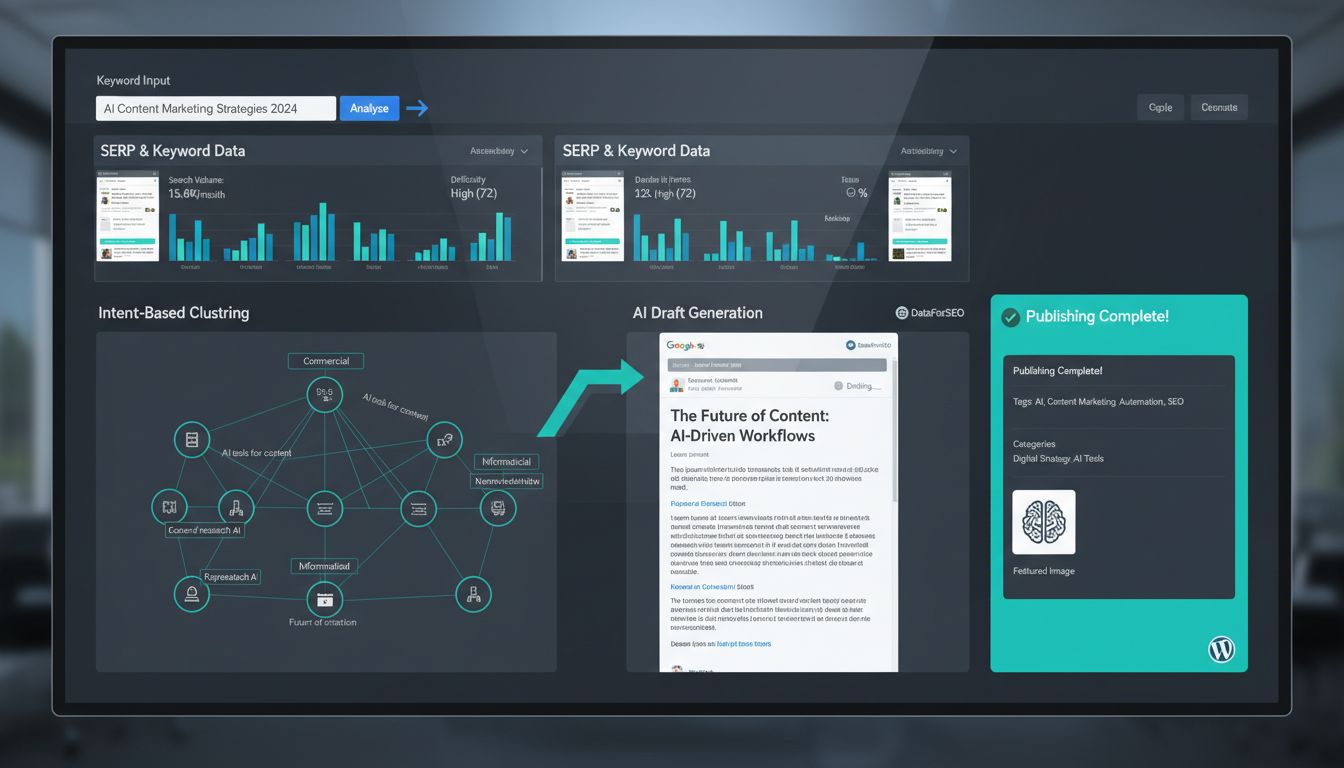
The core is a single automated workflow. Give it a seed keyword, and it handles everything else: pulling SERP and keyword data via DataForSEO, clustering by intent, generating an AI-optimised draft, and publishing directly to WordPress with categories, tags, and featured images already in place.
That process typically eats 60-75% of an agency's content production time [Source: hashmeta.ai]. For multi-client agencies, what used to be a 30-minute publishing task becomes a 30-second background job.
It's also built for multi-client governance from day one. Separate workspaces per brand, isolated keyword libraries, trained brand voices, granular permissions. Not a solo tool retrofitted for teams.
The direct WordPress integration handles scheduled publishing, automatic image optimisation, and meta tag injection across all your client sites at once. It functions as a centralised [WordPress SEO plugin](/blog/best-seo-tools-for wordpress) for your entire portfolio.
Where does it trade off? If you want to tweak every individual SEO suggestion in real-time, this isn't that tool. Spectre is intentionally streamlined for automation, not granular human-in-the-loop editing.
It's also optimised for WordPress ecosystems. APIs exist for custom integrations, but if your clients live in headless CMS platforms, the path of least resistance here is WordPress. That's a deliberate call. The focus is solving the end-to-end workflow for the majority of agency clients, not building shallow connectors for every possible system.
Most integrations fail at error handling. What happens when the CMS is down or an image fails to upload? That's where production systems break. Spectre is built to manage those edge cases.
If you're trying to scale content output without linearly scaling headcount or juggling a patchwork of the best seo agency tools, this is the best seo plugin approach for turning a content bottleneck into a scalable pipeline.
2. Surfer SEO + Jasper AI: Best for Teams Who Demand Granular, Human-in-the-Loop Control
The industry-standard pairing for agencies that want maximum editorial control over optimization and brand voice, accepting manual assembly as the trade-off.
Here's the honest version: this is the most reputable "Frankenstack" out there, and it's popular for a reason. If your agency's value is the meticulous, human-driven process itself, editors poring over Surfer scores, testing Jasper's brand voice variations, these are best-in-class components. You're paying for control, not automation.
Surfer's content scoring is the gold standard among top seo tools. The Content Editor analyzes SERP data to suggest exact term usage, heading structures, paragraph length, a precise, data-backed checklist for editors. A Surfer case study reported an agency improving content velocity by 247% using its tools.
Jasper handles what pure seo software tools free of creative opinion can't: it absorbs a client's existing content to train a brand voice model, then expands briefs into coherent drafts.
The integration is proven. But it's manual. You research keywords in Surfer, export a brief, switch to Jasper's "SEO Mode" (which pulls Surfer's data via API), write the draft, score it, tweak it, then publish, usually by hand into a CMS. Three separate environments. Every single article.
For agencies selling the optimization process as a service, that's actually fine. The hand-crafted approach is the point.
The problems show up when you scale. You're running two subscriptions, Surfer's Enterprise plan starts at $999/month, Jasper's agency plans start at $14,990/year. Two sets of API keys. And the operational overhead of stitching it all together yourself. If Surfer's API runs slow, Jasper's editor stalls. That's not a rare edge case.
This stack works well as one of the best seo tools for small businesses, or for boutique agencies where a senior editor personally touches every piece. The labor cost per article is higher, but for clients who are paying for that level of attention, it holds up.
For everyone else, the manual handoffs just become the new bottleneck. Which is the thing you were trying to fix in the first place.
Among the best seo tools for beginners, this combination isn't ideal, the workflow complexity and cost are real barriers. But as a best paid seo tools pairing for established agencies with the right editorial culture, it's hard to argue with the output quality. It's a fixture on any serious seo tools list for that reason.
3. CapstonAI: Best for AI Visibility Tracking & WordPress Automation
The essential add-on for agencies who need to track where search is going, not just where it's been.

What problem are most top seo tools still ignoring? AI visibility.
Traditional rank trackers watch Google's blue links. CapstonAI watches where your brand shows up in Google AI Overviews, Perplexity, ChatGPT, Claude, and Gemini. According to industry analysis, AI Overviews alone cut click-through rates on position #1 by 9.4 percentage points. If you're not tracking that, you're missing a real shift in how people actually find things.
The WordPress Agent is the other reason agencies end up hooked on it. It automatically deploys schema markup, meta tags, and internal linking suggestions with AI-recommended anchor text. No more manually pasting JSON-LD. No more junior SEO hours burned on stuff that should just... happen.
Best for: Agencies who need to future-proof client reporting and automate WordPress technical SEO at scale.
Strengths:
- Unique AI visibility tracking across all major LLM search sources, giving you a complete picture of brand exposure beyond traditional SERPs
- WordPress automation that handles schema, meta, and internal linking programmatically
- Actionable insights showing exactly which content gets cited in AI answers and why
Weaknesses:
- Not a content creation platform, you'll need to pair it with a writer like Jasper or our own Spectre
- Niche focus means it's an add-on to your core stack, not a replacement for best seo agency tools that cover the full picture
- Learning curve for interpreting AI visibility metrics versus traditional ranking data
Pricing reflects how specialized it is. Plans start at $49/month for the Free tier, up to $199/month for the Agency plan. For reference, that's less than half the cost of adding Ahrefs' AI Content Helper ($99/month) on top of what you're already paying.
The efficiency case is real. One of our agency clients cut their technical SEO deployment time by 70% using the WordPress Agent alone, what used to take an hour per site now happens automatically. They also caught three separate instances where competitors were being cited in AI Overviews for their own branded terms, early enough to actually do something about it.
It's not a best free seo tools situation, and it won't replace a best seo plugin or a full best paid seo tools stack. But as an early warning system for the AI search transition, it earns its place on any serious seo tools list.
It won't write your content. It'll tell you exactly what to write, and how to structure it, for visibility across both traditional and AI-driven search. For agencies who take the "AI" part of AI SEO seriously, whether you're building a stack for a best seo tools for small businesses client or running enterprise accounts, it's hard to leave this one off the list.
It's also worth considering if you're evaluating the best wordpress seo plugin options alongside a broader stack. CapstonAI's WordPress Agent handles a lot of what a best seo plugin would cover on the technical side, just with more automation baked in. Good entry point for the best seo tools for beginners who are managing WordPress sites and don't want to touch the schema by hand.
4. MarketMuse: Best for Enterprise Content Strategy & White-Labeling
Best for agencies whose primary revenue comes from high-ticket content strategy and gap analysis reports, not content production.
Who is MarketMuse actually for?
Not every agency. If you're selling $10,000+ content audits and quarterly roadmaps to enterprise clients, it's built for you. If you're in the execution business, it probably isn't.
The core thing it does well is content gap and topical authority analysis. Not keyword clustering, actual mapping of entire content ecosystems, showing you exactly where a client's portfolio is failing to meet search demand. That depth is what justifies the price. Consultant and agency tiers reportedly start at $299/month, scaling to $599/month for white-labeling.
The white-label reporting is what makes it work for client-facing agencies. You're generating polished, brandable reports that position your agency as the expert, not just someone running a third-party tool. For multi-client shops where presentation drives perceived value, that matters a lot.
Where it falls short is execution. MarketMuse tells you what to write and why. It doesn't automate the writing or publishing. You'll still need a production tool like Spectre or Jasper to actually build out the roadmap it creates.
Think of it as the "top floor" of your agency service stack. It gives you the strategic blueprint. That's it. Which is why it lands on the best paid seo tools list specifically for agencies whose brand is built on deep analysis, not volume.
It's not trying to be on a best free seo tools list, or compete with your best seo plugin, or show up in a best seo tools for beginners guide. It's for the agencies selling strategy as a service, and for that, it's hard to beat.
5. A Strategic Shortlist: Best-in-Class Point Solutions for Building Your Own Stack
Some agencies prefer assembling a custom stack from best-in-class components. Here's a rapid-reference guide to the specialists.
Ahrefs – Best for keyword research and backlink analysis. It's the industry standard for competitor analysis, with an AI Content Helper add-on ($99/month) that groups keywords by intent and scores topical coverage [Source: whatagraph.com]. Core plans start at $129/month, so it's not a casual purchase.
Clearscope – Best for content optimization grading. Starting at $189/month, it gives you precise content scoring against SERP competitors and integrates directly into Google Docs, which is useful if your editorial workflow already lives there.
Link Whisper – Best for automated internal linking on WordPress. Agency pricing runs as low as $1 per site/month. It suggests contextually relevant anchor text and builds link equity without you touching it [Source: linkwhisper.com].
Contentful – Best for headless CMS and enterprise content ops. The free tier covers 5 users and 1 million API calls/month. The Basic plan starts at $300/month and makes sense if you're managing content across multiple channels and locales.
OpenAI Moderation API – One of the best free SEO tools for governance. Free for OpenAI API users, it handles content safety checks and helps catch hallucination risks before they become a client problem [Source: evolink.ai].
Building this stack gives you maximum control over each component. You also inherit maximum integration labor, hidden costs, and operational fragility, exactly the total cost challenges we outlined earlier.
It's the right call if you have dedicated technical resources to maintain everything. For most agencies scaling client work, that's just not realistic.
Non-Negotiable for Agencies: Governance, Fact-Checking, and Hallucination Mitigation
Does your agency have a system for catching AI errors before they reach a client? If not, you're gambling with your reputation every time you hit publish.
Clients don't care which model you used. They care that a stat was wrong, or the brand voice was off, or something slipped through that shouldn't have. That's on you.
Between 2023 and 2025, companies invested $12.8 billion specifically in reducing AI hallucinations [Source: rankprompt.com]. Even with leading models reporting failure rates as low as 0.7% (Google Gemini) and 0.8% (OpenAI's latest), "low" is not "zero." If your agency is pushing 50+ articles a month, you will publish a mistake eventually. That's just math.
So the governance layer isn't optional. It needs three concrete things:
- Mandatory citation and attribution tracking for any factual claim, statistic, or expert opinion. This isn't just academic, it directly supports EEAT signals that Google explicitly rewards.
- Automated moderation screening before any human review. The OpenAI Moderation API is free for API users and catches safety violations. Integrate it, or use a vendor's built-in equivalent.
- A client-facing checklist documenting that these checks were performed. That turns a technical safeguard into something a client can actually see and trust.
Spectre bakes these checks directly into its automated pipeline, every article passes through citation validation and moderation screening before reaching your editor. With Jasper+Surfer, you build this layer yourself, which means another integration point to maintain. CapstonAI's visibility tracking helps you monitor outcomes but doesn't stop the initial error from happening.

The most dangerous assumption is "our editors will catch it." At scale, human review becomes a bottleneck. Fatigue is real. Your tooling has to enforce governance, you can't just rely on someone remembering to check.
Common Mistakes Agencies Make (And How to Avoid Them)
Fifteen years building software for media companies and agencies. Same expensive mistakes, over and over. Here's how to spot them before they cost you a client.
Mistake 1: Skipping keyword research for speed. You brief an AI on a broad topic, hit generate, and publish. The result is generic, over-optimised content that fails to answer specific search intent, and tanks engagement. Antidote: Use a tool like Spectre or Ahrefs to cluster keywords by intent first. Brief the AI on the precise question clusters you're targeting.
Mistake 2: Underestimating the true total cost. You budget for a $300/month AI tool and forget the cost of manual keyword research, editing, and publishing. 46% of SMEs report that high subscription and implementation costs restrict adoption. Antidote: Calculate your real cost per article using the framework in section 2, including all labour and tooling.
Mistake 3: Believing vendor case studies are guarantees. Rocky Brands saw 80% traffic growth in four months using AI tools. That result also depended on their existing domain authority and market. Antidote: Treat case studies as proof of possibility, not promise. Pilot new tools on a low-risk client project first.
Mistake 4: Ignoring governance until it's a problem. Assuming your editors will catch every hallucination or missing citation is how you end up with a reputation-damaging error at scale. Antidote: Build moderation, citation checks, and fact-verification into your workflow from day one, using the tools outlined in section 8.
Mistake 5: Overlooking hidden contract costs. Setup fees, per-language pricing, and punitive exit clauses can double your effective cost. Antidote: Read the fine print on enterprise plans. Ask for a trial period that includes the full setup process.
Mistake 6: Relying on a single vendor's "complete" stack. Jasper needs Surfer for deep keyword optimisation. A standalone "all-in-one" tool almost always has a critical weak spot. Antidote: Stress-test integrations before committing. Choose a platform like Spectre built for the full workflow, or deliberately assemble a best-in-class stack where each tool actually excels at its job.
Conclusion
The real bottleneck for scaling agency content isn't creation. It's everything around creation, the handoffs, the approvals, the publishing pipeline, the governance.
That's what separates a genuinely useful best SEO agency tools platform from a fancy text generator.
Surfer+Jasper gives you granular control. CapstonAI handles AI visibility tracking. Both are worth knowing. But Spectre is the only platform built specifically for end-to-end agency workflow, keyword research through publishing, no manual duct tape required.
Skipping governance is where agencies get burned.
AI hallucinations, missing citations, unverified claims at scale, these aren't edge cases, they're inevitable if you don't build checks in from the start. That's not a risk worth taking with a client's reputation on the line.
Pick the stack that actually lowers your cost per article. Whether that's Spectre for full automation or a custom mix of top seo tools, the logic is the same: if the workflow still breaks down in the middle, the tool isn't doing its job.
Frequently Asked Questions
What should an SEO agency look for in an AI content tool?
Start with workflow automation, how many manual steps does it cut out between keyword research and published content?
Then look at multi-client governance: separate brand voices, user permissions, compliance checks per workspace. Integration depth matters more than the feature list. A tool that pushes directly to your CMS is worth more than two that spit out Word docs you still have to handle yourself.
Also calculate your true cost per article, subscription, revision time, operational overhead. The sticker price will lie to you.
How much does AI content creation actually cost per article for an agency?
The sticker price is misleading.
A $300/month tool producing 20 articles runs $15 in tool cost per article [Source: trysight.ai]. Add an editor's revision time (30 minutes at $50/hour = $25) plus operational overhead, and you're actually at $45-75 per piece.
The goal is finding platforms that improve first drafts (less revision time) and automate publishing (less overhead). That's how the number comes down.
How do I manage AI hallucinations and ensure content quality for clients?
You need layers, not luck.
Mandate tools with built-in citation support for factual claims. Use free APIs like OpenAI's Moderation API for content safety checks. For YMYL topics especially, require human spot-checks of key assertions before anything goes live.
The tools worth using have these governance steps baked into the publishing workflow, not bolted on as an afterthought.
What's the difference between an AI writing tool and a full SEO content platform?
An AI writing tool handles text generation. You still do keyword research, optimization, and publishing yourself.
A full SEO content platform, think of it as the best seo agency tools category, automates the whole pipeline. Keyword clustering, brief creation, AI writing, optimization, one-click CMS publishing.
One is a power drill. The other is a construction crew that hands you a finished house.
Can I build a capable agency SEO toolkit using only free tools?
Technically yes. But it falls apart at scale.
You can stitch together free tiers of Semrush, OpenAI's Moderation API, and a basic CMS. There are plenty of seo software tools free options in the best free seo tools category that appear in any seo tools list worth reading. But that "Frankenstack" has no real automation, needs constant manual integration work, and completely lacks multi-client governance.
For agencies, the labor cost of managing disconnected free tools eats the subscription savings pretty fast. It's not actually cheaper.
How fast is the AI SEO tool market growing, and what does that mean for my agency?
The projections vary, $2.43 billion in 2026 to $32.6 billion by 2035, but every estimate points the same direction [Source: businessresearchinsights.com; market.us].
More useful: 100% of digital agencies have adopted AI, and 84% are worried about keeping up with where it's going [Source: searchenginejournal.com].
Competitive advantage right now comes from workflow efficiency and AI search visibility, not just how fast you can generate content. Speed alone isn't the edge anymore.