April 27th, 2026
How to Write Content for SEO: A Step-by-Step Framework for SaaS Founders
 WD
WDWarren Day
You've read the generic SEO checklists. You've sprinkled keywords into blog posts. And your SaaS organic traffic is still stuck in the low thousands.
The problem isn't effort. SaaS SEO requires engineering, not just writing. A framework that connects targeted content to your technical architecture.
Most founders treat "how to write content for SEO" as a standalone task. That's why they fail.
SEO delivers around 702% ROI for B2B SaaS with a 7-month break-even period. But only when you treat it as a system, not a content calendar.
I've built SEO automation platforms as a technical founder, so what follows isn't another post about keyword density. It's a blueprint for building a scalable content engine that integrates AI, technical SEO, and practical workflows for teams that don't have unlimited time or headcount.
Here's what you'll actually get out of this: SaaS-specific keyword research with a reality check on what you can rank for, content architecture for topical authority, and technical best practices you can wire directly into your publishing workflow. I'll also show you how to use AI to scale your efforts without replacing human judgment, and how to measure what moves the needle, pipeline, not vanity traffic.
Realistic timeline: meaningful pipeline impact in 6-12 months, full ROI around 9-18 months.
Now let's build the system.
Before You Start: Define Your System and Audit Your Foundation
Don't write a single blog post yet. Seriously. Fix what's broken first.
Most early-stage SaaS founders skip this part and then wonder why their content never ranks. I've audited dozens of sites. 90% have at least one major technical blind spot quietly killing their efforts.
Prerequisite 1: Sharpen Your Niche and ICP. You cannot rank for everything. Your Ideal Customer Profile drives your entire keyword strategy.
Are you selling project management software to remote agencies, or HR analytics to enterprise teams? That one answer determines which "how-to" queries you target and which competitor comparisons you write. A vague niche produces vague content that attracts no one.
Prerequisite 2: Assemble Your Core Toolkit. At minimum you need: a keyword and backlink research platform (Ahrefs or Semrush) and Google Search Console for performance data. Add Screaming Frog for technical audits. Tools like Surfer SEO or Frase come later, at the optimization stage.
Without this data, you're guessing. SEO-sourced leads convert at roughly 51% versus 26% for PPC [Source: GrowthSpree], but only if you're targeting the right audience in the first place.
Prerequisite 3: Run a Rapid Technical Health Audit. Non-negotiable. Open Screaming Frog, crawl your site, and check for critical blockages:
- Robots.txt: Is it blocking essential pages like CSS/JS files?
- Indexation: Are key landing pages accidentally set to
noindex? - Google Search Console: Check the Coverage report for major crawl errors.
- Page Speed: Run your homepage through Google's PageSpeed Insights. A slow mobile experience kills rankings before you even start.
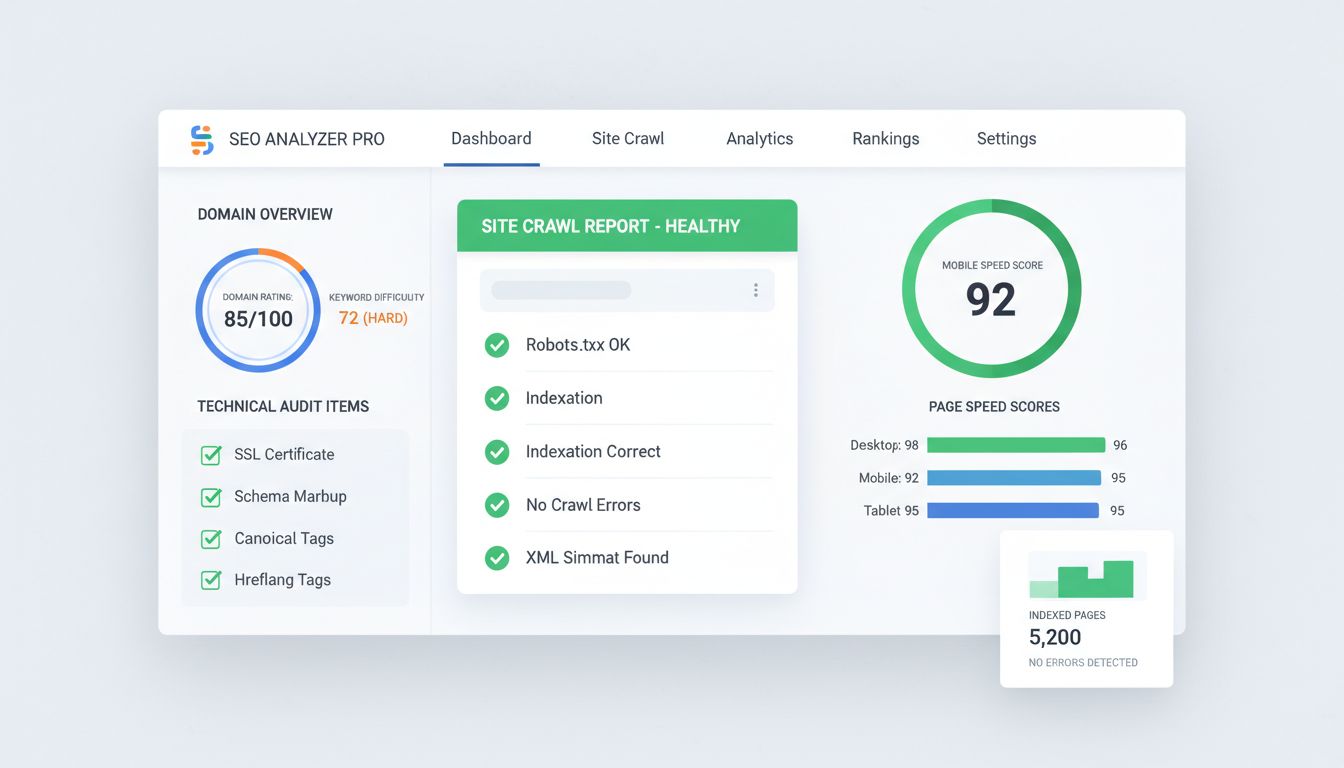
Your domain rating constrains what you can rank for. Accept that now. Start with low-competition, long-tail terms. Skip these checks and the rest of the system doesn't matter.
Here's where most founders waste time: staring at spreadsheets. Automate the initial clustering instead. Use Ahrefs' API to programmatically group keywords by intent and parent topic. I build this directly into Spectre, it saves 20+ hours a month in manual sorting. Spend your time on strategic analysis, not data entry.
Build a 2×2 prioritization matrix. X-axis is Ranking Feasibility (accounting for your DR). Y-axis is Traffic Value, not raw volume, but estimated commercial worth.
Your immediate targets live in the top-left quadrant: high value, feasible. These are usually bottom-of-funnel commercial keywords tied to your product or feature pages, not top-of-funnel blog posts. A 2025 analysis found SaaS sits among the most competitive spaces, with nearly a 1:1 ratio of easy-to-hard keywords. Smart filtering isn't optional.
Finally, exploit competitor gaps. Use Ahrefs' "Content Gap" analysis to find keywords your competitors rank for that you don't.
Pay attention to integration opportunities specifically. "QuickBooks integration with [Your Tool]" is high-intent and low-competition if you actually support that integration. That's how you find keywords that drive signups, not just traffic. And that's the whole point of learning how to write content for SEO in the first place.
Step 2: Architect Your Content for Topical Authority
Stop publishing random articles. Start building a content ecosystem that systematically earns Google's trust on your core topics. When I worked inside large media companies, I saw how editorial teams used hub-and-spoke models to dominate search results, you can adapt the same principle.
Create 3-5 cornerstone "pillar" pages covering your fundamental service categories. If you're a project management SaaS, that's "SaaS Project Management" or "Team Collaboration Software." Then surround each pillar with 8-12 cluster articles on specific subtopics: "agile sprint planning tools," "resource allocation software," "remote team standup templates."
This structure works. Sites building topical authority see 20-40% growth in ranking keywords quarter-over-quarter during early stages.
The internal linking is what makes it stick: every cluster article links back to its pillar page, and the pillar page links out to all its clusters. This concentrates ranking signals instead of scattering them across orphaned blog posts.
Map your clusters to the buyer journey. Not all content should be top-of-funnel. Design some clusters as comparison articles ("Monday.com vs. Asana") or integration pages ("QuickBooks integration with [Your Tool]") that sit in the consideration phase. These feed visitors toward your commercial pages and convert at higher rates.
Build your editorial calendar around topics, not just keywords.
Plan to publish clusters within a topic area closely together, four articles over six weeks signals topical depth to Google faster than spreading them across months. Use a clean URL structure that supports this: /project-management/pillar-page/ and /project-management/cluster-article/.
One technical thing worth knowing how to write content for SEO the right way: orphaned cluster pages with no internal links waste crawl budget and dilute authority. Your CMS has to support this structure without creating navigation silos.
Step 3: Write and Optimize for Both Users and Algorithms
Stop writing content, then trying to "SEO it" afterwards. The real question isn't how to write content for SEO after the fact, it's how to build content that's structured for both humans and algorithms from the first word.
Start with a headline that captures intent. Your H1 needs your primary keyword, but frame it as a benefit. Instead of "Guide to Project Management Software," write "How to Choose Project Management Software That Actually Gets Used." Tools like ShareThrough's Headline Analyzer can help gauge emotional appeal, but the real test is simple: would your ideal customer click this?
Structure for scannability, then depth. Answer the user's core question within the first 150 words. Use H2s and H3s liberally to create a clear information hierarchy.
Aim for 1,500-2,500+ words for guides. Long-form content generates ~56% more leads than shorter posts.
Apply the 4 C's of SaaS content to every piece:
- Clarity: Use plain language. Explain concepts like you would to a colleague, not a press release.
- Credibility: Cite specific data, link to case studies, quote real experts. This builds the 'E' in E-E-A-T.
- Conversion: Every piece needs a relevant CTA. A top-funnel guide should link to a mid-funnel comparison; a comparison page should CTA to a demo. Don't leave the next step to chance.
- Context: Weave in internal links to your pillar and cluster pages. This signals topical authority to Google and guides users deeper.
Optimize on-page elements methodically. Your meta description is a promise, not a summary, write it to improve click-through rate. For images, use alt text that describes function ("screenshot of the project dashboard filtering tasks") not just "screenshot."
Make sure your URL is clean and includes the target keyword (/choose-project-management-software).
Engineer the conversion pathway. This is where I adapt the sales "3-3-3 rule" for content: within 3 paragraphs, establish the problem; within 3 sections, provide the solution framework; by the 3rd CTA, guide them to a commercial next step.
A top-funnel 'how-to' guide's CTA should go to a mid-funnel 'tool comparison' page. That comparison page should CTA to a demo request.
Design the journey.
A typical SaaS free-trial landing page converts at ~5% for small vendors. Your content's job is to pre-qualify visitors so that when they hit that page, they're already halfway sold.
Step 4: Integrate Technical SEO with Your Content Engine
Great content that Google can't crawl is just... content.
If Google can't find it, index it, or render it properly, it doesn't matter how good it is. Technical SEO isn't a separate thing you bolt on later, it's the plumbing underneath everything else.
Start with crawl budget management. Once you're publishing 20+ pages a month, you're competing for Googlebot's attention. Crawl budget is the time Google allocates to scanning your site, and you don't want it wasted on admin panels and staging environments.
Ask your engineering team to:
- Block admin panels, staging environments, and internal tools via robots.txt
- Make sure your sitemap updates automatically and submits to Google Search Console
- Monitor crawl stats in GSC for sudden drops or spikes
I've seen media companies lose 30% of their traffic because a documentation portal was eating the crawl budget meant for revenue-generating pages. If you have an extensive knowledge base, consider moving it to a subdomain you can manage separately.
Implement structured data immediately. Use JSON-LD for:
- Product and SoftwareApplication schema on feature pages
- HowTo schema for tutorials and guides
- Article schema for blog content
- FAQ schema for common customer questions
Structured data helps Google understand what your content is actually about, and can unlock rich snippets that lift click-through rates by 30% or more. Google's Structured Data Testing Tool validates your implementation.
Mobile-first indexing is your baseline. Google crawls and indexes the mobile version of your site first. Run every important page through Google's Mobile-Friendly Test. Core Web Vitals, LCP, FID, and CLS, are direct ranking factors. Technical SEO and engineering coordination matters a lot here, because plenty of SaaS sites fail on mobile speed while having genuinely good content.
Master canonicalization to avoid duplicate content penalties. This is where most SaaS sites trip up:
- Every page needs a self-referential canonical tag
- UTM parameters and session IDs create duplicate versions of the same URL
- Product tier variations (free vs. paid) quietly generate unintended duplicates
Set up redirects for legacy URLs. Make sure your engineering team understands that duplicate content spreads page authority thin across your whole domain.
Here's how to translate this for your dev team: "Make sure Google can find our new content quickly, understand what it's about, and show it correctly on mobile. Block everything that doesn't help customers find us."
The thing most people don't realize? Most of these fixes take less engineering time than writing a single article, and they unlock content that was already there, just invisible to search engines.
Part of knowing how to write content for SEO is recognizing that the writing itself is only half the job. The other half is making sure the infrastructure doesn't quietly undo all of it.
Step 5: Use AI to Scale, Not Replace
Stop asking "can ChatGPT do SEO?" That's the wrong question.
The better question is: where does AI speed up your workflow without watering down the expertise Google actually wants to see?
Use it for ideation and structure, not final drafts. Prompt it with something like: "Generate an outline for a 2,000-word guide on SaaS onboarding best practices, structured for a technical founder audience." It gets you past the blank page. The output will be generic, but that's fine, it's a skeleton you inject real insight into.
Automate your content brief creation. Tools like Surfer SEO or Frase pull the top 10 ranking pages for your target keyword and spit out a brief with keyword targets, suggested headings, questions to answer. In my agency, we use the Surfer API to generate briefs programmatically for entire content clusters. Every piece starts with a data-backed foundation instead of a guess.
The editorial layer is the part AI can't touch.
It can't replicate what you learned from 200 sales calls. It doesn't have your product analytics. It can't write the contrarian take that only comes from actually building in the space. A human has to inject the case studies, the "gotchas," the specific details that make the thing worth reading. That's the core of E-E-A-T, and Google is getting better at detecting when it's missing.
Build a repeatable, hybrid workflow:
- Keyword/Intent Input → 2. AI-assisted Brief Generation → 3. Human Drafting with Sources & Insights → 4. Optimization Check (SEO tool) → 5. Editorial Review → 6. Publish.
Will AI replace SEO? No. It'll replace SEOs who only execute checklists.
Your advantage as a founder is that you have deep, authentic expertise AI doesn't have. The most successful SaaS content engines I've built use AI for the research and structuring phase, then hand off the high-value work to people who actually know the space. That's how to write content for SEO that compounds, AI handles the mechanics, humans handle the stuff that makes it authoritative.
Step 6: Promote, Build Authority, and Measure What Matters
Publishing is the easy part.
Stop hoping for organic backlinks. Build them on purpose. For SaaS, the most effective approach is product-led: create a dedicated integration page for every tool you connect with, Stripe, HubSpot, Slack, then email those companies' partner teams. A simple heads-up often gets you a reciprocal link. Build out real technical documentation or API guides too. Those naturally pull in .edu and .gov backlinks from developers and students without you doing anything extra. And don't sleep on HARO, one relevant citation in a niche publication is worth more than a dozen low-quality links.
Don't just post a link on LinkedIn and call it done. Pull the two or three most useful insights from your pillar guide and turn them into a carousel or thread. Repurpose a key finding into a 90-second Loom. The goal is showing up where your audience actually is, not ticking a "shared" box.
Measure the things that connect to revenue. In Google Analytics 4, track these three:
- Organic MQLs: Form submissions from organic search traffic.
- Sign-ups/Trials from Organic: The direct path from search to your product.
- Attributed Pipeline Value: Connect GA4 to your CRM (like HubSpot) to see the revenue value of organic-sourced leads.
SEO-sourced leads convert to sales-qualified leads at ~51%, versus ~26% for PPC [Source: Click Vision]. That's what you're actually optimizing for. A traffic spike that doesn't move those numbers isn't worth celebrating.
Refresh what you already have. Audit your top 10 performing articles every 6-12 months. Update the stats, add sections that address recent developments, make sure the content still matches what people are actually searching for. I've seen simple refreshes yield 20-30% ranking boosts within weeks.
The timeline is slower than you want it to be. Your first quality backlinks show up 30-60 days after outreach. Measurable traffic follows around 90-120 days. Significant ranking movement on competitive terms takes 6-12 months of consistent effort [Source: Bazoom].
That's not a knock against SEO, it's just the reality of how to write content for SEO that compounds. The returns start accelerating around month nine and keep going from there. You're building an asset, not running a campaign.
Common Mistakes That Derail SaaS SEO Efforts
Your content system is built. Your technical foundations are solid. But you can still blow it with predictable, avoidable errors.
Targeting the wrong keywords first. You're a new domain with DR 20. Chasing "best CRM software" (Volume: 49,500, KD: 85) is financial suicide. You'll waste 12 months and thousands of dollars ranking nowhere.
Start with low-competition, high-intent long-tail terms like "CRM for real estate teams with Gmail integration" that you can actually own within 90 days. Your early wins fund the long game.
Treating your blog as the only SEO channel. This is the most common mistake I see. Your /pricing page, /features, and /integrations are commercial goldmines. SaaS pricing pages often rank in the top 10 for organic traffic [Source: Click Vision].
If you're not optimizing these for high-intent keywords, you're pouring traffic into a leaky bucket. Build content clusters that link directly to these conversion pages.
Publishing without promotion. "Build it and they will come" died in 2012. Publishing a blog post and tweeting it once is not a strategy.
Backlinks are the primary ranking signal Google uses to evaluate domain authority. No promotion means no backlinks, which means painfully slow growth. You need a systematic outreach plan from day one.
Letting technical debt accumulate silently. You fixed your site speed once. Six months later, a new marketing plugin adds 2 seconds to page load. Your documentation subdomain generates 500 thin pages that eat your crawl budget.
Technical SEO isn't a one-time audit. It's ongoing hygiene. Let it slip, and your content ROI evaporates.
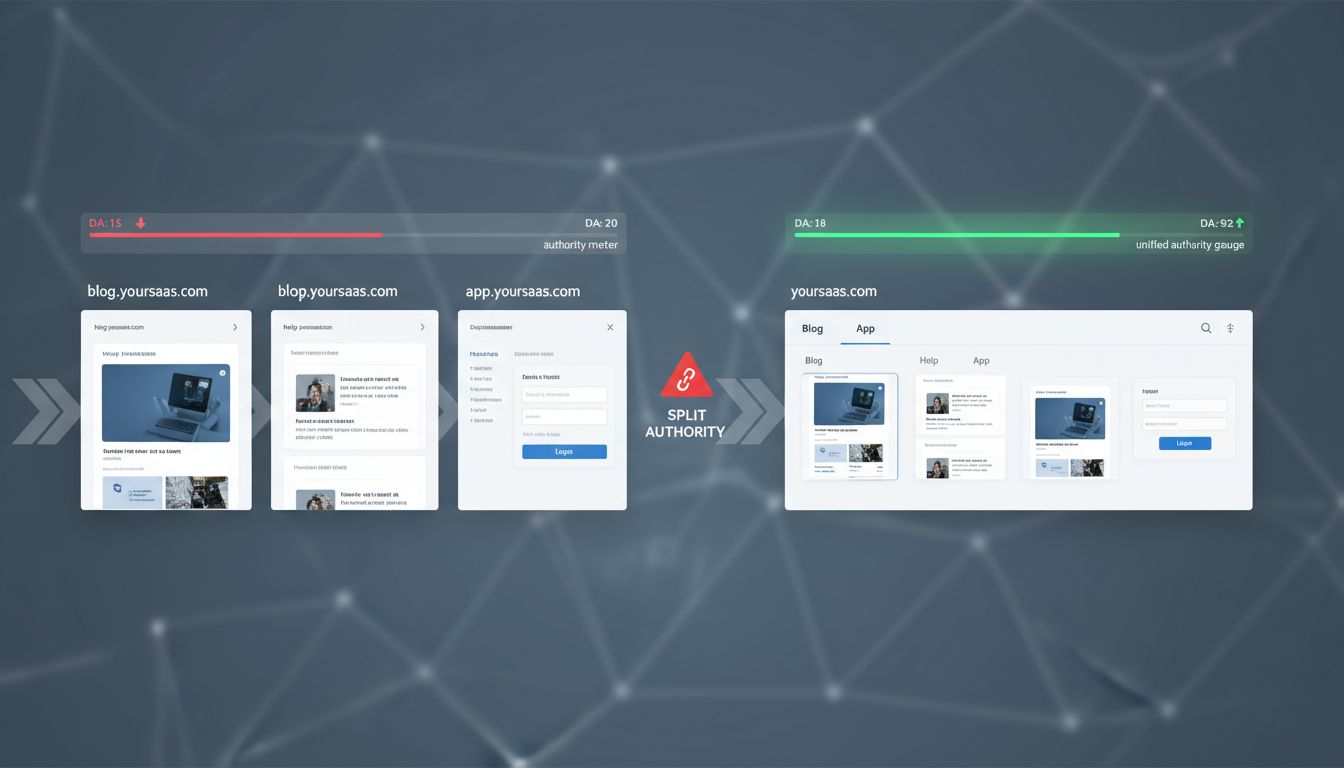
Fragmented architecture. Your blog lives on blog.yoursaas.com, your docs on help.yoursaas.com, your app on app.yoursaas.com. You've just split your domain authority three ways.
Search engines treat subdomains as separate entities. Consolidate where possible, or implement strategic cross-subdomain linking to concentrate authority.
Ignoring the refresh cycle. That guide you wrote 18 months ago now has outdated screenshots, deprecated API references, and dropped from position 3 to 27.
Google's Helpful Content Update explicitly rewards fresh, maintained content. A quarterly refresh program is how you defend your rankings, not a nice-to-have. Part of knowing how to write content for SEO is knowing that the work doesn't stop at publish.
The pattern here is pretty simple. Successful SaaS SEO treats content as a living, interconnected system. Failure happens when you treat it as a series of disconnected tasks.
Conclusion
Here's the honest version: knowing how to write content for SEO isn't really about writing articles. It's about building a system that connects to your technical stack and matches where your buyer actually is in their journey.
AI helps you scale faster. But it can't replace the human judgment that makes your EEAT signals land.
Use the 80/20 rule. High-intent commercial pages first, technical health second, everything else later. Track MQLs from organic, not just rankings. And expect compounding returns over 6-18 months, not next Tuesday.
Don't treat SEO as a checklist you finish once. Run the technical audit and keyword prioritization exercise from this guide, then just... keep going.
Frequently Asked Questions
How to write good content for SEO?
Good content for SEO solves a specific problem clearly and answers the query directly. For SaaS, it also needs to map to where the buyer actually is, informational for discovery, comparisons for consideration, pricing and trial pages for conversion.
Concrete examples, real data citations, and a relevant call-to-action that points toward your product. That's the baseline.
What is the 80/20 rule for SEO?
80% of your organic results will come from 20% of your content. For SaaS founders, that means most of your effort should go into high-intent commercial pages (pricing, comparisons, feature pages) and the cornerstone cluster content that builds topical authority.
Don't scatter resources across hundreds of blog posts. Prioritise content that drives qualified leads and signups, according to Click Vision data, these deliver 44.6% of B2B revenue [Source: click-vision.com].
Is SEO dead or evolving in 2026?
It's evolving. With AI Overviews and Generative Search, clarity, factual accuracy, and user satisfaction matter more than ever.
What's dead is keyword-stuffed, low-value content. What's evolving is the need for helpful content systems that serve both users and AI search engines. The game has shifted from chasing algorithm updates to building topical authority and technical trust.
What are the 4 C's of content writing?
Clarity (be easily understood), Credibility (back claims with evidence), Conversion (guide toward an action), and Context (connect to the broader user journey).
For SaaS, I'd add a fifth: Criticality. Your content has to address the user's urgent business problem. Without that, even well-optimised content won't convert.
Can ChatGPT do SEO?
It can help with specific tasks, content briefs, article outlines, headline brainstorming. But it can't do strategic keyword research, understand nuanced buyer pain points, or build EEAT (Experience, Expertise, Authoritativeness, Trustworthiness).
Use it as a drafting assistant inside a human-led workflow. It supplements the thinking. It doesn't replace it.
What is the 3-3-3 rule in sales and how does it apply to SEO?
Adapted for SEO content: your page should help readers understand their problem in the first 3 seconds, present your insight in the next 3 paragraphs, and give them a clear next step within 30 seconds of reading.
Bottom-funnel keywords drive 40–60% of organic conversions for SaaS. Structure matters as much as substance when you're trying to get someone to a trial signup.