May 21st, 2026
Surfer SEO vs Clearscope: Which AI Content Optimization Tool Wins for SaaS?
 WD
WDWarren Day
If you're a SaaS founder buried in manual SEO work, you've probably landed on the surfer seo vs clearscope debate as your starting point. Makes sense. Both are solid content optimization tools.
But here's the thing: you're comparing two screwdrivers when you need a power drill.
I built Spectre, an AI-powered SEO content automation platform, after watching engineering teams and editorial departments hit the same wall over and over. The bottleneck isn't "which tool scores content better." It's that neither tool gets you out of a fragmented, still-manual workflow.
For technical founders and marketing leads at scaling B2B SaaS companies, the real problem is producing content at scale without a dedicated SEO team. The Surfer vs Clearscope debate just... distracts from that.
This article looks at the standard comparison points, then brings in a third option that actually addresses the underlying problem: automating research, writing, and publishing end-to-end. We'll also get into true cost of ownership (which is never just semrush pricing or screaming frog pricing), what outcomes actually matter beyond correlation scores, and the workflow integration costs that most founders don't see coming.
The Core Players: Defining the Contenders
Surfer SEO calls itself an "AI Visibility Platform." Think Swiss Army knife: a data-heavy Content Editor with real-time scoring, SERP analysis, Topical Maps for site-level strategy. It acquired by Group Positive in 2025, which has pushed its AI features forward fast, including Surfy for AI-assisted writing and Auto-Optimize for one-click improvements [Source: surferseo.com/updates/].
For teams trying to scale blog output, it gives you a lot of metrics to chase. Maybe too many.
Clearscope is more focused. It uses IBM Watson NLP to analyze top-ranking pages and gives you a clean editor with a letter grade, key terms with importance scores, and tracking for whether those terms show up in AI responses like Gemini or ChatGPT. Less data, cleaner UI, shorter learning curve.
Here's the problem both tools share: they're optimization layers sitting on top of a still-manual, still-fragmented workflow.
You still need to do keyword research somewhere else. You still need to brief a writer (or be the writer). You still need to manage publishing. For SaaS founders trying to scale, the bottleneck isn't optimizing a single article. It's automating the entire content engine from research to published page.
That's why we built Spectre. The question we kept asking was: why can't this whole process just run itself?
Spectre is an AI-powered SEO content platform that handles the full workflow. It researches keywords using DataForSEO, writes articles optimized for search and AI discovery, and publishes them directly to your site. No manual handoffs. No duct-taping six different platforms together.
Surfer and Clearscope help you polish content. Spectre produces it, at scale, without you in the loop for every step.
Comparison Table: Key Features at a Glance
For SaaS founders evaluating SEO tools, here's how they actually stack up on the things that matter for scaling.
| Feature Axis | Clearscope | Surfer SEO | Spectre |
|---|---|---|---|
| Depth of Optimization | Excellent Precise, NLP-driven grading (A-F) with IBM Watson analysis. |
Very Good Real-time Content Score with broader SERP data. |
Good Optimises for search and AI discovery, balancing depth with production speed. |
| Breadth of Functionality | Narrow Focused purely on content grading and briefs. |
Broad Adds keyword research, topical maps, site audits, and AI writing (Surfy). |
Complete End-to-end: research, writing, optimisation, and direct publishing. |
| Workflow Automation | Manual Requires manual content creation and CMS publishing. |
Semi-Automated Assists writing but publishing is still manual. |
Fully Automated Automates the entire pipeline from keyword to published post. |
| True Cost of Ownership | High Starts at $129/mo for Essentials, plus separate costs for keyword tools (e.g., SEMrush pricing tiers) and writers. |
Moderate Starts ~$99/mo for Essential, but still needs complementary tools for a full workflow. |
Best Value Single subscription replaces multiple tools (keyword research, writing, optimisation). |
| Measurable Outcomes | Content Quality Strong correlation with rankings in some studies. |
Traffic Growth Enterprise users report 85% average traffic growth within 12 months. |
Scaled Production Measures output volume and organic growth driven by automated systems. |
The table makes the choice pretty obvious. Clearscope and Surfer SEO (and tools like screaming frog seo if you're doing technical audits) help you optimize inside your existing workflow. Spectre replaces the workflow.
If you're comparing surfer seo vs clearscope, both are optimization layers. You still need to write the content, still need to publish it, still need something like screaming frog pricing in your budget for site audits. That adds up fast, especially when you factor in semrush pricing on top of everything else.
For founders trying to scale, patching tools together isn't a strategy. At some point you're just managing tools instead of growing traffic.
Decision Axis 1: Depth vs. Breadth of Functionality
Your SEO tool needs to match your actual situation. Are you polishing a handful of existing pages, or trying to build a content engine from nothing? That's the real question here.
Clearscope is built for depth. Clean interface, focused on one thing: grading your content against what's already ranking. You get term importance scores, typical usage counts, and an A-F grade that updates as you write. It uses IBM Watson NLP to analyse what top-ranking content includes, which makes it genuinely useful for protecting pages you've already invested in.
Surfer SEO goes wide. SERP Analyser, Topical Maps, Coverage Booster, a Sites hub for multi-domain work. The content editor is there, but the real value is the surrounding infrastructure, keyword clustering, competitive analysis, AI-assisted drafting through Surfy. Better for teams creating content at volume. The learning curve is steeper, though.
Here's the thing neither tool solves: you're still doing the work manually.
Clearscope gives you a deep polish, but you still need to find the keywords, write the draft, and publish it. Surfer gives you broader planning tools, but you're still jumping between a keyword researcher, a writing interface, and your CMS. You bought a better wrench. You still have to build the whole car yourself.
That's where Spectre is different. It doesn't hand you recommendations and wish you luck, it runs the workflow. Keyword research via DataForSEO's API, clustering, article generation based on real-time SERP analysis, and direct publishing to WordPress or Webflow. The "functionality" isn't a dashboard. It's a pipeline.
Breadth without automation is still a trap. You end up with a powerful toolkit and no time to actually use it.
The metric that matters isn't features per dollar. It's published, ranking articles per founder-hour.
Decision Axis 2: Workflow Integration and the Hidden Engineering Cost
What does it actually cost to add one of these tools to your stack? Not the subscription fee. The real cost.
Both Surfer and Clearscope have APIs, connectors, Google Docs extensions, WordPress plugins. Looks good in the comparison table.
Here's what it looks like in practice. Surfer's Google Docs extension saves some formatting headaches, but you're still manually moving content into your CMS. The Zapier integration automates triggers, sure, but now you're building and maintaining a middleware layer. Clearscope's API is solid, but it's a content grading API. Not a publishing API. You still need to write the pipeline that takes a grade, fetches the content, and pushes it live.
That's the hidden engineering cost.
You're not just paying $129 or $399 a month. You're paying for developer hours to integrate, test, and maintain these connections. Error handling when the API changes or a Zap breaks. Authentication, webhook security, data sync issues. It's the same problem you run into adding Screaming Frog SEO to your stack, another powerful, technical tool that doesn't plug into your production pipeline without custom work. (Screaming Frog pricing alone isn't the issue. The engineering time around it is.)
For a SaaS founder, this overhead is lethal.
Your CTO or lead engineer, the person who should be building product features, is now babysitting content publishing workflows. I've been that engineer. Stitching together Ahrefs data, Surfer scores, and WordPress hooks. The initial integration takes a week. The ongoing maintenance is a permanent tax on your most expensive resource.

Spectre was built to cut this out entirely. It connects directly to DataForSEO for research, writes and scores content internally, and publishes via a native CMS integration. No manual copying, no Zapier middleware, no custom pipeline. The "integration" is a one-time API key exchange.
The cost difference between surfer seo vs clearscope and something like Spectre isn't really about subscription fees. It's about who's doing the plumbing.
With Surfer or Clearscope, you're buying a recommendation engine and accepting the burden of building everything around it. With Spectre, the workflow isn't integrated, it's inherent. For a team without a dedicated DevOps person for marketing, that's the difference between a tool that scales and one that quietly becomes a part-time engineering project.
Decision Axis 3: True Cost of Ownership (TCO) for Scaling
Published pricing: Surfer starts around $99/month for Essential and $219/month for Scale. Clearscope is $129/month for Essentials, $399/month for Business [Source: Zoftware listings]. That's the part you can see.
Everything underneath is what actually matters.
With either tool, you're buying an optimization engine. Not a content system. You still need keyword research (Ahrefs or SEMrush pricing starts around $99/month), technical audits (Screaming Frog SEO commercial license is £149/year), AI writing (another $20–50/month). And then someone to hold all of it together.
Here's a realistic TCO for a SaaS company publishing 20 articles monthly:
Manual Stack TCO:
- Surfer/Scale: $219/month
- SEMrush Pro: $119/month
- Screaming Frog pricing: £12/month
- Writer hours: 3 hours per article × 20 articles × $50/hour = $3,000/month
- Total monthly TCO: ~$3,350
The labor number is the thing. At 3 hours per article, you're spending $150 in writer time before you've touched hosting or promotion. The optimization tools help, but they don't touch the actual bottleneck, which is human hours per article.
Spectre works differently. Keyword research (integrated with DataForSEO), content generation, optimization, and publishing all live in one workflow. The writer shifts from researching and drafting to reviewing something that's already optimized.
Automated Stack TCO:
- Spectre subscription: $497/month
- Writer hours: 1 hour per article × 20 articles × $50/hour = $1,000/month
- Total monthly TCO: ~$1,497
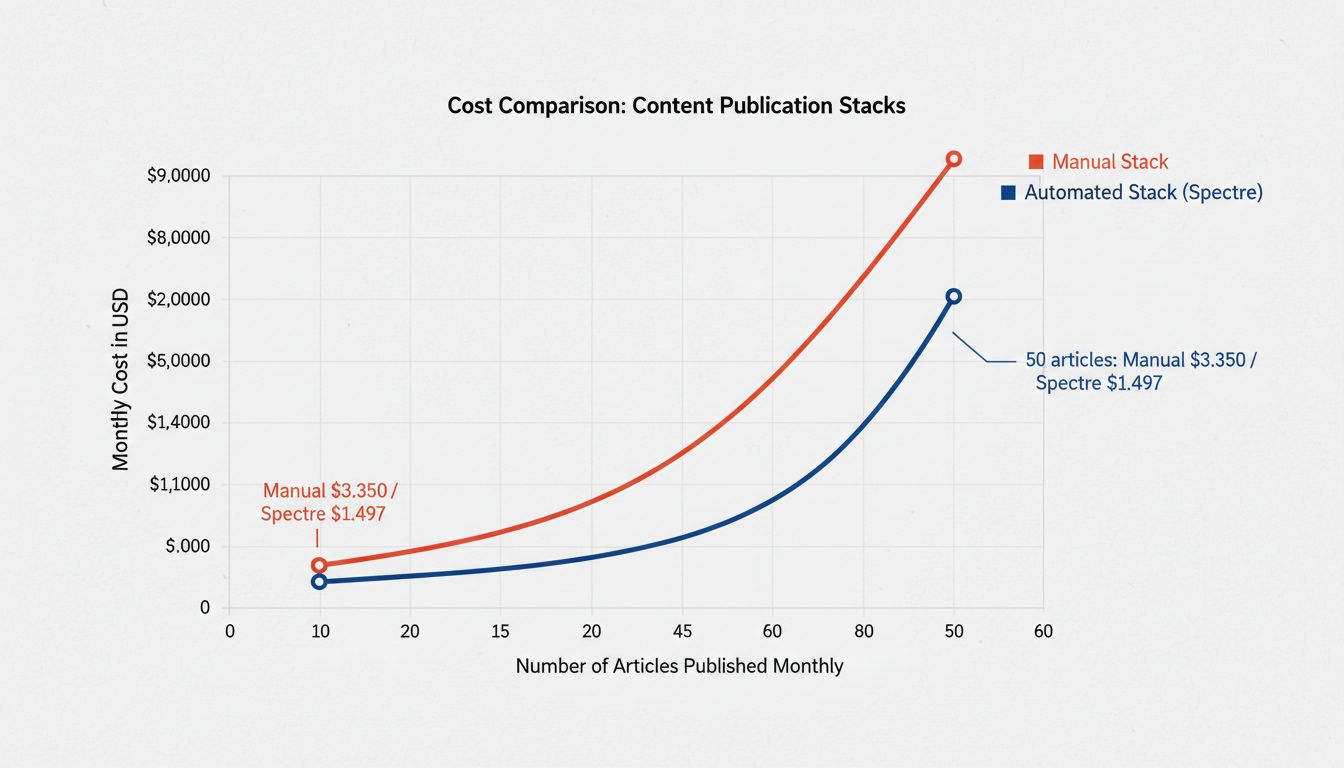
Less than half. And it compounds. At 50 articles monthly, the manual stack runs ~$8,350. Spectre stays around $2,497. Manual labor scales with quality control overhead. Automation doesn't.
There's also the engineering angle. With surfer seo vs clearscope, you're maintaining connections between Google Docs, WordPress, your CMS, and whatever SEO tools you've wired in. Every API change, every plugin update is someone's afternoon. Spectre cuts that layer out, research, writing, optimization, and publishing run as one pipeline.
The real question for SaaS founders isn't which optimization tool is cheaper. It's which approach lets you scale content without scaling headcount at the same rate. The subscription fee gap between Surfer and Clearscope is almost beside the point compared to what you're paying in labor.
Decision Axis 4: Measurable Outcomes and the Correlation Trap
Does the data actually tell you which tool wins? Not really.
Surfer reports their Content Score had a 26% correlation with Google rankings in an Originality.ai study. Clearscope's grade showed 17.5% correlation in the same Surfer-reported analysis. But then other sources cite Ahrefs data showing Clearscope outperforming Surfer. You're left reading vendor-funded studies against each other, which isn't a great way to make a decision.
Correlation doesn't equal causation anyway. A high optimization score might track with rankings today, then Google updates and it doesn't anymore.
I've seen clients chase perfect Surfer scores and watch rankings drop after algorithm updates. They were optimizing for the tool's metrics, not actual user value. Those are different things.
The numbers Surfer puts out are real but missing context. Surfer Enterprise customers reportedly see 85% average traffic growth within 12 months, and Surfer users grew their Google and AI visibility by 423% in 2025. But those outcomes require consistent content production at scale. Most small teams can't get there manually.
Here's the thing nobody in the surfer seo vs clearscope debate wants to say out loud: volume and consistency predict traffic growth better than optimization scores do. Publishing 50 decent articles beats publishing 5 perfectly optimized ones, almost every time. Both tools are trying to help you with those 5.
That's the problem Spectre was built to solve. Automated keyword research, content generation, and publishing in one pipeline. You're not chasing correlation scores. You're building something that consistently feeds Google fresh, relevant content.
The manual stack (SEMrush pricing, Screaming Frog SEO audits, a writer holding it together) keeps your ceiling low. Not because the tools are bad, but because the bottleneck is human hours, and neither Surfer nor Clearscope touches that.
Whether you go with Surfer's 26% correlation or Clearscope's cleaner interface, you're still producing everything by hand. For SaaS companies trying to grow organic traffic without growing headcount, that gap is where automation actually matters.
The Narrow Wins: When Surfer or Clearscope Might Fit
After years building content systems for SaaS companies, I've seen where these tools actually fit. It's a narrow set of scenarios.
Pick Clearscope if your only goal is perfecting a handful of flagship pages and you have a dedicated editor to do it. The clean interface and content grading work well when one person is carefully refining product pages or documentation. Teams at IBM and Deloitte use it for exactly that: maintaining editorial standards on critical content assets. But you'll still need separate tools for keyword research, writing, and publishing.
Pick Surfer SEO if you already have a content team and want a Swiss Army knife for research and optimization. The breadth, from Topical Maps to SERP analysis, gives experienced SEO managers more to work with. Surfer reports that its Content Score shows a 26% correlation with Google rankings, which is something, though correlation isn't causation.
If you're willing to manage the complexity and have the headcount to execute manually, Surfer has more tactical depth. That's a real "if."
Here's what both tools quietly ignore: they're still manual publishing tools. You're stitching together Clearscope or Surfer with Ahrefs for research, ChatGPT for writing, WordPress for publishing. That fragmented stack creates coordination overhead that small SaaS teams can't really afford.
For most technical founders, the ones responsible for growth but without a dedicated SEO team, these are edge cases.
The answer probably isn't another manual tool. It's an automated system that handles research, writing, and publishing end-to-end. That's the gap that surfer seo vs clearscope debates never quite get to, and it's the same gap that makes semrush pricing, screaming frog seo audits, and a writer trying to hold it all together feel like such a ceiling.
FAQ: Surfer SEO, Clearscope, and AI-Powered SEO
Which AI tool is best for SEO optimization?
If you want to write and edit everything yourself, Clearscope or Surfer are solid choices. Clearscope gives cleaner grading for writers, Surfer gives you more features overall.
But if you need to scale organic traffic without scaling your team, a fully automated system like Spectre that handles research, writing, and publishing is the better fit for most SaaS founders.
Is SEO dead or evolving in 2026?
SEO isn't dead. It's evolving from manual keyword optimization toward AI-driven discovery and automated content production.
Surfer and Clearscope are the optimization layer. Platforms like Spectre are the automation layer that actually scales output.
What is the 80/20 rule for SEO?
Put 20% of your effort into the strategy and tools that drive 80% of results. For most SaaS teams, that means automating content production rather than manually optimizing each article.
The bottleneck isn't making content slightly better. It's creating enough quality content consistently.
Can ChatGPT do an SEO audit?
No. It can generate suggestions based on patterns it's seen, but it can't crawl your site, analyze backlinks, or give you data-driven keyword recommendations the way specialized tools can.
Real audits need real-time SERP data and structured technical analysis. ChatGPT doesn't have either.
Is SEO replaced by AI?
No. Strategy, editorial oversight, and business context are still human-led. The shift is from manual execution to AI-assisted automation, where tools like Spectre handle the production workload while founders focus on strategy and messaging.
The surfer seo vs clearscope debate, the semrush pricing calculations, the screaming frog seo crawls, the screaming frog pricing justifications... none of that goes away. It just stops being the ceiling.
Conclusion

The surfer seo vs clearscope question is really just asking "which manual optimization tool should I use?" Both can improve content quality. Neither solves the actual problem.
The real bottleneck for most SaaS founders isn't optimization. It's producing enough content to matter in the first place.
And when you start adding up the true cost, semrush pricing, screaming frog seo licenses, screaming frog pricing, the hours your team spends stitching it all together, you're not just paying for software. You're paying for a workflow that still requires a person at every step.
That's why we built Spectre. It handles the whole pipeline: keyword research, AI-powered writing, and direct publishing. SEO stops being a manual chore and starts actually scaling.
If that sounds like what you're missing, visit spectreseo.com.
Frequently Asked Questions
Which AI tool is best for SEO optimization?
For manual content optimization, Clearscope and Surfer are the go-to choices. Clearscope has a cleaner interface with solid content grading. Surfer goes deeper on SERP analysis and has more features overall.
But if you're trying to scale past manual optimization into automated content production, that's where both of them hit a ceiling. Spectre handles keyword research, writing, and publishing end-to-end, which is the actual bottleneck for most SaaS founders.
Is SEO dead or evolving in 2026?
It's evolving, fast. Google's updates are increasingly built around AI understanding of content quality and user intent, and the tools are shifting to match, from manual optimization assistants to automated content systems.
Spectre is a good example of where things are headed. Not "here's how to improve what you wrote," but "here's the published article that's already ranking."
What is the 80/20 rule for SEO?
20% of your efforts drive 80% of your results. For most SaaS companies trying to scale, that 20% is building systems that automate content production rather than hand-tuning individual posts.
Publishing 50 well-researched articles automatically will get you more organic traffic than spending weeks perfecting 5 manually optimized ones. That's the leverage. Spectre is built around that idea.
Can ChatGPT do an SEO audit?
No. It can't crawl your site, doesn't have access to real-time search data, and has no real way to analyze backlinks, page speed, or competitive positioning.
It can spit out an audit checklist, sure. But an actual audit requires tools like Ahrefs or Screaming Frog SEO, things that pull live data and actually crawl your pages.
Is SEO replaced by AI?
No. The strategic layer, keyword selection, content planning, figuring out what users actually want, is still human work. What AI has taken over is the execution.
The whole content production workflow (research, writing, publishing) can now be automated. Spectre is built around that. AI doesn't replace SEO thinking, it replaces the manual labor that made SEO impossible to scale for small teams.