March 13th, 2026
The AI-Powered SEO Step-by-Step Guide for SaaS Websites in 2026
 WD
WDWarren Day
You know your SaaS needs organic growth, but between rising ad costs and a lean team, traditional SEO feels like a black box of vague advice and endless tasks. Most guides on how to do seo for website step-by-step weren't written for your reality. They assume you have an SEO team, months of runway, and a product that behaves like an e-commerce store.
Look, SEO works. B2B SaaS companies see a 702% ROI from it, and organic search generates 44.6% of all revenue. Those aren't vanity metrics. They're the difference between sustainable growth and burning cash on paid channels that get more expensive every quarter.
But the game has changed. AI search is reshaping how buyers find solutions, and if you're still optimizing like it's 2022, you're already behind. AI Overviews already reduce clicks to websites by 34.5%. By early 2028, AI search visitors will surpass traditional ones. Your competitors who figure out AI search visibility first will own the top of your funnel while you're still tweaking meta descriptions.
The problem? You can't hire a dedicated SEO specialist. You don't have time to become an expert yourself. And most AI tools promise magic but deliver generic content that tanks engagement and wastes your budget.
Here's the thing: you don't need to choose between AI efficiency and human strategy. You need a hybrid workflow that uses both intelligently. This guide shows you exactly how to execute SaaS SEO in 2026 without a specialist on staff.
You'll get a complete framework. A pre-step on aligning SEO with your business model. Six core implementation steps covering everything from AI-powered keyword research to technical foundations. A curated AI toolkit with proven prompts. And a realistic 90-day sprint plan you can start Monday. No fluff, no seven-figure budgets required. Just the system that works when you're building a real company with real constraints.
Pre-Step: Align Your SEO Strategy with Your SaaS Business Model
Before you touch a single keyword or write one blog post, answer this: which part of your funnel actually makes you money?
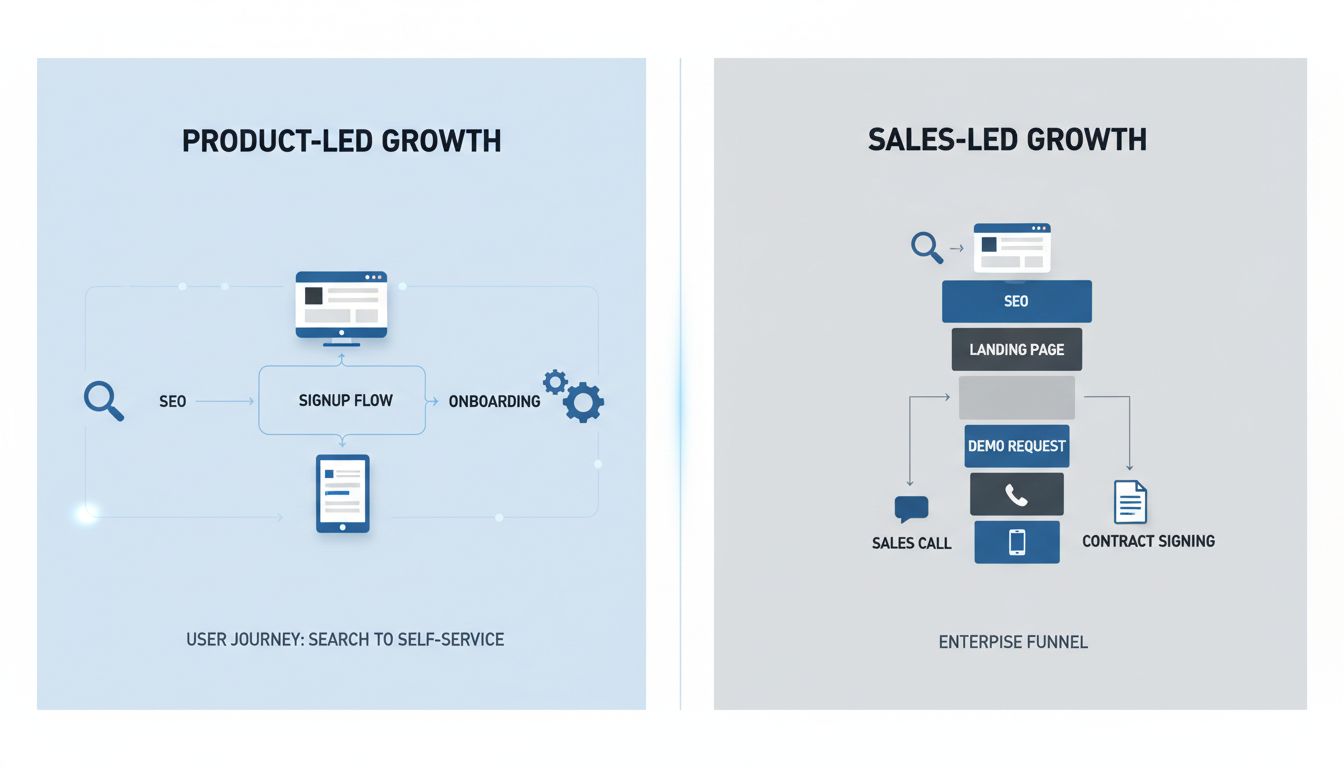
Your SEO priorities should look completely different depending on whether you run product-led growth or sales-led growth. Get this wrong, and you'll spend six months ranking for keywords that bring traffic but zero revenue.
Product-led growth companies (think Slack, Notion, Figma) need SEO that drives self-service signups. Your priority order should mirror how successful product-led SaaS companies structure localization: signup and onboarding pages first, then pricing and packaging, followed by in-product help content, core lifecycle emails, and only then long-form marketing content. Your keyword targets should obsess over "how to" queries, integration searches, and comparison terms that capture users ready to try a tool now.
Sales-led growth companies need a different playbook entirely.
You're not optimizing for immediate signups. You're building authority to generate qualified demos and sales conversations. Your content priorities shift toward use-case education, ROI calculators, buyer's guides, and industry-specific solution pages that speak to multiple stakeholders in a buying committee. Enterprise SaaS and complex B2B platforms live here.
The audience split matters just as much. Selling to developers or technical users? Your content needs code examples, API documentation that ranks, and integration guides with actual implementation details. Targeting business users or executives? Case studies, workflow templates, and strategic frameworks win.
Here's your filter for every SEO decision ahead: Does this move someone closer to your conversion event, whether that's a signup, a demo request, or an enterprise contact form?
If the answer isn't clear, the tactic doesn't belong in your first 90 days.
Everything that follows assumes you've made this alignment. Skip it, and you'll execute a perfect SEO strategy for someone else's business model.
Step 1: The Hybrid AI-Human SEO Audit & SaaS-Centric Goal Setting
Your first step isn't chasing rankings. It's figuring out where you actually stand and what "success" means for your specific business model.
Can ChatGPT do an SEO audit?
No. Anyone telling you otherwise is either selling something or hasn't run a real audit.
ChatGPT and other LLMs can't crawl your site. They can't analyze your backlink profile, measure Core Web Vitals, access Google Search Console data, or identify duplicate canonical tags. They operate in a vacuum, disconnected from your actual technical infrastructure.
What they can do is synthesize findings once you've collected the data. Think of an LLM as a brilliant intern who writes great summaries but needs you to hand them the spreadsheet first.
The hybrid audit workflow
Here's how to combine AI efficiency with technical accuracy:
-
Run technical crawls using Screaming Frog or a similar crawler. Export reports on indexability, canonicalization, broken links, and page speed.
-
Pull backlink and competitor data from Ahrefs or Semrush. Identify your Domain Rating, referring domains, and top-performing competitor pages.
-
Use an LLM to synthesize your findings with a structured prompt:
"I'm auditing a B2B SaaS website. Here are my Screaming Frog crawl results [paste summary], backlink profile [paste key metrics], and Search Console data [paste top issues]. Identify the top 5 technical blockers preventing indexing or ranking, prioritize them by estimated impact on organic signups, and suggest a fix sequence for a 2-person team with limited dev resources."
- Verify every recommendation manually. LLMs hallucinate constantly. They'll confidently tell you to fix a canonical issue that doesn't exist or recommend tactics that stopped working in 2015.
Set goals that actually matter
Traffic is a vanity metric if it doesn't convert.
Your SEO goals should map directly to revenue, not arbitrary traffic targets that make your dashboard look pretty but don't pay salaries:
- MRR from organic – How much monthly recurring revenue comes from users who found you via search?
- Organic Cost Per Lead (CPL) – Organic CPL averages $147 versus $280 for paid search, making it nearly 2x more efficient at scale.
- Activation rate by channel – Do organic signups activate at the same rate as paid? If not, you're targeting the wrong keywords.
- Customer Lifetime Value (CLTV) by source – Organic users often have higher CLTV because they're solving a problem, not responding to an ad.
Track these in a dashboard that connects Google Analytics 4, your CRM, and your billing system. If you can't measure SEO's impact on MRR, you're guessing. And guessing doesn't survive budget review season.
Step 2: AI-Powered Keyword & Entity Research for SaaS Intent
Most SaaS teams waste weeks chasing keywords with impressive search volumes that convert at near zero. A term like "project management software" might show 50,000 monthly searches, but if you're a Series A startup competing against Monday.com and Asana, you'll burn budget without seeing a single trial signup.
The smarter play? Prioritize trial, demo, and integration intent over raw volume.
A keyword with 200 searches per month that includes "vs Salesforce" or "API documentation" signals someone actively evaluating solutions. That's exactly the user you want, not tire-kickers Googling generic category terms.
Start with SERP-based clustering, not volume lists. Tools like Semrush and Ahrefs let you group keywords by SERP similarity. If Google shows the same top 10 results for five different queries, they're the same topic. One well-optimized page can capture all five. This is how you build topical authority without drowning in content debt.
Here's where AI accelerates the workflow: feed your competitor's top-ranking pages into ChatGPT or Claude with a prompt like, "Extract all product use cases, integration mentions, and comparison queries from this content." You'll uncover intent clusters your competitors are targeting that traditional tools miss. Works surprisingly well for finding the edge cases that drive qualified signups.
Steal signal from paid search. If competitors are bidding on "project management for remote teams Slack integration," that's validation of commercial intent. Use Semrush's Advertising Research tool to pull their PPC keywords, then prioritize the ones with sustained spend. Those are the terms that convert. Nobody burns money on keywords that don't drive pipeline.
Now layer in entity-based research.
Instead of just keywords, think concepts and relationships: "project management" as an entity connects to "Gantt charts," "sprint planning," "Jira alternative," and "resource allocation." Map these relationships visually by drawing your core product entity in the center, then branch out to related concepts, integrations, and use cases.
Example: If you're a SaaS tool integrating with Salesforce, cluster keywords around "SaaS + Salesforce integration," "Salesforce automation," "Salesforce data sync," and "Salesforce workflow builder." Each cluster becomes a content hub that reinforces your authority on that entity relationship. Google notices when you own a topic, not just isolated keywords.
Entity optimization isn't just for traditional search. It directly feeds AI search engines and knowledge panels. When ChatGPT or Perplexity answer "What tools integrate with Salesforce for marketing automation?" they're pulling from structured entity relationships, not just keyword density. Build your content architecture around entities, and you're positioning for both Google and AI visibility in 2026.
The intent hierarchy for SaaS keyword research:
- Bottom-funnel: "[Your category] vs [competitor]," "pricing," "demo," "trial"
- Mid-funnel: "[Use case] software," "[integration] tools," "how to [job-to-be-done]"
- Top-funnel: "[Problem] solution," "what is [concept]," industry guides
Prioritize bottom-up. Capture the users ready to buy, then expand into education once you have conversion data proving your positioning works. Too many teams build massive top-of-funnel content libraries that generate traffic but zero revenue because they haven't validated product-market fit at the bottom of the funnel first.
Step 3: A Content Machine Built for AI and Human Audiences
You've mapped your keywords. Now comes the hard part: turning that research into a content engine that actually scales without burning out your team or flooding your site with AI slop.
The data is clear. Publishing 9+ blog posts per month increases organic traffic by 35.8% year-over-year for SaaS sites, and long-form content (2,000+ words) generates 56% more leads than shorter posts. But volume without strategy is just noise. You need a content mix that serves both human buyers and AI systems parsing your site for citations.
Your SaaS content architecture should include three layers:
Blog content (TOFU/education): Problem-focused articles that address pain points before users know your product exists. Think "How to reduce sprint planning time" not "Why our tool is great." These capture early-stage search intent and feed your retargeting funnel.
Documentation, changelogs, and help content (product-led growth): If you're PLG, this isn't optional. Users searching "[your product] + integration" or "[feature] + tutorial" are already in-product or evaluating. Index these pages. Update them with every significant release.
Landing pages (commercial intent): Use cases, integrations, comparisons, and pricing. Bottom-funnel keywords like "project management tool for remote teams" or "Asana alternative" live here. Each page should map to a specific buyer job-to-be-done.
The hub-and-spoke internal linking model ties this together. Your hub page targets a broad, high-value keyword (say, "agile project management"). It links out to 8-12 spoke pages covering subtopics: sprint planning, backlog grooming, velocity tracking, retrospectives. Each spoke links back to the hub and cross-links to related spokes where it makes sense.
This structure reduces crawl depth, clarifies topical authority for Google, and increases session duration. Descriptive anchor text matters: "sprint planning best practices" beats "click here."
Here's where most teams fail: they publish once and move on.
AI search has made content decay faster. AI Overviews prioritize freshness and structured answers. If your comparison page still lists 2023 pricing or your "Top 10 Tools" post hasn't been touched in 18 months, you're invisible.
Format content for AI extraction. Use clear H2 questions ("What is agile project management?"), concise definitions (40-60 words), and bulleted or numbered lists. FAQ schema helps, but structure matters more than markup.
Your SaaS Content Governance Calendar
Maintenance isn't glamorous, but it's your competitive moat. Use this quarterly cadence based on page type:
| Page Type | Update Frequency | Trigger | Time Investment |
|---|---|---|---|
| Competitive comparisons | Monthly | Competitor product changes, pricing shifts | 30-45 min/page |
| Pricing pages | Immediate | Any pricing or packaging change | 15-20 min |
| Statistics & data posts | Quarterly | New data releases, annual reports | 1-2 hours/page |
| Product documentation | Per release | Significant feature updates or UI changes | 20-40 min/doc |
| Evergreen blog content | Quarterly | Seasonal relevance, SERP position drop | 45-60 min/post |
For a lean team publishing 10 posts/month, budget 6-8 hours monthly just for updates. Assign one owner. Track last-updated dates in your CMS. Set calendar reminders tied to product release cycles.
This isn't busywork. A single outdated comparison page can cost you dozens of trials per month. Fresh content signals relevance to both Google's algorithm and AI citation models scanning for current information.
Step 4: Technical SEO Foundations for AI-First Indexing

Great content won't save you if search engines can't find it. Your technical foundation determines whether your carefully researched pages get indexed or ignored.
Start with Core Web Vitals. These three metrics (Largest Contentful Paint, First Input Delay, Cumulative Layout Shift) directly impact both rankings and user experience. Only 40% of websites meet all thresholds, which means fixing yours creates immediate competitive advantage.
Run your key pages through PageSpeed Insights. Focus on the biggest offenders first: compress images, eliminate render-blocking JavaScript, and minimize third-party scripts. If your product pages load slowly, you're losing trials before prospects even see your demo CTA.
JavaScript rendering is where most SaaS sites fail. Single-page applications built in React, Vue, or Angular often serve blank HTML to search crawlers. Google can render JavaScript, but it's slower and less reliable than server-side rendering.
Test every critical page using Google Search Console's URL Inspection tool. Compare the rendered HTML to what you see in your browser. If key content or navigation is missing, implement dynamic rendering or switch to server-side rendering for your marketing pages.
Optimize your crawl budget ruthlessly. Google allocates limited resources to crawl your site. Don't waste it on login pages, user dashboards, or infinite filter combinations.
Block low-value pages in robots.txt. Fix crawl traps like pagination loops or session IDs in URLs. Prioritize your most important pages in your XML sitemap. Product pages, high-intent landing pages, and pillar content should be crawled weekly.
Schema markup is your direct line to AI systems. Structured data tells search engines and LLMs exactly what your content means. Implement FAQPage schema for your knowledge base, Product schema for feature pages, and SoftwareApplication schema for your main product pages.
Use JSON-LD format (Google's preferred method) and validate everything with Google's Rich Results Test. One warning: AI tools love suggesting schema implementations, but they frequently hallucinate required fields or mix incompatible types. Always verify against Google's official documentation before deploying.
For international SaaS products, implement hreflang tags to prevent duplicate content issues across localized versions. And if you're using AI to generate variations of landing pages, canonical tags are non-negotiable to consolidate ranking signals.
Your technical SEO checklist:
- Core Web Vitals passing on all priority pages
- JavaScript rendering verified in Search Console
- Robots.txt blocking low-value URLs
- Schema markup on product, FAQ, and content pages
- Hreflang tags for localized content
- Canonical tags on programmatic pages
Step 5: The 80/20 Rule for Sustainable SaaS Link Building
Most SaaS founders treat link building like cold outreach. Spray and pray. Beg for backlinks. It's backwards and exhausting.
Here's what actually works: websites with blogs attract 97% more backlinks because they create content worth citing. But even within content, there's a hierarchy that matters. Generic how-to posts won't move the needle. You need assets so useful that other sites reference them without you asking.
The 80/20 rule flips the standard approach: spend 80% of your effort creating inherently linkable assets (resource hubs, integration guides, original data) and only 20% on targeted outreach. Most teams do the opposite and wonder why they're stuck.
What Makes a SaaS Asset Linkable?
Run every potential asset through this filter before building it:
- Solves a specific integration or workflow problem (e.g., "How to sync [Your SaaS] with HubSpot")
- Aggregates scattered information into one authoritative hub (comparison tables, glossaries, tool directories)
- Publishes original research or data that journalists and bloggers need to cite
- Provides a free tool or calculator that delivers instant value
If your asset doesn't check at least two boxes, it's not worth the investment.
Case Study: How Figma and Atlassian Built Backlink Machines
Figma didn't beg for links. They created Color Pages (a visual tool exploring color in design) and an Agile Hub packed with frameworks and templates. Thousands of organic backlinks followed from design blogs, universities, and industry publications.
Atlassian took a similar approach with resource hubs focused on project management and collaboration workflows. By consolidating best practices, templates, and integration guides, they doubled their website traffic while competitors were still doing manual outreach.
Both companies understood something critical: backlinks are a byproduct of utility, not persuasion.
Your First Linkable Asset: The Integration Page Template
Start simple. Pick your most-requested integration (Salesforce, Slack, whatever your customers actually use) and build a dedicated page:
- Overview section: What the integration does and who it's for
- Step-by-step setup guide with screenshots
- Common use cases with real examples
- FAQ section addressing setup friction
- Schema markup (HowTo and FAQPage) for AI visibility
Promote it once to relevant communities, then let it work. Integration pages rank for long-tail queries and naturally accumulate links as people reference your setup guide.
The 20% outreach? Save it for promoting your best original research or reaching out when someone mentions your category without linking to anyone. Everything else should be asset-first.
Step 6: Measure What Matters: Mapping SEO to MRR
You've built content, fixed technical issues, and earned links. Now you need to prove it's working. Not with vanity metrics, but with numbers your CFO cares about.
Most SaaS teams track rankings and traffic, then wonder why leadership questions the SEO budget. The problem? You're measuring activity, not outcome. Your job is to connect organic visitors to Monthly Recurring Revenue.
The Organic Revenue Funnel
Map your user journey in four stages: Organic Visitor → Free Signup → Activated User → Paying Customer. Each stage needs a conversion rate and a drop-off diagnostic.
Start with visit-to-signup rate. If 1,000 organic visitors generate 50 signups, you're at 5%. That's right at the B2B SaaS average for organic conversion. Below 3%? Your landing pages or CTAs need work. Above 7%? You're targeting high-intent keywords effectively.
Next, track activation rate for organic users specifically. Segment by source in your analytics. Organic users often activate slower than paid users because they're earlier in their research. If your overall activation is 40% but organic sits at 25%, you're attracting top-of-funnel traffic that needs more nurturing.
Finally, attribute MRR. Tag organic signups in your CRM and measure how many convert to paid within 30, 60, and 90 days. Even a simple UTM parameter (utm_source=organic) lets you filter revenue reports by channel.
The Dashboard You Actually Need
Skip the 47-metric monstrosity.
Set up five reports in Google Analytics:
- Organic traffic by landing page (identify your revenue drivers)
- Visit-to-signup conversion rate (overall and by page)
- Organic Cost Per Lead (total SEO spend ÷ organic signups)
- MQL-to-SQL rate for organic leads (benchmark: 13% average)
- Time-to-paid for organic signups (cohort by month)
Compare your Organic CPL against Paid CPL every quarter. If paid search costs you $280 per lead and organic runs $147, you've got a 48% cost advantage. That gap widens as your content library compounds.
Attribution will never be perfect. Dark social, multi-touch journeys, and long sales cycles muddy the water. But directional accuracy beats precision paralysis. Tag your links, segment your data, and review monthly.
The 2026 AI SEO Toolkit: Prompts, Workflows & Pitfalls
You've built the strategy. Now you need the tools and workflows to execute it without burning out your team or tanking your content quality.
The promise of AI is speed and scale. The reality? AI-assisted content increased organic clicks by 12% over 6 months when paired with human editors, but unedited AI content saw a 35% decline in conversions. The difference isn't the tool. It's the workflow.
Here's your tactical toolkit: the AI tools worth your budget, the exact prompts that work, and the mistakes that will quietly destroy your SEO performance.
Your 2026 AI SEO Tool Stack
| Tool | Primary Use Case | Human Oversight Needed |
|---|---|---|
| Semrush | Keyword research, competitor analysis, AI content templates | High (verify intent clusters, validate competitive gaps) |
| SurferSEO | On-page optimization, content scoring, NLP analysis | Medium (adjust recommendations for brand voice, verify keyword density isn't stuffing) |
| MarketMuse | Content gap analysis, topic authority mapping | High (interpret data for strategic priorities, validate topic relevance) |
| Screaming Frog | Technical audits, crawl analysis, schema validation | Low (automates discovery, but requires human decision on fixes) |
| ChatGPT / Claude | Brief generation, outline expansion, meta descriptions | Critical (never publish unedited; validate all facts and claims) |
| Ahrefs | Backlink analysis, competitor content research, brand monitoring | Medium (use for discovery; human judgment for outreach strategy) |
Budget reality check: You don't need all of these. Start with Semrush or Ahrefs for research, Screaming Frog for technical, and ChatGPT for drafting. Add specialized tools as your team scales.
Copy-Paste AI Prompt Templates for SaaS SEO
Stop wasting time with vague prompts. These templates follow the Action + Target + Modifier + Format structure that actually produces usable output.
Prompt 1: Keyword Clustering & Intent Analysis
Analyze these 50 keywords [paste list] and cluster them into semantic groups based on search intent. For each cluster, identify: (1) primary intent (informational/commercial/transactional), (2) recommended content format (blog post/landing page/comparison), (3) estimated funnel stage (awareness/consideration/decision). Output as a table with columns: Cluster Name, Keywords, Intent, Format, Funnel Stage.
Prompt 2: Generating a Comprehensive Content Brief
Create a detailed content brief for a blog post targeting the keyword "[your keyword]" for a B2B SaaS product that [describe product in 10 words]. Include: (1) target audience pain points, (2) 5 H2 section headings, (3) 3 competitor content gaps we should fill, (4) 5 related long-tail keywords to incorporate naturally, (5) suggested internal links to [product page/pricing/related posts]. Format as a structured document.
Prompt 3: Drafting Meta Descriptions at Scale
Write 3 variations of meta descriptions (150-155 characters each) for a page about "[topic]" targeting SaaS founders. Each should: (1) include the keyword "[keyword]" naturally, (2) highlight a specific benefit or outcome, (3) include a subtle call-to-action. Avoid generic phrases like "learn more" or "discover how."
Test these prompts, then customize them with your product details, audience specifics, and brand voice guidelines. Save your best-performing versions as templates.
5 Common AI-Powered SEO Mistakes to Avoid in 2026
1. Over-reliance Without Fact-Checking
AI hallucinates statistics, invents case studies, and confidently states outdated information. Every claim needs human verification. One fabricated stat can torpedo your credibility.
2. Publishing Unedited AI Content
Generic, surface-level content won't convert. That 35% conversion drop from unedited AI content isn't a fluke. It's what happens when readers sense they're reading a machine. Edit for specificity, inject examples, add your unique take.
3. Vague Prompting
"Write a blog post about SEO" produces garbage. Specific prompts with context, constraints, and desired format produce usable drafts. Invest time in your prompt library.
4. Ignoring Technical Foundations
AI can't fix broken canonicals, missing hreflang tags, or crawl traps. If your technical SEO is broken, no amount of AI-generated content will rank. Fix the foundation first.
5. Skipping Content Maintenance
AI makes it easy to publish, but that doesn't mean you should abandon pages after launch. Pricing pages need monthly reviews, comparison posts need competitor updates, and statistics need refreshing as new data arrives.
The hybrid workflow wins: AI for speed and scale, humans for strategy and quality control. Use the tools to amplify your team, not replace judgment.
Your 90-Day AI-Powered SEO Sprint Plan
You don't need a year to see results. A focused 90-day sprint will get you measurable traffic and signups faster than a sprawling six-month roadmap you'll abandon by week eight.
Here's exactly how to start SEO for your website, broken into monthly sprints with specific deliverables. Beginners can execute this, especially with AI handling the grunt work and this plan keeping you honest.
Month 1: Audit & Foundation (Weeks 1–4)
Week 1: Technical audit & goal setting
- Run Screaming Frog crawl and Google Search Console audit
- Document indexing issues, broken canonicals, and Core Web Vitals failures
- Set one revenue goal (e.g., "50 organic trial signups by Day 90")
- Allocate your budget: If you're working with the $7,000–$15,000/month range most growth-stage SaaS companies spend, earmark $4,000–$7,000 for content, $2,000–$4,000 for links, and $500–$2,000 for technical fixes
Week 2: Keyword & entity research
- Use the AI entity mapping prompt from Section 8 to build your semantic keyword clusters
- Identify 3–5 pillar topics that map to product use cases
- Extract 20–30 supporting long-tail keywords with trial/demo intent
Week 3: Content calendar build
Map keywords to a 12-week publishing calendar. Two posts per week minimum. Draft outlines for your first 4 pillar posts using the hybrid AI workflow, then set up schema templates (FAQ, HowTo, Organization) for each content type.
Week 4: Technical fixes sprint
- Fix critical crawl errors and implement mobile responsiveness patches
- Add structured data to 5 highest-traffic pages
- Set up AI Overview tracking in Search Console
Month 2: Production & Optimization (Weeks 5–8)
Week 5–6: Content production ramp
Publish 2 pillar posts per week (AI first draft, human edit, publish). Implement internal linking from new posts to product pages. Add FAQ schema to every post. The rhythm matters more than perfection here.
Week 7: On-page optimization
- Audit your top 10 existing pages for entity gaps
- Update metadata and add missing schema
- Compress images and improve page speed on conversion-critical pages
Week 8: Measurement setup
Build your MRR attribution dashboard (Section 6 framework). Tag all organic traffic with UTM parameters for trial signup tracking. Document baseline metrics: traffic, rankings, AI Overview impressions. You can't improve what you don't measure.
Month 3: Link Building & Iteration (Weeks 9–12)
Week 9–10: Strategic link acquisition
- Claim 10 partner/integration directory listings
- Identify 5 unlinked brand mentions and request links
- Publish one original data study or free tool to attract natural backlinks
Week 11: Content refresh
Update your 3 highest-traffic posts with new data and internal links. Expand FAQ sections based on Search Console query data. Re-submit updated pages for indexing. Fresh content signals matter, especially for competitive keywords.
Week 12: Sprint retrospective
- Measure against your Day 1 goal
- Identify your top 3 traffic drivers and double down
- Plan your next 90-day sprint based on what actually moved signups
The sprint mindset keeps you focused. Twelve weeks of disciplined execution beats twelve months of scattered effort every time. Most teams overestimate what they can do in a month and underestimate what relentless weekly progress compounds into by day 90.
Conclusion

SEO in 2026 isn't about choosing between AI and humans. It's about using both intelligently.
Let AI handle the grunt work: data analysis, content first drafts, technical audits that would take your two-person team weeks to complete manually. You bring the strategy, the brand voice, and the quality control that keeps your content from sounding like every other AI-generated piece flooding the SERPs.
The hybrid workflow we've covered gives you an actual playbook. AI-powered audits, entity optimization, sprint-based execution. It's designed to build a sustainable organic channel that captures both traditional search and AI Overview visibility while your competitors are still arguing about whether ChatGPT killed SEO.
Forget vanity metrics. Track what actually grows your SaaS: organic signups, MQL quality, activation rates, MRR contribution from organic [Source: sureoak.com]. The 90-day sprint removes the guesswork and gives you a clear sequence to follow.
Pick one step from the sprint this week. Maybe start with the hybrid audit. Use the prompts we covered. Test the workflows. Momentum beats perfection, and your organic channel won't build itself while you wait for the perfect moment to start.
Frequently Asked Questions
How do I start SEO for my website?
Start with the Hybrid AI-Human SEO Audit outlined in Step 1. You need a baseline first. Identify technical issues, audit your current keyword visibility, set goals tied to actual business metrics like trial signups or MRR. Not just "more traffic."
From there, the 90-Day Sprint Plan gives you a clear sequence: build your foundation, spin up your content engine, get measurement in place. Follow it in order.
Can ChatGPT do an SEO audit?
No. ChatGPT can't crawl your website or access live web data on its own.
What it can do is analyze and summarize findings from other tools if you feed it the right data. Export your Screaming Frog crawl or Search Console reports, give it proper prompts, and it'll interpret the results. Think of it as a powerful assistant that makes sense of audit data, not the auditor itself.
Can I do SEO by myself?
Yes, especially with the hybrid workflow this guide provides.
AI tools act as a force multiplier for lean teams. They handle research, initial drafts, and data analysis while you focus your limited bandwidth on strategy, editing, and high-level decisions. The trick is knowing where to apply your human effort for maximum impact. That's what this guide maps out.
What is the 80/20 rule for SEO?
For SaaS link building, 80% of your backlink results should come from creating remarkable, link-worthy assets. Resource hubs, original research, integration guides, free tools that naturally attract links [Source: olivermunro.com]. Only 20% of your effort should go to active outreach.
Stop chasing links. Start building assets worth linking to.
Can a beginner do SEO?
Absolutely. This guide is designed for marketing leaders who understand SEO's importance but lack specialist expertise.
By following the how to do seo for website step-by-step process and using AI to handle complex analysis (keyword clustering, entity research, content optimization), a motivated beginner can execute a professional-grade strategy. The 90-Day Sprint Plan gives you the structure to move from zero to measurable results without needing years of experience.
What are common SEO mistakes to avoid?
The biggest mistake in 2026 is publishing unedited AI content. Case studies show it can reduce conversions by 35% [Source: rankscience.com]. Readers can tell. And it kills trust fast.
Other critical errors: over-relying on automation without human oversight, poor prompt engineering that generates generic output, and neglecting technical fundamentals like Core Web Vitals. Only 40% of sites pass all thresholds [Source: upwardengine.com], which means most teams are leaving easy wins on the table.
Look, AI is a tool. Not a replacement for strategic thinking. Use it to move faster, not to avoid doing the actual work.