May 27th, 2026
Best AI Text Generator Tools for SEO Content: Top Picks for Founders
 WD
WDWarren Day
You're not looking for a writing tool. You're looking for a system.
As a founder, the difference matters. A text generator that makes writing easier is nice. A best ai text generator that automates keyword research, SERP analysis, content creation, and publication in one place is actually useful.
The global AI SEO market is projected to hit $2.2 billion in 2025, and 68% of marketers are already using tools like this. But nearly half of SMEs say cost is the reason they haven't committed. So this isn't a roundup of the prettiest writing assistants.
It's about finding the one that turns SEO into a repeatable system, not a thing you do when you have time.
For time-poor founders in B2B SaaS, tech, or e-commerce, the tool that wins is the one that handles the whole workflow. We're evaluating on four criteria: end-to-end automation, SEO-first architecture, pricing that actually fits early-stage economics, and data privacy.
You'll get recommendations for bootstrapped, growth-stage, and enterprise founders. Plus the common pitfalls that kill AI SEO efforts before they get anywhere.
How We Chose: The Founder's Checklist for an AI Text Generator
I built Spectre because I needed this exact solution myself. Years of integrating with Ahrefs, DataForSEO, and CMS platforms will do that to you, you start noticing exactly where teams burn hours stitching tools together.
So that's what we tested for. Not which best ai text generator writes the prettiest paragraph, but which ones actually run the whole workflow.
Four criteria:
-
End-to-End Workflow Automation: Does it move from keyword research to published article without manual handoffs? Most tools stop at content generation and leave you handling SERP analysis, internal linking, and publishing on your own.
-
Native SEO-first architecture: Is SEO built into the core, or is it a bolt-on? Tools that treat SEO as a separate "mode" tend to miss things like topical authority and content clusters.
-
Founder-Friendly Economics: What's the actual ROI on time saved? About 68% of digital marketers are already using AI SEO tools, but nearly 46% of SMEs say cost is the reason they haven't committed [Source: businessresearchinsights.com]. We prioritized tools where the time savings are real and visible relative to the price.
-
Data Privacy & Control: Where does your content and strategy data actually live? For B2B founders, proprietary keyword research and unpublished content are competitive assets. They shouldn't be training public models.
You'll see these criteria reflected in the picks below, organized around four founder types: the Bootstrapped Solo Founder, the Scaling B2B Founder, the E-commerce Builder, and the Privacy-Conscious Tech Founder.
General AI tools like ChatGPT, Gemini, and Claude aren't on the main list. They're components, not systems. They can answer "what AI is better than ChatGPT?" but they won't help you build a predictable SEO channel.
The math on upgrading is pretty simple: if you're spending more than 4-5 hours a month on content orchestration, the tool pays for itself.
1. Spectre
The autonomous SEO content engine that researches, writes, and publishes fully-optimised articles for you.
Best for founders who want to set up a keyword pipeline and move to a hands-off, scalable content system.
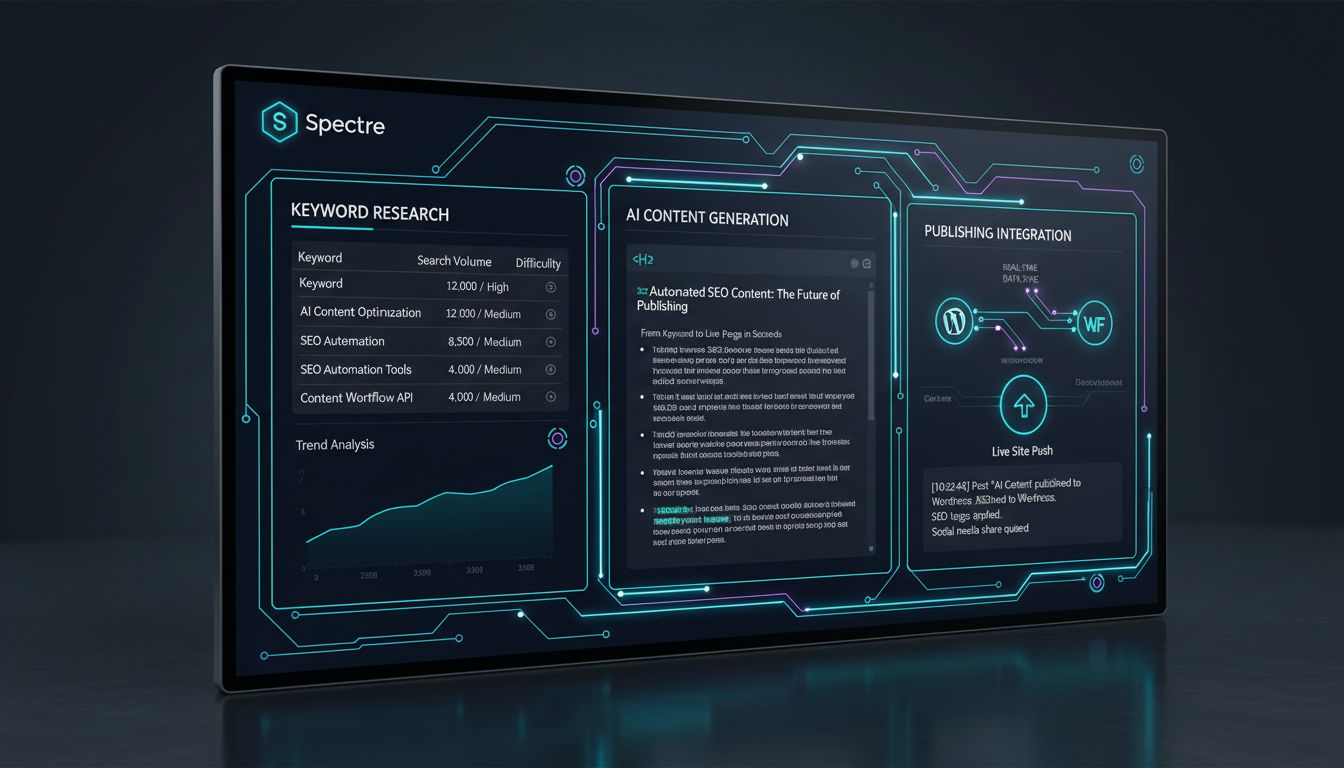
Most tools call themselves "AI writers." Spectre is something different: an AI-powered SEO content engine. That distinction matters more than it sounds.
It doesn't just generate text. It automates the entire workflow, keyword discovery, clustering via integrated DataForSEO data, drafting with proper H2/H3 structure and meta tags, then pushing directly to your CMS via API (WordPress, Webflow, others). That final publishing step that manually eats 10-15 minutes per article? Gone.
The native SEO architecture is what actually separates it from the best ai text generator alternatives that bolt optimisation on as an afterthought. Ranking factors are baked into the generation model from the start. And it filters keyword suggestions by realistic win probability based on your Domain Rating, which sounds minor until you've wasted three months targeting terms you had no shot at.
That last part comes from deep work with the Ahrefs and DataForSEO APIs. Not consuming dashboards. Building the systems underneath them.
The trade-off is real and intentional. Spectre is automation-first, edit-later. If you want a heavy interactive editor to tweak sentences for an hour before hitting publish, this isn't it.
The power is in the system. For time-poor founders, automating the publishing step is the thing most tools miss entirely, it turns content from a sporadic project into something that actually runs on its own.
When roughly 68% of marketers have already adopted AI SEO tools, the winner isn't whoever writes the prettiest paragraph. It's whoever removes themselves from the loop.
2. Frase
The deep-dive SEO research platform that gives you the strategic blueprint before you write.
Best for founders who want to reverse-engineer the top 20 results and control every detail of the content brief.
Frase automates the manual research that enterprise SEO teams spend hours on. You give it a keyword, and it doesn't just suggest topics, it scrapes and analyses the entire first page of Google.
It breaks down the questions people are asking, the exact headings your competitors use, their average word count, and even flags featured snippet opportunities. Then its integrated AI writer drafts against that brief.
For a founder who wants to be strategic, that's genuinely useful. It replaces days of manual SERP analysis with minutes. One documented case study showed it saved Opinion Stage more than 500 hours over 18 months on content creation.
You're not guessing what Google wants. You're building your article directly from the evidence.
The trade-off is in the workflow. Frase is a solid assistant, not an autonomous system. It's good at research and planning, generating a strong brief and a decent first draft, but it stops there.
Publishing, scheduling, scaling, all still manual. If you want to go from keyword to published post without touching it yourself, that's where Frase runs out of road.
For a founder who wants to be deep in the strategy and still comfortable being the best ai text generator editor in the room, it's a good fit. For a founder who needs the whole process automated, it's only half the answer.
3. Jasper
The collaborative AI copywriting platform for teams that need strict brand voice governance across every output.
Best for scaling startups with small marketing teams juggling blogs, ads, and emails who need one centralised voice.
Jasper is the market leader for a reason: it solves the chaos of multiple writers producing off-brand content. The core feature is Brand Voice and Knowledge assets, you feed it your style guide, product details, and messaging, and it enforces that tone across blog posts, ad copy, and email sequences.
For a team of 2-3 marketers managing multiple channels, that centralisation is genuinely useful. It also has an explicit 'SEO Mode' and integrates with Surfer SEO, so you get decent optimisation features without leaving the platform [Source: spendflo.com/blog/jasper-pricing-guide].
The trade-off is cost and focus. Pro plans start around $59-69 per month per seat, which means you're paying a premium for that team collaboration layer.
For a solo founder whose whole job is publishing SEO blog posts, those features become overhead. The SEO capabilities are present, but they feel bolted on rather than native to the tool. It's over-engineered if you just need to be the best ai text generator user in the room cranking out articles that rank.
Think of it this way: if your bottleneck is maintaining a consistent brand voice across a small team producing varied marketing copy, Jasper is a powerful solution. If your bottleneck is the operational workload of getting SEO-optimised articles from keyword to published post, you're paying for features you won't touch.
4. Hypotenuse AI
The enterprise-grade AI platform that prioritises data privacy and handles massive SKU counts for e-commerce.
Best for founders in regulated industries (healthtech, fintech) and e-commerce businesses needing bulk product copy generation.

What sets Hypotenuse AI apart is the enterprise-first approach. It's one of the few platforms that explicitly claims SOC 2 Type II compliance and a policy of not using your data to train public models.
In my work with B2B SaaS clients, that's not just a checkbox. When you're handling sensitive client data or operating in regulated verticals, it's a hard requirement. Their architecture includes encryption in transit and at rest with role-based access controls, the stuff enterprise procurement teams specifically audit for.
The platform is built for scale. Unlimited SKU support means you can generate thousands of product descriptions in batch operations. If your primary content need is populating a large e-commerce catalogue, this is a targeted solution. Pricing starts at $9/month for basic usage, scaling to $109/month for higher credit tiers that include plagiarism checks.
The trade-off is workflow design.
Hypotenuse excels at batch generation of repetitive product copy. It doesn't orchestrate an ongoing, automated blog strategy. Its strengths are compliance and bulk operations, not the end-to-end SEO content workflow that most founders trying to build organic traffic actually need.
If you're comparing it as the best ai text generator for SEO content, it's probably not your answer. But if you're running an e-commerce operation and need to fill a 10,000-product catalogue, it's a different conversation.
5. Writesonic
The budget-friendly volume generator that helps you test content ideas without breaking the bank.
Best for bootstrapped founders who need to validate content strategies quickly on a minimal budget.
Is Writesonic actually worth it? Depends entirely on where you are.
The main draw is pricing. High word allowances, low monthly cost, and a relatively low-risk way to start experimenting with AI-powered content creation. There's an SEO AI Agent built in that handles basic keyword optimisation and structure analysis, decent enough if you're just getting started with automated SEO workflows.
There's even a case study claiming a 25% AI visibility boost for IGLeads within 30 days, which suggests it can move the needle fast when you're in proof-of-concept mode.
So if you're testing whether AI content works for your startup at all, Writesonic is fine. You can run multiple content angles without committing real resources upfront. That's the point.
The problem shows up at scale.
Output needs a lot of editing to get to the depth and uniqueness search engines actually reward now. The SEO features feel bolted on rather than part of any real workflow. You end up spending more time stitching together research, generation, and optimisation than you would with a purpose-built best ai text generator for SEO content.
Once you've validated that content drives growth, you'll hit the ceiling pretty fast. At that point, the manual lift stops being worth it.
A Note on Self-Hosted & General AI (ChatGPT, Gemini, Claude)
The most popular tools in the world, but not the right system for SEO content production.
If you're asking "what's better, ChatGPT or Gemini?" for SEO, you're asking the wrong question.
ChatGPT is everyone's first stop. And it's genuinely useful for brainstorming and editing, I use it for both. But it's raw material, not a finished product. No keyword integration, inconsistent structure, zero publishing automation. It's not a system. It's a starting point.
Self-hosted options like Ollama with Llama models are interesting if you care about data privacy. Complete control, no external API calls. That matters for sensitive client work.
But it's not turnkey. You're signing up for setup, maintenance, and constant prompt engineering just to get consistent output. That's an infrastructure project, not a tool you pick up and use.

The real cost isn't the engineering hours. It's what you're not building while you're maintaining raw components that still don't automatically research keywords, structure content against SERP analysis, or publish to your CMS.
A purpose-built best ai text generator for SEO already does all of that. You're paying for a complete workflow, not a pile of parts you have to assemble yourself and keep fixing.
For most founders, that math isn't close.
Common AI SEO Mistakes Founders Should Avoid
Treating AI as a set-and-forget content factory. The most common mistake I've seen founders make, and one I've made myself, is assuming the tool handles strategy. It doesn't. You get generic content that sounds like everyone else's. Your unique insight, proprietary data, and founder perspective are what make content rank. The AI writes; you direct.
Keyword stuffing in the name of "optimisation." Modern search engines, especially with AI Overviews now appearing on 13.14% of all queries, prioritize helpful, natural language. Forcing keywords kills readability and triggers penalties. A good tool integrates them semantically. A bad one, or a bad prompt, just creates unreadable garbage.
Skipping plagiarism and originality checks. This isn't just an SEO risk. It's a reputational and legal one. AI models train on publicly available text and can reproduce it verbatim. You're legally liable for what you publish. Always run a final check.
Ignoring EEAT (Experience, Expertise, Authoritativeness, Trustworthiness). AI content almost always lacks the first E: Experience. It can explain a concept, but it can't share a real case study from your company or a painful lesson you learned. Founders have to inject that themselves. Without it, your content has no competitive moat.
Neglecting the technical SEO basics. No best ai text generator will fix your slow site speed, broken mobile experience, or poor indexation. These tools create the asset. You're responsible for the infrastructure it lives on. I've seen well-written articles fail completely because the site couldn't be crawled.
Forgetting about internal linking architecture. Internal links distribute crawl budget and topical authority across your site. Some platforms (like Spectre) suggest relevant internal links during writing. Most leave it entirely to you, which creates a major hidden gap in your content's effectiveness that most founders don't catch until it's too late.
Conclusion
Which tool is actually worth it for a founder?
It depends on what you're trying to avoid. If it's the full grind of research, writing, and publishing, Spectre handles all of it. If you want more hands-on control over strategy, Frase gives you that depth. Jasper is the call when you have a team and brand guidelines that can't slip. Hypotenuse AI is built for when privacy is non-negotiable. Writesonic works if you're still figuring out what you need.
But for most founders, the math isn't complicated. Your time is the most expensive thing in the business.
A tool like Spectre turns content from something you manage into something that runs. That's the difference between a workflow and an asset.
The best ai text generator isn't the one with the most features. It's the one that gets you out of the loop.
See how Spectre can automate your SEO content from start to finish.
Frequently Asked Questions
Which is the best AI text generator for a solo founder?
Depends on what you want automated. If you need the full workflow handled, keyword research through to publication, Spectre is the answer. If you want deep SEO research on a tighter budget, Frase Starter does that well. Writesonic is the lowest cost entry point if you're still figuring things out.
But honestly, the tool matters less than this question: how much manual work is left after the text gets generated?
Is it illegal to use AI to write content?
No. But transparency isn't optional if your platform or client agreement requires disclosure.
The actual risk isn't the AI part. It's publishing content that's unverified, plagiarised, or factually wrong. Human oversight before you hit publish isn't a nice-to-have.
How can you tell if someone used ChatGPT?
Generic phrasing. No specific examples. No recent events. An oddly formal, verbose tone that doesn't quite sound like a person.
AI detectors exist, but they're not reliable enough to be definitive. The real tell is just... specificity. Good content, AI-assisted or not, has it. Bad content doesn't.
What chatbot does Elon Musk use?
He co-founded xAI and uses Grok. But that's kind of beside the point for founders focused on SEO growth.
General-purpose chatbots are the wrong category. You need tools built for keyword research, content structuring, and publishing workflows. Conversational text generation is a different thing entirely.