July 9th, 2026
How to Master SEO Content Writing: A Step-by-Step Guide for Founders
 WD
WDWarren Day
You've built something real. The product works, customers are happy. But every SEO guide you find online reads like it was written for a company with a full content team and a six-figure marketing budget.
Most advice on SEO content writing comes from agencies serving clients with established domain authority. That's just not your situation.
Generic guides say: chase high-volume keywords, publish constantly. They skip over the part where you're starting with a low Domain Rating, a product that still needs your attention, and zero time to produce "endless content."
This guide is the system I built for my own software products. A founder-specific framework for seo content writing that compounds over time instead of burning you out. We're skipping the fluff and going straight to the 80/20 moves that actually matter when you're constrained.
Here's what we'll cover: how to assess your real starting point, research intent over volume, reverse-engineer competitor wins, and structure content for both searchers and bots. Plus efficient AI-assisted drafting, editing for real E-E-A-T signals, and promotion tactics that work for startups.
We'll also deal with the 2026 reality: AI Overviews are cutting clicks by 58% [Source: outerboxdesign.com]. Whether you're doing this yourself or working with a seo content writing services provider or a content writing company, the playbook has to account for that.
The goal is a content engine that grows with your business, not one that requires you to feed it constantly.
Assess Your Current SEO Fitness
Start here before you write a single word of new content.
The product works, customers love it. But before you touch anything, you need an honest look at where you actually stand. Not guesswork. A real audit.
Organic search drives 53% of all website traffic, and the median ROI for SEO over three years is 748%. Capturing any of that starts with knowing your baseline.
Map Your Current Rankings and Gaps
Open Ahrefs or Semrush. Run a site audit on your domain and export every keyword you're currently ranking for, even the ones buried on page 10. That list is your reality check.
Create a spreadsheet with four columns: Target Keyword, Current Ranking, Search Volume, and Intent. Compare it against the keywords you should be ranking for based on your product and what your customers actually search for.
The gap between those two lists is your immediate content opportunity. Use Ahrefs' "Content Gap" tool here, input your domain and two or three top competitors to see which keywords they rank for that you don't. That's where to start.
Common mistake: Founders chase high-volume, broad keywords their new site can't possibly rank for. Start with specific, lower-competition terms that signal clear commercial or informational intent.
Diagnose Technical Barriers to Crawling
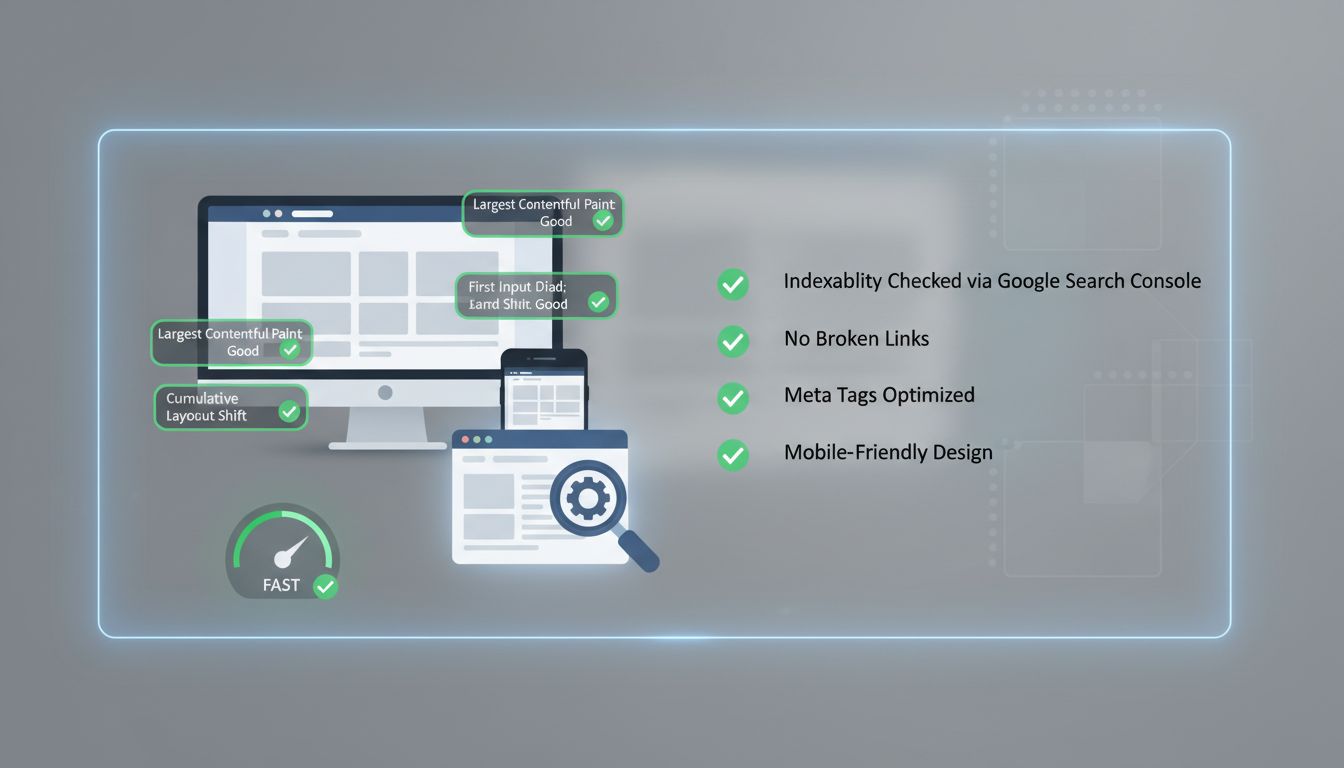
SEO content can't rank if Google can't find it. And users won't stick around if it loads slowly.
- Check Indexability: Open Google Search Console. Go to the "Pages" report under "Indexing" and look for anything marked "Excluded" or "Crawled - currently not indexed." These are pages Google knows about but won't show in results. Usually it's a
noindextag or something blocked inrobots.txt. - Audit Core Web Vitals: Run your homepage and key landing pages through PageSpeed Insights. You want a "Good" score for Largest Contentful Paint (LCP), First Input Delay (FID), and Cumulative Layout Shift (CLS). Slow pages hurt both rankings and conversions.
- Verify Site Structure: Use Screaming Frog SEO Spider (free up to 500 URLs). Crawl your site and flag broken links, missing meta titles or descriptions, and orphaned pages with no internal links. Google needs a clear path to follow.
Verification: When you're done, you should have a concrete list, 10 to 20 target keywords you're not ranking for, three to five critical technical issues to fix, and a real picture of your site's current health. That's your starting line.
Master Keyword and Intent Research
Intent is everything. Google's entire purpose is to satisfy a user's goal at that moment. Your content has to align with that goal, or it won't rank, no matter how many keywords you stuff in.
Think of it as the "3 C's of SEO": Content (what you write), Context (the user's situation), and Connection (matching their need). You need all three.
Start by classifying intent. Is the searcher looking to learn, compare options, or buy?
For a founder, high-intent commercial keywords are your gold. "Best [your product category]" or "[your tool] vs [competitor]" bring visitors ready to evaluate, not just browse. These often convert far better than a massive-volume informational term like "digital marketing tips," which a new site can't rank for anyway. (Source: Salesforce blog)
Run your ideas through Ahrefs Keyword Explorer or Semrush. Filter for keywords with a difficulty score that matches your domain rating (DR).
If your DR is 20, a keyword with a difficulty of 80 is a fantasy. Focus on terms you can realistically compete for.
Your biggest advantage as a founder is context. You hear the raw, unfiltered pain points daily. Turn support ticket themes, sales call transcripts, and product usage data into keyword ideas.
That specific problem your customer described on a call? That's a perfect long-tail keyword. "How to measure SaaS customer retention" is a better target than a vague, high-volume term.
Treating content as a "publish and pray" activity is the most common failure mode.
You have to start with intent. Every seo content writing decision you make, from what you pitch to a content writing company to how you brief seo content writing services, flows from this step.
Verification: You should have a list of 10-20 primary target keywords. For each, annotate:
- Search intent (Informational/Commercial/Transactional)
- Monthly search volume
- Keyword difficulty score
- A draft of the "searcher's question" your page will answer
This list is your strategic blueprint, not just a to-do list.
Dissect Competitors Who Are Winning
You know what people are searching for. Now you need to understand why certain pages already rank there.
This isn't about copying them. It's about reverse-engineering what's working so you can build something better.
Open your target keyword in an incognito browser. Look at the top 5-10 results. Don't just skim headlines, do a proper SERP analysis. For each page, ask:
- What's the core structure? (Listicle, guide, comparison, tutorial)
- How deep do they go? (Word count, number of sections, data density)
- What media do they use? (Images, videos, diagrams, interactive elements)
- What's their call-to-action? (Newsletter signup, product demo, lead magnet)
This is your blueprint. You're looking for the "ranking triggers", the specific elements that signal authority to Google.
Is it heavy data citation, like a study showing SEO marketing has an average ROI of 22:1 (2200%)? Is it unique expert quotes, step-by-step tutorials, feature comparisons?
Here's the mistake most people make: copying a competitor's outline without understanding why it works.
If the top results are all 3,000-word ultimate guides, a 500-word summary won't rank. They've already set the depth expectation.
Your verification step here is a one-page analysis for each primary keyword. Document the top competitors, their approximate word count, key sections, media types, and a summary of what they're doing strategically. Then write a bulleted list of what you'll adopt and, more importantly, how you'll go further.
Will you add founder-level insights they don't have? More current data? Better visuals?
Clone the formula. Then inject something they can't replicate. That applies whether you're writing the content yourself, working with a content writing company, or briefing seo content writing services, the competitive analysis has to come first. It's what makes seo content writing decisions actually defensible.
Structure Your Outline for Both Searchers and Bots
You've done the research. Now you need to turn it into something Google can actually parse, and something readers don't bounce out of after ten seconds.
Start with your H1 as the single core question your page has to answer. From your SERP analysis, pull out 3-5 supporting intents that keep showing up across competitor pages. Each one becomes a descriptive H2. This matters because Google's passage indexing can rank individual sections of your page for different queries, your headings aren't just navigation, they're ranking surface area.
Write headings that say something. Not "Benefits of SEO", try "How SEO Content Drives Qualified SaaS Pipeline." Not "Tools", try "The Content Research Tools That Actually Save Founder Time." If a heading could stand alone as a search result, you're doing it right.
Sequence the sections like a thought process, not a table of contents. Follow the user's journey: problem recognition, why it's actually hurting them, what their options are, how to execute. That's the Problem-Agitate-Solution framework, and it mirrors how your reader is already thinking before they land on your page.
Look at where People Also Ask boxes appear in your target SERPs. Those are free H3 prompts. Answer them directly and concisely. If there's a definition or comparison that could pull a featured snippet, structure it with a clear heading and tight bullet points, don't bury it.
This applies whether you're writing solo, working with a content writing company, or outsourcing to seo content writing services. The outline logic doesn't change. Good seo content writing starts here, before a single sentence gets written.
Verification: Read just your headings top to bottom. You should understand the complete argument. If you can't follow the logic from H1 through every H2 and H3, your outline isn't done yet.
Draft Efficiently with AI (And Avoid Its Pitfalls)

AI is now a real part of the SEO content writing process. By November 2024, 86.5% of top-ranking pages contained some AI-generated content. The question isn't whether to use it, it's how.
Can ChatGPT write SEO content? Yes. Well enough to publish unsupervised? No. It's a drafting assistant, not a replacement for strategic thinking.
Here's the hybrid process I use.
Step 1: Feed your detailed outline to the AI. Copy the full outline from the previous step, H1, descriptive H2s, H3s, key data points, statistics, and whatever competitor insights you've gathered. Paste it into Claude, ChatGPT, or Jasper.
Step 2: Generate a first draft. Prompt the AI to expand the outline into a full article. Treat the output as raw material. It gets you 75% of the way there in minutes.
Step 3: Execute the human review. This is where you close the gaps AI can't. It hallucinates facts, lacks real examples, writes in a generic voice, and has no actual expertise to draw from (the "Experience" part of E-E-A-T).
Open your draft side-by-side with the AI output. Your job is to:
- Fact-check every claim and statistic.
- Replace generic statements with specific tool names, workflow steps, and real friction points from your experience.
- Inject personal anecdotes and brand-specific analysis.
- Tighten arguments and infuse your distinct voice.
Around 93% of companies review and edit AI content before publishing. That's not a coincidence. Publishing pure AI output without this step is how you end up with thin, untrustworthy content that Google's Helpful Content System ignores.
Whether you're doing this yourself, working with a content writing company, or using seo content writing services, this review step isn't optional. Good seo content writing has a human behind it.
Verification: You should have a complete first draft that's structurally sound but needs your expert commentary and personality added in. If it reads like every other generic blog post, you haven't done your job yet.
Edit for E-E-A-T and Human Connection
So you have a structurally sound draft. Now what?
Now you make it something only you could have written. That's where E-E-A-T actually matters.
Experience means putting your firsthand stories in. Don't just describe a process, explain the time you tried it and it broke. If you're writing about SEO automation, mention the specific API call that threw a 500 error and how you fixed it. That's lived-in knowledge. No one else has it.
Expertise means citing real data and showing depth. Replace "studies show" with "Ahrefs data from February 2026 indicates a 58% CTR drop from AI Overviews." Name your tools, DataForSEO, Ahrefs API, your own Spectre platform. This grounds your advice in a practitioner's reality, not a generic blog post's.
Authoritativeness gets built through connections. Link to authoritative sources. Mention where you've been cited. Make sure your author bio clearly states your 15 years as a technical founder building SEO systems. Google's QRG updates treat trust and source reputation as real ranking signals. Your bio is part of that equation.
Trustworthiness is non-negotiable. Fact-check every claim. If you mention a statistic, attribute it. Be transparent about limitations, if a tactic works for SaaS but not e-commerce, say so. That honesty does more than any boast ever could.
Run this checklist before publishing:
- Fact-check: Verify every data point and technical claim.
- Insert specificity: Replace "a tool" with "the DataForSEO Keyword Difficulty API".
- Add opinion: Where do you disagree with common advice? State it.
- Review tone: Is it helpful, or does it sound like a lecture?
- Final verification: Can a colleague point to sentences that demonstrate Experience, Expertise, Authoritativeness, and Trustworthiness?
The most common failure is skipping this stage entirely.
You get a competent article, but it has no moat. No insights from your specific journey that an AI or junior writer could replicate. Whether you're producing your own seo content writing, using seo content writing services, or managing a content writing company, this is the step that separates a generic guide from something people actually trust.
A searcher choosing between you and an established brand needs a reason. This is where you give them one.
Optimise and Publish for Maximum Impact
Your edited content is ready. Now do the technical stuff that actually moves rankings.
Start with your title tag and meta description. Primary keyword in the first 60 characters of the title. Add a modifier like "(2026 Guide)" or "Complete" to lift click-through rates. Your meta description should summarise the value and include a secondary keyword. Don't skip this, it's essentially your ad in the SERPs.
Next, internal linking. Link from your new article to at least two existing pillar pages in your topical cluster. Then go back and add a link from one of those pillar pages to the new piece. Most founders miss this second part because they're only thinking about external links. That's where the real authority distribution happens.
The golden rule still applies: create content for users first. If a keyword feels forced, it is. If an internal link feels irrelevant, it is. No algorithmic trick beats actually serving the reader.
A few basic on-page things to check. All images should have descriptive alt text with your target keyword where it fits naturally. Clean up your URL slug, /seo-content-writing-checklist not /post12345. And you should have exactly one clear H1 that matches the page's intent.
The common failure here is obsessing over meta tag keyword density while ignoring internal linking and content structure. A perfect meta description won't save an article that's floating, disconnected, in your site's architecture.
Verification checklist before publishing:
- Title tag includes primary keyword within first 60 characters
- Meta description summarises value and includes a secondary keyword
- Primary keyword appears naturally in the first 100 words of the body
- At least 2-3 relevant internal links added (to and from the article)
- All images have descriptive alt text
- URL slug is clean and readable
- Single, clear H1 present
Whether you're doing your own seo content writing, using seo content writing services, or running a content writing company, tick those boxes, then hit publish.
Promote, Measure, and Iterate
Publishing is the starting gun, not the finish line. SEO compounds over time. Your job now shifts from creation to amplification and analysis.
First, execute a basic promotion plan. Share your piece in one or two online communities where your audience actually hangs out, provide context, don't just drop a link. Send it to your email list. Repurpose the key insight into a short LinkedIn post or a Twitter thread.
For a new piece, reach out to a handful of complementary websites or newsletters for a potential backlink. One genuine, contextual share beats a dozen spammy link drops every time.
Set up measurement now. Install Google Analytics 4 and verify your site in Google Search Console if you haven't already. Then define two or three KPIs: organic traffic to the new page, rankings for your primary target keyword, and conversions (sign-ups, demo requests, whatever matters to your business). Don't just watch vanity metrics.
Set a calendar reminder to check performance at month 1, month 3, and month 6. Visible SEO results typically show up between 3 and 12 months out, with B2B SaaS break-even averaging around month 7 [Source: FirstPageSage]. Checking rankings daily is how most people quit right before the compounding kicks in.
When you review, enter the iteration loop. If a page underperforms, don't scrap it. Update the content with new information or data, strengthen its internal links, and consider another round of promotion. Content refreshes can move rankings within 30 to 60 days in many industries.
Whether you're doing your own seo content writing, using seo content writing services, or running a content writing company, the system is the same: publish, promote, measure, learn, refine.
Verification: You have a calendar reminder set for your first performance review in one month. Your KPIs are documented somewhere simple. You've executed at least two of the promotional activities above for your newly published piece.
Navigate the 2026 SEO Landscape: Evolve or Stagnate
The rules changed. The question is whether your approach changed with them.
"Is SEO content writing still relevant?" Yes. Organic search drives 53% of all website traffic. The channel isn't dying, the approach that worked in 2019 is.
"Is SEO a dying industry?" No. The median SEO ROI over three years is 748%. That's not a dying channel. That's a maturing one where expertise separates the people winning from everyone else.

Here's the brutal shift: the zero-click economy. Nearly 60% of Google searches now end without a click to any website. AI Overviews reduce click-through rates for top-ranking pages by 58%.
Your goal isn't just to win the click anymore. It's to win recognition within the answer itself.
So how do you adapt? A few things actually matter here.
Double down on E-E-A-T, especially Experience. Google's Helpful Content System rewards demonstrable expertise because it wants credible answers surfaced directly in AI Overviews. Your author bio, case studies, and original data aren't just for readers, they're trust signals for answer engines.
Structure content for passage indexing. Write clear, descriptive H2s and H3s that can stand alone as answers. Think of a single page as a cluster of mini-answers. More passages, more chances to get featured.
And stop measuring only traffic. Track branded search volume and direct traffic too. When someone sees your company cited as an authoritative source in an AI Overview, they remember the name. Next time, they search for you directly. That's what winning looks like now, whether you're doing your own SEO content writing, using SEO content writing services, or running a content writing company that needs to prove value to clients.
Scale Your SEO Content Production
You've got the workflow. Now you have to actually do it at volume without burning out.
Scaling isn't about working harder. It's about figuring out what actually needs your attention and automating everything else.
Start with what's repeatable. Keyword tracking, brief generation, initial drafting, tools can handle all of that. Platforms like Spectre automate the whole end-to-end workflow: research, SERP analysis, drafting, publishing. You focus on editing for E-E-A-T instead of starting from scratch every single time.
When volume outpaces your capacity, outsource. Hire a content writing company or freelancers, but the quality of your brief is everything. Give them the research, the outline, the competitor analysis. You stay the expert; they write the words.
Never outsource the E-E-A-T. That part stays with you.
Then measure where your time actually goes. How long does one article take, start to publish? Where's the bottleneck, drafting, research, optimisation? Once you know, either automate it or delegate it with instructions clear enough that you don't have to follow up.
Verification: You should know your weekly time budget for content, have identified the single biggest bottleneck in your process, and have a concrete plan to eliminate it through automation or delegation.
This is where the leverage kicks in. The manual process teaches you the why. Once that's internalised, tools like Spectre handle the how at scale, whether you're running your own SEO content writing operation, using SEO content writing services, or managing a content writing company that needs repeatable output.
You've built the process. Now let it run.
Conclusion
SEO content writing is a compounding system, not a campaign. Expect results in months, not weeks. The median three-year SEO ROI is 748%, but that return only comes from consistently applying a user-first, intent-matching approach [Source: omnibound.ai].
Your actual job is to satisfy the searcher's goal. Prioritize high-intent keywords over raw volume. Structure content with clear, descriptive headings so Google can index passages, not just pages. Use AI as a drafting engine, but edit hard for E-E-A-T and human connection, that's the part no one can easily copy.
Then promote, measure, iterate. Nearly 60% of searches now end without a click, so visibility has to extend beyond the traditional blue link [Source: forbes.com].
This is a discipline. It works when you commit to the process, not just the output.
If you're ready to run this system but want to skip months of manual work, try Spectre. It automates the research, writing, and publishing, turning this workflow into a scalable content engine that grows your organic traffic while you focus on your product. Whether you're running your own seo content writing operation, evaluating seo content writing services, or managing a content writing company that needs repeatable output, the process is the same.
Build it once. Let it run.
Frequently Asked Questions
What is SEO in content writing?
SEO content writing is creating content that ranks in search engines while actually being useful to the person searching. It's not about stuffing keywords. It's about matching your content's structure and message to what someone was actually trying to find when they typed that query.
Think of it as building a bridge between the search and the answer.
How much do SEO content writers make?
It varies a lot. Freelancers on platforms like Upwork might charge $50-150 per article. Established specialists working with agencies or directly with businesses can earn $200-500+ per piece.
In-house SEO content roles in the UK typically pay £35,000 to £70,000, with senior strategists earning more.
The real differentiator is whether you're just writing or also doing the keyword research and performance analysis. The second one pays better.
Can I make $1000 a month freelance writing?
Yes, but treat it like a business. You'll need 4-5 consistent clients or 8-10 one-off projects a month.
Pick a niche where you can charge premium rates. Technical SaaS, finance, healthcare, these command higher fees than general content.
The fastest path is showing a client that your content actually moved their organic traffic or conversions. Once you have that proof, higher rates are easy to justify.
Is SEO content writing still relevant?
Yes. Content marketing generates $3 for every $1 spent, with median SEO ROI at 748% over three years [Source: genesysgrowth.com].
The game has changed though. 58% of AI Overviews reduce click-through rates to top pages [Source: outerboxdesign.com], so you're now writing for both searchers and AI summaries. Success means blending E-E-A-T signals with keyword targeting that accounts for zero-click searches.
Is SEO writing hard?
The fundamentals aren't hard to pick up. The hard part is doing it consistently across dozens of articles while algorithm updates keep shifting the goalposts.
It's a multi-step system: keyword research, competitor analysis, outlining, drafting, optimization, promotion. Where most founders fall down isn't the writing itself. It's maintaining that whole process at scale.
Are SEO writers in demand?
Demand is high, but what's being demanded has shifted. By late 2024, 86.5% of top-ranking pages contained some AI-generated content [Source: linkedin.com].
That's actually increased demand for writers who can direct AI tools and maintain quality, not replace them. The most valuable people in seo content writing right now combine editorial judgment with real technical SEO understanding. Whether you're running a content writing company or evaluating seo content writing services, that's the profile worth hiring for.