June 3rd, 2026
How to Start Digital Marketing: A Step-by-Step Guide for Founders Using AI
 WD
WDWarren Day
You've built the product. You have users. Now growth has stalled and you're staring at a blank screen wondering how to start digital marketing without burning six months or hiring a team you can't afford.
The noise doesn't help. A hundred channels, a thousand tools, and everyone promising AI will handle it all.
Here's the thing: most founders I talk to aren't stuck because they lack information. They've read every how to start digital marketing guide, sat through entire digital marketing course after digital marketing course, and still don't know where to place their first bet.
That's the actual problem. Too much information, no system to filter it.
92.1% of firms reported benefits from AI adoption in 2023 (Source: aiprm.com). The value isn't the question anymore. The question is how to deploy it as your marketing department from day one, when you have no team and no runway to waste.
This article is that system.
The goal is a classic, channel-driven growth framework, but using AI as your execution engine to compress six months of learning and labor into a 90-day launch plan with actual numbers attached.
You'll see how to build your founder's toolkit, skip the traps that eat time and money, and get from zero to measurable revenue. The 10-20-70 rule for your AI investment. A path to $10k monthly revenue you can track. And why most digital marketing courses miss the point entirely for founders working with limited resources.
By the end, you'll have a working system. Not theory. Something that generates leads while you sleep and scales without turning you into a full-time marketer.
Before You Start: Assemble Your Founder's Toolkit
You have a product. You have users. Growth has stalled. You're staring at a blank screen wondering how to start digital marketing.
Stop staring. Start building a system.
Before you execute any plan, you need a toolkit. Not every shiny SaaS subscription you can find. A minimalist stack that turns you into the strategist, while AI does the repetitive execution.
The Non-Negotiables
Three things must exist before you spend a minute on marketing:
- A Live Website: Even a basic one-page site with a clear value proposition. It's your digital storefront.
- A Way to Capture Emails: A simple form connected to an email service. This is your direct line to potential customers.
- An Analytics Tool: Google Analytics 4 or a simpler alternative like Plausible. Without data, you're guessing.
If you don't have these, set them up now. Everything else builds on top of them.
Your Founder's Core AI Stack

Your role is direction and review. AI's role is execution. Pick one tool per core function and avoid the "integration tax", the hidden time cost of moving content between systems that don't talk to each other.
| Function | Tool Example | Approx. Cost/Month | Primary Use-Case |
|---|---|---|---|
| Content Generation | ChatGPT/Claude | $20-$30 | Drafting blog posts, ad copy, email sequences |
| SEO Assistant | Surfer SEO or Ahrefs | $99-$199 | Analyzing competitors, optimizing page content |
| Graphics | Canva | Free (Pro: $12.99) | Creating social media images, simple logos, ad visuals |
| Email Marketing | Klaviyo or Dotdigital | $0-$45 (starter plans) | Automating welcome sequences, sending campaigns |
This stack costs less than £200/month. It covers content, visibility, design, and communication. You're not building a marketing department. You're building a marketing system.
Mindset Shift: You Are The Strategist
AI won't replace you. It replaces the hours you spend on repetitive execution. Only 12% of organisations describe their AI maturity as "integrated." The gap isn't technology, it's direction.
Your new core skill isn't learning ten tools. It's mastering the prompt layer.
The Prompt Layer is the New Skill
A bad prompt: "write a blog post about SEO."
A good prompt: "You are an experienced SaaS founder writing for a technical audience. Draft a 800-word blog post introducing the concept of 'domain rating' as the fundamental constraint on SEO strategy. Use a tone that is direct and slightly cynical. Include one concrete example of how a startup with DR 20 should approach keyword research differently from a media company with DR 80. Structure it with a short introduction, three key principles, and a practical next step."
The difference is context, role, tone, structure, and a specific angle. That's what turns a generic content generator into something actually useful.
You define the strategy. AI carries it out at speed. That's the leverage.
Assemble this toolkit, adopt this mindset, and you can stop staring at the blank screen and start building your first campaign. Any digital marketing course will tell you what the tools are. This is how you actually use them.
Sidestep the Major Pitfalls: AI Governance and Keyword Reality
You have the toolkit. The temptation now is to just... start. Don't. The most common reason founder-led marketing fails isn't lack of effort. It's hitting predictable pitfalls that drain your budget before you see a single result.
Pitfall 1: Using AI without any rules around it.
Roughly 72% of marketers admit to using AI without written guidelines. That's reckless. AI outputs are suggestions, not facts. Without governance, you're one bad generation away from publishing something factually wrong, legally problematic, or just wildly off-brand.
The fix is a one-page AI use policy. Not corporate bureaucracy. Just an operational checklist covering three things: fact-checking (verify AI claims against a primary source), tone alignment (does it actually sound like you?), and compliance (no AI touching personal data without legal review). Every piece of AI-assisted content gets a human look before it goes out. That's it.
Pitfall 2: Ignoring data privacy.
GDPR and CCPA aren't hypothetical. Aggregate GDPR fines hit €6.714 billion by March 2025. And 74% of companies don't know all the third parties handling their personal data. If you're using an AI tool for email personalization or ad targeting, you're probably one of those third parties.
Before you connect any AI marketing tool, map your data flow. For each tool you're considering, answer: What customer data does it ingest? Where does it live? Is it processed outside your legal jurisdiction? If you can't answer those, don't connect it yet. Start with AI tools that run on publicly available or synthetic data until you have legal counsel.
Pitfall 3: Expecting AI to be the strategy.
It isn't. It's a force multiplier for a competent human. Only 12% of organizations describe their AI maturity as "integrated." The rest are stuck in experimentation because they threw tools at a problem without a plan first.
You are the strategy. AI executes. Your job is to define the audience, the message, the funnel, the KPIs. Then you use AI to draft the email, generate the ad variants, cluster the keywords. The tool follows your lead. Start with the tool and you'll end up with generic output that goes nowhere.
Pitfall 4: Targeting keywords you can't win.
This is where most founders quietly waste months. Your domain rating (DR) is a score from tools like Ahrefs that estimates your site's authority. A new site with a DR of 10 cannot outrank a DR 80 publisher for broad, high-volume terms like "digital marketing course." It doesn't matter how good your content is.
Target long-tail, question-based keywords instead. Low volume, high intent. Use Ahrefs or DataForSEO (which Spectre integrates with) and filter by "Keyword Difficulty." Set the max difficulty to 10 points below your current DR. Look for question-phrased searches like "how to start digital marketing with no money" or terms with specific modifiers like "for startups" or "bootstrapped." Lower competition, and they match exactly what your audience is actually searching for.
That's how you start SEO with a limited budget: compete only where you can win.
Will AI replace digital marketers? No. It'll replace the ones who don't learn to govern it. The money you save on tools will disappear in fines, wasted campaigns, and misdirection if you skip these steps. Govern the AI, respect privacy, lead with strategy, pick your battles.
Execute Your 90-Day, AI-Augmented Marketing Launch Plan
You've governed your AI and understood your keyword reality. Now you execute.
This isn't a list of disconnected tasks. It's a sequential build where each phase feeds the next. Forget "trying everything." You'll focus on three phases over ninety days, using AI to compress months of manual work into something one person can actually ship.
Phase 1 (Days 1-30): Lock Down Your Foundation & Messaging
Your first month is about eliminating ambiguity. Define who you're talking to and what you're saying, then build the single page that proves it.
Week 1-2: Achieve Message-Market Fit
Start with your ideal customer profile (ICP). Don't just list demographics. Use AI to interview them.
Open ChatGPT or Claude. Prompt it: "Act as a skeptical [your ICP job title] who is considering [your product category]. List your top 10 pain points and objections to buying a new solution." Let the AI argue against you. This surfaces the real friction you need to overcome.
Then feed those pain points back in: "Based on these objections, write three distinct value propositions for [your product]. Focus on overcoming skepticism and proving immediate ROI."
Your goal isn't a perfect slogan. It's a clear, testable hypothesis: "Our product solves [specific pain point] for [ICP] by [unique mechanism]."
Week 3-4: Build Your Website & Conversion Basics
Now build the machine that tests that hypothesis. Your website isn't a brochure. It's a conversion tool.
Use AI to write your core pages. Prompt: "Write homepage copy for a [your industry] SaaS targeting [ICP]. Value proposition: [your refined prop]. Include a headline, subheadline, two or three bullet points of key benefits, and a clear call-to-action for a free trial or demo."
Do the same for a dedicated landing page. The AI draft will be generic. You must inject your unique insight. Replace one of the benefit bullets with a real customer result or a technical detail only you know.
Set up email capture immediately. Install a form on that landing page. Use ConvertKit or HubSpot's free tier. Connect it so submissions go directly to a list. That's your first conversion signal.
Deliverable: A single landing page with a clear value prop, one primary CTA, and a working email capture form. Verification: submit the form yourself and confirm the contact appears in your email tool.
Common Mistake: Spending weeks designing a full website. You only need one page that converts. Everything else is vanity until you prove the messaging works.
Phase 2 (Days 31-60): Build Your Scalable Content Engine
With a converting page live, you build the engine that drives people to it. This phase is about a systematic, AI-powered content pipeline that attracts organic traffic.
Week 5-6: Establish Your SEO Foundation
Open your SEO tool (Ahrefs, DataForSEO, or Google Keyword Planner). You're not chasing broad terms. You're hunting for long-tail, question-based keywords with a difficulty score below 20.
Search for "how to [solve specific problem] for [your audience]". If you're a project management tool for agencies, search something like "how to track freelance project hours." Find five to ten keywords where the top-ranking articles are mediocre. You can out-depth them.
Then use AI to analyze the SERP. Prompt ChatGPT: "Analyze the top 3 Google results for the keyword '[your chosen keyword]'. What common subtopics do they cover? What gaps or missing details can you identify?" That gives you a battle plan.
Week 7-8: Launch Your Content Production System
Here's the weekly production workflow:
- AI Analysis & Outline: Feed the SERP analysis and your keyword into an AI writer. Prompt: "Create a detailed article outline for '[keyword]', covering the common subtopics from the top results and adding sections to address these gaps: [list gaps]."
- AI First Draft: Use that outline to generate a full draft. I use Spectre for this because it pulls SERP data directly and drafts against it, but ChatGPT or Claude works too.
- Human Insight Injection: This is the critical step. Review the draft. Insert two or three unique insights, things only you know. A specific technical implementation detail, a counter-intuitive result from your own data, a mistake you see users make constantly. This is where you build EEAT.
- AI Optimization: Run the final text through Surfer SEO or prompt: "Suggest a meta title and description for this article, targeting '[keyword]'."
- Publish: Post it to your blog. Aim for two posts per week.
Deliverable: A consistent publishing cadence (2 posts/week) and initial organic traffic. Target: 1,000 visitors/month from SEO by day 60.
Common Failure Mode: Publishing the raw AI draft without injecting your expertise. That creates generic content that won't rank. The AI handles structure and volume. You provide the authority.
Phase 3 (Days 61-90): Scale with Targeted Paid & Automation
Your content engine is running. Now you amplify it with paid channels and automate the follow-up.
Week 9: Automate Your Email Nurturing
Everyone who subscribed via your landing page should enter an automated sequence.
Use your email platform's AI features. In Klaviyo, use Flows AI to generate a welcome sequence. In Dotdigital, use WinstonAI to create subject line alternatives and dynamic content blocks.
Create a few variants for your first email's subject line using AI, then A/B test them. AI-personalized email open rates hit 20.9% versus 9.7% for generic emails. The goal is to move subscribers from "interested" to "engaged."
Week 10-11: Launch Efficient Paid Acquisition
Start with a small, defined budget, maybe £500. Don't try manual targeting.
Use AI-powered campaign types. On Google, launch a Performance Max campaign. Feed it your landing page URL and a few text assets describing your product. Let Google's AI decide where to place ads across Search, Display, and YouTube. A B2B fintech case saw Performance Max cut cost-per-lead by 73% while generating 110% more qualified leads.
On Meta, use Advantage+ shopping campaigns if you're e-commerce, or let its AI optimize for conversions.
The key: AI performance depends on quality conversion signals. Make sure your landing page clearly tracks conversions (form submits, button clicks). The AI needs that feedback loop to learn.
Week 12: Systemise & Measure
Connect your analytics. Set up a simple dashboard in Google Looker Studio or even a spreadsheet.
Define three core KPIs you'll track weekly:
- Cost per Lead (CPL): From your paid campaigns.
- Lead Velocity Rate (LVR): The growth rate of qualified leads per week.
- Organic Traffic Growth: Weekly increase from your SEO content.
These tell you if the system is working. If CPL is high but LVR is flat, your messaging or targeting is off. If organic traffic grows but leads don't, your content isn't converting.
Deliverable: A functioning, measurable growth system. A content pipeline feeding traffic, paid campaigns amplifying it, email automation nurturing leads, and a dashboard telling you what's working.
This 90-day plan moves you from zero to a measurable system. You don't need a marketing team. You need a repeatable process where AI handles execution volume and you govern the strategy and inject the real expertise. That's how you start digital marketing in 2026, not with a bigger budget, but with a better process. If you want to go deeper on any of this, a structured digital marketing course can help you fill in the gaps, but the framework above is enough to get started.
Apply the 10-20-70 Rule to Your AI Investment
You've executed the 90-day plan. Now what? This is where most founders waste months, chasing tools instead of building systems.
The 10-20-70 rule tells you where to put your time:
- 10% on AI tools and technology, selecting, configuring, and maintaining the software
- 20% on data and process integration, connecting tools to your workflows and data sources
- 70% on business integration and change management, strategy, human review, iteration, and measuring outcomes
Most founders flip this completely. They spend 70% of their time researching tools, 20% on setup, and 10% on actual strategy. That's why only 12% of organizations describe their AI maturity as "integrated."
Here's how it maps to the 90-day plan:
Month 1 (Foundation) is 70% business integration. You're defining ICP, messaging, and content strategy. The AI tools, ChatGPT for drafts, Spectre for SEO research, are just 10%. They execute what you've already decided strategically.
Month 2 (Acceleration) is 20% process integration. You're connecting Klaviyo's AI features to your email flows, linking Google Analytics to your conversion tracking, establishing review workflows. The tools are integrated now, not just installed.
Month 3 (Optimization) is where the 10% tool work actually happens. A/B testing AI-generated subject lines, fine-tuning your Spectre content briefs, experimenting with different prompts. Squeezing incremental gains from things that are already working.
The uncomfortable truth? Over-investing in that 10%, the tool chasing, pretty much guarantees failure. Your strategic input, the 70%, is what determines whether AI delivers 41% higher email revenue or just generates generic content nobody reads.
Think of it practically: if you spend 10 hours a week on marketing, 7 go to strategy and review, 2 go to process setup, 1 goes to tool optimization. You don't have a marketing team to manage, which means you can actually enforce this from day one. That's the advantage.
There's a difference between "using AI" and having an AI-augmented marketing system. One is a collection of tools. The other scales with you, and that's what this whole approach, from how to start digital marketing to picking the right digital marketing course, is actually pointing at.
From Plan to Profit: Measure Your Path to $10k Monthly Revenue
What does $10k/month actually require from you, in concrete numbers?
Most founders never do this math. They just... keep building, keep posting, keep hoping. So let's work through it.
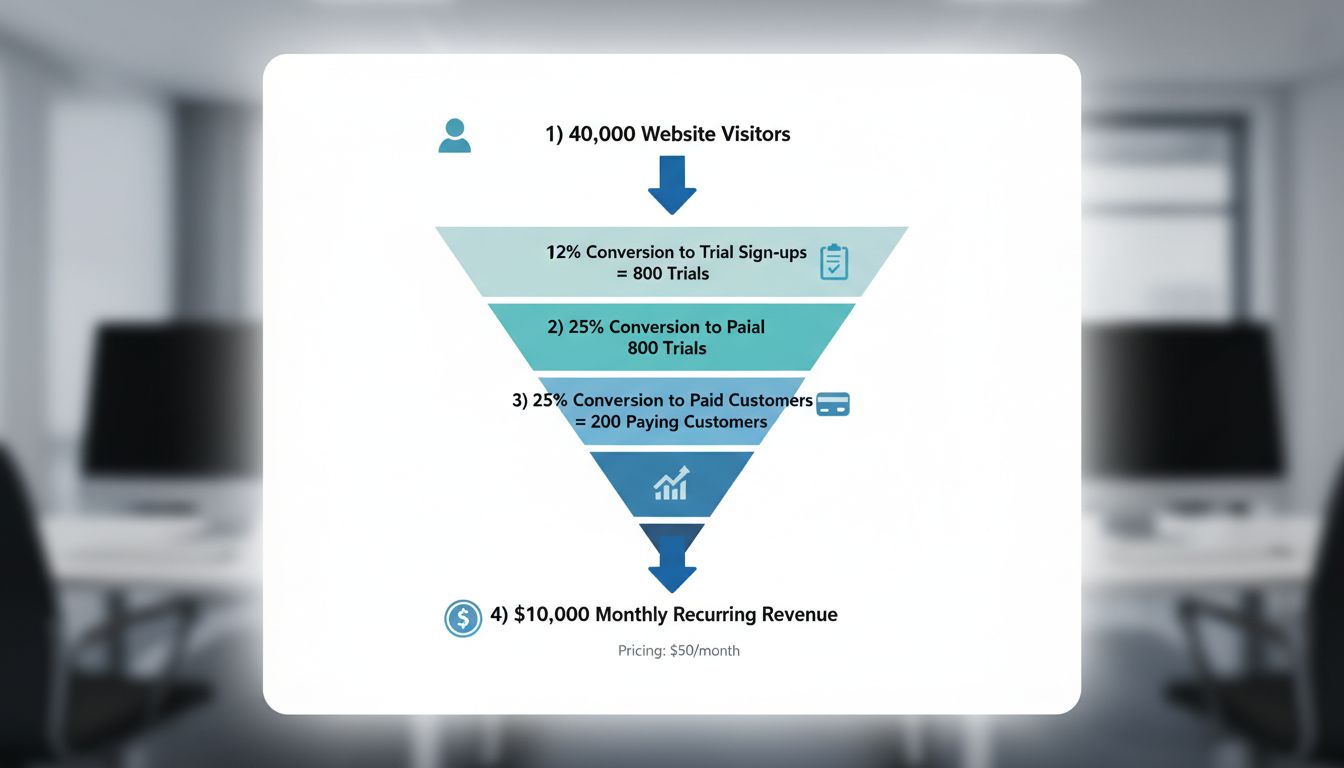
If your product is $50/month, you need 200 paying customers to hit $10k MRR. Assume a 2% conversion rate from visitor to trial, and 25% from trial to paid. That means you need 800 trial sign-ups. Which means you need 40,000 targeted visitors per month.
That's the number. Your 90-day plan is how you get there.
Month 1 (Foundation) isn't about traffic. It's about clarity. Get a landing page converting at 2% and an email sequence converting trials at 25%. If your page only converts at 1%, your traffic requirement doubles to 80,000 visitors. Fix the fundamentals first.
Month 2 (Content) is where you start building the traffic base. Publish eight keyword-targeted blog posts, aim for 1,000 SEO visitors. Use AI to speed up research and drafting, but the topics need to come from real search demand you actually validated, not guesses. This traffic is what you test your messaging against.
Month 3 (Paid) is where you scale what's working. Take the keywords that drove your best organic traffic and run a paid search campaign against them. A small budget on high-intent keywords can close the gap between where your organic traffic lands and the 40,000 you need.
The funnel logic here is classic. AI just compresses the timeline.
Take email as an example: AI-powered email programs deliver 41% higher revenue than manual campaigns. Apply that to your trial-to-paid rate. If AI tools nudge that from 25% to 35%, you now only need 571 trial sign-ups instead of 800. That pulls your required monthly traffic down from 40,000 to 28,550.
That's not a small shift. That's the difference between a manageable content strategy and an impossible one.
The mindset change is from "I need more traffic" to "I need a system that improves my conversion metrics." Keep a simple spreadsheet. Inputs: product price, target revenue, current conversion rates. Output: required traffic. Each month, pick one input and make it better.
That's the whole model. Whether you're figuring out how to start digital marketing from scratch or you've already taken a digital marketing course and you're putting it into practice, run these numbers for your own business first. Everything else follows from there.
Appendix: Useful Frameworks for Strategic Context
You've followed a tactical playbook. These are the classic frameworks that give it strategic context, you'll see them referenced elsewhere, and now you'll know what they actually mean.
The 3-3-3 Rule for Early Traction A time-boxed model for early-stage startups: 3 months learning your market and customers, 3 months building foundational systems (website, content, email), 3 months scaling what works. The 90-day plan compresses the "learn" and "build" phases into one launch, so you're ready to scale with real data instead of assumptions.
The 7 Ps of Marketing Product, Price, Place, Promotion, People, Process, Physical Evidence. For a digital-first founder, "Place" is your website and distribution channels. "Process" is your automated content and email workflows. "Physical Evidence" is the trust signals on your site, case studies, reviews. Use this to audit your market position once you're past launch.
The 5 Cs Analysis Company, Customers, Competitors, Collaborators, Climate. This one forces you to look outward.
"Climate" includes things like regulatory shifts, GDPR fines now exceed €6.7 billion [Source: usercentrics.com/knowledge-hub/data-privacy-in-2024-what-we-are-watching]. AI governance isn't optional.
The 70/20/10 Rule for Budget Allocation This only applies once you have performance data. Put 70% into proven, profitable channels (your optimised SEO and email). Put 20% into growth experiments, a new ad platform, a different content format. Reserve 10% for moonshots, things with uncertain payoff but real upside.
It keeps you from over-investing in what isn't working.
These frameworks aren't your day-to-day workflow. They're the strategic layer that keeps your 90-day execution pointed at something longer-term. Come back to them when you're deciding what to scale next.
Conclusion
You now have a 90-day playbook to start digital marketing with AI doing the heavy lifting. Foundation first, then content engine, then scale what's working. The only thing that actually stops people is execution, AI handles the labor, but you still have to show up and steer.
This isn't about going viral or waking up to a flood of traffic. It's about going from nothing to a system that's measurable and repeatable.
You've moved past asking how to start digital marketing to actually knowing which tools to use, what to track, and where your next 10 hours should go. That's the shift.
If the Phase 2 workflow, keyword research, drafting, optimizing, publishing, is where things bog down for you, that's exactly what Spectre is built for. It automates that whole pipeline so you can stay focused on the 70%: strategy and the tweaks that actually move numbers.
Frequently Asked Questions
How do beginners start digital marketing?
Follow the 90-day sequential plan in this guide. Core message and website first, then a content engine built around keywords you can actually win, then paid ads and email automation once you have something working.
Use AI tools like Spectre for execution. But remember: AI executes strategy. It doesn't create it.
Can I teach myself digital marketing?
Yes. This guide is basically a self-teaching blueprint for how to start digital marketing without needing a digital marketing course or a mentor holding your hand.
The thing that makes it work is the systematic, project-based approach. Randomly consuming tutorials gets you nowhere. Executing each phase, measuring what happens (traffic, conversions, revenue), and adjusting based on what the data tells you, that's where the actual learning is.
Will AI replace digital marketers?
No. AI replaces tasks, not judgment.
Strategy, creative direction, data interpretation, those roles survive. AI compresses labor-intensive work, but it still needs a human to review the output, set the direction, and catch what it gets wrong. Your job becomes managing the system, not doing every task manually.
How to start digital marketing with AI?
Keep the toolstack minimal. One AI-powered tool per core function: writing (Spectre for SEO content), graphics (Canva or Midjourney), email (Klaviyo or Dotdigital).
Then run the 90-day plan. Each phase has a specific job for AI: messaging research early on, drafting foundational content, generating email variants, optimizing ad performance. You're not replacing your thinking with AI. You're using it to execute faster so your thinking is what actually matters.