May 8th, 2026
How to Use SEO Content Writing Tools to Scale Your Blog Output
 WD
WDWarren Day
You've been told to double your blog output. Maybe you've tried an AI writer or two. The content feels generic, it's not ranking, and now you're quietly worried about Google penalties. Buying more SEO content writing tools hasn't fixed it.
That's because tools don't scale. Systems do.
The real bottleneck isn't software. It's that there's no repeatable production engine behind any of it. Going from 4 posts a month to 16 isn't a tool problem, it's a process problem.
Here's the math that makes this worth caring about: the average blog post takes 3 hours and 51 minutes to write manually. Businesses publishing 16 or more posts a month generate 4.5x more leads. The gap between those two facts is exactly where a proper system lives.
I'm not approaching this as a marketer configuring dashboards. I'm a software engineer who has actually built content automation platforms, including Spectre, so what follows is an engineering spec, not another "here are some ai content writing tools to try" roundup.
We'll cover the domain rating reality check most people skip, how to build hybrid drafting workflows using things like Surfer SEO and seo writing ai tools without letting them do all the thinking, where human QA is non-negotiable, and how to close the measurement loop. I'll also get into where free ai writing tools like chatgpt and other seo software tools free tiers actually fit, and where they fall short.
The goal is a five-step blueprint that uses content writing ai tools for speed and human expertise for the stuff Google actually rewards: quality, accuracy, E-E-A-T signals.
Before You Start: Assemble Your Prerequisites
Think of this as pre-flight. You wouldn't build a house without a foundation. You can't build a content engine without these elements. If you're missing any, stop here and fix it first.
Define concrete goals. "More traffic" isn't a goal. You need a number: "Increase organic traffic by 30% in Q3" or "Generate 50 qualified leads per month from blog content." That focus determines everything else.
Secure a core SEO research tool. You cannot scale based on hunches. You need real data on keyword difficulty, search volume, and competitor gaps, which means a paid subscription to Semrush, Ahrefs, or a platform like Spectre with research built in. Most seo software tools free tiers cap your searches or drop features like content gap analysis. Serious scaling requires actual investment.
Document your brand voice. A one-page style guide. Tone, banned words, the works. Every human or AI draft runs through this, it's the single source of truth.
Verify basic technical health. Is your site indexed in Google Search Console? Are Core Web Vitals acceptable? Is your CMS ready for a higher publishing cadence? Fix the foundational stuff before piling on more content.
Allocate a budget. Beyond tool subscriptions, budget for human review time. The most common failure point is assuming AI eliminates all human effort.
It doesn't.
Step 1: Assess Your Starting Point (The Domain Rating Reality Check)

Here's the truth nobody wants to hear: your domain authority is the single biggest constraint on your content strategy. It's just physics. A site with a Domain Rating (DR) of 30 cannot outrank a DR 70 site for the same high-volume head term, no matter how good your Surfer SEO brief is or how polished your seo writing ai draft looks. You're not competing on content quality in a vacuum. You're competing with established authority.
So run a diagnostic first. Open Ahrefs or Semrush, check your DR, and write it down. That number is your baseline.
Then look at the DR of the sites actually ranking on page one for your target keywords. If the average is 55 and you're at 32, that keyword isn't a realistic target right now. The most expensive mistake in scaling content is spending months of effort on keywords you have no real chance of winning.
The strategy fix is to focus on "reachable" mid-tail keywords where competitor DR is within 10-15 points of your own. Instead of targeting "seo content writing tools" (DR 70+), go after something like "best seo content writing tools for SaaS startups" (DR 45-55). That's your actual beachhead.
This is what we built into Spectre. It pulls competitor DR for every keyword suggestion across all the major ai content writing tools and free ai writing tools like chatgpt, so you only see opportunities you can win. No more chasing keywords that look good on paper but are basically fantasy.
It's not discouraging. It just means you're not burning your budget on content that will never rank. Work within your authority moat first, then widen it.
Step 2: Build Data-Driven Content Briefs (The Foundation)
What actually separates content that ranks from content that just... exists? The brief.
Not the AI tool. Not the prompt. The brief.
Think of it like a blueprint. You wouldn't start construction before you knew the structural requirements. Same logic applies here. A weak brief produces a weak, unrankable article regardless of which seo content writing tools or seo writing ai you're using.
The goal is converting raw keyword data into a clear, actionable document that any writer (human or AI) can follow to match search intent and SERP patterns. This is where you answer "how do I actually SEO optimize this?" at the planning stage, before a word gets written.
The single biggest mistake teams make here is skipping the brief or making it generic. You cannot scale quality by dropping a keyword into ChatGPT and hoping for the best. The brief is your control mechanism.
What a Best-in-Class Brief Looks Like
Not a one-line instruction. A data-rich document. Here's the exact template I use.
Core Metadata:
- Primary Keyword: "surfer seo"
- Search Intent: Commercial (user is researching and comparing tools, likely in the consideration phase).
- Word Count Target: 1,800 words (based on the average of the top 3 ranking pages).
- Top 3 Competitors Analyzed: [URL 1], [URL 2], [URL 3] (from your SERP analysis in Step 1).
Structural Blueprint (H2/H3 Outline): This isn't creative work. It's reverse-engineered from what's already ranking. Example:
- H2: What is Surfer SEO?
- H2: Key Features of Surfer SEO (Content Editor, SERP Analyzer, AI Writer)
- H2: Surfer SEO Pricing & Plans
- H2: Surfer SEO vs. Competitors (Frase, Semrush, Clearscope)
- H2: Pros and Cons of Using Surfer SEO
- H2: Who is Surfer SEO Best For?
Semantic & Entity Requirements: List 5-10 key terms, questions, and related entities that must appear naturally in the content. For "surfer seo," this includes: content optimization, NLP (Natural Language Processing), content score, keyword density, SERP analyzer, Frase alternative, on-page SEO tool.
Here's the contrarian part: prompt engineering is overrated. The real leverage is in the brief's detail. Once that's solid, your AI prompt becomes almost boring: "Write a helpful draft that strictly follows the structure and requirements in this brief." The tool doesn't need creative freedom. It needs a precise specification.
This is where tools like Frase (for deep entity and question analysis) or Surfer SEO (for SERP density and word count targets) actually earn their place in the stack. They're also genuinely useful as seo software tools free tiers for getting started. These tools automate data collection that used to take hours of manual SERP work, and turn it into a structured brief in minutes.
Alongside broader ai content writing tools and free ai writing tools like chatgpt, they give you something those tools can't on their own: actual data underneath the draft.
The brief is your quality control layer. Every article built on one is built on data. Every article without one is guesswork.
Step 3: Power the Hybrid Drafting Engine (AI Speed + Human Direction)
What's the most misunderstood part of using AI for content? It's not the prompt. It's not the tool. It's that people think AI is a content creator when it's actually just a very fast execution engine.
Think of it like a research assistant who will follow your instructions perfectly but has zero judgment about what's actually useful. Your brief provides that judgment. The AI just runs with it.
Here's the production workflow:
-
Export your completed brief from Frase, Surfer SEO, or your chosen tool as a plain text document. Include everything: target keywords, SERP analysis, outline structure, and entity requirements.
-
Feed it into your AI of choice with a strict, no-nonsense prompt. I use this exact template in Claude or ChatGPT:
"Using the attached content brief, write a comprehensive first draft for a blog post.
- Adhere strictly to the provided outline and heading structure
- Include all mentioned entities and semantic keywords naturally
- Maintain a [Your specific tone: e.g., 'authoritative but approachable'] tone
- Write for an audience of [Your ICP]
- Target approximately [Your word count] words
Do not invent new sections or deviate from the brief."
- Let the AI generate the draft. This is where the 10x speed boost actually happens. 65% of bloggers now use AI to some extent, primarily for this drafting phase.
The difference between this and just asking ChatGPT to "write about X" is that you're not asking for creativity. You're asking for structured execution against a spec that's already been validated.
Tool spotlight: Some seo content writing tools have built this directly into their workflows. Frase's AI-agent system claims to reduce article production time from a typical 9-14 hours to just 30-60 minutes in their tests. Surfer AI can generate a fully optimized 2,500-word article in under 20 minutes according to their documentation.
Here's what that looks like in practice:
- Frase: Upload your keyword, it builds the brief, then generates a draft directly within the platform that's already aligned with SERP requirements.
- Surfer AI: Similar workflow, keyword → brief → AI-generated draft that's pre-optimized for their content score metrics.
- ChatGPT/Claude + manual brief: The manual approach I outlined above, which gives you more control over model selection and prompt engineering.
Critical warning: Publishing raw AI output is the single fastest way to produce generic content that Google will ignore. I've seen entire content strategies collapse because teams treated the AI draft as final content.
Your AI-generated draft is just clay. It has the structure, the keywords, the entities. What it's missing is human judgment, real experience, and an understanding of what actually helps the reader.
When 76% of content marketers use seo writing ai and other ai content writing tools to draft copy, they're using them exactly this way, as a first-draft engine, not a publishing button. The same logic applies to free ai writing tools like chatgpt and content writing ai tools more broadly.
AI gives you speed. Your brief gives it direction.
Step 4: Enforce the Non-Negotiable Human QA & Optimization Layer
Here's the rule: you scale the drafting, not the editing.
AI can produce a 1,500-word draft in 20 minutes. That's raw material. This step is what turns it into content that actually ranks. Skip it and you're just publishing faster, not better.
I've seen teams burn through their SEO budget publishing 30 AI articles a month that never crack the top 50. The March 2024 Core Update specifically targeted this: scaled, low-quality content with no distinct user value (source: Search Engine Journal). Your human QA layer is your insurance against that.
Copy this SOP into your project management tool. Make completion mandatory before anything goes live.
The E-E-A-T Injection Checklist
Run every AI draft through this four-point inspection. Don't just read it, actively edit to inject these signals.
Experience: Add Real-World Context
- Action: Insert at least one first-person anecdote, client case study, or implementation lesson.
- Example: Instead of "Keyword research is important," write: "Last quarter, a SaaS client targeting 'cloud migration tools' was stuck on page 2. We discovered through Ahrefs' Content Gap that all top-ranking pages included the term 'cost calculator.' Adding that section moved them to position 3 within six weeks."
- Why it matters: This is the single biggest differentiator between human and AI content. It answers "How do you know this?"
Expertise: Cite and Explain
- Action: Find the original source for every statistic and explain the mechanism behind the recommendation.
- Example: Don't just state "Businesses publishing 16+ posts generate 4.5x more leads." Cite Semrush's study and add: "This correlation exists because frequent publishing builds topical authority, telling Google you're a comprehensive resource, which increases rankings across your keyword cluster."
- Why it matters: Google's E-E-A-T guidelines explicitly reward demonstrated expertise. Vague claims demonstrate none.
Authoritativeness: Link to Trusted Sources
- Action: Replace generic references with links to primary, authoritative sources.
- Example: Change "Google recommends..." to "As per Google's Search Essentials documentation on helpful content, the primary goal is..."
- Why it matters: Outbound links to authorities are a trust signal. They show your content exists within a verified ecosystem of information.
Trustworthiness: Balance and Disclose
- Action: Moderate absolute claims, acknowledge limitations, and transparently disclose commercial interests.
- Example: When discussing a tool like Surfer SEO, note: "Surfer's own case study shows updated pages are ~2x more likely to hit the Top 10, though as a vendor study, consider this a strong indicator rather than a guarantee." If mentioning our product, Spectre, we state it upfront as we do here.
- Why it matters: Overly promotional content erodes user trust, which search engines infer from engagement metrics like bounce rate.
The Technical & Readability Pass
After the E-E-A-T edit, run the human-polished draft through two automated gates.
1. SEO Scoring with Surfer or Semrush
- Action: Paste your final draft into Surfer's Content Editor or Semrush's SEO Writing Assistant.
- Goal: Hit a minimum score (e.g., 70/100 in Surfer). Don't chase 100, that leads to unnatural writing. Focus on fixing critical warnings: missing primary keywords in H2s, insufficient semantic term coverage, or very low recommended word count.
- Verification: The tool should show green checks for your target keyword placement and a readability grade of "Fair" or better.
2. Originality & Plagiarism Check
- Action: Run the content through Originality.ai or Copyscape.
- Goal: Keep similarity to existing web content under 5%. AI models can inadvertently reproduce phrasing from their training data.
- Common Mistake: Skipping this because the content is "original." I've caught near-verbatim paragraphs from competitor sites in AI drafts, it's a direct spam risk.
Before and After: The Transformation
See the difference this layer makes.
AI-Generated First Draft (Generic):
"Using SEO tools is important for content strategy. They help you find keywords and analyze competitors. Many marketers use them to save time."
After Human QA & E-E-A-T Injection:
"When I audit content strategies, the teams struggling are often using seo content writing tools in isolation. For example, they'll pull a high-volume keyword from Ahrefs but miss that the SERP is dominated by product comparison pages (transactional intent) when they've written a beginner's guide (informational intent). The fix isn't more tools, it's using the competitor analysis in SEMrush or Surfer SEO to decode intent first. 65% of bloggers now use AI for ideation, making this strategic layer the only real competitive edge left."
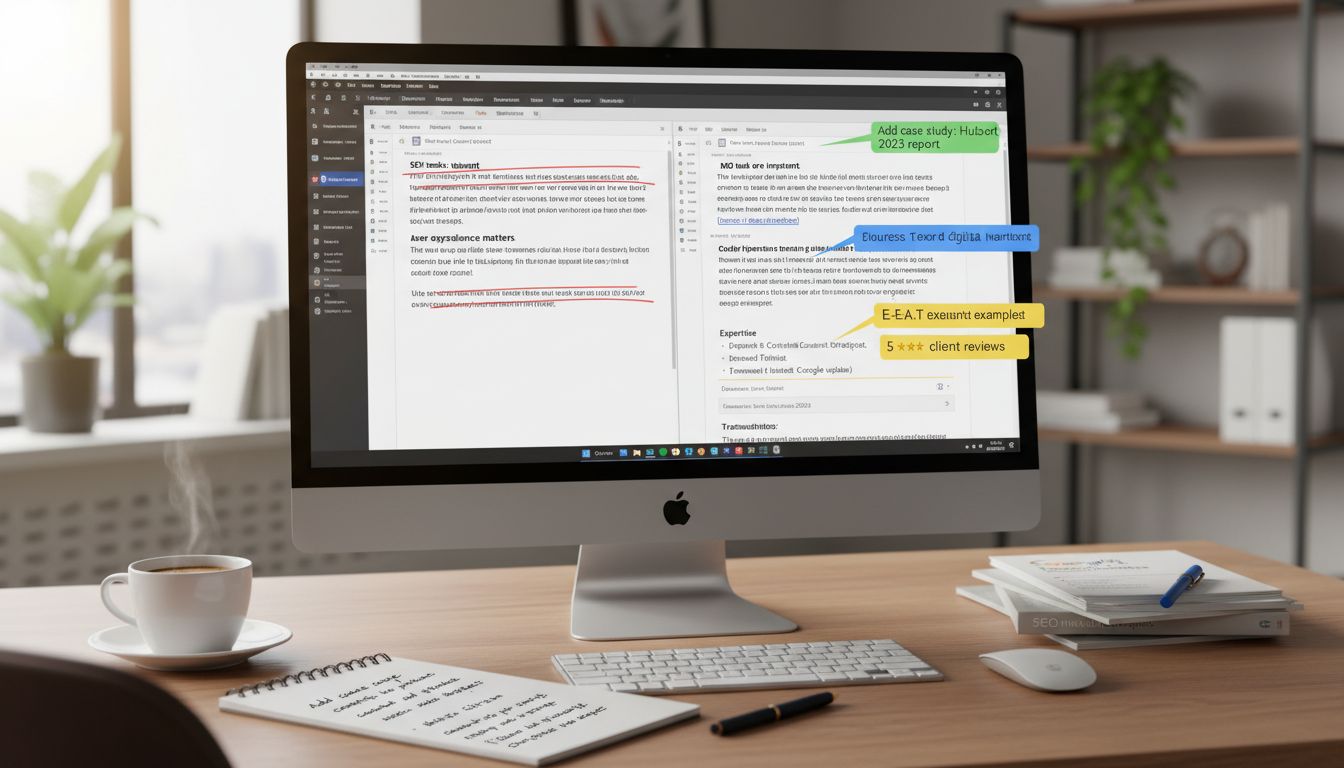
The first version is forgettable. The second demonstrates experience, cites a specific source, explains the "why," and positions your insight as the solution.
That's what builds authority. That's what ranks.
Your editing time per piece might be 60-90 minutes. That's the fixed cost of quality. The variable cost, drafting, is what seo writing ai and other ai content writing tools reduce from 4 hours to 20 minutes. The same logic applies whether you're using free ai writing tools like chatgpt, paid content writing ai tools, or seo software tools free options.
Protect the edit. Scale the draft.
Step 5: Publish, Measure, and Iterate (Closing the Loop)
Publishing without a feedback loop is just throwing words into the void.
1. Automate the publishing friction away.
Use your tool's CMS integrations. Semrush's WordPress plugin pushes optimized content directly. Frase can format for WordPress, Webflow, or Sanity. The goal is one-click export from your editing environment to live.
Watch for the "Hidden Integration Tax": some connectors strip formatting or require manual meta tag tweaks. Test one article end-to-end before scaling.
2. Track the right metrics in one dashboard.
Stop logging into six different tools. Centralise your KPIs in DashThis or Databox. Pull data from GA4, GSC, and your rank tracker.
Focus on these four:
- Rankings (specifically Top 10 and Top 50 movement)
- Organic traffic (sessions, not just pageviews)
- Conversion rate from organic
- Bounce rate
This tells you whether your hybrid workflow is producing content that performs, not just content that exists.
3. Apply the 80/20 rule to your content portfolio.
Run a report in Google Analytics. You'll likely find that 80% of your traffic comes from 20% of your posts.
That 20% is where your leverage is.
4. Update, don't just create.
This is the one most scaling teams miss. Instead of churning out new, low-value posts, use seo content writing tools like Surfer SEO or Clearscope to audit your top 20%. Find the posts with decaying rankings or thin content.
Update them with fresh information, expanded sections, and current optimization. Surfer's own data found that pages updated with their Content Editor were roughly 2x more likely to break into the Top 10 within 30 days, treat that as a strong signal rather than a guarantee, given it's a vendor study.
5. Iterate based on data, not guesswork.
Your dashboard shows you what's working. Double down on the topic clusters and content formats driving conversions. Sunset or rewrite posts that get traffic but no engagement.
The same logic that applies when choosing between free ai writing tools like chatgpt, paid ai content writing tools, or seo software tools free options also applies here: what you stop doing matters as much as what you start. Whether you're running seo writing ai at scale or using content writing ai tools selectively, the ones worth keeping are the ones your data actually backs up.
This loop, publish, measure, update, turns your blog from a publication into a growth asset.
Model the Economics of Scaling Your Output
Before you commit to a content model, run the numbers. The wrong choice burns through budget without moving anything.
Here's a realistic scenario: 20 articles per month, 1,500 words each. 30,000 words total. Here's what each approach actually costs.
Monthly Cost Breakdown
| Model | Monthly Cost (20 articles) | Key Assumptions |
|---|---|---|
| Freelancers | $900 – $6,000 | Based on market rates of $0.03 to $0.20 per word for standard SEO content. Lower end assumes basic, templated work; higher end includes research and expertise. |
| In-house Specialist | ~$8,300+ | Average U.S. SEO specialist salary is ~$74,778, with operational overhead adding ~30% [Source: jvglabs.com/cost-of-inhouse-seo-team/]. This is a fixed cost regardless of output volume. |
| Tool Stack + Hybrid | $400 – $1,200 + editing | Combines subscriptions (e.g., Semrush Content Toolkit ~$120, Surfer SEO ~$90, Frase ~$100) with a human editor for QA. Editing time is the variable cost. |
| Fully Automated Engine | Platform subscription + minimal oversight | Tools like Spectre handle research, briefing, drafting, and publishing. Your cost is the subscription plus final human review (1-2 hours per article for E-E-A-T). |
The freelancer model looks cheap until you factor in quality variance and management overhead. I've seen teams spend more time briefing and rewriting outsourced content than they'd spend just writing it themselves.
In-house gives you control but creates a high fixed cost ceiling. You're paying for 40 hours a week whether you ship 10 articles or 30. For most startups, that capital could go elsewhere.

Here's the contrarian take: for sites with a Domain Rating under 40, targeting 15-30 articles per month, the hybrid tool stack model consistently wins on cost and quality. You use seo content writing tools and ai content writing tools to generate 80% of the draft, the research, structure, initial prose, then apply human judgment to the last 20%: accuracy, voice, strategic nuance.
That split cuts your marginal cost per article fast. Instead of $0.10 per word for a full freelance draft, you might pay $0.02 for AI-assisted creation via seo writing ai and $0.03 for expert editing. A 1,500-word article drops from $150 to $75, with better adherence to your brief.
One caveat: SEO tool pricing moves constantly. The figures above reflect 2026 market data, verify current plans before building your budget. Features and credit allowances change quarterly.
The economic case for a system like Spectre isn't just automating writing. It's automating the preparation that makes writing efficient in the first place. No more jumping between Ahrefs for keywords, Surfer SEO for outlines, and free ai writing tools like ChatGPT for drafts. That saved time directly reduces your cost per published piece.
Which is the whole point. You want scaling to be financially sustainable before you've built the domain authority to justify a large team. The right mix of seo software tools free options and paid platforms, including content writing ai tools used selectively, gets you there faster than throwing headcount at the problem.
Build a Resilient, Update-Proof Workflow
Let's address the obvious question: you're building this system while Google keeps moving the goalposts. "Is SEO dead? What's going to replace it?"
Neither.
SEO isn't dying, it's maturing. It's shifting from a keyword-matching game into a quality-verification system. Google's helpful content Update quietly dropped the "written by people" phrasing. They don't care how content gets made. They care if it's helpful. The March 2024 Core Update went after low-quality, scaled content specifically.
Nothing is "replacing" SEO. Relevance, authority, usefulness, those don't go away. What changes is how efficiently you can meet those standards.
Your workflow needs to hold up through those shifts. Here's how.
First, tier your content by risk and value. High-stakes money pages and YMYL topics, financial advice, health, legal, get the full human treatment from brief to final edit. I route those to senior writers in my agency. Supporting topical cluster content can lean on more automation in the draft phase, but it still goes through the same human QA gate. It's not about cutting corners. It's about putting finite human attention where E-E-A-T actually depends on it.
Second, make "helpfulness first" part of your SOPs. Every brief should start with one question: what does my reader get here that they can't find in the top five results? Use seo content writing tools like Surfer SEO or Clearscope to spot gaps in competing articles, but fill those gaps with real expertise, not just more words. That's exactly why the human QA layer isn't optional. It's the part that makes the ai content writing tools and seo writing ai work for the user instead of against them.
The goal here isn't tricking algorithms with clever seo software tools free or paid. It's using those tools, free ai writing tools like ChatGPT, content writing ai tools, the whole stack, to efficiently produce content that deserves to rank.
When the next core update hits, your site won't be sitting on thousands of thin AI pages. It'll be built on a scalable engine for creating genuinely helpful content.
That's the whole point. You're not chasing algorithms. You're building something that can outlast them.
Common Mistakes & Troubleshooting Your Scale-Up
What actually breaks these systems when teams try to scale them?
Usually the same six things, over and over.
Mistake 1: Scaling raw AI output without distinct human value.
You're publishing AI drafts with minimal edits. The content is generic, lacks unique insights, and triggers Google's spam policies.
Fix: Implement the Step 4 QA SOP. Every piece goes through your human editor for E-E-A-T signals, factual verification, and brand voice alignment. No exceptions.
Mistake 2: Chasing keywords your domain can't win.
You're targeting "best CRM software" with a DR 15 blog. You'll spend months producing content that never ranks.
Fix: Do the Step 1 Domain Rating Reality Check. Use Ahrefs to filter keywords by competitor DR and stay in your realistic opportunity zone.
Mistake 3: Drafting without a data-driven brief.
You're feeding ChatGPT a keyword and hoping for the best. The output misses search intent and competitive gaps.
Fix: Never start a draft without a Step 2 brief from Frase, Surfer SEO, or SEMrush. The brief is your production spec. That's the actual prompt.
Mistake 4: Publishing only new posts, ignoring updates.
You're chasing volume while older, high-potential posts decay. Surfer's research shows updated pages are roughly 2× more likely to break into the Top 10.
Fix: Use your analytics in Step 5 to find "traffic leak" pages. Refresh them with current data, expanded sections, and fresh optimization.
Mistake 5: Not measuring what matters.
You're tracking "posts published" instead of organic traffic, conversions, and keyword rankings. You can't iterate on what you don't measure.
Fix: Define your core KPIs in Step 5. Set up a dashboard in Databox or DashThis and check it weekly.
Mistake 6: Using generic AI prompts.
"Write a 1500-word blog about project management" produces fluff. The AI needs direction.
Fix: Your content brief is the prompt. Feed it the structure, key points, competitor analysis, and target entities. That's what separates good output from garbage when using seo content writing tools, ai content writing tools, or free ai writing tools like ChatGPT.
One honest thing before you go build this: even flawless execution won't make weak pages rank without domain authority and backlinks. Seo writing ai, content writing ai tools, seo software tools free or paid, all of it accelerates production. None of it replaces a solid technical foundation or a long-term link-building strategy.
This engine makes you efficient. It doesn't make things easy.
Conclusion
There's no magic seo content writing tool that fixes everything on its own.
What actually works is a repeatable system: check your domain rating, build data-driven briefs, use AI to draft faster, run real human QA, and measure what happens. That's the whole engine. AI handles the drafting acceleration, humans handle the judgment calls that keep E-E-A-T intact.
And don't sleep on updating old content. That's often where the highest leverage is, not publishing more new stuff.
Your domain authority is the real constraint. Work within it. Target keywords you can actually win.
Start with one step this week. Audit your domain rating, build one brief for your next article, test the hybrid drafting process with seo writing ai or free ai writing tools like chatgpt, see what breaks. The ai content writing tools and seo software tools free options are all there, even surfer seo has enough in its free tier to get started.
If you want the entire thing pre-built, from research to publishing, that's what Spectre does.