April 7th, 2026
Key Positions in Digital Marketing: The Rise of the AI SEO Specialist
 WD
WDWarren Day
If you're a digital marketer feeling the ground shift beneath your feet, you're not imagining it. The positions in digital marketing that dominated job boards five years ago are being quietly retired, rewritten, or consolidated. A new tier of roles is emerging, ones that carry salary tags that would have seemed absurd for a "marketing" job not long ago. Anthropic recently posted an SEO Lead role at $255,000–$320,000. That's not a typo, and it's not an outlier.
The generic digital marketer is being unbundled. What's replacing it isn't just a longer list of specialisms, it's a fundamental restructuring of what the most valuable marketing professionals actually do. The AI SEO Specialist sits at the top of that restructuring. Not because they've learned to prompt ChatGPT, but because they operate at the intersection of marketing strategy, data science, and software engineering. That combination is rare, it's in demand, and it commands a measurable premium, roles that mention AI in the job description pay a 25% median salary premium over those that don't.
So that's what this article is about. What the role actually involves day-to-day, what it pays across different seniority levels and company sizes, the specific technical skills and tool stack you need to build, and a four-stage progression path from where you are now to where this market is heading.
I'm not going to tell you to "embrace AI" or "stay curious." That kind of advice is useless. What I'll give you instead is a precise picture of the skill gap, drawn from real job listings and current salary data, and a systematic way to close it.
By the time you've finished reading, you'll have a clear-eyed view of whether this path is right for you, and if it is, exactly where to start.
Beyond the Buzzword: What an AI SEO Specialist Actually Does in 2026
Let me be direct about something. Most articles describing this role will tell you it's someone who "uses AI tools to enhance their SEO workflow." That's about as useful as describing a software engineer as someone who "uses a computer."
The AI SEO Specialist isn't an evolved version of the SEO professional from five years ago. It's a different category entirely.
What a Traditional SEO Specialist Does (And Why It's No Longer Enough)
A traditional SEO Specialist does keyword research, optimises on-page elements, builds or acquires backlinks, fixes technical issues flagged by crawl tools, and reports on rankings and traffic. Skilled work. But largely reactive and manual, you're responding to what the tools surface, executing against a checklist, and waiting weeks to see if changes land.
That workflow is being hollowed out. Not by AI replacing the human, but by AI compressing the time-value of those tasks to near zero. When a junior marketer with Claude can produce a keyword-clustered content brief in 20 minutes that used to take a specialist two days, the specialist's value can't live in doing those tasks anymore. It has to live somewhere else.
The Three Pillars of the AI SEO Specialist's Day
The actual work breaks down into three distinct areas, and none of them are "prompt ChatGPT and publish."
1. Diagnostic and data engineering. This is where the role earns its technical premium. Python scripts querying the Ahrefs API to pull keyword movement data into BigQuery, joined against GA4 session data, so you can isolate which content types are losing ground to AI Overviews versus which are gaining LLM citation traffic. Log file analysis, not as a box-ticking exercise, but as a genuine diagnostic for understanding how Googlebot and AI crawlers like GPTBot and PerplexityBot are spending their time on your site.
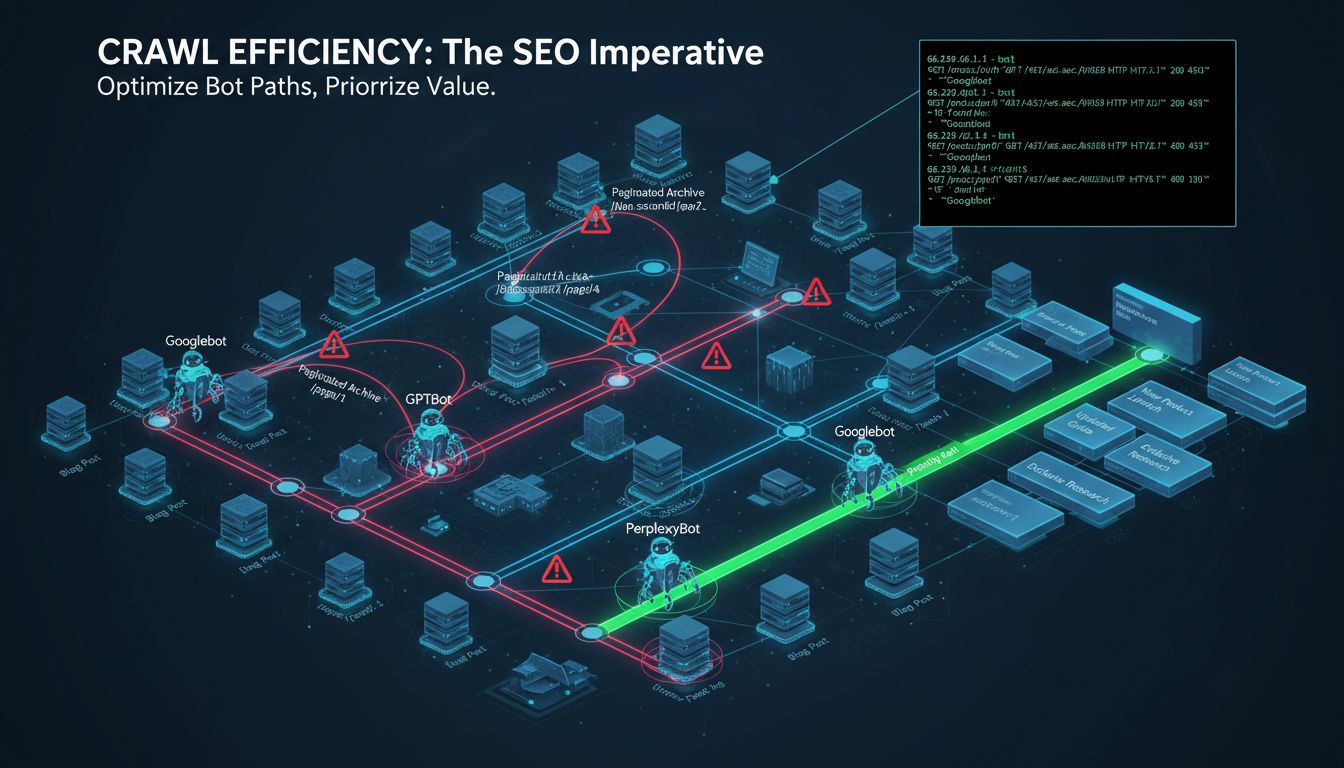
Log file analysis matters more now than it ever has. Crawl efficiency is the foundation of indexation, and indexation is the foundation of everything else. If Googlebot is burning its crawl budget on paginated archives or parameter-heavy URLs, your freshest content isn't getting indexed promptly. For AI agents that prioritise recently crawled, well-structured content when composing answers, that delay is a visibility problem. Fixing it requires reading raw server logs and knowing what you're looking at, not configuring a dashboard.
2. AI-native optimisation. This is where the role diverges most sharply from traditional SEO. You're optimising for two distinct audiences simultaneously: Google's ranking algorithms and the retrieval mechanisms of LLMs. That means structuring content so it chunks cleanly, discrete, self-contained passages that an LLM can extract and cite without losing context. It means implementing schema markup not just for rich snippets but for AI feature eligibility. And it means tracking KPIs that didn't exist two years ago: AI citation count, chunk retrieval frequency, inclusion rate across LLM platforms.
AI search traffic grew 527% year-over-year between early 2024 and early 2025, according to Semrush. That's not a trend you optimise for later. That's a channel already eating your organic share.
3. Engineering collaboration and tooling. This is the part most SEO job descriptions still underestimate. An AI SEO Specialist at a serious company writes technical briefs for developers, not vague requests, but specific implementation specs for JavaScript rendering fixes, structured data implementations, or API integrations. At the higher end, they're building internal tooling: custom scripts for content gap analysis, automated pipelines that pull SERP data and flag topical authority gaps, integrations between SEO platforms and content management systems.
Anthropic's SEO Lead listing, which came with a base salary of $255,000–$320,000, explicitly called out crawl efficiency, indexation, log file analysis, JavaScript framework experience, and schema markup as core requirements. That's not a content marketing role with a shiny AI label. That's a systems-level engineering position that happens to live inside a marketing function.
The Domain Rating Constraint Nobody Talks About
Here's the uncomfortable reality for most practitioners: the tactics available to you are fundamentally constrained by your domain's authority. A high-DR site can target competitive head terms and brute-force rankings with decent content. An AI SEO Specialist at a smaller company, a Series A SaaS, a regional agency, a B2B consultancy, doesn't have that luxury.
The strategic value of the role at those companies is precisely the ability to use AI to work around that constraint. Clustering long-tail intent to build topical authority before going after competitive terms. Identifying "answer targeting" opportunities, questions that AI Overviews are answering poorly, where a well-structured, authoritative page can earn citation. Mapping content gaps not just against competitors, but against what LLMs are currently citing when someone asks a question in your space.
That's not a checklist. It's a systems-thinking problem that requires both marketing judgement and technical execution, which is exactly why the role commands the salary premium it does.
The AI SEO Salary Report: What You Can Really Earn (2026 Data)
Let's talk numbers, and why the ones you'll find first are probably misleading.
The baseline is noisy
Search "SEO Specialist salary" and you'll get two very different answers. Glassdoor puts the US average at $86,049, while Payscale reports $59,099 for the same year. That's a $27,000 gap for ostensibly the same role.
The discrepancy isn't a data error. "SEO Specialist" covers an enormous range, from a junior at a regional agency optimising meta titles, to a technical SEO with Python skills running log-file analysis at a SaaS company. Title normalisation is poor across the industry, and neither figure accounts for AI skills. These are starting points, not ceilings.
In the UK, the picture is similarly compressed at the baseline. The median SEO Specialist salary sits around £35,500 nationally, rising to £55,000–£60,000 in London for experienced practitioners. Head of SEO roles in larger organisations push £80,000–£100,000+. These are the pre-AI-premium figures.
The skill premium is real and quantifiable
Here's where it gets interesting for anyone considering this digital marketing career path. According to Webflow's 2026 salary analysis, data analysis skills (GA4, BigQuery, Python) add £6,000–£12,000 to your package in UK terms, while AI/ML expertise adds £8,000–£14,000. US premiums run $8,000–$15,000 and $10,000–$18,000 respectively.
More striking is the LinkedIn/Aquent data: roles that simply mention AI in the job description pay a 25% median premium, $100,000 versus $80,000. Roles with AI in the actual job title jump to a 27% premium at $113,625 median. That's not a marginal uplift. That's the difference between a standard digital marketing job salary and a genuinely well-compensated one.
The realistic salary band
Based on available data, here's a practical framework for AI-focused positions in digital marketing (US figures, with approximate UK equivalents):
| Level | US Salary Band | UK Equivalent |
|---|---|---|
| Entry-level AI SEO (with demonstrable skills) | $70,000–$90,000 | £55,000–£70,000 |
| Mid-level AI SEO Specialist / Manager | $90,000–$130,000 | £70,000–£100,000 |
| Senior / Lead AI SEO | $130,000–$200,000+ | £100,000–£150,000+ |
Semrush's analysis of 3,900 job listings found median pay for senior SEO roles had already reached $130,000, nearly double the $71,630 median for non-senior positions. Directors of SEO average $141,178 and VP-level roles reach $191,850, according to Previsible's dataset.
The outlier you'll see quoted, and what it actually means
Yes, Anthropic advertised an SEO Lead role at $255,000–$320,000. That figure is real, but it requires near-engineering-level skills: crawl efficiency, log-file analysis, JavaScript framework experience, schema implementation at scale. It's a role sitting at the intersection of software engineering and SEO strategy, inside one of the most well-funded AI companies in the world.
Most people reading this should target the $90,000–$130,000 band as a realistic medium-term goal with the right upskilling. The $255,000+ ceiling exists to show you what the role can become, not what it typically pays.
A note on using this data: salary figures shift quickly in this space. Cross-reference anything here against current listings on Levels.fyi, Glassdoor, and sector-specific job boards before making career decisions. The premium for AI skills is consistent across sources, the exact numbers are a guide, not a contract.
The 2026 AI SEO Skills & Tools Roadmap: From Chatbots to Systems
Most "AI SEO skills" lists are useless. They tell you to "learn prompt engineering" and "get familiar with ChatGPT", advice so vague it could apply to anyone with a laptop. What actually separates an AI SEO Specialist from a marketer who uses AI tools is a specific, layered skill stack that compounds on itself. Here's what that actually looks like.
The T-shaped skill model (and why the shape matters)
The T-shape metaphor is overused, but it's structurally accurate here. You need breadth across four domains, with genuine depth in at least two.
1. Deep technical SEO This is the non-negotiable foundation. Crawl budget management, JavaScript rendering, Core Web Vitals, log file analysis, advanced schema markup. These aren't optional extras, they're the reason Anthropic's SEO Lead listing starts at $255,000 and explicitly calls out crawl efficiency and JS framework experience. If you can't diagnose why Googlebot isn't rendering your client's React app correctly, no amount of AI tool fluency compensates.
2. Data analysis and engineering
SQL and Python aren't "nice to have." They're the difference between a specialist who reads reports and one who builds them. Python (specifically Pandas for data manipulation, requests and BeautifulSoup for scraping, and the Google Search Console API for programmatic data pulls) lets you automate analysis pipelines that would otherwise eat entire working days. BigQuery and Looker Studio sit on top of GA4 as the reporting layer, and proficiency here is directly tied to the $8,000–$15,000 salary premium in the previous section.
3. AI and LLM proficiency Not "using ChatGPT." Actual LLM proficiency means writing structured prompts for content briefing and topic clustering, calling the OpenAI or Anthropic APIs programmatically, and understanding how AI search platforms like Perplexity and Google's AI Overviews surface and cite content. These are now traffic sources in their own right, with conversion rates that reportedly dwarf traditional organic.
4. Strategic communication The technical work means nothing if you can't translate it into a business case. Knowing your crawl budget is being wasted on faceted navigation is one thing. Explaining to a CMO why that's costing them six figures in missed organic revenue is a different skill entirely.
The essential toolbox (grouped by function)
Discovery and research Ahrefs and Semrush are the industry standard, but treat their volume figures as relative indicators, not ground truth. Independent research has found average error margins of around 50% compared to Google Search Console actuals. The real value is comparative analysis and trend direction, not absolute numbers. For either tool, API access matters more than dashboard fluency, that's where you build the custom pipelines.
Analytics and data GA4 → Looker Studio → BigQuery is the standard stack. GA4 alone is insufficient for serious analysis; BigQuery unlocks unsampled, event-level data that you can query with SQL and join against your Search Console exports.
Technical and crawl Screaming Frog for site audits. Botify or Lumar for enterprise-scale crawl intelligence and log file analysis. Log file analysis is underused across the industry, it shows you what Googlebot actually crawled versus what you think it crawled, which are often very different things.
AI and automation ChatGPT, Claude, and Gemini for content and research workflows. Playwright or Selenium for browser automation and JavaScript rendering tests. Streamlit for building lightweight internal dashboards that surface your data pipelines to non-technical stakeholders without requiring them to touch a spreadsheet.
The gap between tool data and what actually ranks
Here's the part most training programmes skip. Ahrefs says a keyword has 1,200 monthly searches. Semrush says 2,400. Neither figure tells you whether the keyword is worth targeting for your domain.
An AI SEO Specialist validates keyword opportunity by layering signals: How many "People Also Ask" boxes appear in the SERP? (High PAA density usually signals strong informational intent, good for content, harder to monetise.) What's the content depth of the top three results? Does the SERP show AI Overviews absorbing the click? Is there a featured snippet you can displace?
This is where AI earns its place, not as a content generator, but as an analysis accelerator. You can use Claude or GPT-4 to cluster hundreds of keyword variants by intent in minutes, then cross-reference against your domain's actual topical authority to find the gaps worth pursuing.
On courses and certifications
If you're looking at a digital marketing course with certificate as your entry point, that's a reasonable foundation, but be selective. A free digital marketing course like Google's Digital Garage covers the basics well enough to orient you. For AI SEO specifically, the higher-value investments are narrower: a Python for data analysis course, the Google Analytics API documentation (free), and hands-on prompt engineering practice with real SEO tasks.
A digital marketing course online from a reputable provider can accelerate your understanding of the strategic layer. Worth checking digital marketing course fees before committing, some charge thousands for content you can get cheaper elsewhere, and the credential rarely matters as much as the work you build alongside it.
No certification substitutes for building something real. A Python script that pulls your Search Console data. A Looker Studio dashboard that tracks AI referral traffic separately from organic. That kind of portfolio beats the certificate every time, and it's what actually moves the needle on digital marketing manager salary conversations and broader digital marketing job salary negotiations when you're interviewing for serious roles.
How to Become an AI SEO Specialist: A 4-Stage Progression Path
Most digital marketing career path guides hand you a flat skill list and leave you to figure out the rest. This isn't that. What follows is a sequential build, each stage creates the foundation the next one requires. Skip stages and you'll hit a ceiling fast.
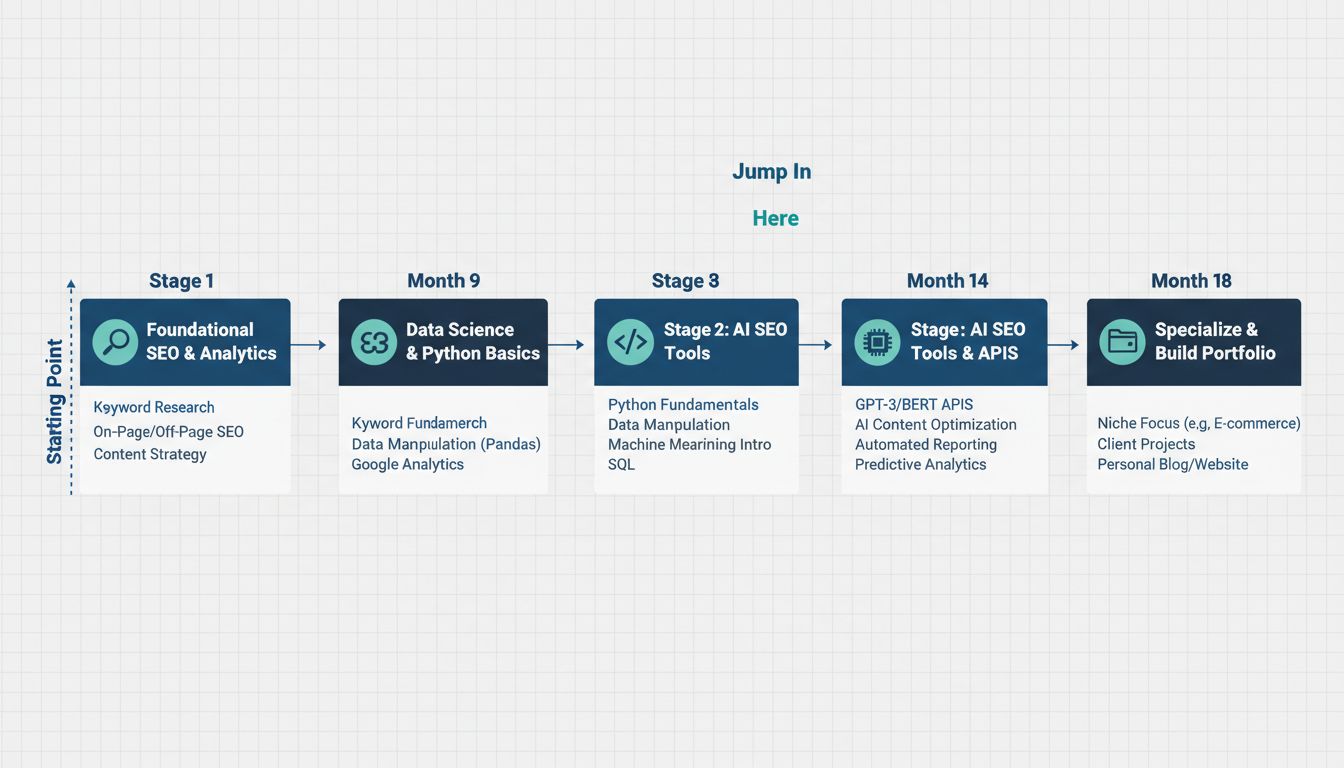
Honest caveat upfront: this takes 12–18 months of consistent effort from scratch. If you're already partway along, jump to the stage that fits where you are.
Stage 1: Master Foundational SEO & Analytics (The Bedrock)
Goal: Become genuinely proficient in core SEO and web analytics, not "familiar with," proficient.
Get Google Analytics 4 certified, then spend real time in Search Console. Not just checking dashboards, actually understanding what crawl coverage reports and index status pages are telling you. Run a full technical audit on a personal site or a willing friend's business. Find broken internal links, identify crawlability issues, map the site architecture. Do it manually before you automate anything.
Resources worth your time: Google's Analytics Academy (free, credible), the Ahrefs blog for technical depth, and the Moz Beginner's Guide for solid fundamentals. The goal isn't the certificate. It's being able to diagnose a site's organic performance problems without a checklist in front of you.
Stage 2: Layer on Data Science & Python Basics (The Power-Up)
Goal: Move from observing data to manipulating and interrogating it.
This is where most traditional marketers stall. They see "Python" and assume it's not for them. It absolutely is, and you don't need to become a software engineer to get value from it.
Learn Python basics: variables, loops, functions, list comprehensions. Then Pandas for data manipulation. Then do the thing that will immediately separate you from 90% of SEO practitioners: connect to the Google Search Console API and pull your own data programmatically. Filter by page, query, device, date range. Spot the patterns the GSC dashboard buries.
Kaggle's free Python course or Python for Everybody on Coursera will get you started. Google Colab means you don't even need a local environment. There's no excuse for skipping this stage, it's the one that unlocks everything after it.
Stage 3: Get Hands-On with AI SEO Tools & APIs (The Integration)
Goal: Connect your SEO and data skills to actual AI workflows.
Build something. Specifically: write a Python script that takes a list of target keywords, calls the OpenAI or Anthropic API, and returns structured content briefs, topic angle, semantic clusters, suggested headings, competing entities to address. It doesn't need to be polished. It needs to work and you need to understand every line of it.
Then use Playwright or Scrapy to scrape SERP features for those keywords. Which results have AI Overviews? Which trigger featured snippets? What schema types appear? This is how you build real intuition for what Google is actually rewarding, not what blog posts claim it rewards.
Experiment with tools like Frase or MarketMuse, not to outsource your thinking, but to understand the logic behind content scoring. When you know how the tool works, you can replicate its outputs programmatically and customise them for your specific context.
Stage 4: Specialise and Build a Portfolio (The Proof)
Goal: Demonstrate compound skills with results you can point to.
Execute one complete AI SEO project end-to-end: technical audit, keyword and topic clustering with AI assistance, content optimisation, tracking both traditional metrics and AI-native KPIs like LLM referral traffic and AI citation frequency. Document the process and the results as a case study. Publish it.
This matters more than any certificate. Only 19% of SEO professionals reinvest AI-saved time into professional development, which means a documented, results-backed project immediately puts you in a small minority. That's the competitive moat.
Where You Should Actually Start (By Background)
Traditional Marketer: You likely have Stage 1 covered, at least partially. Your gap is Stage 2. Start Kaggle's Python course this week and commit to pulling your own GSC data before the month is out. Don't wait until you feel ready, you won't.
Data Analyst: You probably have Stage 2 locked. Your gap is Stage 1, specifically the SEO domain knowledge. Spend a month doing technical audits and keyword research with Ahrefs or Semrush before touching the AI tooling. Data skills applied to the wrong SEO problems produce confident nonsense.
Software Engineer: You can move through Stages 1–3 quickly. The real challenge is Stage 4: building a portfolio that demonstrates marketing judgement, not just technical execution. Engineers often build impressive tools that solve no actual business problem. Pick a real site with real traffic goals and optimise for outcomes, not elegance.
The positions in digital marketing that command the highest salaries aren't filled by people who completed the most courses. They're filled by people who built things, measured results, and can explain what they learned.
The Reality Check: Common AI SEO Pitfalls & How to Avoid Them
The hype around AI in SEO is real. So are the failure modes. Here are the ones I see most often, and how to avoid them before they cost you time, credibility, or a Google penalty.
Pitfall 1: Treating AI output as gospel
More than half (54.2%) of marketers cite inaccurate or inconsistent AI output as their biggest barrier to adoption, and yet the instinct to publish first and check later is everywhere.
AI hallucinates. It confabulates statistics, invents citations, and confidently states things that are simply wrong. I've seen this in my own pipelines building Spectre, even with well-structured prompts and retrieval-augmented generation, you still get factual drift on technical topics.
The fix: human-in-the-loop review is non-negotiable for anything that goes live. Use AI for ideation, first drafts, and structural scaffolding. Fact-check every claim with a named source before publication. The goal is compressing the time from brief to publishable draft, not removing human judgement from the process entirely.
Pitfall 2: Ignoring AI-native KPIs
If you're still measuring success purely through CTR and average position, you're flying blind.
Search Engine Land's framework of 12 new generative AI search KPIs, including chunk retrieval frequency, embedding relevance score, and AI citation count, reflects a genuine shift in how content performance gets measured. The crossover point where these metrics start to eclipse traditional ones is roughly now, 2025-2026.
CTR becomes meaningless when your content is being synthesised into an AI Overview and the user never clicks. What matters is whether your content is being retrieved and cited by the model.
Start logging AI bot traffic separately (GPTBot, Google-Extended, CCBot) via server logs or Cloudflare. Run prompt tests across ChatGPT, Perplexity, and Gemini weekly to track brand and content citation frequency. Tools like SearchAtlas have begun building dashboards for this. It's early, but the teams building these habits now will have a year's worth of baseline data when everyone else is scrambling.
Pitfall 3: Neglecting legal and compliance requirements
This one is under-discussed and genuinely risky.
Google now mandates IPTC metadata on AI-generated images used in Shopping listings. The EU AI Act requires machine-readable watermarks or metadata identifying synthetic media. These aren't theoretical future requirements, they're in force now.
Audit your content creation pipeline. If you're generating images with Midjourney, DALL-E, or Firefly and publishing them without disclosure metadata, you're already non-compliant in certain contexts. Build disclosure and metadata tagging into the workflow from the start, not as an afterthought.
Pitfall 4: Pocketing the time savings instead of reinvesting them
This one is quietly career-limiting.
According to Search Engine Land, 93% of SEO professionals say AI saves them time, but only 19% reinvest that time in professional development. The other 81% are using AI to do the same job slightly faster, rather than using it to move up a level.
Treat AI as a force multiplier. Every hour AI saves you on routine keyword clustering or meta description generation is an hour you can spend learning Python, building a custom analytics dashboard, or understanding how RAG pipelines actually work. Anyone serious about a digital marketing career path, or eyeing a digital marketing manager salary worth having, needs to think in terms of compounding skills, not just faster outputs. That's the compounding advantage.
Pitfall 5: Underestimating cost and complexity for smaller teams
Nearly 46% of SMEs cite high subscription and implementation costs as a primary barrier to AI SEO adoption, according to Business Research Insights. The enterprise AI SEO stack, full Semrush or Ahrefs licences, BigQuery, custom Python pipelines, LLM API credits, adds up fast.
Start small and prove value incrementally. Run local LLMs via Ollama for content drafting and internal tooling before committing to expensive API subscriptions. Use Google Colab for Python experimentation without infrastructure overhead. Build a focused pilot, one content cluster, one keyword category, measure the ROI, and use that data to justify broader investment. A business case built on a real experiment beats a vendor's marketing deck every time.
The Future-Proof Verdict: Will AI Replace Digital Marketers?
Let me answer this directly: no, AI will not replace digital marketers. It will replace digital marketers who don't use AI. That distinction sounds like a bumper sticker, but the data backs it up.
The anxiety is understandable. AI search traffic grew 527% year-over-year between 2024 and 2025. AI Overviews now appear in nearly half of all Google searches. The interface of search has fundamentally changed. But none of that makes SEO expertise less valuable. It makes it harder to fake.
AI Automates Tasks. It Doesn't Replace Judgement.
What AI is genuinely good at: grouping keywords at scale, generating first-draft content structures, pulling performance data, and running pattern recognition across thousands of pages. What it can't do: understand why a particular market is shifting, decide which content cluster is worth the investment given your domain authority, or build the trust signals that make a brand citable across AI platforms.

The Rankmax B2B case study makes this concrete. A property management outsourcing company went from 4,973 to 26,313 organic search users and generated $5.9 million in revenue over 17 months at a 6,864% ROI. Not by automating their way to mediocrity, but by combining topical authority building with deliberate AI citation optimisation across ChatGPT, Gemini, and Perplexity. Human strategy, executed with AI leverage.
The Battlefield Has Expanded, Not Disappeared
"Is SEO dead?" is the wrong question. Ranking #1 on ten blue links mattered when that was the only interface. Now the goal is being the most cited, most trusted source across Google AI Overviews, ChatGPT responses, Perplexity answers, and direct model outputs. That's a larger surface area to optimise for, not a smaller one.
As Rita Steinberg, VP of Media at FUSE Create, put it: "The fight isn't for position one anymore. It's for contextual inclusion inside the model's response." That fight requires more sophistication, not less.
Which Roles Survive?
The roles that hold up are the ones AI can't easily replicate: strategic positions in digital marketing (CMO, Growth Lead, AI SEO Specialist), high-touch creative and relationship roles, and anyone who can operate at the intersection of systems thinking and business outcomes. The AI SEO Specialist sits squarely in that category, a role defined by the ability to understand the system, interpret the data, and translate both into commercial results.
The positions that will struggle are purely executional ones: manual reporting, templated content production, basic keyword list assembly. Those workflows are already being absorbed into AI pipelines.
The verdict is straightforward. The AI SEO Specialist isn't just surviving this transition, it's the role the transition is creating demand for. If you've read this far, you already understand what it takes to get there. The only question is whether you act on it.
Conclusion
The AI SEO Specialist isn't a rebranded job title or a marketer who learned to write ChatGPT prompts. It's a genuinely new kind of role sitting at the junction of marketing strategy, data engineering, and systems thinking. That's precisely why it commands a 25%+ salary premium and why 74% of enterprise companies are actively hiring for it right now. [Source: semrush.com / webflow.jobs]
The positions in digital marketing that will matter most over the next five years won't go to people who know about AI. They'll go to people who can build with it, measure it honestly, and know when not to trust it.
The path laid out here isn't theoretical. It mirrors how this skill set develops in practice: starting with foundational technical SEO and analytics, moving through Python and API integrations, and eventually into systems that run content pipelines at scale. Each stage builds on the last.
No computer science degree required. What it does take is deliberate practice and the discipline to reinvest the time AI saves you. According to Search Engine Land, only 19% of practitioners actually do that. [Source: searchengineland.com] That gap is your competitive advantage.
Pick one skill from the roadmap this week. Python basics, GA4 custom reporting, the Ahrefs API, or even just dissecting a log file. One hour. That's how this starts.
Frequently Asked Questions
How does the AI SEO Specialist role differ from a Data Scientist or ML Engineer?
A Data Scientist builds predictive models and runs statistical analyses. An ML Engineer trains and deploys those models at scale. An AI SEO Specialist sits downstream of both, consuming those outputs, interpreting them through the lens of search visibility and commercial intent, and translating them into growth strategies. Think of it as the difference between building an engine and knowing which roads to drive it on.
You mentioned 'jobs that will survive AI', which three are the strongest candidates?
The AI SEO Specialist is a strong one precisely because it requires judgment AI can't replicate: knowing which keywords are worth targeting given your domain rating, or why a technically perfect piece of content isn't ranking.
Beyond that, strategic leadership roles (CMOs, VPs of Growth) require contextual decision-making under uncertainty that no model handles well. Enterprise sales survives because complex B2B deals depend on trust, negotiation, and reading a room. And creative direction, not content execution, but the senior judgment about what a brand should say and why, remains stubbornly human.
The common thread: these roles require non-routine cognitive work combined with real accountability.
Is SEO dead or evolving in 2026?
SEO is going through its biggest structural shift since the move to mobile, but dead? No. Organic search still accounts for 53% of all website traffic [Source: webflow.jobs], and AI search traffic grew 527% year-over-year between 2024 and 2025 [Source: semrush.com].
What is dying is the version of SEO that treats it as a checklist of on-page tweaks. Practitioners who understand how LLMs surface content, how to optimise for AI Overviews, and how to measure AI-native KPIs like citation frequency aren't worried about SEO dying. They're too busy capitalising on the fact that most competitors still think it is.
What is the 3-3-3 rule in marketing?
The 3-3-3 rule is a campaign clarity framework built around three core messages, three target audience segments, and three primary distribution channels. Most marketing fails not from lack of effort but from lack of focus, trying to say everything to everyone everywhere.
Where it connects to the AI SEO Specialist's work is in the strategic layer: no amount of AI-generated content or automated keyword clustering replaces the human judgment needed to define those three messages and decide which audience segments actually matter.
What are the top 7 types of digital marketing?
The seven major channels underpinning most digital marketing strategies:
- Search Engine Optimisation (SEO), earning organic visibility through technical, content, and authority signals
- Search Engine Marketing (SEM/PPC), paid placement in search results
- Social Media Marketing (SMM), building audiences and running paid campaigns across LinkedIn, Instagram, and TikTok
- Content Marketing, creating articles, video, and tools that attract and convert audiences over time
- Email Marketing, direct communication with opted-in audiences, typically the highest-ROI channel for retention
- Affiliate Marketing, performance-based partnerships where third parties drive traffic or sales for a commission
- Marketing Automation, platforms and workflows that orchestrate personalised, triggered communications across all of the above
What jobs are 100% safe from AI?
Bluntly: none. Any claim of "100% safe" is either wishful thinking or selling you a course.
What the data actually shows is that roles combining non-routine cognitive work, complex human interaction, and ethical accountability are the most resilient, not immune. According to BCG's 2026 analysis, AI will reshape far more jobs than it eliminates outright, with demand growing for roles requiring hypothesis formation, strategic judgment, and human-AI collaboration [Source: bcg.com].
The practical takeaway: safety comes from positioning yourself at the direction level of your field, not the execution level. An AI can draft copy. It can't own the brand strategy, manage the client relationship, or be held accountable for the outcome.