March 15th, 2026
The Post-Starter Guide: AI Overviews, E-E-A-T, and SEO for SaaS in 2026
 WD
WDWarren Day
You've heard the statistics. Seen the headlines. Organic CTR down 58% when AI Overviews appear. Zero-click searches approaching 70%. Publishers losing half their traffic overnight.
And you're sitting there, solo founder or tiny team, wondering: is SEO still worth your time, or should you just dump your budget into paid ads and pray?
Here's what nobody's saying clearly enough: SEO isn't dead. It's fundamentally transformed. The old google seo starter guide playbook (pick keywords, write blog posts, build backlinks, watch traffic grow) is what's obsolete. Because in 2026, getting traffic isn't the win anymore. Getting cited is.
For early-stage B2B SaaS founders, the only SEO strategy that matters now is one that treats AI Overview citation and demonstrable expertise (E-E-A-T) as core infrastructure from day one. Not afterthoughts you bolt on later. You're not just optimizing for clicks anymore. You're building a trust engine that makes your product discoverable when AI systems recommend solutions and buyers ask "what tool should I use for [your category]?"
The counterintuitive reality? Being cited in an AI Overview drives 35% more organic clicks and 91% more paid clicks than not appearing at all. AI didn't kill SEO. It just raised the bar for who gets to play.
This isn't another 47-step enterprise guide. It's a 90-day roadmap built specifically for founders with no dedicated SEO team, limited budget, and zero tolerance for theory that doesn't convert. You'll get the exact workflow to go from zero to AI-citable: the technical foundation that matters, the content strategy that wins citations, and the E-E-A-T signals that make AI systems trust you enough to recommend your product.
The game changed. The opportunity didn't.
The 2026 Reality Check: AI Overviews, Zero-Clicks, and Your New SEO Goal
AI Overviews now appear in 20-25% of searches, and when they do, organic click-through rates drop by 47%. For informational queries (the kind that used to fill your funnel), CTR collapsed by 61% in late 2025.
Zero-click searches are approaching 70%. That top organic result you spent months chasing? It sits below a wall of AI-generated text that answers the question without sending anyone to your site.
If you're staring at flatlined organic traffic, this isn't paranoia. It's baseline reality now.
Here's what the "SEO is dead" crowd misses completely:
Being cited in an AI Overview delivers 35% more organic clicks and 91% more paid clicks than not being cited. The click didn't disappear. It moved. The game isn't dead, the win condition changed.
Your new goal isn't ranking #1. It's becoming the source Google's AI trusts enough to cite. That shift (from ranking to citation) is the entire strategy.
And for SaaS founders, the opportunity is disproportionately massive. Product content accounts for 70% of AI citations. Not blog posts. Not thought leadership. Product pages, feature specs, documentation, and structured FAQs get cited 10-20× more often than editorial content.
You're not a publisher trying to survive the collapse of ad-supported traffic. You're selling software. Your product pages, comparison tables, and integration docs are exactly what AI systems want to reference when someone asks "what's the best tool for X" or "how does Y feature work."
Traditional SEO taught you to optimize for the click. The 2026 playbook is about optimizing for the citation, then converting the traffic that citation earns.
SEO isn't a traffic channel anymore. It's an AI citation and trust engine. The founders who internalize that will own the next five years of organic growth.
The Post-Starter Guide Mindset: The 80/20 Rule for 2026
The traditional 80/20 rule told you that 20% of your SEO effort would drive 80% of your results. That was true when backlinks and keyword-stuffed blog posts were the game.
The math changed in 2026.
The old 20% was guest posts, link building, and churning out "ultimate guides" that ranked for head terms. The new 20% is radically different: product-first content and E-E-A-T signals that make you AI-citable.
Here's what actually matters now:
| Old 80/20 (Pre-2025) | New 80/20 (2026) |
|---|---|
| Generic blog posts ("How to...") | Product pages, feature specs, comparison tables |
| Backlink outreach | Structured data (JSON-LD, schema markup) |
| Keyword density optimization | Author expertise signals + freshness cadence |
| Ranking for traffic | Getting cited in AI Overviews |
Product content accounts for 70% of AI citations. AI engines cite product specs and feature pages 10-20× more often than blog posts. Pages with three or more schema types are 13% more likely to be cited. Pages refreshed within three months are three times more likely to appear in AI answers.
The pattern is pretty clear.
For founders with 2-4 hours per week, this is your filter:
- Spend 60% of your time on product-led landing pages (feature pages, use-case pages, comparison pages).
- Spend 30% on structured data, author bios, and keeping high-value pages fresh.
- Spend 10% on everything else (blog posts, backlinks, social).
This isn't about doing less SEO. It's about doing the right SEO. The kind that gets your product shortlisted by AI systems when buyers ask, "What's the best tool for [your category]?"
The old starter guide (and honestly, any generic how to do seo for website step-by-step tutorial) told you to write 50 blog posts. The new playbook tells you to make 5 product pages citation-worthy.
Your Founder's 90-Day SEO Roadmap: From Zero to AI-Citable
Here's what most guides won't tell you: you don't need a year to see results. You need 90 days and a willingness to ignore half of what traditional SEO taught you.
This roadmap assumes you're a solo founder or small team with 2-4 hours per week. No agency. No dedicated SEO hire. Just you, your product knowledge, and a commitment to showing up consistently.
The framework breaks into four overlapping phases. These phases run concurrently after the initial foundation work because AI citation doesn't wait for your content calendar to catch up.
| Phase | Timeline | Core Focus | Weekly Time |
|---|---|---|---|
| Foundation & Audit | Weeks 1-2 | Technical baseline, competitor analysis, tool setup | 4-6 hours |
| Keyword & Content Strategy | Weeks 3-6 | Product-first content, AI-citable formats | 3-4 hours |
| E-E-A-T Starter Pack | Ongoing from Week 3 | Author schema, expertise signals, trust markers | 1-2 hours |
| Technical SEO for AI | Ongoing from Week 4 | Structured data, schema implementation, refresh cadence | 2-3 hours |
Each phase builds on the last, but you won't finish one before starting another.
By Week 3, you're creating content while simultaneously implementing schema markup. By Week 6, you're maintaining a refresh schedule while expanding your E-E-A-T footprint. It's messy. That's the point.
This isn't how to do seo for website step-by-step in the traditional sense. It's how to build an AI citation engine that happens to rank in traditional search too.
The sections that follow detail each phase with specific action items, tools, and decision frameworks. No theory. No "it depends." Just the exact moves that get early-stage SaaS products cited.
Phase 1: Foundation & Audit (Weeks 1-2)
Can you do Google SEO yourself? Yes, and you should. Paying an agency $5K/month to audit your 12-page site is absurd at this stage. These first two weeks are about establishing a baseline and fixing whatever's blocking Google from actually reading your content.
Can ChatGPT do an SEO audit? Sort of. It'll analyze a page and catch obvious problems, but it can't crawl your site, check indexation status, or pull performance data. Use it as a checklist generator. Nothing more.
Your Week 1 Checklist: Google Search Console Essentials
Verify your domain in Google Search Console if you haven't already. Then do these three things:
1. Check your index coverage. Navigate to Pages → Why pages aren't indexed. If more than 20% of your pages show "Discovered – currently not indexed" or "Crawled – currently not indexed," you've got a crawl budget or quality problem. For a sub-20-page SaaS site, every page should be indexed. Period.
2. Review mobile usability. Go to Experience → Mobile Usability. Any errors here block Google's mobile-first indexing, and since AI Overviews prioritize mobile-rendered content, this isn't optional.
3. Run a Core Web Vitals check. Experience → Core Web Vitals. Product pages flagged as "Poor"? Fix them now. AI systems deprioritize slow pages because they assume poor UX correlates with low-quality content. Use PageSpeed Insights for specific fixes. Usually it's image compression and render-blocking JavaScript.
Week 2: Content Gap Analysis with ChatGPT (and Its Limits)
Here's a copy-paste prompt to identify quick wins:
I run a B2B SaaS product that [describe your product in one sentence]. My main competitors are [list 2-3 competitor domains]. Analyze the following and suggest 5 high-impact content gaps I should fill:
- Problems my product solves: [list 3-4]
- Current pages on my site: [list your key pages]
- Target customer: [role, company size, pain point]

Focus on topics where I can demonstrate first-hand product expertise.
ChatGPT will give you ideas, but don't stop there.
Plug your competitors into Ahrefs' free Site Explorer (5 queries/day) and check their top organic pages. Look for product comparison pages, integration guides, and "vs [competitor]" content. These are citation magnets.
Action Item: Pick Your Pilot Page
By the end of Week 2, choose one product or feature page as your optimization pilot. Not a blog post. A page that describes what your product does. This is where you'll apply every tactic in the phases ahead, because product content drives 70% of AI citations.
Phase 2: The 2026 Keyword & Content Strategy (Weeks 3-6)
How to do SEO for website step-by-step? The old answer was simple: research keywords, write blog posts, build links. That playbook doesn't work anymore.
The 2026 content strategy starts with one question: Will an AI system cite this page when someone asks about my product category?
If the answer is no, don't publish it.
Keyword Research for 2026: Intent Clusters, Not Keyword Lists
Stop building spreadsheets of individual keywords. Start mapping intent clusters instead. These are groups of related searches that represent a single buying question or workflow decision. One cluster might include "project management software for agencies," "agency workflow tools," and "how agencies track client projects." All variations of the same core intent.
For a SaaS product, your clusters break down like this:
- Product-first cluster: "[Your feature] vs [competitor feature]", "[Your feature] pricing", "how [your feature] works"
- Use-case cluster: "[Job title] workflow for [outcome]", "[industry] [process] automation"
- Comparison cluster: "[Category] tools for [use case]", "best [category] software 2026"
Use Google's "People Also Ask" and "Related Searches" to map each cluster. Then prioritize clusters where product content already drives 70% of AI citations. That means your feature and product pages, not your blog.
The AI-Citable Content Template
This is the structure AI systems actually want to cite. Use it for every product page, feature page, and high-value landing page:
- Clear H1 (identical or semantically aligned with your title tag)
- Problem Definition (2-3 sentences: what breaks without this feature?)
- Solution Overview (2-3 sentences: what your feature does, in plain language)
- Structured FAQ Section (H2: "Common Questions", then H3 for each question, use actual PAA queries)
- Step-by-Step Implementation (H2: "How It Works" or "Getting Started", numbered list, 3-5 steps)
- Technical Specs Table (if applicable: integrations, limits, formats, API endpoints)
- Schema Markup (Product, HowTo, or FAQPage JSON-LD, we'll cover this in Phase 3)
Every section should be self-contained. AI systems extract passages, not full pages.
Can ChatGPT Write SEO Articles?
Yes, as a research assistant and outline generator. No, as the sole author.
Use ChatGPT to draft the FAQ section by feeding it your PAA queries and asking for concise answers. Use it to structure your "How It Works" section. But the substance has to come from you. Your unique workflow, your customer's actual pain points, your specific implementation steps. That's what separates cited content from ignored content.
AI-generated fluff gets filtered out. First-hand experience gets cited.
Before & After: The FlowMetrics.io Example
Before (generic, un-citable):
"Our funnel visualization feature helps you understand user behavior. It's powerful and easy to use. Try it today!"
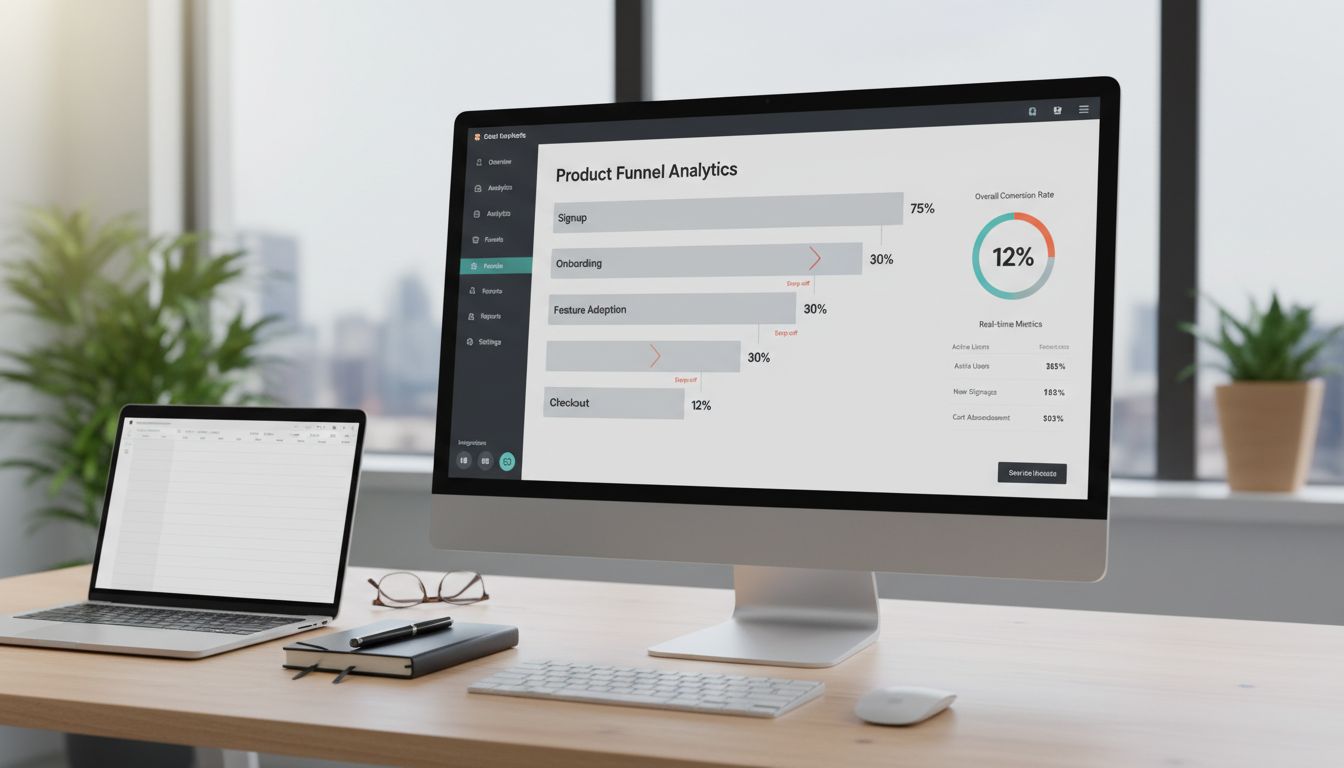
After (structured, AI-ready):
H1: Funnel Visualization for SaaS Analytics
Problem: Most analytics tools show pageviews, not drop-off points in multi-step flows.
Solution: FlowMetrics maps every step of your signup, onboarding, or checkout flow and highlights where users abandon.
FAQ (H2):
H3: How does funnel visualization differ from event tracking?
Event tracking logs actions. Funnel visualization sequences them and calculates conversion rates between steps.
How It Works (H2):
- Define your funnel steps (e.g., "Visit pricing" → "Start trial" → "Add payment")
- FlowMetrics auto-instruments each step via SDK
- View real-time drop-off rates and A/B test variations
Technical Specs (Table):
| Feature | Limit |
|---|---|
| Max steps per funnel | 20 |
| Supported platforms | Web, iOS, Android |
The second version answers specific questions, uses clear headings, and structures data for machine extraction. That's what gets cited.
By Week 6, you should have 3-5 pages rebuilt using this template. Prioritize your highest-traffic product pages first.
Phase 3: The 2026 E-E-A-T Starter Pack (Ongoing)
What are the 4 pillars of SEO? The textbook answer (technical, content, links, and user experience) is already obsolete. For 2026, think of them as: 1) Technical (optimized for AI consumption), 2) Content (product-first, not blog-first), 3) E-E-A-T (trust signals for algorithms), and 4) AI Citation Optimization (structured for LLM retrieval).
Most founders treat E-E-A-T like a philosophy course. They read about "demonstrating expertise" and nod along, then do nothing.
That ends now.
E-E-A-T isn't abstract. It's a checklist of machine-readable trust signals that tell Google and AI systems: "This content comes from someone who actually builds and uses this product." Implementing author schema validates expertise for AI citation. Pages with clear expertise markers are disproportionately cited in AI Overviews.
Here's your 5-point E-E-A-T implementation checklist. Start this week.
1. Author Schema for Founders
Add JSON-LD author markup to your About page, product documentation, and any thought leadership content. Link to your LinkedIn, GitHub, or personal site.
This isn't vanity. It's entity validation.
Most SaaS founders already have the credentials. You just need to surface them in a format AI systems can parse. If you've shipped code, spoken at conferences, or worked in the industry for years, that's your expertise signal.
2. 'Behind-the-Login' Proof
Your product documentation, changelog, and internal knowledge base contain proof of deep expertise. Make strategic parts of it public.
Create detailed how-to guides that reference specific product features, technical architecture decisions, or edge cases you've solved. Anonymized customer case studies work even better. This signals first-hand experience, the "E" in E-E-A-T that separates you from content farms.
3. Freshness Cadence
Pages refreshed within three months are three times more likely to be cited in AI answers. Set a quarterly review for your top 5 product pages.
This doesn't mean rewriting everything. Update pricing, add new integration examples, refresh screenshots, or expand a feature comparison. Even minor updates with a visible "Last updated" timestamp signal recency.
4. Community & Support Signals
Link to your GitHub repo (if open-source), community Slack or Discord, detailed changelog, or public roadmap.
These are trust proxies that show real users and ongoing development. If you don't have a public community yet, your changelog is enough. Just make sure it's detailed and regularly updated, not generic "bug fixes and improvements" entries.
5. Citation of Your Own Data
Use anonymized customer metrics, benchmark data from your user base, or internal research to back claims. "Our users see an average 40% reduction in [metric]" beats "studies show this approach works."
Original data is catnip for AI citations. You don't need a formal research paper. A simple aggregated insight from your customer base is enough.
These aren't nice-to-haves. They're the difference between being cited in an AI Overview and being invisible when buyers search for solutions in your category.
Phase 4: Technical SEO for AI Citation (Ongoing)

Think of technical SEO for AI like preparing a dataset, not decorating a website. AI systems don't browse your pages. They parse them. If your content isn't machine-readable, it doesn't exist to ChatGPT, Perplexity, or Google's AI Overviews.
Structured data isn't optional anymore. Pages with three or more schema types have a 13% higher likelihood of being cited, and 61% of AI-cited pages use multiple schema types. That's not correlation.
Your priority schema list, in order:
- Product schema for your feature/pricing pages (remember: product content gets cited 10-20× more than blog posts)
- FAQ schema for your support and product pages
- HowTo schema for any guides or tutorials
- Author schema for every piece of content with a byline
If you're on WordPress, install Schema Pro or Rank Math. If you're on Webflow or a custom stack, use Google's Structured Data Markup Helper to generate JSON-LD snippets and drop them in your page <head>. No developer required.
What about MCP and NLWeb? Here's the non-technical explanation: Model Context Protocol (MCP) is essentially an API that lets AI systems pull trusted, structured data directly from your site instead of scraping HTML. NLWeb does the same for conversational interfaces.
Both rely on the same foundation: clean, structured data via schema markup. You don't need to "implement MCP" today. You need to implement schema so you're ready when AI systems come knocking.
Freshness matters at the code level, too. AI systems check lastmod dates in your XML sitemap and dateModified in your schema. When you update a page, update those timestamps. Better yet, schedule quarterly content reviews and use product changelog releases as triggers to refresh related pages.
Track AI referrals in GA4. Set up a custom segment for referrers containing "chatgpt.com," "perplexity.ai," "gemini.google.com," and "copilot.microsoft.com." You won't see massive volume yet, but you'll see the trend. More importantly, you'll know which pages are earning AI citations.
The technical work isn't glamorous. But it's the difference between being a wall of text and being a citable source.
Conclusion
SEO in 2026 isn't about ranking first. It's about being cited first. The playbook has changed, and if you're still following the traditional google seo starter guide mentality, you'll be invisible when AI Overviews answer your customers' questions without them ever reaching your site.
Here's the opportunity: most of your competitors are still optimizing for 2019. They're churning out blog posts while you're structuring product pages with schema markup. They're chasing backlinks while you're building first-hand expertise signals.
The numbers tell the story. Product content drives 70% of AI citations [Source: guptadeepak.com]. Pages with multiple schema types are 13% more likely to be cited [Source: yourcontentmart.co]. Being cited in an AI Overview delivers 35% more organic clicks than not being cited [Source: seerinteractive.com].
You don't need a team of ten or a six-figure budget.
You need two hours this week to restructure one high-value product page using the AI-Citable Content Template. Add schema markup. Write a first-hand experience section. Structure your headings sequentially. Document what you changed and why. This is how to do seo for website step-by-step in 2026, not copying tactics from a free digital marketing course with certificate you took three years ago.
Then measure what happens when AI systems start reading your content like a dataset instead of a blog post.
Frequently Asked Questions
Is SEO dead or evolving in 2026?
Dead? No. Completely transformed? Yes.
SEO morphed from a traffic engine into a citation and trust engine. AI Overviews now show up in 20-25% of searches [Source: thedigitalbloom.com], which fundamentally rewrites how people interact with results. The old principle still holds (provide the best, most authoritative answer), but now you're optimizing for human readers and the AI systems that decide which sources deserve to be quoted.
Will AI replace SEO?
AI will kill off the garbage. Keyword stuffing, thin content, all the lazy tactics that never should've worked in the first place.
But it makes real expertise more valuable. Being cited in an AI Overview gets you 35% more organic clicks than not being cited [Source: seerinteractive.com]. AI systems actively hunt for content with demonstrable first-hand experience and trust signals. Founders who can inject genuine expertise, use AI tools strategically instead of letting them run wild, and build actual E-E-A-T signals are going to dominate in 2026.
Is SEO difficult to learn?
The hard part isn't learning SEO. It's unlearning all the outdated stuff cluttering your brain.
The 80/20 framework in this guide cuts through the noise and focuses on what actually moves the needle: product-centric content (which drives 70% of AI citations [Source: guptadeepak.com]), structured data, and trust signals. You can grasp the core concepts in weeks. If you follow a lean, product-first workflow, you'll start seeing results within 90 days.
Can ChatGPT do an SEO audit?
For high-level content gap analysis? Sure. Try this: "Act as an SEO auditor. Analyze [URL] and list the top 3 technical issues and 5 keyword opportunities compared to [Competitor URL]."
But comprehensive technical audits require actual tools. Crawl analysis, indexation issues, backlink profiles, schema validation, you need Screaming Frog, Ahrefs, or Search Console for that. Use AI as a research assistant, not a replacement for proper tooling.
Can ChatGPT write SEO articles?
ChatGPT is excellent for research, outlines, and first drafts. But articles that rank and get cited in 2026 need something AI can't fake: your expertise.
AI-generated content must have human oversight to rank [Source: dool.agency]. AI systems favor content with clear first-hand experience and author authority. Use ChatGPT to accelerate your workflow, absolutely. But you, the founder with actual product knowledge, need to be the one adding unique insights, real data, and E-E-A-T signals that make content worth citing.
What is the golden rule of SEO?
Create the best, most trustworthy answer for both humans and AI systems.
That means two things. Structure your content so AI can easily parse and cite it: clear headings, schema markup, concise answers. Pages with sequential heading structures boost citation odds by 2.8× [Source: yourcontentmart.co]. But also provide undeniable value and expertise that only you can offer. Structure without substance gets you exactly nowhere.