May 14th, 2026
Search Engine Optimization vs Search Engine Marketing: A SaaS Founder's Guide
 WD
WDWarren Day
You're a SaaS founder with a few customers and a spreadsheet of ideas. You need leads yesterday, but you're also building something for the next five years. Every blog you read says "do both SEO and SEM," and you've got maybe 10 hours a week for marketing.
That's the trap the search engine optimization vs search engine marketing debate puts you in.
The standard advice, that you should manually juggle both channels, isn't just unrealistic. It's a path to mediocre results in both. You can't outwrite a well-funded competitor's content team, and you can't outbid them on every click.
Here's the thing nobody actually says out loud: the winning move for 2026 isn't picking one channel or burning yourself out trying to do both manually.
It's deciding which growth engine you automate first.
For most SaaS founders, that means automating SEO content creation, building an asset that compounds while you sleep, and saving your limited bandwidth for focused, manual experimentation with SEM. That's the seo and sem strategies framework that actually works at this stage.
This is only possible now because of tools like AI-powered SEO automation like Spectre, which remove the scaling bottleneck that made SEO feel impossible for a solo founder. Spectre exists specifically for this problem: turning organic search from a manual, time-consuming grind into something systematic and predictable.
The rest of this guide is a practical framework for seo and sem marketing, not a theoretical debate. You'll learn how to assess your unit economics, run a 90-day hybrid plan that builds pipeline now while stacking long-term assets, and know when the data is telling you to shift gears. Along the way we'll cover the seo and sem tools worth your attention at each stage.
H2: Decoded: What SEO and SEM Actually Mean in 2026
Let's clear the fog. These terms have evolved past their textbook definitions, and getting this right is your first real advantage.
SEO (Search Engine Optimization) is building your website into something that earns unpaid visibility in search results. Not just ranking on Google anymore, you're optimizing for AI Overviews, Answer Engine snippets, and zero-click SERPs that now dominate how people actually find things.
The four pillars still apply: technical infrastructure (Core Web Vitals, indexation), on-page optimization (keyword targeting, structure), off-page authority (backlinks, domain rating), and user experience. But the goal has shifted. It's no longer "rank #1." It's "become the source Google's AI chooses to cite."
SEO compounds. Every piece of content you publish adds to an asset base that keeps generating traffic long after you've moved on to other things.
SEM (Search Engine Marketing) is renting traffic through paid placements. In 2026, that mostly means Google Ads, plus niche platforms like LinkedIn for B2B intent. You're not building anything, you're buying visibility for specific keywords, and the moment your budget runs out, the traffic stops.
The control is precise and results are immediate. It's also a pure operational expense with zero residual value.
The distinction that actually matters: SEM is paid placement, SEO is earned visibility. One is renting space, the other is buying property. Fundamentally different economic models.
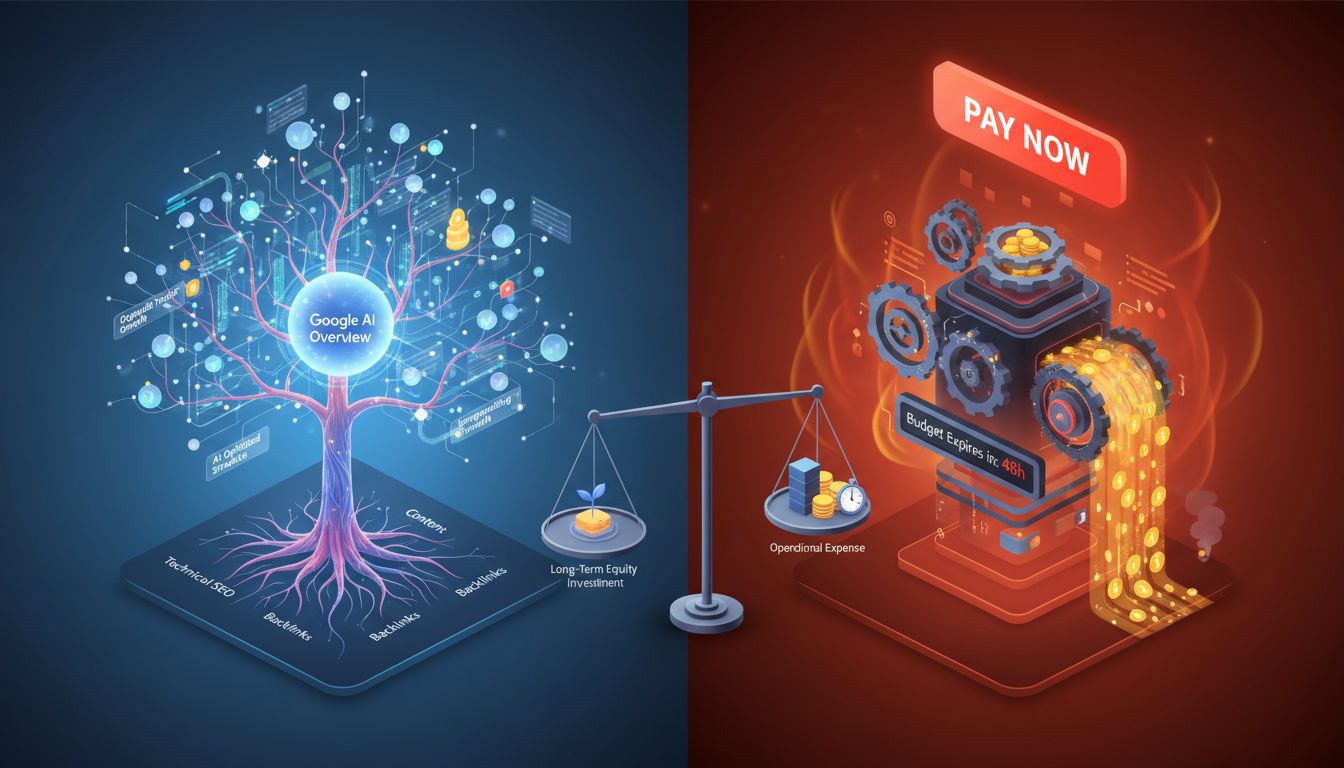
Here's what most founders miss in 2026: SEO's "four types" have basically merged. Technical SEO isn't separate from content, it's the foundation that determines whether Google's crawlers can even understand your pages.
Content isn't just blog posts anymore. It's structured data, FAQs, and information architecture that feeds AI Overviews. Over 60% of SaaS marketers report AI-driven search results have fundamentally changed their organic patterns, with around 40% seeing measurable CTR drops from AI Overviews alone.
That's the playing field now.
SEM has evolved too. It's not just keyword bidding, it's audience targeting, remarketing pools, performance max campaigns that blend search with display and video. But the core economics haven't changed: you pay per click, you stop paying, the traffic disappears.
This matters because the old search engine optimization vs search engine marketing debate was built on 2010s thinking. In 2026, you're not choosing between channels. You're deciding how to split resources between building permanent assets and renting temporary visibility. The seo and sem strategies that work now treat those as different budget categories, not competing options, and the seo and sem tools you pick should reflect that split too.
H2: The Core Decision Axes for SaaS Founders
The "search engine optimization vs search engine marketing" debate is a distraction. You're not comparing tactics, you're looking at two completely different growth engines that affect your cash flow, your team, and whether you're still around in 18 months.
Forget features. There are four axes that actually matter here.
| Axis | SEO (Organic Search) | SEM (Paid Search) |
|---|---|---|
| 1. Time-to-Value | Slow build (3-6+ months) | Instant traffic (hours) |
| 2. Cost Model | Capital investment (compounds) | Recurring operational expense |
| 3. Operational Drag | High initial setup, then automatable | Constant manual optimisation |
| 4. 2026 Adaptability | Must evolve for AI Overviews & AEO | Directly targets AI-generated answers |
Each one hits your runway and roadmap differently. That's what we're getting into next.
H3: Axis 1: Time-to-First-Result vs. Time-to-Durable-Asset
When your pipeline is empty, the difference between these timelines feels existential.
SEM gets you traffic within 48 hours. Turn on Google Ads for something like "best CRM for small business" and qualified visitors show up almost immediately. That speed is genuinely useful when you need pipeline now, when you're testing messaging before committing to content, or when users are actively searching for you.
SEO runs on a completely different clock.
You'll see the first trickle of organic traffic after a month or two, if you're going after low-competition keywords. Actual SQLs from organic search? That's more like 4-6 months, based on the Tripledart case studies. The real compounding happens over 12-24 months, where consistent investment produces 20-40% quarterly organic traffic growth after that initial ramp.
Founders get stuck on the immediacy. They pour budget into SEM because they can see daily clicks and conversions. SEO feels like throwing money into a hole with no bottom.
So they end up permanently renting their traffic, never building the kind of search asset that actually compounds.
Here's the reframe: SEO is a capital project. You fund it knowing the asset will pay off for years, often at a fraction of what you'll pay in future paid CAC. SEM is the operating expense you run during construction, it generates leads while you wait, tests what converts, and fills gaps.
One builds equity. The other covers this month's payroll. Both matter. But only one of them shows up on your balance sheet later.
H3: Axis 2: Economics & Cash Flow: Recurring Cost vs. Capital Investment
This is where it gets real. You're not just comparing marketing costs, you're choosing between two completely different financial models.
SEM is a perpetual operating expense. Pure cash flow: CPC × Clicks = Monthly Burn. The traffic stops the moment you stop paying. For SaaS, those clicks aren't cheap, B2B keywords regularly hit $4–$8 CPC, with enterprise terms climbing to £15+ in competitive markets [Source: PPCChief, LeverDigital]. That feeds directly into your CAC. A typical paid search channel CAC sits around $341, versus $205 for organic [Source: Prospeo 2026].
That's a 66% premium every single time you acquire a customer through ads instead of search.
SEO is a capital investment with depreciating cost. You pay upfront for seo and sem tools, content, and link-building. But once a page ranks, the marginal cost of that traffic approaches zero. The content becomes an asset that keeps working. After 12–24 months, organic CAC typically runs 5–10× lower than paid CAC [Source: OwlClaw SaaS SEO benchmarks]. For top SaaS companies, SEO-driven traffic represents 40–70% of MRR, revenue that flows in without additional spend.
Here are the actual numbers. Average annual contract value of $5,000, 60-day sales cycle:
- Paid Search CAC of $800 → Payback period: ~100 days
- Organic SEO CAC of $200 → Payback period: ~25 days
Which business would you rather own?
The one burning cash to maintain pipeline, or the one where past investments keep generating leads at near-zero marginal cost? This is the core difference in search engine optimization vs search engine marketing when you're thinking about unit economics. It's not about seo and sem marketing theory, it determines your runway, your valuation, your ability to scale.
Good seo and sem strategies account for both. But only one of them shows up as an asset later.
H3: Axis 3: Scalability & Operational Drag
This is where the traditional argument for SEO falls apart, and where modern automation changes everything.
SEM scales linearly, but the management complexity scales with it. You can double your ad spend today. The platform will happily take your money. But scaling effectively means your time and expertise become the bottleneck. Every new keyword group needs negative keyword lists, bid adjustments, custom landing pages. At a certain point you're hiring an agency or building an internal team just to maintain what you've bought, creating operational drag that eats directly into margins.
Traditional SEO hits a hard human wall. The benchmarks show that publishing 9+ blog posts per month correlates with significant organic traffic gains, but most founders hit a ceiling at 2-4 articles. Why? Because scaling content means hiring writers, managing briefs, editing, publishing workflows. Each new piece creates more overhead.
You're not just paying for content. You're paying for project management, quality control, and the mental load of maintaining a content calendar. This is why so many SaaS SEO initiatives stall, the founder becomes the bottleneck.
Automated SEO removes the human bottleneck entirely. This is the 2026 pivot. With platforms like Spectre, the system handles keyword research, article generation, and publishing at a scale that's impossible manually. The operational drag shifts from managing people to configuring an intelligent system.
Instead of briefing a writer, you're setting targeting parameters. Instead of editing drafts, you're reviewing AI-generated content that already follows SEO best practices.
The scalability calculus changes completely. With automation, SEO can scale almost as linearly as paid, but retains the compounding, low-CAC economics of organic. You're not limited by how many writers you can hire. You're limited by how many relevant keywords exist in your space.
This is what changes the strategic recommendation across seo and sem strategies: SEO becomes the scalable channel, while SEM becomes the tactical accelerator for specific campaigns. It's also why the right seo and sem tools matter so much here, the difference between a team of ten and a system of one is mostly infrastructure. That's the real story behind search engine optimization vs search engine marketing in 2026, and it's what separates seo and sem marketing theory from how it actually plays out operationally.
H3: Axis 4: Adaptability to the 2026 Search Landscape (AEO, AI Overviews)
Updated for the 2026 search landscape. Google Search is no longer just a list of links. It's an AI-powered answer engine now, and AI Overviews, zero-click results, and rich snippets have fundamentally changed how users interact with results.
Your seo and sem strategies need to account for this. Or they don't work.
For SEM, this creates real risk. You might be bidding on keywords that Google now answers directly inside an AI Overview panel, over 40% of SaaS marketers report visible CTR drops from these features. Your ad spend could be chasing queries where commercial intent is gone before the user even thinks about clicking.
For SEO, the game has shifted from "ranking on page one" to "becoming the cited source." That means clear direct answers, structured data, E-E-A-T signals, content so authoritative that search engines want to quote it. Answer Engine Optimization (AEO) isn't a nice-to-have anymore.
Keeping pace with this manually is close to impossible. The SERP features for your target keywords change week to week.
This is where the right seo and sem tools stop being optional. A tool like Spectre is built specifically for this environment, it researches not just keywords but the SERP features and AI Overview patterns around those terms. Then it creates content structured to serve as a primary source, prioritizing depth and clarity over word count.
The old playbook of publishing a 1,500-word post and waiting is broken. That's just the reality of search engine optimization vs search engine marketing in 2026, the gap between what worked before and what works now is wide enough that seo and sem marketing teams who haven't adjusted are basically running on fumes.
Systematic, AEO-aware content production at scale is the only answer. And that's only operationally feasible with automation.
H2: The Consensus is Wrong: Automate SEO, Accelerate with SEM
Every marketing consultant will tell you to "do both" SEO and SEM. That's useless advice for a founder with 10 hours a week.
Manually executing quality SEO and strategic SEM guarantees burnout and mediocre results in both channels. It's not a strategy. It's a failure mode.
The modern solution is to invert your resource allocation. Automate the long-term asset creation, SEO, and manually manage the short-term, high-touch experiments, SEM.
Think of it this way: your SEM campaigns are live, tactical sprints. You need to monitor bids, tweak ad copy, and run A/B tests on landing pages. That's work that demands human creativity and immediate feedback.
Meanwhile, your SEO pipeline should be a compounding engine building equity in the background, month after month.
That's exactly what we built Spectre to do, automate keyword research, content creation, and publishing so you're building that asset on autopilot.
Look at Ahrefs, which grew to $40M ARR through SEO and content. Imagine if they could have built that foundational content library 10x faster with automation. The freed-up resources could have gone into product development years earlier.
That's the acceleration you get when you stop treating SEO as a manual content chore.
This directly answers questions I see founders asking all the time. Is SEO dead or evolving in 2026? It's evolving. The old playbook of sporadic blog posts is dead. The new playbook is systematic, AEO-aware content production at scale, which is only operationally feasible with automation.
Is SEO replaced by AI? No. AI is not replacing SEO. It's its most powerful ally when used correctly to handle the repetitive, data-heavy parts of the workflow.
The verdict on search engine optimization vs search engine marketing isn't really "pick one." It's "stop doing both manually."
For a resource-constrained SaaS founder, the right seo and sem strategies in 2026 look like this: let a tool like Spectre handle the scalable, long-term SEO work. That frees you to personally steer the high-leverage, immediate-impact SEM work.
You get the durable asset and the accelerated pipeline. The right seo and sem tools make this possible. Without them, "doing both" is just a thing people say before they burn out.
H2: Your 90-Day Hybrid Action Plan for 2026
Theory without execution is just reading. Here's the exact 90-day plan I'd follow if I were starting today, balancing limited time against the need for both immediate pipeline and long-term assets.
Phase 1: Foundation & Firestarters (Days 1-30)
Don't overthink this. Fix what's broken, then light two fires: one automated, one manual.
- Run a Technical SEO Audit (Day 1-3). Use Ahrefs Site Audit or Semrush. Fix anything flagged as "High Priority", indexation issues, canonical errors, Core Web Vitals problems. Meduzzen's playbook gets this right: technical debt caps your organic growth before you've even started.
- Set Up Measurement (Day 4-5). Connect Google Analytics 4 with Search Console. Configure one conversion event (demo request, trial sign-up). If you have the technical bandwidth, look at server-side tagging, it recovers roughly 34% of lost conversion signals from ad blockers [Source: Tracklution].
- Launch Spectre (Day 6-10). Input your core product category and a handful of competitor names. Let it research keywords, find content gaps, and queue your first content cluster (5-7 articles around a specific sub-topic). Set it to publish 2 articles per week. Your time investment: about 2 hours.
- Launch One Focused SEM Campaign (Day 11-15). One campaign, one high-intent keyword phrase, something like "[Your Tool] vs [Competitor]" or "[Your Tool] pricing." Start at £15-£20/day and send traffic to a dedicated landing page.
Phase 2: Execution & Early Signals (Days 31-60)
Now you run the system and watch for signals.
- Spectre Autopilots Content. Your first articles go live. Check Search Console for impressions and early ranking movement. Don't expect traffic yet, you're just looking for Google to acknowledge the content exists.
- Optimise the SEM Campaign. Pull your search terms report and add negative keywords ("free," "open source," anything bleeding budget). A/B test two ad copies. Run one CRO test on the landing page, the headline or the CTA button, pick one.
- Tools in Play: Ahrefs for ranking tracking, Google Ads for optimisation, Spectre dashboard for content pipeline health.
Phase 3: Analysis & Strategic Pivot (Days 61-90)
This is where activity becomes strategy.
- Review Spectre's Performance. Which articles from the first cluster are gaining traction? Which keywords moved from position 20 to 15? Queue more content on those winning topics.
- Calculate Initial CAC. Total SEM spend over 90 days divided by qualified leads generated. Do the same for any early organic conversions. Now you have real, channel-specific CAC data, not guesses.
- Make Your First Budget Re-allocation. Based on CAC and lead quality, decide: increase SEM spend on what's working, or shift resource toward the organic topics showing promise? Either way, it's an informed decision now.
After 90 days you won't have massive traffic. What you'll have is a functioning, measurable system, an automated content engine building your long-term asset, and a manually-optimised SEM campaign generating immediate pipeline.
That's the practical reality of seo and sem marketing done right. The search engine optimization vs search engine marketing debate assumes you have to pick. With the right seo and sem tools and seo and sem strategies, you're not picking. You're running both, and neither one is eating your week.
H2: Common SaaS Founder Mistakes (and How Automation Sidesteps Them)
Most founders don't fail at SEO because they don't care. They fail the same way, every time.
I've watched dozens of SaaS founders make the same four operational errors. Not mistakes of intent, mistakes of execution. And automation solves them at the system level.
Mistake 1: The 'We'll Do SEO Later' Delay.
You launch, focus on product, promise to fix the website later. The result? Technical debt compounds. Your site becomes a mess of duplicate content, poor Core Web Vitals, and broken indexation that costs 2-3x more to fix later [Source: Meduzzen, ArchcoWebDesign].
Spectre requires a technically sound foundation to work. It won't publish to a broken site. So you're forced to fix canonical tags, sitemaps, and site structure upfront, technical SEO stops being an afterthought and becomes a prerequisite.
Mistake 2: Inconsistent, Random Content Publishing.
You publish three articles one month, then nothing for three months. Search engines see no authority building, and you get no compounding returns.
Spectre runs on a scheduled publishing pipeline. It doesn't get distracted. You set a cadence, two articles a week, say, and the system executes. That kind of regularity is what builds topical authority, and it's also the thing human teams almost never sustain.
Mistake 3: Targeting Broad, Unwinnable Keywords.
Founders with a DR 15 site target "CRM software." That's a knife-to-a-tank-fight situation. You spend months on content that never ranks, and eventually just... stop.
Spectre's AI research identifies ranking pockets, clusters of long-tail keywords your site can actually compete for given your current Domain Rating. It stops you from fighting battles you're going to lose anyway, which matters a lot when you're thinking about seo and sem strategies that actually move the needle.
Mistake 4: Ignoring the Shift to AEO/Answer Engines.
Writing blog posts for a 2020 SERP is obsolete. Over 60% of SaaS marketers now report AI-driven search results affecting their organic patterns [Source: OliverMunro].
Spectre's AI is trained to produce the kind of content modern answer engines prefer, comprehensive, clearly structured, semantically rich. FAQ schemas, thorough subtopic coverage, E-E-A-T signals. It handles the 2026 search landscape by design, not as a retrofit.
Automation isn't just about saving time. It's about enforcing the disciplined, systematic approach that manual efforts, even good ones, consistently fail to maintain. That's the part most seo and sem tools don't tell you.
H2: Verdict: Clear Guidelines for Your Situation in 2026
Let's cut through it. This isn't really about picking a channel. It's about picking the right operational model for where you actually are.
Choose Automated SEO (with Spectre) If:
This is the default path for most B2B SaaS founders. Your product has product-market fit, your average deal size is over $500, and your sales cycle stretches past 30 days.
You're building a company, not running campaigns. You need an asset that compounds while you're doing other things. According to OwlClaw SaaS SEO benchmarks, after 12-24 months, organic CAC runs 5-10× lower than paid. That's not speculation, that's just the economics of scaling SaaS.
Choose Manual SEM (Temporarily) If:
You're in a launch window where you need demos this week to survive. Or you're testing demand for a completely novel category with zero existing search volume. Or there's a time-bound promotion where visibility right now matters more than long-term asset value.
Key word: temporarily. SEM is a surgical probe, not a strategy. Once you validate demand, you'll need the SEO foundation anyway.
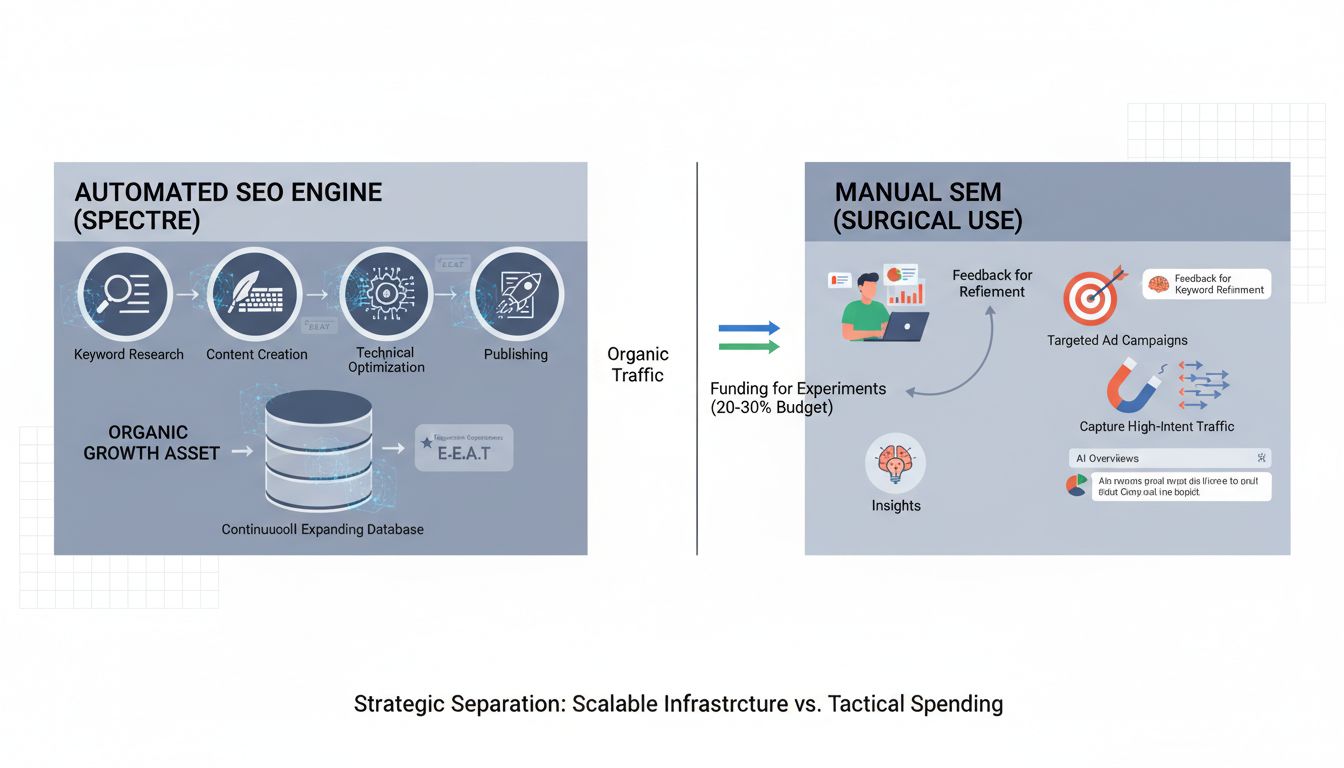
The Hybrid Champion Path (Recommended):
This is the 2026 playbook I built Spectre to enable. Automation handles the SEO asset systematically, keyword research, content creation, optimization, publishing, all running without you touching it.
Then you take a controlled budget (20-30% of marketing spend) and run manual, hypothesis-driven SEM campaigns. Target high-intent keywords your SEO content hasn't captured yet.
Your automated SEO engine funds your SEM experiments. That's not "doing both", that's separating a capital investment from an operational tool. The seo and sem strategies that actually compound treat them differently from the start.
Final Summary:
The search engine optimization vs search engine marketing debate is basically settled by automation. SEO becomes a hands-off capital project. SEM becomes a focused tool you manage directly.
Your job as a founder in 2026 isn't to choose between them. It's to start building the automated asset now, while using paid channels with precision. The seo and sem marketing question stops being either/or once you have the right seo and sem tools running in the background.
The companies that win are the ones that stop treating SEO as a manual task and start treating it as infrastructure.
Conclusion
Search engine optimization vs search engine marketing isn't really the debate. The actual question is: are you building an asset or buying time?
SEO compounds. SEM expenses. That's the whole calculus.
The old ceiling on SEO growth was manual content production. You could only publish so much. Tools like Spectre killed that ceiling. You can now run a content operation on autopilot that would've required a full editorial team two years ago.
In a world of AI Overviews and zero-click SERPs, consistent E-E-A-T-optimized content is the moat. Sporadic, manual efforts won't cut it. Automation is what makes consistency actually possible for small teams.
The seo and sem strategies that work in 2026 treat these as two different jobs. Automate the SEO content creation. Run your SEM budget manually, focused on high-intent gaps your organic content hasn't captured yet. That's not "doing both", that's building a growth engine where each part does what it's actually good at.
The seo and sem marketing question stops being either/or once you have the right seo and sem tools running in the background.
Stop treating SEO as a task on your to-do list. It's infrastructure. Build it now, use SEM as a scalpel later.
Start your 90-day SEO automation plan with Spectre: audit your technical foundation, set up your first keyword cluster, launch one focused SEM campaign. Let the asset compound while you sleep.
Start your 90-day SEO automation plan with Spectre
Frequently Asked Questions
What are the 3 C's of SEO?
The '3 C's' are Content (user-first quality), Code (technical health and Core Web Vitals), and Credibility (authority through backlinks and E-E-A-T signals). Miss one and the others suffer.
A tool like Spectre covers all three systematically, quality content generation, automated technical publishing, and topical authority built into the structure itself.
What is the 80/20 rule for SEO?
Roughly 80% of your qualified traffic comes from 20% of your content. [Source: OwlClaw Technologies] Usually your bottom-of-funnel pages, pricing, comparisons, alternatives. Not your blog posts about industry trends.
This is why any seo and sem strategies worth following have to prioritize these pages first. Spectre is built to identify and scale exactly these high-leverage pages automatically. You stop wasting cycles on content that won't move anything.
What is the 3-3-3 rule in sales?
A framework for new reps: 3 hours researching the prospect, 3 hours preparing for the call, 3 hours on follow-up. The point is deliberate time allocation across research, execution, and analysis.
For founders doing their own marketing, automating the execution block with seo and sem tools like Spectre frees you up to actually spend those hours on sales. That's the trade worth making.
Is SEO replaced by AI?
No. It's being augmented. AI handles the repetitive stuff, content drafting, keyword clustering, and changes how results are displayed through AI Overviews. [Source: OliverMunro]
Winning in 2026 means treating AI as the engine, not the threat. Using tools like Spectre to produce more content, faster, optimized for search engine optimization vs search engine marketing realities in this new environment. The job shifts from doing SEO manually to running the system that does it for you.