June 14th, 2026
Surfer SEO vs Semrush: Which Tool Wins for AI Content Teams?
 WD
WDWarren Day
You're a content lead in 2026, tasked with scaling AI-powered content production. Your team's efficiency and your budget both hinge on picking the right SEO tool.
The surfer seo vs semrush debate isn't really about features. It's about which tool actually moves content out the door without burning resources on things you don't need.
For teams focused on scaling AI-powered content, Surfer SEO is the more focused, cost-effective path to rankings. Semrush is a powerful market intelligence platform, but that breadth adds cost and complexity that doesn't directly translate to faster content output.
The real edge, though, comes from moving beyond manual tools entirely and building fully automated content pipelines.
This comparison breaks down the decision across four axes that actually matter for scaling teams: AI-powered content creation, data depth, total cost of ownership, and usability. You'll get a clear, situation-based recommendation, plus a look at what comes next when you outgrow manual workflows.
H2: What is Surfer SEO? A Content Optimization Engine

Surfer SEO is a specialized AI-powered platform built for one purpose: helping content creators produce articles that rank. Unlike broad marketing suites, it focuses entirely on the content creation workflow, research, writing, and on-page optimisation.
The core of it is the Content Editor, which analyzes the top-ranking pages for your target keyword in real-time. It gives you a live "Content Score" based on over 500 ranking signals, specific guidance on word count, keyword usage, and structure as you write.
The integrated Surfy AI assistant can generate drafts, rewrite sections, and apply your brand's tone of voice.
For content teams scaling SEO, Surfer is basically a co-pilot for ranking. It removes the guesswork from on-page optimisation and turns keyword research into an executable, optimized draft.
H2: What is Semrush? A Market Intelligence Platform
Semrush takes the opposite approach. It's not a content co-pilot, it's a full-stack digital marketing intelligence platform.
Where Surfer focuses on guiding you through a single content draft, Semrush wants to give you a complete picture of your entire market.
The foundation is a massive proprietary database: 26.5 billion keywords globally, trillions of backlinks tracked. That data powers a sprawling suite of modules covering deep-dive SEO research, PPC competitor analysis, social media tracking, local SEO, and content toolkits.
It's built for analysts and managers who need to monitor everything, keyword rankings, backlink profiles, competitor ad spend, social engagement.
The philosophical difference is pretty stark.
Surfer asks, "How do I write this article to rank?" Semrush asks, "What's happening across my entire market, and where should I be putting resources?"
H2: Side-by-Side: A Quick-Reference Table
Here's how the three platforms stack up at a glance. Focused content engine, broad marketing suite, or fully automated pipeline, the table makes the choice pretty obvious.
| Surfer SEO | Semrush | Spectre | |
|---|---|---|---|
| Core Function | AI-powered content optimization & writing | Full-stack SEO & marketing intelligence | Automated SEO content pipeline |
| Key AI Features | Real-time Content Editor (500+ signals), Surfy assistant, Auto-Optimize | AI Article Generator, SEO Briefs, AI Visibility tracking | End-to-end automation: research, write, optimize, publish |
| Pricing Model | $49–$999/month (tiered by content volume) | $139.95–$499.95/month + add-ons & seats | API-first, usage-based scaling |
| Ideal User | Content teams & marketers scaling SEO articles | Marketing departments needing broad data & reporting | Founders & technical teams automating content at scale |
| Scalability | Manual optimization workflow | Manual research & planning workflow | Programmatic, hands-off production |
If you're purely focused on scaling SEO content, surfer seo pricing starts at $49/month and the concentrated approach delivers clearer ROI than paying for tools you won't use.
Semrush makes more sense if you need market-wide visibility across paid, organic, and social all in one place.
But if the goal is getting out of the manual workflow entirely, automated pipelines like Spectre are a different category. Not just a surfer seo alternative, something further down the road than either of these tools.
H2: Decision Axis 1: AI-Powered Content Creation & Optimization
If your primary job is producing SEO content that actually ranks, this is where the choice gets simple. Surfer was built for this workflow. Semrush added it as a feature suite.
Surfer's Content Editor is the centrepiece. You write in a real-time environment that scores your draft against the top 20 ranking pages using over 500 signals. The score updates with every sentence, not a checklist you review after the fact.
The integrated Surfy AI assistant generates drafts directly inside the editor, pulling from live SERP data. The thing that actually sets surfer seo ai apart from the rest is the AI Humanizer.
AI Humanizer Explained: The surfer seo humanizer isn't just a surfer seo ai detector workaround. It's a tone-matching engine. You feed it a sample of your brand's voice, existing posts, style guides, and it rewrites AI drafts to match that cadence, cutting the robotic phrasing while keeping the SEO structure intact. Content that passes both automated checks and a real editor's eye.
The workflow is linear: research → AI draft → humanize → real-time optimize → publish. Teams report cutting optimization time by 50% because the feedback loop is immediate.
The results back it up too. One e-commerce client saw a 3,403% increase in keyword rankings. ClickUp published over 150 articles and hit 85% blog traffic growth in 12 months.
Semrush's approach is modular. The AI Article Generator and Content Optimizer are separate tools inside a broader Content Marketing Toolkit. You generate a draft in one interface, then copy it into the Optimizer for a score after the fact.
The friction is constant context switching. Research in one tab, writing in another, optimizing in a third. The tools work, but there's no flow to it.
For a content lead, that adds up to more management overhead and slower output per writer.
Verdict: For pure, scalable content creation, surfer seo wins. Its environment is built for the writer, not the analyst. Semrush makes sense if you need AI visibility tracking across external platforms, but for producing publish-ready articles that rank, surfer seo's real-time guidance is in a different class. If you're weighing a surfer seo alternative, that's the gap you're giving up.
If you want to dig deeper into surfer seo reviews or compare surfer seo pricing against what Semrush charges for the same workflow, that breakdown is coming up.
H2: Decision Axis 2: Data Depth & Research Scalability
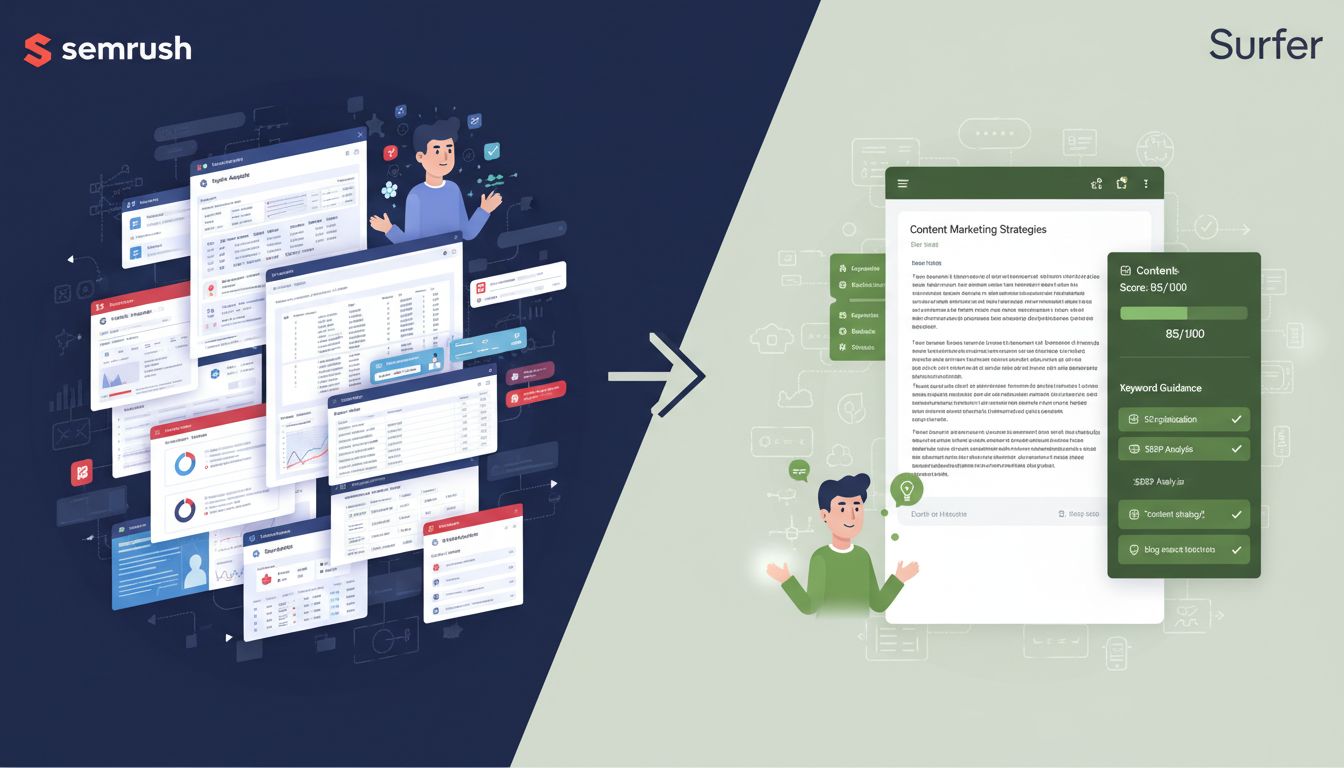
On raw data volume, Semrush dominates. Their platform indexes 26.5 billion keywords globally, tracks 43 trillion backlinks from 390 million referring domains, and crawls over 10 billion URLs daily. For enterprise teams doing global competitive intelligence at scale, that's genuinely hard to argue with.
Surfer's data set is more focused. It's built around the 500+ ranking signals powering its real-time Content Score. Some users report occasional keyword volume discrepancies when cross-referencing with Ahrefs or Google Keyword Planner, so if your workflow demands analyzing entire markets across multiple regions, Semrush's depth is hard to match.
But here's the question most content teams should actually be asking: do you need to analyze an entire market, or do you need to make this specific article rank?
The latter happens far more often.
Surfer's data is sufficient for optimizing individual pages and building topical authority within your niche. Its API is built for content-specific automation, creating editor sessions, running audits, exporting drafts directly into your CMS.
Semrush's API enforces a rate limit of 10 requests per second per IP address. For teams building automated research pipelines that need to process thousands of keywords, that becomes a bottleneck fast.
And honestly? The platform's sheer scale can feel like overkill when you're just trying to research a handful of target keywords for next week's post.
The data depth question ultimately reveals a workflow mismatch. Semrush gives you a microscope to study the entire ocean. Surfer gives you a fishing rod optimized for catching the fish you actually want.
Most scaling content teams need more fishing rods.
This is worth keeping in mind as you weigh surfer seo vs semrush on pricing too, surfer seo pricing is built around the content workflow, not the research stack. If you're looking at a surfer seo alternative, that's the trade-off you're making. More data, less direction.
H2: Decision Axis 3: Total Cost of Ownership for a Scaling Team
Pricing structures tell you a lot about what a platform thinks it's selling. Surfer charges based on content output, articles optimized, articles generated. Semrush charges based on features and seats, regardless of how much you actually publish.
As of 2026, Surfer's Essential plan runs about $99/month for 30 Content Editor articles and 5 AI articles. Semrush's Pro tier starts at $139.95/month for keyword research basics. Source: aitoolradar.io The gap gets bigger when you model a real team.
Take a three-person team publishing 50 articles a month. Surfer Scale at $219/month (annual) gives you 100 Content Editor articles and 20 AI articles, enough for the whole workflow. Semrush Guru at $249.95/month plus two extra user seats at $80 each lands you at $409.95/month before anyone's written a single word.
The seat trap is real. A five-person marketing team on Semrush Guru can hit $6,340 annually once you add user costs. Source: smartguidehubs.com That's money going toward PPC competitor analysis and social media tracking that your content writers will never open.
Surfer's surfer seo pricing actually makes sense for content teams: your cost scales with content volume, which is the thing you're trying to grow. Publish more, pay more, but you're also producing more. Semrush scales with users and features, which creates real friction when you hire a new writer or want to expand access.
Hidden costs are worth thinking through too. Semrush's Business plan at $499.95/month includes 5,000 keyword tracking, a ceiling scaling teams hit faster than expected. Semrush's API rate limits (10 requests per second) can also quietly strangle automation workflows.
This is a big reason why surfer seo reviews from scaling content teams tend to favor Surfer on cost. You're not subsidizing tools for other departments. Every dollar maps to content creation and optimization, which is what actually moves organic growth for most SMBs and startups.
If you're comparing surfer seo vs semrush purely on total cost of ownership, the math usually favors Surfer once your team has more than two people. That's also worth keeping in mind if you're evaluating a surfer seo alternative, you're often trading cost efficiency for data volume you may never use.
H2: Decision Axis 4: Trust, Usability & Practical Reality
Before you commit to either platform, two questions matter: can you trust it, and will your team actually use it?
The Russian founder narrative around Semrush is outdated corporate history. Semrush is publicly traded on the NYSE (SEMR), headquartered in Boston, with global data centers. That concern is a non-issue at this point.

For day-to-day usability, Surfer wins. G2 surfer seo reviews consistently praise how fast it is to get going, many users report a two-minute setup. The Content Editor is real-time: you write, it scores, you adjust. Surfer holds a 4.9 out of 5 on Capterra from 401 reviews, with users pointing to how it takes complex SEO workflows and makes them feel obvious. It focuses on one job and does it well.
Semrush is a different experience. The Capterra ratings are high, but that reflects how much the platform can do, not how easy it is to do it. New team members need real training to navigate 40+ tools. That's the trade-off for having everything in one place.
On the AI question, both Surfer's Surfy and Semrush's AI Article Generator are assistants. Not autopilots. A study of 2,600 businesses found 93% of marketers review AI-generated content before publishing. The surfer seo ai tools and Semrush's equivalents are useful, but human judgment still does the work for brand voice, accuracy, and E-E-A-T signals. Worth keeping in mind when you see people asking about the surfer seo ai humanizer or surfer seo humanizer, the content still needs eyes on it.
Same goes for the surfer seo ai detector angle. No AI writing tool eliminates the review step.
Semrush's breadth becomes a real advantage in one specific situation: your team is also running PPC campaigns, tracking social analytics, and managing local listings alongside content. If that's you, having everything unified in one platform makes sense. But for a content team focused on scaling SEO articles, that breadth just adds cognitive overhead and slower onboarding.
That's also worth keeping in mind when evaluating a surfer seo alternative. More features doesn't mean more useful, it often just means more to learn before you can publish anything.
H2: The Next Evolution: From Manual Tools to Automated Content Pipelines
Picking between Surfer SEO vs Semrush is still just picking a better manual tool.
You're still the one logging in, building the brief, generating the draft, running the optimization check, and hitting publish. Every single time. For every single article.
That workflow has a ceiling. Human time is the bottleneck, and no amount of good tooling changes that.
As an engineer, I see this as a systems problem. We stopped manually compiling and deploying code years ago, CI/CD pipelines handle that now. The same shift is happening in SEO content. The next step isn't a better interface for a human-driven process. It's a pipeline that takes a keyword list and outputs published, optimized articles with minimal intervention.
This is why we built Spectre.
Spectre isn't a surfer seo alternative or a Semrush competitor. It's the system that operationalizes what both tools are trying to do. You hand it a target keyword list. It handles the rest, researching search intent and competitors via DataForSEO, generating the draft, optimizing against ranking signals, and publishing directly to WordPress or your CMS.
Your role shifts from operator to strategist. You're reviewing output and setting direction, not executing a 12-step content workflow.
This is the real answer to what people mean when they ask about surfer seo ai or whether AI is replacing SEO. It's not replacing the strategy. It's replacing the repetitive execution that tools like Surfer still require you to do yourself.
The surfer seo pricing question matters less when you're thinking at scale. If your goal is going from 10 articles a month to 100, the constraint isn't which tool you're using, it's that you're still doing it manually. An automated pipeline removes that constraint entirely. You scale by scaling infrastructure, not headcount.
Conclusion
If you're a content team focused purely on scaling SEO articles, Surfer SEO gives you better ROI for that specific job. Semrush is the right call if you need broad market intelligence across SEO, PPC, and social.
But both of those are still manual workflow choices.
Getting from 10 articles a month to 100 isn't a tool problem. It's a systems problem. The bottleneck is that you're still doing it yourself, step by step, every time.
That's why we built Spectre. Not as a surfer seo alternative or a Semrush replacement, as the pipeline that handles research, writing, optimization, and publishing as one unified system, not four separate manual steps.
The surfer seo pricing question, the surfer seo reviews, the surfer seo ai detector features, all of that matters less when you're thinking at scale. If you're still asking "which tool should I use," you're still thinking in terms of manual execution.
The real question is whether you want a tool or an engine.
If it's the latter, Spectre is where to start.