April 15th, 2026
How an AI Content Idea Generator Can Scale Your SEO Strategy
 WD
WDWarren Day
Your content calendar is a graveyard of ambitious keywords you'll never rank for. You've got 500 "opportunities" but no clear signal on which five to actually write about next Monday. The bottleneck in scaling SEO isn't writing, tools for that are everywhere. It's the paralyzing, time-sucking void of deciding what to write.
An ai content idea generator is a system that analyzes SEO data, keywords, SERP features, competitor content, and domain authority, to suggest, score, and filter topics aligned with your actual ability to rank. The real value isn't an infinite idea fountain. It's a strategic filter that ruthlessly prioritizes viable opportunities, turning a creative bottleneck into a predictable pipeline.
Here's what this guide covers: how these tools actually work under the hood, beyond the marketing copy. How to build an integrated technical workflow from idea to published article. How to measure real pipeline impact versus vanity metrics. And an engineer's checklist for choosing between a free ai content generator and a paid one, based on API depth and integration capabilities, not feature-page claims.
If you've been hunting for the best free ai content generator without a clear framework for what "best" even means in your context, that's exactly what we're going to fix.
How an ai content idea generator actually works (beyond the buzzwords)
Most tools market themselves as creative brainstorming partners. That's the pitch. Underneath, they're systematic data pipelines. The AI isn't conjuring ideas from a void, it's running your inputs through a series of filters built on SEO and competitive data.
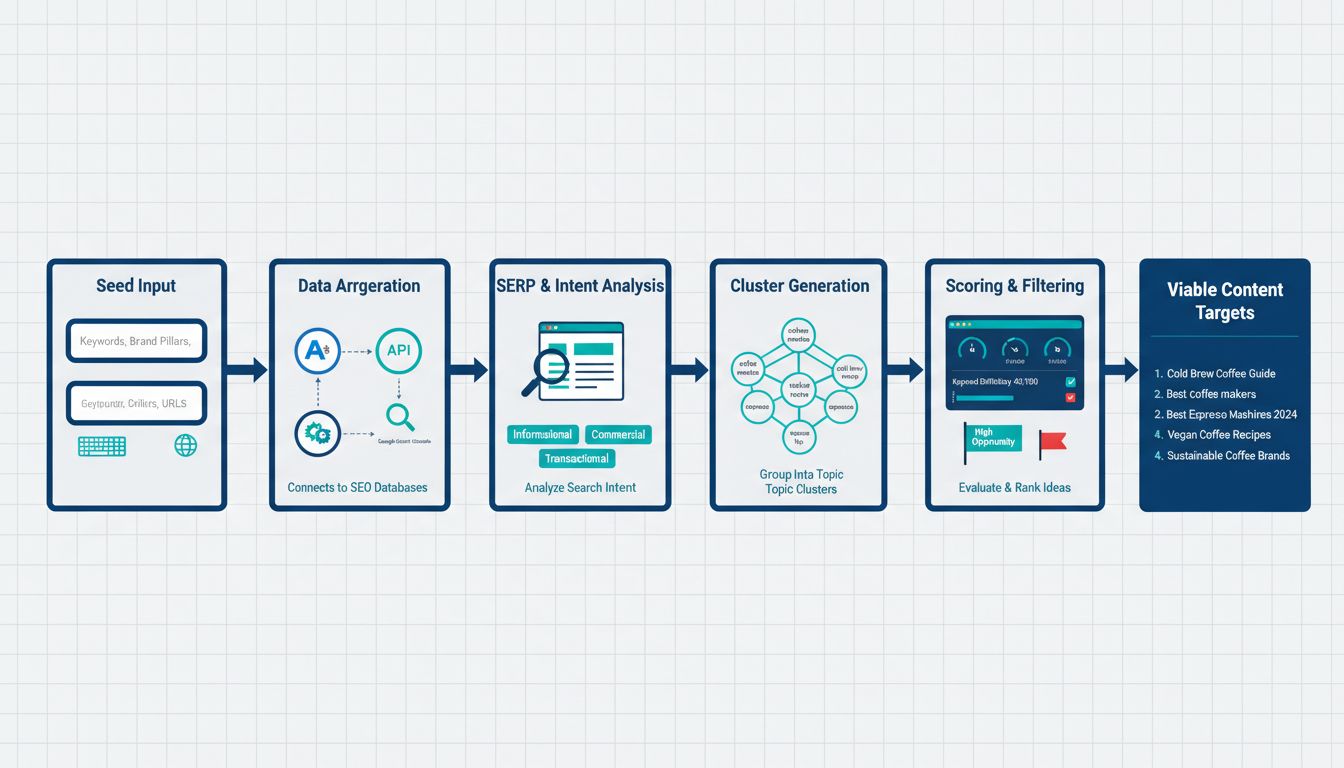
The process breaks down into five technical stages:
- Seed input: Your starting point. You feed the system your brand's core pillars, target keywords, or competitor URLs. It's not creating from scratch, it's extrapolating from your strategic direction.
- Data aggregation: The tool connects to external data sources via APIs, pulling metrics from platforms like Ahrefs, SEMrush, or Google Search Console, search volume, keyword difficulty, domain rating, competitor backlink profiles. This is where vague suggestions become data-informed analysis.
- SERP and intent analysis: The system fetches the current top 10-20 results for your seed terms, classifies search intent (informational, commercial, transactional), and reverse-engineers what's working: content length, structure, featured snippets, subtopic coverage.
- Cluster generation: Using semantic analysis, it groups thousands of related long-tail queries into logical topic clusters. Instead of a flat list of 500 keywords, you get 15 core topics with 30-50 supporting queries each. This maps directly to a pillar-and-cluster content architecture.
- Scoring and filtering: Each idea gets scored against your actual situation. Rules like "if our DR is 45, flag any topic where the top 3 results have a DR above 60" or "prioritize clusters with high 'how-to' query volume if we're writing tutorials." This is where the real work happens.
The output isn't a creative spark. It's a filtered list of viable targets, ranked by calculated probability of success given your domain's authority and resources. Whether you're using a free ai content generator or a paid platform, the value isn't the volume of ideas, it's the ruthless elimination of bad ones before they ever touch your content calendar.
That's what separates a genuinely useful best free ai content generator from one that just hands you a keyword dump and calls it strategy.
The Strategic Filter: Aligning Ideas With Your Domain's Reality
Most ai content idea generator tools treat every domain like it's Wikipedia. They'll cheerfully suggest you target "best CRM software" with your DR 15 SaaS blog. That's not strategy, it's a recipe for wasted effort. The real value comes when the tool acts as a filter, matching output to your domain's actual competitive position.
The Domain Rating (DR) Gatekeeper
Your domain rating is your competitive ceiling. I work with a simple heuristic: target Keyword Difficulty below (Your DR + 10). A DR 25 site should filter for KD35. This isn't about avoiding competition forever, it's about winning battles you can actually win first. Suggesting ultra-competitive terms to a new domain is like telling a local bakery to out-logistics Amazon. A good tool automatically excludes keywords where the top 10 results all have DR 50+, saving you from ranking fantasies before they touch your calendar.
Intent & Format Matching
The best free ai content generator won't just look at keywords, it analyzes SERP features and content types. If the top results for "project management software" are all comparison tables and "best of" lists, suggesting a theoretical "what is project management" guide is the wrong call. The SERP wants product comparisons. Creating the right content in the wrong format is a waste of time that no amount of optimization will fix.
Competition-Aware Gap Spotting
This is where things get genuinely useful. Tools can identify subtopics that top-ranking pages mention briefly but never fully cover. A top-ranking "SEO tools" guide might list 20 tools but dedicate one sentence to API access. That's your opening. A lower-DR site could write "The Complete Guide to SEO Tool APIs" and actually rank for that long-tail variation, not by competing head-on, but by going deeper where the leaders went shallow.
The filter's job isn't to generate more ideas. It's to generate fewer, better ones that match what your domain can realistically achieve right now. Whether you're using a free ai content generator or a paid platform, this is the difference between content planning and wishful thinking. You're not guessing, you're identifying opportunities that fit within your current constraints and ignoring everything else.
The Integrated Workflow: From AI Idea to Published Article
Once you have a filtered list of viable topics, the real work begins. Most teams stumble here, treating the idea as the finish line rather than the starting pistol. A systematic workflow turns that bottleneck into a predictable pipeline. Here's the five-step process I run for clients.
1. Seed & Strategy Setup Start by feeding your ai content idea generator your core brand pillars and technical constraints. Don't just type "marketing." Define your sub-niches: "B2B SaaS lead generation," "PLG onboarding flows," "enterprise sales enablement." Then connect the tool to your SEO data via API. I plug Spectre directly into DataForSEO and Ahrefs, so the AI is working from your actual domain rating, current rankings, and backlink profile, not generic industry averages.
2. AI Ideation & Automated Filtering Run the ideation engine with your pre-configured filters. Mine are typically: Keyword Difficulty under 35, a SERP dominated by DR 30-60 sites (not DR 90+ giants), and clear commercial or informational intent. The output shouldn't be a static CSV. Configure a webhook to push shortlisted ideas into your project management system. I send mine directly to an Airtable base, where each row becomes a potential content ticket with all its metadata attached.
3. Human Validation & Briefing (The Non-Negotiable Step) This is the critical handoff. An ai content idea generator outputs a topic like "content marketing strategy." A human strategist injects the unique angle. For a UK fintech client, that becomes "How UK challenger banks use content to navigate FCA compliance while scaling." Tools like Spectre bridge this gap by taking the validated topic and generating a production-ready brief: target persona pain points, competitive analysis of the top 3 SERP results, and a suggested H2/H3 structure. The brief is the contract between strategy and execution.
4. AI-Assisted Drafting & Optimization The validated brief moves to a drafting tool. Crucially, this is a separate stage, using the same tool for ideation and drafting tends to produce repetitive, formulaic content. I feed the brief into a custom GPT configured with our brand voice guide and E-E-A-T checkpoints. The first draft is a skeleton: accurate, structured, but deliberately lacking flair. That's by design.
5. Technical Publishing & Tracking Automation closes the loop. I use Make.com scenarios (Zapier works too) that take the final edited copy, format it with proper structured data, and publish via the WordPress REST API. The same automation creates a tracking ticket in our performance dashboard with the target keyword, fires a UTM-tagged social post through Buffer's API, and schedules a content freshness check six months out.
Whether you're using a best free ai content generator or a paid platform, the workflow's power isn't in any single step. It's in their connection. An idea flows from validation to brief to draft to published asset without manual handoffs or context switching. You're not just generating content ideas, you're running a content factory.
Measuring Impact: Pipeline Metrics vs. SEO Vanity Metrics
Most teams measure the wrong things. Rankings for individual keywords, total backlinks, domain rating, these are lagging indicators. By the time they move, you've already spent months and budget. What you actually need are leading indicators that tell you whether your pipeline is healthy right now.
Leading Indicators (Pipeline Health)
Track these weekly.
Ideation Velocity: How many validated, brief-ready content ideas does one hour of human effort produce? Before an ai content idea generator, a strategist might spend four hours manually researching and surface maybe three or four viable topics. With a systematised tool, that same hour should yield 10-15 pre-filtered ideas. That's your content throughput.
Validation Rate: What percentage of the AI's suggestions pass editorial review? A properly tuned system should clear 70% or higher. A low rate means your filters are off or your source data is poor.
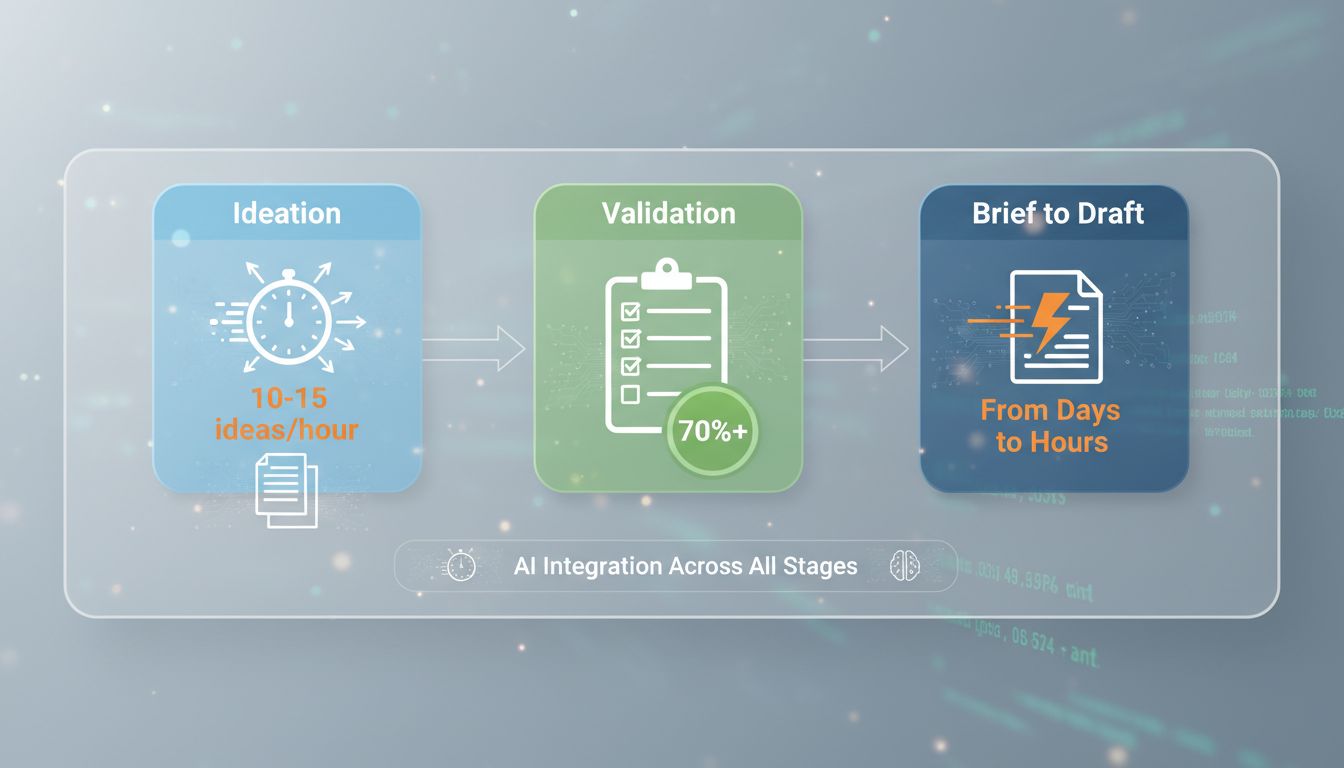
Brief-to-Draft Time: How long from approving an idea to receiving a first draft? This measures workflow friction. If your AI generator produces a detailed, intent-aligned brief, that window should collapse from days to hours.
Lagging Indicators (SEO Results)
Stop tracking individual article rankings. Measure clusters.
If your tool identified a gap around "cloud migration strategies," track the average position improvement for that entire topic cluster over 6-12 months, then monitor the incremental organic traffic it drives. That's what proves whether the strategic filtering actually worked. One publisher I worked with saw a 40% higher click-through rate on clusters built from AI-identified gaps versus their manually chosen topics, not a small difference.
The ROI Calculation
The business case is pretty direct:
(Estimated monthly traffic value) - (Monthly tool cost + (Hourly rate × Human hours saved))
The quickest win is almost always time savings. If your content lead was spending 20 hours a month on manual research and briefing, and your best free ai content generator cuts that to five hours, you've already covered the tool's cost in reclaimed salary. Traffic gains are just the profit on top.
Choosing Your Tool: An Engineer's Evaluation Checklist
Don't evaluate tools by their marketing copy. Evaluate them by how they'll plug into your existing stack and whether their data sources are credible. Here's the checklist I use when assessing platforms for my own agency or for clients building automated pipelines.
| Criteria | Why It Matters | What to Look For |
|---|---|---|
| Data Source & Freshness | Garbage in, garbage out. An idea is only as good as the keyword and SERP data it's based on. Stale or generic data leads to irrelevant suggestions. | Direct API integrations with major providers like Ahrefs, SEMrush, or DataForSEO. The ability to connect your own Google Search Console data is a major plus for personalized insights. |
| Integration Capabilities (API-first) | Automation is the entire point. If you can't connect the tool to your CMS, project management software, or custom scripts, you're just creating another manual step. | A well-documented REST API with authentication keys. Webhook support for event-driven workflows. Pre-built connectors for Zapier, Make.com, or direct plugins for WordPress, Webflow, etc. |
| Output Flexibility | Your content pipeline is unique. The tool should adapt to your workflow, not force you into its proprietary dashboard. | CSV/JSON export for bulk analysis or custom scripting. The ability to push structured briefs directly to Notion, Google Docs, or your task manager (like Linear or Jira). |
| Filtering Granularity | This is the core "strategic filter" function. Broad filters waste your time; precise filters save it. | Customisable filters for Domain Rating (DR), Keyword Difficulty (KD), search volume ranges, commercial vs. informational intent, and desired content format (guide, comparison, listicle). |
| Cost vs. Scale Model | Freemium walls and opaque pricing become bottlenecks just as you start to scale. You need predictable costs. | Transparent, usage-based API pricing or clear tiered plans that map to your monthly idea volume. Be wary of tools that charge per "credit" without clear ceilings. |
This is also why most free ai content generators fall short for systematic work. They typically cap API calls, offer basic or no domain authority filtering, and lock you into their interface for exports. Fine for one-off brainstorming. Not fine when you're trying to build a repeatable, data-driven content engine.
The most common mistake I see is teams picking a tool for its slick UI or low upfront cost, then hitting a scalability wall three months later when they can't automate the output. Start by mapping the tool's capabilities to your intended workflow. Not the other way around.
Essential guardrails and mitigating the inevitable pitfalls
The most common mistake I see is teams choosing a tool for its slick UI or low upfront cost, only to hit a scalability wall three months later when they can't automate the output. Start by mapping the tool's capabilities to your intended workflow, not the other way around.
The originality trap
AI suggestions naturally trend toward the consensus found in the SERPs. They'll give you "10 Best CRM Software" because that's what ranks. To counter this, mandate that every approved idea in your brief includes a 'unique angle' field. This forces a human to define the perspective before a word is written, focusing on SMB use cases, including proprietary platform data, or challenging industry norms.
Brand voice erosion
The tool has no inherent understanding of your brand's tone, perspective, or expert insights. This is where the editorial briefing step becomes non-negotiable. It's the human-led process where you inject the "why" behind the data, ensuring the final output doesn't read like generic, AI-authored text.
Capacity blindness and tool dependency
An ai content idea generator will happily output 200 viable topics a week. Your team can likely handle ten. Set a hard 'realistic output' filter based on your actual bandwidth to prevent pipeline clog and team burnout.
Don't become dependent on a single tool's data silo either. Periodically validate opportunities with manual SERP analysis or cross-reference with an alternative source like Google Search Console to check for blind spots. This matters whether you're using a best free ai content generator or a paid platform, every tool has gaps.
The over-optimization cliff
Don't let keyword difficulty and search volume filters completely override your domain's reality. Sometimes, writing the definitive guide on a niche, lower-volume topic where you have genuine expertise is a smarter long-term play than chasing a high-volume, high-KD term you'll never realistically own. The filter should guide you, not dictate a strategy divorced from your actual authority.
Conclusion
An ai content idea generator doesn't scale your strategy by flooding you with ideas. It works as a filter, cutting the list down to what you can actually win, given your domain rating, your competition, and your team's real capacity.

The pipeline only becomes predictable when that filtered list connects to an automated workflow, one that moves from validated idea to published article without someone manually passing the baton at each step. Track idea velocity and validation rate first. Traditional SEO metrics follow once the output is actually live.
Here's a practical first step: pull your current keyword list and run it through a free ai content generator with keyword difficulty capped at your domain's realistic ceiling. Count how many ideas survive. That shortlist, however short it is, is where you actually start. Whether you're testing the best free ai content generator you can find or already paying for something more robust, this audit tells you immediately whether your pipeline is built on real opportunity or wishful thinking.
Frequently Asked Questions
How does AI generate content ideas for SEO?
An AI content idea generator does more than expand a seed keyword. It pulls from search data, competitor content, and SERP features to find gaps, questions users are asking that existing content doesn't actually answer, or connections between topics that manual research tends to miss. That's the shift from basic keyword research to content ideas you can act on with some confidence.
Can AI content ideas really improve rankings?
Not directly, and not automatically. The real value is filtering out ideas you'd waste resources on and surfacing ones where you have a realistic shot given your domain authority. Better inputs lead to better cluster performance and less wasted editorial budget. That's where the ranking lift comes from, eventually.
What's the best workflow for using these tools?
Start with a target keyword cluster, run it through the AI ideator, then have a human strategist look at each suggestion against your domain's actual expertise. What survives that review becomes a brief. Writers add the original insight and real perspective that the tool can't. The point is to clear the research bottleneck without handing over editorial judgment.
Is there a good free AI content generator to start with?
Ahrefs has a free content idea generator that's worth testing to understand how the process works. [Source: ahrefs.com] That said, free tools usually can't filter by domain rating or search intent, and their data isn't always fresh. Start there to get a feel for it, but the filtering that makes a free ai content generator genuinely useful for scaling is mostly behind a paywall.
What are the biggest risks of using AI for content ideation?
Generic ideas. Without a strong human validation step, you end up publishing articles that sound identical to everyone else's, no unique angle, no genuine expertise, nothing that passes the helpful content test. The fix is making human briefing non-negotiable, where someone with actual knowledge injects a specific perspective before anything goes to a writer.
How do I measure if the AI tool is actually working?
Start with leading indicators: time saved per validated idea, and what percentage of AI suggestions actually make it through editorial review. For longer-term signal, compare rankings and traffic for content built from AI-identified topics versus manually researched ones. Ten articles from each source over 90 days gives you something real to look at.