April 1st, 2026
From 2025 to 2026: An Updated Guide to the Best AI Writing Tools for SEO
 WD
WDWarren Day
If you're still running your content through a generic AI writer, you're showing up to a knife fight with a butter knife. AI-written content now appears in 17.31% of top Google search results , up from 2.27% in 2019. Knowing which are the best AI writing tools 2025 has to offer isn't optional anymore. Your competitors already know.
You're probably feeling the squeeze. Output targets keep climbing, your current process has hit a ceiling, and something , an algorithm update, a rival's content surge, a brutal leadership meeting , made it obvious your toolkit isn't keeping up. The issue isn't that AI writing tools don't exist. There are hundreds of them. The problem is that most stop at the draft.
That's not enough anymore.
The tools actually moving rankings in 2025 do something different. They fold content creation, real-time SEO optimization, SERP analysis, and performance tracking into one coherent workflow. A standalone AI writer is basically a word processor with autocomplete. An integrated AI writing system is something else entirely.
What you'll find here is built on hands-on testing against criteria that reflect where search actually is right now: AI Overviews, E-E-A-T signals, schema requirements, workflow automation. Not where it was two years ago. You'll get a ranked list of ten tools, a framework for choosing between them, and practical guidance on building a stack that holds up in both traditional search and the AI-driven interfaces that are quietly reshaping how people find your content.
The 2025-2026 SEO Landscape: Why Your Old AI Writer Falls Short

Search changed its fundamental contract with content creators in 2025. It used to reward pages that ranked. Now it rewards pages that get cited -- inside AI-generated answers that millions of users never click past.
Organic CTR for informational queries with AI Overviews dropped 61% compared to mid-2024, according to Seer Interactive's analysis of 25 million impressions across 42 organizations. Ahrefs' December 2025 data puts the CTR reduction for top-ranking pages at 58%. These aren't edge cases.
That's the new baseline for anyone publishing informational content.
The flip side is where the opportunity sits. Brands that earn citations inside AI Overviews see 35% more organic clicks and 91% more paid clicks than those that don't. Visibility inside the AI answer is now the metric that matters -- not the ranking below it.
That shift has two direct implications for your tooling.
First, schema and structured data are no longer optional. AI systems -- whether Google's Gemini-powered Overviews or external LLMs -- rely on structured signals to identify authoritative sources, understand entity relationships, and decide what to cite. A tool that generates text without helping you implement schema is leaving that citation opportunity on the table.
Second, E-E-A-T has expanded well beyond YMYL. Google's December 2025 core update applied experience, expertise, authoritativeness, and trustworthiness requirements to SaaS comparisons, e-commerce reviews, and how-to guides -- not just health and finance. Generic AI output with no author attribution, no demonstrable experience, and no brand voice signal fails this test by default.
Here's the core problem with most AI writers in this environment: they're text generators, not SEO systems. No live connection to SERP data. No schema templates. No integration with your keyword research stack, and no way to track whether what they produce actually earns visibility. They optimize for words on a page, not performance in search.
The tools worth evaluating are those that close that gap -- combining content generation with real-time optimization data, E-E-A-T support, structured data capabilities, and measurable outcome tracking. That's the framework used to rank every tool in this guide.
The 2025-2026 SEO Tool Evaluation Framework
Not every tool earns its place here by doing one thing brilliantly. The best ones hold up across all seven criteria used to evaluate each platform:
- SEO Effectiveness -- SERP analysis depth, on-page optimization, schema and structured data support, and evidence of ranking impact
- Content Quality -- Factual accuracy, E-E-A-T signals, brand voice control, and resistance to hallucination
- Workflow & Integrations -- Native CMS connections, SEO platform compatibility (Ahrefs, Semrush, Surfer), and API flexibility
- Features & UX -- Brief generation, outline tools, editor experience, and export options
- Pricing & Licensing -- Value at each tier, word/token limits, and enterprise contract terms
- Privacy & Compliance -- Data retention policies, model training practices, GDPR/CCPA considerations
- Measurement & Outcomes -- Analytics, AI visibility tracking, and verifiable performance evidence
A tool that aces content generation but ignores schema support or workflow integration is a partial solution. Every review that follows scores against all seven criteria -- because that's the only honest way to compare them.
How We Tested: Our Hands-On Evaluation Protocol
Every tool in this guide went through the same structured process. No free passes for brand recognition, no dismissals based on price.
The test covered three content types: a short blog post (600–800 words), a long-form pillar page (1,500–2,500 words), and a product/landing page. These formats stress-test different capabilities. A tool that handles a 700-word post well can completely fall apart on a 2,000-word technical article.
For each tool, the workflow ran in six stages:
- Brief creation , using the tool's native SEO features: keyword input, SERP analysis, competitor gap identification, and outline generation.
- Draft generation , recording time-to-first-draft and total time-to-publish-ready, including all manual editing passes.
- On-page optimization , applying the tool's own recommendations for titles, meta descriptions, headings, internal link suggestions, and schema where available.
- Performance tracking , monitoring Google rankings, organic clicks, impressions via Search Console, and AI visibility signals for 12 weeks where timelines allowed.
- Quality scoring , each draft was rated 1–5 on four dimensions: factual accuracy, coherence, brand voice consistency, and originality. This rubric was applied blind, before checking which tool produced which output.
- Pricing and privacy verification , all pricing data was cross-checked against official vendor pages at time of writing. Privacy and data-handling claims were verified against published privacy policies, not marketing copy.
One thing worth being upfront about: where vendor-provided case studies are cited, they're labeled as such. You'll sometimes see claims that AI content tools can cut blog production time by 50–90%, but that figure tends to come from the vendors themselves. Internal case studies and independent benchmarks are different categories of evidence, and you deserve to know which one you're looking at.
The 10 Best AI Writing Tools for SEO in 2025-2026
What follows is the core of this guide. Ten tools, ranked by how well they actually perform across the full evaluation framework, not by how good their landing pages look.
Each tool gets the same breakdown: what it does, where it shines, where it stumbles, pricing, and the workflow it fits. The "Best For" label isn't a participation trophy. It's a genuine signal about who each tool actually serves.
The best ai writing tools 2025 aren't always the most feature-packed. They're the ones that move the needle on organic performance inside a real workflow.
1. Surfer SEO + Surfer AI: Best for Real-Time, Data-Driven Optimization
No other tool closes the gap between SERP data and content creation as tightly as Surfer. Its Content Editor scores your draft in real time against the top-ranking pages for your target keyword, flagging term usage, heading structure, word count, and NLP entity coverage as you write. Not after. As you write.
Surfer AI takes that further by generating full drafts from SERP-based outlines rather than pattern-matched training data alone. The result is a first draft that already knows what the top 10 results look like.
What's new in 2025: The standout addition is AI Tracker , a dedicated module that monitors how often your brand, products, or topics appear inside ChatGPT, Gemini, and Google AI Overviews. It's one of the first native tools to bring GEO (Generative Engine Optimization) monitoring into an SEO content platform without requiring a separate subscription. December 2025 also shipped a one-click Auto-Optimize feature that refreshes existing articles for both traditional and AI search simultaneously.
Real-world proof: Lyzr AI drove 150% organic traffic growth in three months using Surfer to create and optimize their blog content.
Pricing: Essential starts at $79/month (billed annually) or $99/month billed monthly. Scale runs $175/month annually. Pricing has shifted multiple times, so verify current tiers on Surfer's official pricing page before budgeting.
Weaknesses: The learning curve is real. New users routinely underutilize the Content Score system or chase it mechanically without understanding what it's measuring. Solo bloggers may also find the price-to-article-volume ratio tight at Essential.
Ideal for: SEO specialists and content teams who want benchmark-driven optimization baked into every draft, not bolted on afterward.
2. Semrush Content Toolkit & AI Visibility: Best All-in-One SEO Suite
If you already live inside Semrush for keyword research and rank tracking, the Content Toolkit closes the loop from discovery to published draft without switching tabs.
The AI Article Generator is the workflow anchor. Feed it a target keyword, let it pull competitive data from Semrush's index, and it produces an SEO-ready draft structured around search intent. Semrush's own internal data puts the time to create and publish an 800-word article at around 20 minutes, down from two hours. That's not marginal.
What separates Semrush from pure-play writing tools in 2025 is the AI Visibility Toolkit , a $99/month add-on that tracks your brand's presence across ChatGPT, Perplexity, Google AI Overviews, and Gemini. You get share-of-voice metrics, sentiment analysis, and prompt-level research. Think keyword research, but for AI answers. For teams trying to understand why a competitor keeps appearing in AI-generated responses, this is the diagnostic layer most tools simply don't offer.
Weaknesses: Full SEO Writing Assistant access requires the Guru plan at $249.95/month. The AI Visibility Toolkit is a separate line item on top of that. For teams using Semrush as a single platform, the value stacks up. For single-use cases, it's overkill.
Pricing: Pro plan starts at $139.95/month; Content Toolkit available standalone at $60/month; AI Visibility Toolkit at $99/month per domain.
Ideal for: Marketing teams and agencies already invested in the Semrush ecosystem who need one platform spanning keyword research, content production, and AI search monitoring.
3. Jasper: Best for Enterprise Brand Voice & Scalable Campaigns
Where Jasper genuinely outperforms the field isn't keyword density or SERP scoring. It's brand consistency at scale. No other tool on this list comes close to its Brand Voice system, which lets you upload style guides, tone examples, and knowledge assets so every output sounds like your company, not generic AI.
The 2025 platform overhaul introduced agentic workflows , autonomous agents that handle campaign planning, content creation, and SEO audits as connected tasks rather than isolated prompts. The Jasper Grid feature enables systematic content execution across large batches, which makes it genuinely useful for enterprise teams running multi-channel campaigns simultaneously.
The SEO caveat is worth being direct about: native optimization is thin. Jasper's SEO capabilities lean almost entirely on its Surfer SEO integration, which is only available on Pro plans and above, adding to an already premium price.
Pricing: Pro starts at $59/seat/month (billed annually) or $69/month billed monthly. Business is custom. Verify current tiers at jasper.ai/pricing.
Ideal for: Enterprise marketing teams and agencies managing multiple brands who need high-volume, on-brand content across campaigns and are willing to pair Jasper with a dedicated SEO tool for optimization depth.
4. NeuronWriter: Best for NLP-Driven Content Planning & Optimization
NeuronWriter earns its place here by doing one thing exceptionally well: showing you exactly what your content is missing before you write a single sentence. Its TOP Analysis feature audits up to 30 competing pages for your target keyword, surfacing the NLP terms, heading structures, and subtopics that top-ranking content shares and that yours probably lacks.
The real-time editor uses a color-coded scoring system (green, yellow, gray, red) to track semantic term coverage as you write. It turns optimization from guesswork into something measurable. In 2025, NeuronWriter added support for GPT-4o and Claude Sonnet 3.5 for AI drafting, keeping its generation quality competitive.
Where it falls short: AI drafting output still requires more editorial polish than Jasper or Surfer AI, and the interface lacks the refinement of pricier tools.
Pricing: Bronze $23/mo · Silver $45/mo · Gold $69/mo (annual billing reduces each tier by roughly $10-12/mo). Gold unlocks WordPress/GSC integrations and team collaboration, making it the minimum viable tier for most content teams.
Ideal for: SEO-focused content creators and bloggers who want rigorous topical planning and semantic gap analysis at a price that doesn't require a budget approval meeting.
5. Writesonic: Best for Speed & Agility in Long-Form Drafting
When your bottleneck is sheer output rather than optimization depth, Writesonic earns its place. The platform's AI Article Writer 6.0 takes a structured, multi-step approach: select reference articles from live SERPs, input your target keywords, approve an outline, get a full draft in minutes. That human-in-the-loop checkpoint is what separates it from tools that just flood you with text.
The built-in SEO Checker and Optimizer runs alongside your draft in real time, flagging keyword gaps and competitor term misses without forcing a tab switch. The "Improve SEO" one-click rewrite is blunt but fast , useful for getting a draft from a 60 to an 80 before your editor touches it.
Brand voice controls are noticeably thinner than Jasper's, and optimization granularity doesn't match Surfer. Expect to spend time editing for personality and factual accuracy. The structure is solid; the prose can feel formulaic.
What's new in 2025-2026: Writesonic added Generative Engine Optimization (GEO) tracking to higher-tier plans, letting you monitor brand visibility across AI search engines like ChatGPT and Perplexity. A meaningful addition for teams thinking beyond Google.
Pricing: Paid plans start at $39/month (billed annually). A free trial is available with no credit card required.
Ideal for: Solo bloggers, small content teams, and agencies that need high volumes of solid first drafts fast, without a steep learning curve.
6. Alli AI: Best for Bulk Technical SEO Automation
Alli AI occupies its own category on this list. It doesn't write content. It deploys SEO fixes at scale, across hundreds or thousands of pages, without a single line of code.
The core mechanic is straightforward: define your optimization rules once (meta tag structures, schema templates, internal linking patterns), and Alli AI pushes those changes live across your entire site through a single JavaScript snippet. Works across virtually any CMS, which matters when you're managing a multi-site portfolio with inconsistent tech stacks.
Here's the thing about where it earns its place: most teams can audit their way to a long list of technical issues. The bottleneck is always implementation, especially when developers are backlogged or simply unavailable. Alli AI removes that dependency entirely. The September 2025 dashboard redesign specifically optimized multi-account management, making it easier to deploy simultaneous fixes across 30+ client sites.
Pricing: Business plan starts at $299/month; Agency tier at $599/month. A 10-day free trial is available. One real caveat worth noting: optimizations revert if you cancel, so factor that into your commitment before signing up.
Ideal for: SEO agencies and in-house teams managing large sites or multi-site portfolios where implementation speed, not content creation, is the primary bottleneck.
7. Ahrefs AI Features: Best for SEOs Rooted in the Ahrefs Ecosystem
Ahrefs didn't set out to build an AI writing tool. It built one of the most powerful SEO data platforms around and then added AI features that make that data immediately actionable for content teams already working inside it.
The centerpiece is AI Content Helper, a paid add-on that analyzes the top 10 SERP results for your target topic, scores your draft out of 100 against search intent, and surfaces specific topic gaps as you write. One Ahrefs team member reported a 72% traffic boost after using it consistently. The tool also generates AI-powered title tags and meta descriptions with competitor comparisons alongside each suggestion.
Beyond content, the Patches feature (launched early 2025) lets you edit title tags and meta descriptions across your site without touching code. Identify Intents maps keywords to funnel stages automatically. Brand Radar tracks your visibility inside AI Overviews and LLM responses.
Honest caveat: Ahrefs isn't an end-to-end AI writing platform. It doesn't draft long-form content. If you're already living in Ahrefs for keyword research and backlink analysis, these AI layers slot in seamlessly. If you're not, there's no compelling reason to start here for content creation alone.
Pricing: Check ahrefs.com for current plan pricing; AI Content Helper is a separate add-on.
Ideal for: SEO professionals and teams who already use Ahrefs as their primary research tool and want AI-assisted optimization without switching platforms.
8. Clearscope: Best for Content Grading and Editorial Rigor
Clearscope does one thing better than almost any tool on this list: it tells you, objectively, whether your content is actually good enough to compete.
Its real-time editor assigns letter grades (A++ to F) by crawling the top-ranking pages for your target keyword and surfacing the terms, topics, and depth those pages share. That's not AI writing. It's AI quality control. For editorial teams managing multiple writers or reviewing high-stakes content before publication, that distinction matters.
The grading system is intuitive in a way numerical scores often aren't. Writers understand "you're at a C, get to an A" far faster than they parse a 67/100 content score. It removes subjectivity from editorial review.
In 2025, Clearscope leaned further into its role as a discoverability platform, adding AI Tracked Topics and LLM visibility monitoring, signals that align directly with E-E-A-T and topical authority requirements.
Pricing: Essentials starts at $129/month. Business at $399/month.
Where it falls short: Clearscope is an optimizer, not a drafter. You need another tool to generate your first draft.
Ideal for: Editorial teams and content leads who need an objective, repeatable standard for content quality before anything goes live.
9. RankIQ: Best for Bloggers and Niche Site Owners
Most tools on this list are built for teams. RankIQ is built for the person running a food blog at 11pm trying to figure out why a post isn't ranking.
Created by podcaster and blogger Brandon Gaille, RankIQ takes a deliberately narrow approach: hand-curated keyword libraries of low-competition, high-traffic terms organized by niche, paired with a Content Optimizer that shows you exactly which LSI terms and topics to cover. No sprawling dashboard to learn. No enterprise features you'll never use.
The Content Optimizer grades your draft in real time and tells you what's missing. The Title Toolset analyzes your headline for keyword placement and character count. That's essentially the full toolkit , and for a solo blogger, that's often enough.
Pricing: Starts at $49/mo (Blogger plan, 16 SEO reports/month). Pro is $99/mo; Agency is $199/mo.
Limitations: No rank tracking, no backlink analysis, no integration with major CMS platforms. If you're managing multiple sites or need competitive intelligence, you'll outgrow it fast.
Ideal for: Individual bloggers, niche site owners, and solopreneurs who want a clear, low-friction path from keyword to published post without learning a platform built for an SEO agency.
10. WordLift: Best for Boosting E-E-A-T with Structured Data

WordLift sits at the intersection of two trends defining search in 2025: schema markup for AI interpretation and verifiable E-E-A-T signals. It doesn't write your content. It makes your existing content legible to machines.
The core mechanic: WordLift uses NLP to extract entities from your pages (people, places, concepts, products), builds a site-specific knowledge graph from those entities, and automatically generates schema markup that communicates your topical authority to both Google and LLMs. Schema and structured data became more critical for AI citations in 2025, making this kind of infrastructure-layer work increasingly non-optional for competitive publishers.
Its free suite now includes an Agentic AI Audit, a Structured Data Audit, and an Entity Extraction tool , a useful entry point before committing to a paid plan (Starter at $19/mo, Business at $79/mo, Pro at $129/mo).
WordLift requires technical comfort and a clear content architecture. It won't rescue thin content. It amplifies what's already well-structured.
Ideal for: Tech-savvy content teams, publishers, and e-commerce sites serious about making their content machine-readable and citation-worthy in AI-driven search.
Comparison at a Glance: AI Writing Tools for SEO (2025-2026)
| Tool | Best For | Core SEO Features | Starting Price/Mo | Free Trial or Tier |
|---|---|---|---|---|
| Surfer SEO + Surfer AI | Real-time data-driven optimization | Content scoring, SERP analysis, NLP suggestions, AI Tracker | ~$99 | 7-day trial |
| Semrush Content Toolkit | All-in-one SEO suite | Keyword research, AI briefs, AI Visibility, rank tracking | ~$139.95 | Free limited tier |
| Jasper | Enterprise brand voice | Brand voice controls, 100+ templates, Surfer integration | ~$49 | 7-day trial |
| NeuronWriter | NLP content planning | Semantic gap analysis, SERP outlines, real-time scoring | ~$23 | Free tier |
| Writesonic | Speed & long-form drafting | SEO checker, keyword suggestions, competitor analysis | ~$16 | Free tier |
| Alli AI | Bulk technical SEO automation | Bulk meta/schema/internal link deployment, no-code | ~$299 | 10-day trial |
| Ahrefs AI Features | Ahrefs ecosystem users | AI keyword ideas, intent analysis, meta suggestions | ~$129 | No |
| Clearscope | Editorial rigor & grading | Semantic grading, term recommendations, content reports | ~$129 | Demo only |
| RankIQ | Bloggers & niche sites | Curated keyword libraries, step-by-step optimization | ~$49 | No |
| WordLift | E-E-A-T & structured data | Schema markup, knowledge graph, AI content recommendations | ~$59 | 14-day trial |
Note: Pricing changes frequently. Always verify current plans and features on each vendor's official website before purchasing.
Beyond SEO: A Note on AI for Fiction and Creative Writing
Every tool in this guide gets evaluated through a single lens: does it move the needle on organic search performance? That's a deliberately narrow focus, and it's intentional.
If you searched for NovelCrafter, Squibler AI, an AI story generator based on prompt, or story writing ai free options and ended up here, you're looking for something different. Those tools serve authors and fiction writers, not SEO teams. NovelCrafter's Codex system handles character lore and world-building across complex narratives. Squibler combines AI drafting with project management built specifically for structured storytelling. Neither was designed for keyword optimization or SERP performance, and honestly, they shouldn't be.
Free story writing AI tools are everywhere, but they all share the same gap: zero SEO integration. That's not a flaw. It's just a different job.
The criteria that matter for fiction -- narrative consistency, voice, plot structure -- are pretty much the opposite of what gets content ranking. A dedicated piece covering the best AI tools for fiction writers would do that category far more justice than squeezing it into an SEO guide.
Building Your 2026 AI SEO Tech Stack: Integration Blueprints
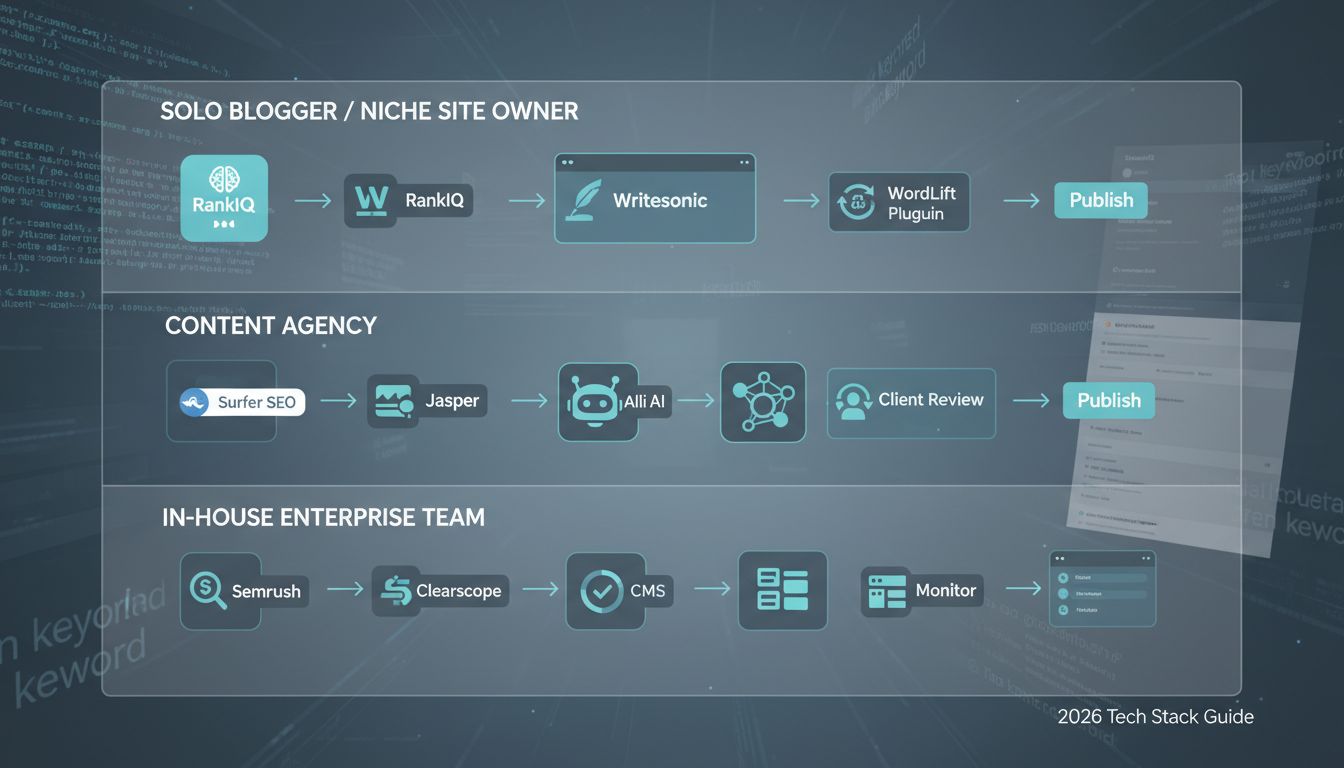
None of these tools work in isolation. The teams actually getting results aren't picking one and calling it done -- they're building stacks where each tool owns a specific stage, then hands clean output to the next layer.
Here are three blueprints matched to real team structures.
Blueprint 1: The Solo Blogger / Niche Site Owner
RankIQ → Writesonic → WordLift Plugin → Publish
Start with RankIQ to find low-competition keywords your site can realistically rank for. Use Writesonic to draft against that target keyword. Then run the published post through WordLift's plugin to apply schema markup and strengthen your entity signals. The whole cycle -- keyword selection to live, structured content -- can run in under two hours.
Blueprint 2: The Content Agency
Surfer SEO → Jasper → Alli AI → Client Review → Publish
Surfer's Content Editor builds SERP-grounded briefs for each client. Feed those into Jasper with the client's trained brand voice active, so drafts arrive already on-tone. After sign-off, push Alli AI across the client's site to apply meta tags, internal links, and schema in bulk -- no code required. That last step is where most agencies bleed time, and this stack cuts it considerably.
Blueprint 3: The In-House Enterprise Team
Semrush (Strategy + AI Visibility) → Clearscope (Editorial Grading) → CMS Integration → Monitor
Semrush anchors strategy: keyword clustering, competitive gaps, AI Overview tracking. Content moves into Clearscope for semantic grading before approval -- nothing publishes below a target grade. Post-publish, Semrush's AI Visibility Toolkit tracks whether your content is being cited in AI-generated answers, not just ranking in blue links.
The principle across all three is simple: each tool has one job. Overlapping tools without purpose just means paying for redundancy. Sequence them deliberately, and the output of one becomes the input of the next -- your workflow compounds instead of stalling.
Performance Verification: What Do the Benchmarks and Case Studies Tell Us?
Vendor numbers deserve skepticism. They're not worthless, but they're always best-case.
The most cited example is Lyzr.ai's use of Surfer SEO to grow organic traffic by 150% in three months (August-October 2024). Worth knowing: Lyzr was starting from a low baseline, which makes that percentage swing more achievable than it sounds. Semrush also reports cutting an 800-word article from two hours to 20 minutes using its AI Article Generator -- cooperative topic, skilled editor, favorable conditions. Not typical. But not impossible either.
So what can you actually expect?
- First-draft time: 30-50% reduction is achievable for most teams
- Content consistency: Measurable improvement, especially across high-volume publishing workflows
- Ranking improvements: Highly variable -- dependent on your domain authority, competition level, and how much human editing goes into the final piece
Here's the thing: AI tools compress the production side of the equation. A weak backlink profile, thin topical authority, misaligned search intent -- none of that gets fixed by drafting faster.
Run your own pilot before committing. Take 3-5 target pages, apply the test protocol from Section 3, and track rankings, time-to-publish, and editor satisfaction over 30-60 days. Your site's specific conditions will tell you more than any vendor benchmark.
AI is an accelerant for a strategy that already works. Not a substitute for having one.
The 4 Most Common AI Writing Mistakes That Sabotage SEO (And How to Fix Them)
Speed is where AI writing earns its keep. But speed without discipline is how you publish content that actively hurts your rankings.
Mistake 1: Publishing without fact-checking. AI models hallucinate. Statistics get fabricated, quotes get invented, and product details drift from reality. Treat every AI draft as a first draft that needs a human verification pass, especially for any numerical claim or attributed quote. No tool automates your way out of this.
Mistake 2: Ignoring brand voice. Generic AI output is recognizable. Readers feel it, and so does Google's quality assessment. If you're using Jasper, configure Brand Voice before you generate a single word. If you're on another tool, feed it a detailed style guide as a system prompt. Honestly, this takes 30 minutes once and pays dividends on everything you publish afterward.
Mistake 3: Skipping post-draft optimization. Generating a draft and hitting publish is the single fastest way to waste your AI investment.
Run every draft through the optimization pane in Surfer, Semrush's SEO Writing Assistant, or NeuronWriter before it goes live. These checks catch missing semantic terms, weak title structures, and absent internal links. Small fixes, but they're the difference between a piece that ranks and one that doesn't.
Mistake 4: Not monitoring AI visibility. Publishing AI-assisted content into a void is increasingly costly as AI Overviews reshape the SERP. Use Surfer AI Tracker or Semrush AI Visibility to track whether your content earns citations inside AI-generated answers. When it doesn't, that's your signal to adjust, not ignore.
The Future of AI Writing & SEO: Trends Shaping 2026 and Beyond
The target has moved.
Tools built around "rank for this keyword" are already losing relevance faster than most teams realize. The game now is getting your content cited inside AI-generated answers. AI search traffic grew 527% year-over-year, and with Google AI Mode, ChatGPT Search, and Perplexity becoming default starting points for buying decisions, that trajectory isn't slowing down anytime soon.
A few forces are reshaping what good looks like. Hyper-personalization means "Position 1" is increasingly a fiction -- there isn't one anymore. Results get tailored to individual search history, so the same query returns different answers for different people. Multimodal search means text-only strategies are quietly bleeding visibility; video with transcripts, structured images, and voice-optimized copy aren't differentiators anymore, they're the floor. And intent cluster optimization -- building content around how people actually think rather than just what they type -- is what separates teams that earn AI citations from those that get ignored entirely.
If you're thinking about future-proofing your stack, look for tools with open APIs, active development roadmaps, and measurement that tracks AI visibility alongside traditional rank data. Check vendor blogs quarterly. Seriously. Features that don't exist today will matter by Q3.
Here's the thing: the core formula hasn't changed. Human strategy sets direction, AI accelerates execution. What has changed is the surface area you're optimizing for. It's bigger, more fragmented, and moving faster than most content teams are built to handle.
Build accordingly.
Conclusion
The tools worth using in 2025 aren't glorified text generators with an SEO badge bolted on. They're integrated platforms that connect keyword intelligence, content creation, optimization scoring, and AI visibility tracking into one coherent workflow.
Your choice really comes down to where you're most constrained. Optimization depth points you toward Surfer SEO or Clearscope. Workflow scale points toward Semrush or Jasper. E-E-A-T and structured data points toward WordLift. No single tool covers everything, but the right combination, built around a clear stack logic, compounds over time in ways a scattered toolkit never will.
The hybrid model isn't a preference anymore.
AI handles velocity. Your editorial judgment handles substance. Strip either one out and you're either publishing slow or publishing shallow. Neither is a winning position.
One practical next step: pick one or two tools that map directly to your biggest current bottleneck, run a focused 30-day pilot using the test protocol from Section 3, and measure what actually moves. Workflow speed, content scores, organic impressions. The right tool isn't overhead. It's the engine your entire content operation runs on.