March 17th, 2026
Content Creation Software and E-E-A-T: A 2026 Guide for Founder-Authored SEO
 WD
WDWarren Day
You're a founder investing in content creation software to scale your message, but there's this nagging question: what if all this just pumps out more generic content that nobody ever clicks on?
That worry isn't paranoid. Right now, 58.5% of US Google searches end with zero clicks. For queries triggering AI Overviews, that rate jumps to 83%. Ahrefs measured a 34.5% click reduction wherever AI Overviews appear. The traffic you were counting on to fuel your pipeline is vanishing before anyone reaches your site.
Most founders panic and double down on volume. They pick software based on how fast it generates words, how many templates it has, how quickly they can publish. But pumping out more content without real authority behind it? That's just accelerating the slide. Google's algorithms and AI systems like ChatGPT, Perplexity, and Gemini are trained to surface content with clear expertise signals. Structured author entities, provenance metadata, schema that proves an actual human with actual experience wrote this. Generic AI-generated articles get filtered out or buried, no matter how polished they look.
In 2026, choosing content creation software isn't a features comparison. It's about finding platforms that give you the technical infrastructure to bake founder expertise into every piece at scale. Schema integration, provenance tracking, entity mapping. The stuff that verifiably connects your content to a real person who knows what they're talking about. That's your only real defense against zero-click AI Overviews.
This article breaks down how to actually do it. You'll learn how to evaluate software through an E-E-A-T lens, build a founder-led content workflow that scales without tanking your authority, and assemble a 2026 tech stack focused on the signals that protect your visibility.
Redefining 'Best': The 2026 Content Creation Software Criteria for Founder Authority
You've seen the listicles. "50 Best content creation software Tools!" They rank platforms by word count per minute, template libraries, and integration counts. Optimized for affiliate commissions, not your actual problem.
Here's what those lists miss: In 2026, the "best" content creation software isn't the one that produces the most words. It's the one that helps you produce the most verifiable authority signals per piece. Machine-readable proof that a real expert (you) created this, that it reflects genuine experience, and that it can be trusted.
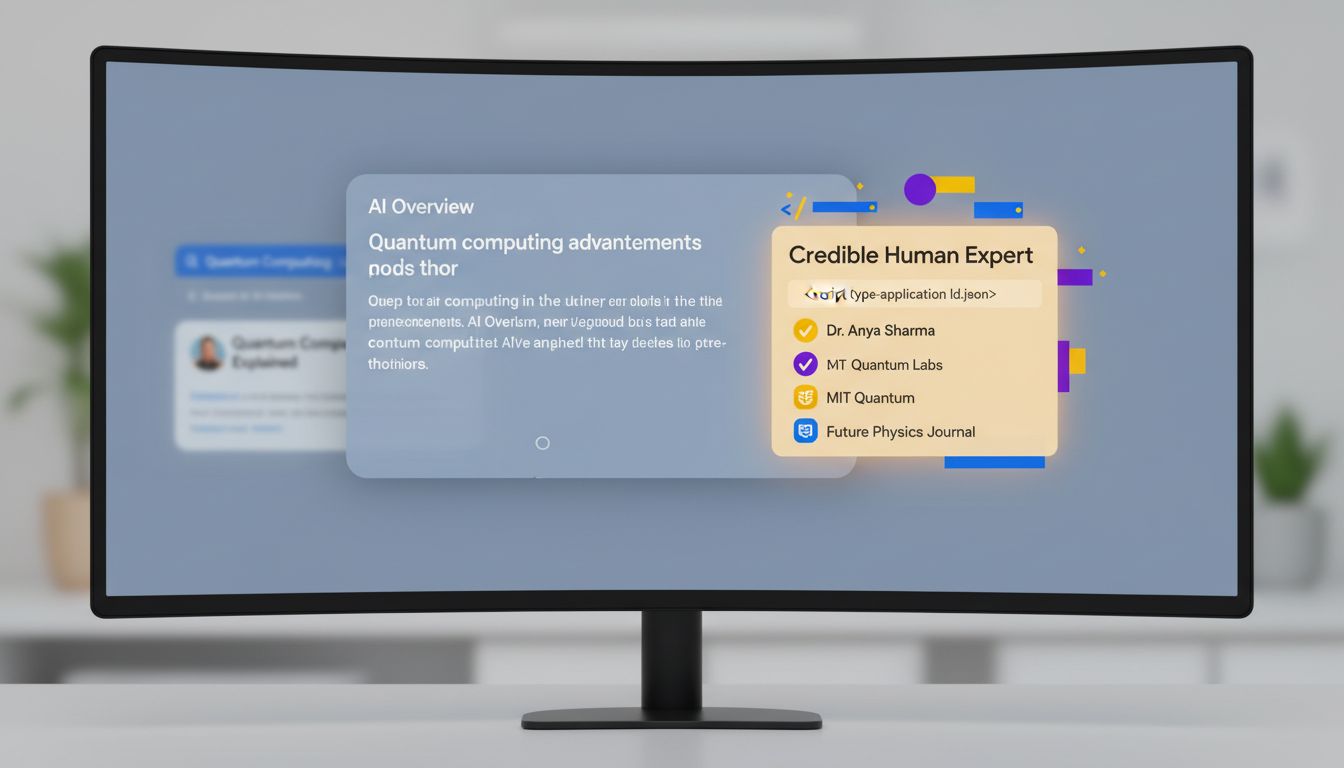
58.5% of US Google searches now result in zero clicks, and when AI Overviews appear, that number jumps to 83%. Generic content gets buried or bypassed entirely, no matter how well-written. The only sustainable defense is building content that screams "credible human expert" in both human-readable and machine-readable formats.
So before you evaluate another feature matrix, ask yourself four questions. These aren't "nice-to-haves." They're the 2026 non-negotiables for any content creation software that claims to help founders scale authority.
Criterion 1: Does It Support Foundational Author & Entity Schema?
Schema markup is no longer a technical SEO checkbox your developer handles once. It's the primary language search engines and AI systems use to understand who wrote your content, why they're qualified, and how it connects to your brand entity.
Think of schema as your content's machine-readable resume. Without it, Google sees a blob of text. With it, Google sees: "This article was written by [Founder Name], CEO of [Company], who has published 47 articles on this topic, speaks at industry conferences, and is cited by authoritative sources." That context is what separates you from the AI-generated noise.
Your content creation software needs to make schema implementation trivial, not theoretical. Look for these specific capabilities:
Native JSON-LD generation for Person, Organization, and Article schema. The tool should automatically output properly formatted JSON-LD that you can drop into your CMS header. Bonus points if it auto-populates fields from your author profile.
Easy byline-to-author-page linking. Every piece you publish should link to a dedicated author page with complete Person schema: your role, credentials, social profiles, and publication history. The software should make this connection automatic, not a manual task your team forgets.
'sameAs' profile field support. This field tells Google "this person on our site is the same person on LinkedIn, Twitter, and Medium." It's how you build a Knowledge Graph entity for yourself. Your software should have dedicated fields for these URLs, not force you to hand-code them.
The data here is pretty straightforward: adding detailed author bios and schema to articles has driven 34% traffic increases within 60 days. That's not a long-term investment, that's an immediate competitive advantage. If your content creation software doesn't streamline this process, you're paying for a word processor, not an authority-building platform.
Criterion 2: Does It Facilitate Transparent AI-Human Workflow Governance?
Google's Quality Raters now explicitly evaluate whether content appears AI-generated and whether that AI usage is disclosed. Transparency isn't a nice gesture anymore. It's a ranking signal.
But here's the operational reality: you're going to use AI. Every founder does. The question isn't if you use it, but how you govern it, document it, and prove human expertise elevated the output.
Your content creation software needs built-in governance scaffolding. Not policies you pin to a Notion doc that nobody reads. Actual features that enforce quality standards in your daily workflow.
Built-in AI disclosure fields. The tool should have a standard place to note AI assistance: which model, what it generated, what a human changed. This becomes your audit trail. Some CMSs are adding machine-readable disclosure tags; your content software should prepare you for that standard.
Version history that shows human edits. You need to prove a human didn't just hit "publish" on raw AI output. Look for tools that track revision history with clear attribution: who edited what, when. This matters for internal accountability and external credibility.
Integration points with project management for fact-checking. The best systems let you assign fact-checking tasks directly from the editor, tag claims that need verification, and require sign-off before publication. If your tool treats fact-checking as something that happens "somewhere else," it's not built for 2026 standards.
The reality is clear: hybrid AI-human workflows with rigorous human review are table stakes now. Tools that make that review optional or invisible are setting you up for the next helpful content update to decimate your traffic.
Criterion 3: Does It Integrate or Connect to Provenance & AI Visibility Tracking?
You're creating content to be found. But in 2026, "found" has two meanings: found in traditional search results, and found (or cited) by AI systems like ChatGPT, Perplexity, and Google's AI Overviews.
Your content creation software needs to help you understand both dimensions. That means two technical capabilities most tools ignore: provenance tracking and AI visibility monitoring.
Provenance is the verifiable history of who created an asset and how. For high-stakes content like proprietary research, original data, or expert opinions on YMYL topics, you need a way to prove it came from you, not a content farm. The emerging standard is C2PA (Coalition for Content Provenance and Authenticity), which embeds cryptographic metadata in images, videos, and documents. Start with your most valuable assets: original research reports, founder-authored guides, proprietary datasets.
Your software doesn't need to do this natively (yet), but it should integrate with or export to tools that do. If you're publishing PDFs or visual assets, ask: can I embed provenance metadata before distribution?
AI visibility tracking is the new frontier. Tools like Sight AI and Clearscope now monitor whether your content is being cited in AI-generated answers across ChatGPT, Claude, and Perplexity. This isn't vanity metrics. It's understanding whether your content is training the systems that are replacing traditional search.
Look for software that either tracks this natively or integrates with visibility platforms. Are AI systems ignoring you? Citing you? Misrepresenting you? If your tool treats AI Overviews as someone else's problem, you're flying blind into the biggest traffic shift since mobile.
Criterion 4: Does It Reduce Friction for Founder Involvement?
Here's the paradox: E-E-A-T requires founder expertise, but founders have the least time.
Most content creation software is built for content teams with dedicated writers, editors, and SEO specialists. You don't have that luxury. The right tool must make it easier for you to inject your unique insights, not harder. If it takes 45 minutes to format your thoughts into the system, you won't use it. If it requires you to learn a new interface, you'll delegate it and lose the authenticity advantage.
Voice and tone calibration based on your past writing. The best AI writing assistants can ingest your previous articles, emails, or transcripts and learn your style. Look for tools that let you upload samples and then generate drafts that sound like you, not a generic marketer.
Lightweight 'add insight' prompts. Instead of staring at a blank page, the tool should prompt you with questions: "What's a common mistake you see clients make here?" or "What surprised you when you first tried this?" These micro-prompts let you drop knowledge bombs in 2-3 minutes, which the tool then weaves into structure.
Easy audio-to-text input for capturing anecdotes. You're on a walk, in the car, between meetings. That's when the best insights hit. Tools with mobile-first voice capture let you record a 90-second story, and the software transcribes and positions it in your draft. This is how you scale founder voice without scaling founder time.
Simple byline assignment and author profile management. If assigning yourself as author requires navigating five CMS menus, you'll skip it. The tool should default to your profile, auto-populate your schema, and make byline management a one-click action.
If your content creation software feels like it was designed for a 10-person content team at a Series B company, it's not for you. You need a tool that treats founder time as the scarcest, most valuable resource in the workflow. Because it is.
The 2026 Founder's Content Tech Stack: Tools Mapped to E-E-A-T Signals
You don't need more software. You need the right software, arranged in a stack where each layer defends a specific E-E-A-T signal.
Most founders approach tool selection backwards. They ask "Which tool writes the best blog post?" when they should be asking "Which combination of tools lets me prove I wrote it, verify its accuracy, and signal my expertise to both Google and ChatGPT?"
Here's the truth: no single platform handles the full E-E-A-T workflow. The winners in 2026 are running integrated stacks where AI accelerates drafting, schema tooling broadcasts authority, and governance layers protect integrity.
Each category below serves a distinct function in the authority-signaling chain.
Category 1: AI Writing & Orchestration (For Scale with Guardrails)
Purpose: Generate efficient first drafts while enforcing the human oversight that separates credible content from spam.
The paradox of AI writing tools is that their speed becomes their liability. Founders who publish raw AI output at scale trigger Google's "scaled content abuse" filters faster than they can say "helpful content update." Your AI layer must include built-in friction. Mandatory review steps, fact-check prompts, experience injection workflows.
Sight AI stands out because it solves two problems simultaneously. It's a content creation platform and a multi-LLM visibility tracker across ChatGPT, Claude, and Perplexity. When 83% of searches with AI Overviews result in zero clicks, you need to know whether your content is being cited in those overviews or ignored entirely. Sight's dual function means you're not just creating, you're monitoring whether AI search engines recognize your authority.
eesel AI takes a different approach: it architecturally enforces E-E-A-T. The platform requires manual fact-checking and explicitly prompts you to inject real-world experience into AI-generated sections. It won't let you skip the human layer. For founders who need process discipline, this is the guardrail that prevents your team from accidentally publishing hallucinations.
Other tools in this category serve specific niches. Typeface.ai excels at brand voice consistency across large teams and includes notification systems that ensure content doesn't publish without human sign-off. Jasper.ai remains a solid choice for long-form blog drafting, but only if you pair it with rigorous editing protocols. Copy.ai works well for social media copy where E-E-A-T stakes are lower.
The common thread: every tool here must integrate with your governance layer. If your AI writing assistant doesn't force a human checkpoint, it's a liability.
Category 2: SEO & Entity Optimization (For Visibility & Authority)
Purpose: Structure content so both human readers and machine parsers recognize your expertise and topical authority.
This is where most founders skip steps. They optimize for keywords but ignore entity relationships.
Google doesn't just index words anymore. It maps entities (people, organizations, concepts) and their connections. Your SEO layer needs to broadcast "this article was written by [Founder Name], who is an entity with documented expertise in [Topic], published by [Company Name], which is an entity with authority in [Industry]."
Clearscope bridges traditional SEO and the new AI search reality. It provides content scoring and optimization recommendations while monitoring AI visibility, essentially showing you whether your content appears in AI-generated answers. For founders managing lean teams, this dual capability means one fewer platform to juggle. Clearscope's reference lists also help you cite authoritative sources, which strengthens your own Trust signals.
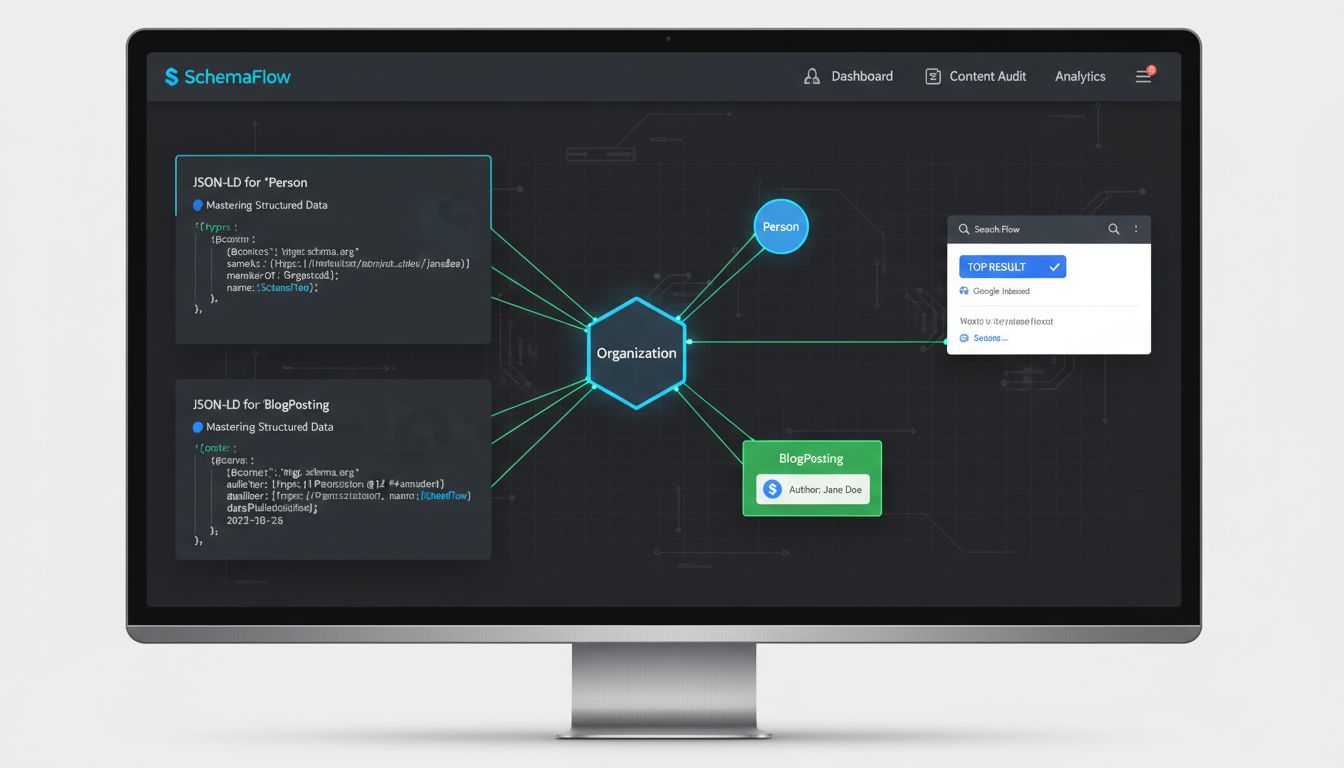
Schema App is non-negotiable if you're serious about entity optimization. It's purpose-built for implementing and managing Person, Organization, and Article schema markup, the structured data that tells Google "this person is a recognized expert." Schema App specifically advocates for linking Person and Article entities, which is exactly the relationship you need to establish founder authority. Only 1.40% of pages use BlogPosting schema, which means this is still a differentiator, not table stakes.
BrightEdge works for enterprise teams that need to generate hundreds of content briefs at scale. Siteimprove helps you monitor which SERP features your content is capturing and whether your schema implementation is actually working.
Both are overkill for early-stage founders but become relevant as you scale past 20-30 employees.
The mistake here is treating SEO tools as optional polish. They're the technical scaffolding that makes your expertise machine-readable.
Category 3: Quality Assurance & Governance (For Integrity & Trust)
Purpose: Act as the final verification layer that protects your reputation and institutionalizes E-E-A-T practices.
Trust is fragile. One factual error, one plagiarism accusation, one obviously AI-generated article can undo months of authority-building.
Your QA layer isn't about perfection. It's about demonstrating due diligence.
Grammarly handles the basics: clarity, tone, grammar. But its plagiarism checker is the real E-E-A-T asset. Accidental duplication or too-close paraphrasing from sources destroys Trust signals. Grammarly Premium catches this before publication.
Originality.ai is controversial because it's marketed as AI detection, but smart founders use it differently. Don't use it to "prove" content is human-written (that's a fool's errand). Use it to verify that your editing process was substantial enough to add genuine human perspective. If Originality flags 95% AI probability after your "edit," you didn't actually edit. You just changed a few words.
Free resources matter here. Many founders search for free social media management tools when building their stack, but distribution tools don't build trust, your core content does. Prioritize free governance resources instead: Insites offers a free E-E-A-T audit tool that identifies exactly where your site is weak on author signals, credentials, or citations. Geneo, emarketexperts, and Wellows all publish editorial policy templates that give you the 30/60/90-day implementation roadmap for byline standards, AI disclosure language, and correction protocols.
The governance layer is where theory becomes operational. You're not just "being trustworthy", you're documenting your editorial standards, tracking corrections, and creating an audit trail that proves you take accuracy seriously.
The integration principle: These three categories only work if they talk to each other. Your AI writing tool should feed into your SEO optimizer, which should trigger your QA checks. If you're copy-pasting between five disconnected platforms, you'll skip steps under deadline pressure.
The best stacks have APIs, webhooks, or at minimum, shared workspaces that enforce the workflow.
Your content creation software stack isn't a collection of tools. It's a system of checks and balances where each layer compensates for the weaknesses of the others, and together, they let you scale founder expertise without diluting it.
Your Blueprint: The Founder's E-E-A-T Content Workflow for 2026
You've got the criteria. You've mapped the tech stack. Now here's the part that matters: the actual Monday morning process that turns software into authority.
This is a six-step cyclical workflow you can implement this week. Each step has a clear goal, specific tool actions, and a direct connection to the E-E-A-T signal it strengthens. Think of it as your production assembly line, except instead of widgets, you're manufacturing verifiable expertise at scale.
The beauty of this workflow is its honesty about what AI can and cannot do. It doesn't pretend you can automate authority. It shows you exactly where to spend your founder time for maximum impact, and where software can legitimately carry the load.
Step 1: Ideation with Authority – Find Gaps Only You Can Fill
Goal: Identify topics where your founder experience is a unique differentiator, not just topics with high search volume.
High-volume keywords are tempting. But if 500 other sites have already covered "how to choose project management software," your AI-assisted article will be the 501st version of the same thing. Google's August 2024 core update specifically targets content made solely for search performance, not genuine usefulness.
Instead, use your content creation software's SEO module to find questions in your niche. Clearscope's content inventory, Sight AI's keyword insights, even basic Search Console data work fine. Then apply the founder filter: "Can I tell a story about this? Do I have a client case study? Did I personally make this mistake and learn from it?"
Let's say you run a B2B SaaS company. Instead of "what is customer churn," target "how we reduced churn from 8% to 3% without a customer success team." The second topic has lower volume, but you're the only person who can write it with authority.
Signal strengthened: This demonstrates Experience and Expertise from the very beginning. You're not chasing traffic. You're claiming territory only you can occupy.
Step 2: AI-Assisted Drafting – Leverage Efficiency, Not Final Voice
Goal: Create a structured, factually accurate first draft at speed.
This is where your AI writing tool earns its subscription. Use Sight AI's Article Writer, eesel AI's workflow, or Jasper to generate a draft, but feed it properly. A vague prompt like "write about customer retention" produces generic garbage. A detailed brief with your key data points, the specific framework you use, and the outcome you achieved gives AI something real to work with.
Your brief should include: the core argument, three supporting points with data, any proprietary terminology or frameworks your company uses, and links to sources you want cited. Think of AI as a research assistant who can structure information quickly but has no lived experience.
The draft you get back will be grammatically correct and logically organized. It will also be utterly forgettable.
That's fine. You're not publishing this. You're using it as scaffolding.
Signal strengthened: Provides a solid Trustworthiness foundation via accurate facts and proper structure, freeing you to focus on adding the value only you can provide.
Step 3: The Human Injection Layer – Mandatory Founder Rewrite
Goal: Transform a generic draft into a unique piece of expert testimony.
This is your hands-on step, and it's non-negotiable. Open that AI draft and rewrite the introduction completely. Replace the generic opening with a specific moment: "Three months after we launched, our churn rate hit 8%. I remember the board meeting where our lead investor asked if we'd validated product-market fit."
Go through the body and inject real examples. Where the AI wrote "companies should track engagement metrics," you write "we built a simple dashboard that flagged any account that hadn't logged in for seven days, then I personally called the first twenty. Fifteen were about to churn. We saved twelve."
Rewrite the conclusion with an opinion or a contrarian take. The AI will give you "customer retention is important for growth." You give them "most founders obsess over acquisition because it feels like progress. Retention feels like maintenance. That's exactly why your competitors are ignoring it and why you shouldn't."
If your content creation software includes voice calibration features, use them to maintain consistency across articles. But the core work, the stories, the failures, the lessons, has to come from you.
Signal strengthened: This is the core of Experience. Adding detailed author perspectives and real-world examples is the un-fakeable element that separates founder-led content from the mass-produced alternative.
Step 4: Fact-Check & Provenance Tagging – The Governance Checkpoint
Goal: Verify accuracy and document the creation process for transparency.
Before you publish, run a fact-check pass. Every statistic needs a source. Every claim needs to be verifiable. Use Grammarly's plagiarism checker or manually verify your data points. This step catches AI hallucinations, and they happen more often than vendors admit.
If you used AI to generate the first draft, add a disclosure. It doesn't have to be elaborate: "This article was researched and written by [Your Name], with AI assistance for initial structuring." Google's quality raters are now explicitly checking whether content is AI-generated and whether that's disclosed.
For high-stakes content, YMYL topics, proprietary research, original data, consider implementing C2PA provenance tags for your images and data visualizations. This is still emerging, but early adopters are signaling a level of rigor that competitors aren't matching. Start with your most important assets and expand from there.
Log this governance step in your project management system. Create a simple checklist: sources verified, AI disclosure added (if applicable), provenance tagged (for key assets). This becomes your audit trail.
Signal strengthened: Reinforces Trustworthiness and Accountability. You're not just claiming expertise. You're documenting the rigor behind it.
Step 5: Schema Markup & Entity Publishing – Flip the Authority Switch
Goal: Publish the content with all machine-readable authority signals activated.
This is where your technical infrastructure pays off. Assign the byline to you, the founder, not "Admin" or "Marketing Team." Link to your author page, which should have Person schema with your credentials, your LinkedIn profile (sameAs property), and a bio that establishes your expertise.
Use Schema App, your CMS's native schema tools, or a plugin to generate Article JSON-LD. The markup should declare you as the author entity, your company as the publisher, and include datePublished and dateModified fields. If you've updated the article, log that in the schema.

Publish. At this moment, you're not just adding a blog post to your site. You're adding a node to your entity graph. Google now has machine-readable confirmation that this piece of content was created by a specific person with verifiable credentials, published by an organization with a knowledge panel, on a specific date.
Signal strengthened: Activates Authoritativeness. Makes your expertise discoverable as an entity to Google, not just as text on a page.
Step 6: Post-Publish AI Visibility Monitoring – Measure in the New Landscape
Goal: Track if your authoritative content is being sourced by AI systems, not just ranking on page 1.
Traditional SEO tracking ends at "we ranked #3 for our target keyword." In 2026, that's incomplete.
You need to know if your content is being cited in AI Overviews, pulled into Perplexity answers, or referenced by ChatGPT when users ask about your topic. Use Sight AI's visibility tracker, Clearscope's AI monitoring features, or Siteimprove to track this. Set up a dashboard that monitors both traditional metrics (rankings, clicks, impressions) and AI visibility metrics (citations in AI Overviews, mentions in LLM responses, featured snippet ownership).
Track this monthly. If a piece of founder-led content is getting cited by AI systems, double down on that topic cluster. If it's ranking well but not getting AI visibility, revisit the structure, AI systems prefer content with clear answers, bullet points, and schema markup.
This step closes the loop. You're not just producing content. You're measuring whether your content creation software investment is actually defending you against the zero-click future.
Signal strengthened: Competitive Intelligence. Shows your content's relevance in the AI-driven search ecosystem and gives you data to refine your workflow for the next cycle.
This workflow isn't aspirational. It's operational. You can implement it with the tools you already have or with the stack you're about to choose. The key is treating it as a system, not a checklist. Each step feeds the next, and the monitoring step informs your next ideation cycle.
Pitfalls to Avoid: The 2026 Quick Path to Irrelevance
You can follow every step perfectly and still fail if you fall into these traps. Each one quietly dismantles a different E-E-A-T pillar, and the damage compounds fast.
Publishing Raw AI Output (The Hallucination Hazard)
The mistake looks like this: You hit "generate," skim the draft, fix a typo, and publish. The AI voice stays generic. The examples sound plausible but aren't yours. Worse, a statistic is confidently wrong, a hallucination that slipped through.
Trustworthiness evaporates the moment a reader (or Google's quality rater) spots the error. AI-generated content without human oversight is exactly what Google's 2024 core updates target. Your content gets labeled "made for search engines," not humans. The traffic doesn't just decline. It disappears.
The fix: Treat Step 3, Human Injection, as the firewall. No draft goes live without you rewriting at least one section in your voice, adding a firsthand example, and fact-checking every claim against your source documents. The AI writes the scaffold; you build the house.
Neglecting the Author Entity (The Ghostwriter Problem)
Articles publish with no byline, or "Admin," or your name spelled three different ways across pages. No author bio. No schema linking you to LinkedIn or your company entity.
You're a ghost.
Google can't attribute expertise to anyone. Every signal of Authoritativeness, your speaking gigs, your LinkedIn thought leadership, your decade in the industry, stays invisible. You might as well be anonymous. The content floats untethered, and so does your authority. Pages get indexed, but they carry no weight.
The fix: Implement Criterion 1 and Step 5 without exception. Every piece carries your name, consistently. Your author page has Person schema with sameAs links to your LinkedIn, company bio, and any external profiles. Use a tool like the Insites E-E-A-T audit to catch gaps. Your content creation software should make byline and schema implementation a default, not an afterthought.
Choosing Opaque Tools & No Governance (The Black Box)
You pick software because it's cheap or because a competitor uses it. It has no version history, no audit log, no way to tag AI-assisted sections or track who edited what. Your workflow is a black box.
Here's the problem: When Google's quality raters ask "Can we verify this content was reviewed by a human expert?", the answer is silence. Trustworthiness requires demonstrable process. Without governance, editorial policies, disclosure standards, correction SLAs, you can't prove anything. You're asking readers to take your expertise on faith, and in 2026, that doesn't work anymore.
Choose tools meeting Criterion 2. Look for version control, collaborative editing with attribution, and the ability to add machine-readable disclosure tags. Adopt a simple editorial policy template (many are available from industry consultants) that defines byline standards, fact-check steps, and update protocols. Document your process. It's a trust signal, and it's auditable.
Ignoring AI Search as a KPI (The Page-1 Fallacy)
The mistake: Your dashboard shows #1 for your target keyword. You celebrate. Meanwhile, 83% of those searches now trigger an AI Overview that answers the question inline.
Nobody clicks. Your traffic flatlines.
You're optimizing for a game that's over. Traditional rank tracking is a vanity metric when searches with AI Overviews have an 83% zero-click rate. You're winning position one in a desert while your competitors are getting cited as sources inside the AI answer itself.
The fix: Adopt Criterion 3 and Step 6. Track whether your content appears in AI Overviews, gets cited by ChatGPT or Perplexity, and drives engagement when it does get clicked. Use tools like Sight AI or Clearscope to monitor LLM visibility. Shift your KPIs from "rank" to "cited as authoritative source." That's the new page one.
Conclusion
content creation software in 2026 isn't about pumping out more articles. It's about making your expertise machine-readable so AI search engines can actually cite you.
Look at the data: 83% zero-click rates when AI Overviews show up, 34.5% traffic drops across the board [Source: ahrefs.com]. Publishing more content won't fix that. The only play that works is proving you're the authoritative source, with schema, provenance tracking, and entity mapping that connects your name to your expertise.
The four criteria and the founder-authored SEO workflow I walked through aren't aspirational. They're operational steps you can start today. Every article you publish needs to carry the technical signals that Google and LLMs use to decide who gets cited. This 2026 guide gives you the blueprint. Execution is what separates recovery from becoming invisible.
Start with one article. Take it through the complete workflow, inject your actual experience, validate the schema, track whether it shows up in LLM responses. Then scale.
Your competitors are still optimizing for page one rankings that don't drive clicks anymore. You'll be building authority that works in the search engines people actually use.
Frequently Asked Questions
Which software is best for content creation?
In 2026, the "best" content creation software isn't about word count or template libraries. It's whether the tool helps you build verifiable authority signals that actually protect against zero-click AI Overviews.
You need platforms that support Person and Organization schema markup, enable transparent AI-human workflows with provenance tracking (like C2PA), and integrate visibility monitoring across ChatGPT, Claude, and Perplexity [Source: trysight.ai]. Tools like Sight AI (which combines content generation with LLM visibility tracking) and eesel AI (which enforces E-E-A-T workflows with mandatory fact-checking steps) represent this new category. They're built for authority-first publishing, not just content velocity.
What is the best platform for beginner content creators?
Choose simplicity over feature bloat.
If you're a founder just starting to build content authority, pair an AI writing assistant that emphasizes governance, like eesel AI, which requires manual fact-checking and human experience injection, with a dedicated schema implementation tool like Schema App to handle your author entity markup [Source: eesel.ai, schemaapp.com]. Skip the complex enterprise platforms with collaboration features you won't use yet.
Here's what actually matters: picking platforms that make it effortless to attach your name, credentials, and firsthand experience to every piece from day one. That's what Google's Quality Raters are evaluating. Sophistication doesn't matter if the tool can't help you prove authorship.
What tools do I need as a content creator?
A modern founder-led content stack requires three layers focused on E-E-A-T signals, not production speed.
Layer 1: AI Writing & Orchestration (Sight AI, Typeface.ai, or Jasper.ai) for research-backed drafting and workflow automation. Layer 2: SEO & Entity Optimization (Clearscope for content scoring, Schema App for Person/Article/Organization markup) to ensure Google can verify your authority. Layer 3: Quality Assurance & Governance (Grammarly for accuracy, editorial policy templates from sources like Geneo) to maintain integrity and track AI disclosure [Source: geneo.app, machined.ai].
This trinity makes sure your content is created, optimized for entity recognition, and verified for trustworthiness. Those are the three requirements for surviving AI Overview cannibalization. Miss one and the whole system breaks down.
How do I start my own content creator?
Don't chase volume. Architect your presence for authority first.
Your first 90 days should focus on three foundation steps: (1) Claim and interlink your author entity across LinkedIn, your site's author page, and any industry profiles, then implement Person schema with sameAs links so Google recognizes you as a knowledge entity [Source: themakerdesk.com]. (2) Document a lightweight editorial policy covering byline standards, AI disclosure language, and a fact-check process. Even if you're a team of one, this governance signals trustworthiness to Quality Raters. (3) Use a structured workflow (AI draft → founder experience injection → schema markup → provenance tagging) to publish 3-5 cornerstone pieces that deeply reflect your unique founder experience.
Case studies show this approach increased organic traffic by 34% in 60 days [Source: themakerdesk.com]. The framework works because it front-loads the authority signals that AI search engines actually check before citing sources.