March 2nd, 2026
How Content Creation Software Integrates with AI SEO Workflows for SaaS
 WD
WDWarren Day
You're running a dozen different tools right now. One for keyword research, another for AI writing, something else for SEO scores, and yet another for publishing. Each one claimed it would transform your content operation. Instead, you've got fragmented data and inconsistent quality. Your content creation software stack keeps expanding, but your workflow? Still broken.
Maybe it's Jasper for drafts, Surfer for optimization, MarketMuse for topic planning, WordPress for publishing. They all work fine on their own. The problem is everything between them. Manual exports. Copy-paste sessions that eat up entire afternoons. Version control chaos. Your team wastes more time moving content between platforms than actually creating it, and even then, you're still doing three rounds of edits to make anything sound remotely like your brand.
Look, adding more tools won't fix this.
The real advantage isn't finding the perfect platform. It's building a connected workflow where specialized software actually talks to each other, passing data automatically from keyword discovery all the way through to publication. With human oversight baked in to keep quality consistent and prevent your brand voice from turning into generic AI mush.
This guide shows you how to actually wire these systems together. You'll see the specific data handoffs that make AI content work at scale, the APIs and connectors that kill the manual busywork, and the governance controls that protect your brand. We've mapped out three stack templates (startup, growth-stage, enterprise) so you can build something that actually ships quality content faster instead of just promising to.
The SaaS Content Scaling Dilemma: More Tools, More Fragmentation

You added Jasper to speed up drafting. Then Surfer to optimize for search. MarketMuse for topic clusters. Contentful for publishing. Each tool promised to solve a piece of the puzzle, but now your team spends more time copying data between platforms than actually creating content.
Here's the thing about modern content creation software: every new tool adds capability but kills coherence. Your keyword research lives in one dashboard, your AI drafts in another, your brand voice guidelines in a Google Doc, and your CMS in a fourth silo. Writers toggle between six tabs to publish a single post. Editors can't track what's been optimized or who changed what. Your content calendar? A Frankenstein of spreadsheets and Slack threads.
The cost isn't just operational chaos.
When tools don't talk to each other, quality tanks. AI drafts ignore your keyword targets. Optimized content loses your brand voice. Published posts skip technical SEO checks. You're producing more content but seeing diminishing returns because nothing connects.
The data backs this up: HubSpot customers using AI features saw a 167% increase in website traffic after six months, but only when those features were integrated into a coherent system. The gap between teams that connect their stack and those that don't is widening fast. Fragmentation isn't a minor inconvenience. It's leaving qualified traffic on the table while your team drowns in browser tabs.
The Modern Framework: From the 5 C's to the AI-Integrated Workflow
If you've searched "what are the 5 C's of content creation," you've probably found the traditional framework that's guided content teams for years. It still works. The execution is what's changed.
The 5 C's of content creation are:
- Concept – Identifying topics, keywords, and audience intent
- Crafting – Writing and producing the content itself
- Curation – Editing, optimizing, and refining for quality
- Circulation – Distributing across channels and platforms
- Conversion – Measuring performance and driving business outcomes
The framework holds up fine. What's different in 2025 is how each phase actually happens when you build your content creation software stack as a connected system instead of random tools you happened to buy.
Concept now runs through platforms like MarketMuse that automate cluster analysis and spit out data-backed briefs. No more spending hours manually scraping SERPs. Crafting happens in Jasper or Surfer AI, where your brand voice profiles and SEO parameters are already loaded before you type a word. Curation shifts from one editor's opinion to systematic quality checks via tools like Acrolinx that enforce terminology, tone, and compliance rules across every single draft.
Circulation integrates directly with your CMS and social schedulers through API connections. Not manual copy-paste hell. Conversion tracking expands way beyond Google Analytics now that AI Overviews trigger for 24.61% of queries. If you're only measuring traditional organic CTR, you're missing a quarter of your potential reach.
The 5 C's didn't disappear. They got instrumented.
Each phase now generates structured data that feeds the next. MarketMuse briefs flow into Jasper drafts, which flow into Surfer optimization scores, which flow into WordPress, all without leaving your workflow. That's the real shift: from content creation software as a collection of tools to content creation software as architecture. One system where the pieces actually talk to each other.
Blueprint: The Connected AI SEO Content Workflow
The question "which software is best for content creation?" assumes a single answer. There isn't one.
The competitive advantage belongs to teams that architect a connected stack where each specialized tool handles its core function and passes structured data to the next stage without manual re-entry or context loss. Not five disconnected tools. A system.
Here's what the actual workflow looks like when it works:
Phase 1: Discovery & Briefing
Start with automated keyword and topical analysis. Tools like MarketMuse scan your domain authority and competitor gaps, then cluster semantically related keywords into topic maps. These clusters export directly into brief templates, complete with target keywords, recommended headings, and competitor content scores.
The output isn't a spreadsheet you manually interpret. It's a structured JSON or API payload that feeds your next tool. Surfer's Topical Map can push this data into Content Editor via API, eliminating the copy-paste step that breaks most workflows.
Phase 2: Drafting & Brand Voice
AI-assisted draft generation begins with the brief as input, not a blank prompt.
Jasper or Frase ingests the structured brief (keywords, outline, word count targets) and generates a first draft pre-tuned to your uploaded brand voice examples. The handoff here matters: the AI doesn't write "about" your topic. It writes from the brief's intent signals and in your brand's documented tone. This phase outputs a draft tagged with metadata (target keyword, content score, brand voice ID) that travels with the document.
Phase 3: Optimization & Technical SEO
On-page SEO optimization scoring happens in real time. Surfer Content Editor or Clearscope grades your draft against live SERP data, flagging missing semantic terms and structural gaps.
Simultaneously, tools like Alli AI crawl your staging environment to inject schema markup, fix internal linking paths, and validate H1 hierarchy. All without touching your CMS codebase. The output: a technically optimized draft with a passing content score (typically 75+) and audit-ready markup.
Phase 4: Publishing & Distribution
Direct CMS integrations close the loop.
Surfer's WordPress plugin or Contentful's API publishes the optimized draft, preserving all metadata and schema. For global SaaS teams, Contentful's AI Content Generator localizes into nearly 100 languages at this stage, creating translated variants that maintain brand voice and SEO structure. The handoff isn't manual export. It's a single-click publish that triggers localization, staging, and live deployment in sequence.
Beyond the Blog: Integrating Social & Multimedia
SEO content doesn't end at publication.
Repurpose optimized posts into social snippets, LinkedIn carousels, and video scripts using free social media management tools like Buffer or Hootsuite's free tier. These platforms ingest your published URL, extract key points via API, and auto-schedule distribution. The same brief that fed your AI writer now feeds your social calendar, ensuring message consistency across channels without rewriting from scratch.
Technical Integration Patterns: APIs, Plugins, and Connectors
How your content creation software actually connects matters more than most people think. The integration method determines who on your team can manage it, what it'll cost, and whether the whole thing breaks the next time a vendor pushes an update.
API Integrations: For Programmatic Control
APIs give you direct access to a platform's core functions. Most use API keys in request headers. Straightforward for developers, completely invisible to everyone else.
Surfer's API is available on their Peace of Mind and Enterprise plans ($299+/month as of 2025). It lets you create Content Editor queries, run audits, and generate AI drafts without ever opening the Surfer interface. This matters when you're running custom dashboards or automating brief creation for 50+ articles monthly. Your engineering team pulls SERP data, feeds it into an internal tool, and pushes optimized briefs directly to writers. No manual exports.
The catch: APIs need developer time to build and maintain. Budget 10-20 hours for initial setup, plus ongoing maintenance whenever endpoints change.
Plugin & Marketplace Integrations: For Seamless UX
Plugins embed one tool inside another. Context-switching eliminated.
Surfer's WordPress plugin displays your Content Score directly in the Gutenberg editor. Writers see optimization suggestions without leaving the CMS. Contentful's AI Actions offer pre-built templates like SEO Keyword Optimization that inject target keywords into drafts and enforce brand phrases via Text Variables. These marketplace integrations work out-of-the-box. Configuration required, but no code.
The limitation: you only get what the vendor supports. If your CMS isn't on their integration list, you're back to copy-paste or custom builds.
Automation Connectors: Linking Platforms Without Code
Zapier and Make bridge tools that don't natively integrate. Common pattern: new lead enters HubSpot (trigger), Zapier calls Jasper's API to generate a personalized follow-up email draft (action), then posts it to Slack for review.
HubSpot's MCP server uses OAuth to let LLM assistants query CRM data securely. It's a more sophisticated connector pattern for teams using AI agents in their workflow.
Automation platforms charge per task. Zapier starts at $19.99/month for 750 tasks. For high-volume workflows, costs scale fast. A single content piece moving through five handoffs consumes five tasks.
Governance Architecture: The Human Controls That Actually Matter
Google has explicitly warned against publishing unedited AI content. That's not a suggestion. It's a signal that algorithmic detection is coming, if it isn't already here.
Yet most teams treat governance as an afterthought, bolting on a "quick review" after the AI has already generated thousands of words. The teams scaling content successfully treat it as architecture, not polish. They build controls into the workflow itself, not around it.
Tool-Level Guardrails: Built-In Quality Controls
Your content creation software should enforce standards before a human ever sees a draft.
Jasper's Brand Voice feature lets you upload example content or URLs so the AI learns your tone, terminology, and style patterns. Frase offers similar brand voice profiles that reduce editing time by pre-training the model on your existing content. The AI starts closer to your actual voice instead of generic corporate speak.
Role-based permissions matter more than most teams realize. Jasper's Business plan includes Admin, Manager, Developer, and Member roles. Junior writers can't publish directly. Every piece passes through defined approval gates. Audit logs track who generated what and when, creating accountability that prevents the "AI content factory" problem where no one owns quality.
Acrolinx takes this further by automating terminology, tone, and compliance checks against customizable rule sets. It's not just flagging errors. It's enforcing your style guide at machine speed.
Process Checkpoints: Mandatory Human Intervention
Tool guardrails fail without process enforcement.
For cornerstone content (pillar pages, product launches, thought leadership) mandate subject matter expert review before publication. No exceptions. One startup paused their entire AI content program after a factual error went live. They implemented mandatory human fact-checking and clear AI disclosure labels on every piece. Traffic recovered within two months because trust returned.
Staged rollouts prevent catastrophic mistakes. Pilot new AI workflows on low-stakes blog posts before scaling to high-value landing pages or customer-facing documentation.
Auditing & Compliance: Ensuring Ongoing Quality
AI models drift. Your GPT-4 output today won't match next quarter's without continuous monitoring.
Acrolinx recommends regular content audits to catch brand voice degradation before it compounds across hundreds of articles. You're not just checking individual pieces. You're looking for systemic drift in how the AI interprets your guidelines.
Security and privacy frameworks aren't optional for enterprise teams. If your content creation software touches customer data or proprietary research, you need audit trails, data residency controls, and clear ethical guidelines for AI use. The legal risk alone justifies the overhead.
Measuring What Matters: From Clicks to AI Visibility
Your analytics dashboard still shows traffic and conversions. That's necessary, but it's not the whole picture anymore.
The search landscape shifted under your feet in 2025. Your measurement framework needs to catch up.
Traditional KPIs: The Foundation
Organic sessions, lead conversion rates, and marketing-qualified leads are still the bedrock of content performance. You need to know how many visitors arrived, how many converted, and what that traffic cost to acquire. Basic stuff.
HubSpot's 2025 data showed customers using AI features achieved a 167% increase in website traffic after six months. Traditional metrics matter because they tie directly to pipeline and revenue. Don't abandon them.
AI-Era Metrics: Visibility in New Formats
Here's what changed: AI Overviews now appear in nearly 25% of Google queries as of July 2025. Over 27% of U.S. searches end without any click at all.
Your content might be driving value without generating a single session.
You need to track share of voice in AI-generated answers. Whether Google's AI Overview, ChatGPT, Perplexity, or Gemini cite your brand matters now. PlushBeds saw a 753% surge in LLM-origin traffic by optimizing for these channels. That traffic doesn't show up in traditional organic reports unless you're specifically tagging and segmenting it, which most teams aren't doing yet.
Tools and Dashboards for a Unified View
Surfer AI Tracker monitors your visibility across AI Overviews and synthesized results. For a complete picture, build custom dashboards that pull SEO data via API (from Surfer, Semrush, or Ahrefs) and combine it with CRM conversion data from HubSpot or Salesforce.

The goal isn't choosing between old and new metrics. It's creating a unified view that shows both traditional rankings and emerging AI visibility, so you can allocate resources where they actually drive growth. You can't optimize what you're not measuring, and right now most teams are flying half-blind.
Building Your Stack: Templates for Startup, Growth, and Enterprise
Your company size determines which content creation software you actually need. A 15-person startup shouldn't build like a 500-person enterprise, and vice versa.
Here are three proven templates, each designed around different constraints and goals.
Starter Stack: Centralization on a Budget
Core tools: Frase (Starter plan, ~$39/month) + HubSpot Marketing Hub (with Breeze AI features)
Total monthly cost: ~$250–500
Early-stage teams need to consolidate, not fragment. Frase handles AI-optimized briefs and drafts with built-in brand voice profiles, while HubSpot's AI features deliver measurable ROI through integrated publishing, workflow automation, and CRM connectivity. You can draft, optimize, and publish without switching platforms.
For social distribution, pair this with free social media management tools like Buffer's free tier or Hootsuite's basic plan to amplify published content without adding major costs. The key is limiting your stack to 2–3 paid tools max while leveraging native integrations.
Growth Stack: Velocity and Optimization
Core tools: MarketMuse (Research plan, ~$249/month) + Surfer SEO (Peace of Mind, ~$299/month with API access) + Jasper (Business plan with audit logs) + WordPress
Total monthly cost: ~$800–1,200
Scaling teams need speed and consistency. MarketMuse automates cluster analysis and topic briefs, cutting research time by 60–70%. Surfer provides real-time optimization scoring and API access for workflow automation. Jasper maintains brand voice across multiple writers with role-based permissions and audit trails.
This stack helped teams reduce time-to-publish from 14 days to 6 days while tripling content velocity. The investment in API-enabled plans pays off when you're publishing 15+ pieces monthly and need seamless handoffs between research, drafting, and optimization.
Enterprise Stack: Compliance and Global Scale
Core tools: Acrolinx (enterprise governance) + Contentful (with AI Actions) + Custom integration layer via Make/Zapier + Screaming Frog (team licenses)
Total monthly cost: ~$2,500–6,000+ (plus $10,000–50,000 integration setup)
Global teams need enforceable governance. Acrolinx automates compliance checks for terminology, tone, and regulatory requirements across 100+ languages. Contentful's AI Actions support brand phrase enforcement, localization into nearly 100 languages, and External References to pull live data into AI outputs.
Enterprise pricing reflects the complexity: Contentful alone ranges $5,000–70,000 annually depending on scale. Add custom API development, training programs ($2,000–10,000), and dedicated integration resources. For companies managing multi-region compliance or regulated industries, the alternative doesn't scale. Manual review at that volume simply breaks down.
Common Pitfalls & How to Avoid Them
You've built the workflow, connected the tools, and started publishing. Here's where most teams stumble.
Pitfall #1: Treating AI as a replacement, not an assistant
Over-automation creates content that's technically accurate but emotionally flat. The human element that makes readers actually care? Missing. Your workflow should position AI as a drafting tool, not the final voice.
Avoidance strategy: Set mandatory human review gates in your workflow. Require subject matter experts to add original insights, examples from customer conversations, or contrarian perspectives before any piece publishes. One SaaS startup paused all AI content after a quality incident, then rebuilt with mandatory fact-checking and AI disclosure labels. The rebuild took three weeks. Worth it.
Pitfall #2: Ignoring brand voice drift
You configured brand voice profiles in month one. By month six, your AI output sounds nothing like your actual brand.
Model drift is real, and most teams don't monitor for it. The AI learns from its own output, gradually homogenizing toward generic LinkedIn-speak.
Avoidance strategy: Schedule quarterly brand voice audits. Have your content lead read five recent AI-assisted pieces alongside five human-written ones. If they can't tell which is which (or worse, if the AI pieces sound generic), recalibrate your brand voice settings and add fresh training examples. Think of it like tuning an instrument that slowly goes out of key.
Pitfall #3: Chasing velocity over substance
Publishing six shallow posts weekly beats two deep ones, right? Google disagrees. Prioritizing quantity leads to content floods that harm visibility and can trigger algorithmic penalties for thin content.
Avoidance strategy: Define minimum quality thresholds before scaling volume. Set word count floors, require original data or expert quotes, and track engagement metrics (time on page, scroll depth) alongside traffic. If readers bounce immediately, you're creating noise, not assets. Better to publish half as often with twice the retention.
Conclusion
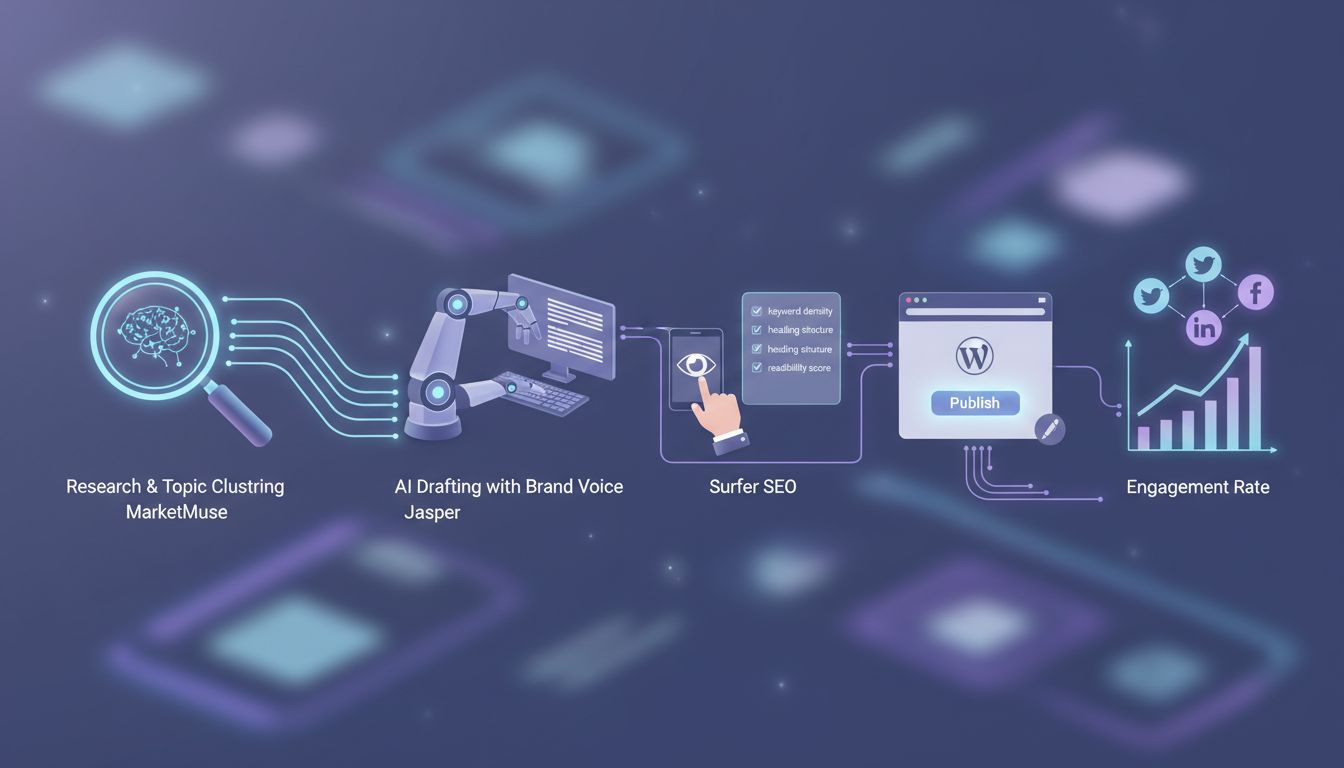
There isn't one perfect content creation software. What matters is the system you build around your tools.
For SaaS companies trying to scale organic traffic without burning budget on freelancers or sacrificing quality, your edge comes from how well your tools talk to each other. Keyword research flows into AI drafts, drafts move through editing workflows, published posts feed back performance data. All of it connected, all of it with human checkpoints that prevent the generic slop problem.
You've seen how this works. Research connects to writing, writing connects to optimization, optimization feeds measurement. The technical pieces (APIs, native plugins, automation connectors) aren't complicated once you understand the handoff points. And governance isn't bureaucracy, it's what keeps you from publishing content that sounds like everyone else.
Start with one broken handoff in your current workflow. Maybe keyword data never makes it to your writers. Maybe AI drafts skip the brand voice review. Pick one, fix it with a simple integration (Zapier works fine for testing), then measure whether you're actually saving time without sacrificing quality.
Your competitors are buying more tools. You're connecting the ones you already have into something that actually compounds.
That's the difference.
Frequently Asked Questions
Which software is best for content creation?
Wrong question. There's no single best tool.
What actually matters is how your tools connect. For B2B SaaS teams running SEO, the pattern that works looks like this: research platform (MarketMuse or Semrush), AI writer with brand voice controls (Jasper or Writer), optimization layer (Surfer SEO or Frase), and a CMS that plays nice with everything else (Contentful or WordPress). Your specific stack depends on whether you're a 5-person team moving fast or a 200-person company that needs governance and audit trails to keep things from going sideways.
What are the 5 C's of content creation?
The traditional framework (Concept, Crafting, Curation, Circulation, Conversion) still holds. AI just changes how you execute each phase.
Concept gets faster with automated topical maps and cluster analysis. Crafting accelerates when you're starting from brand-trained drafts instead of blank pages. Curation becomes systematic when software flags outdated content that needs refreshing. Circulation runs through automated CMS publishing workflows. Conversion improves with real-time on-page SEO scoring [Source: contentful.com]. The framework hasn't changed, but now software handles the repetitive parts while humans make the judgment calls.
What do OnlyFans creators use to edit videos?
Video creators typically use Adobe Premiere Pro, Final Cut Pro, or mobile-first tools like CapCut. These are built for multimedia production, not SEO text workflows.
For B2B SaaS teams producing video content (product demos, explainers, webinars), the same principle applies: use specialized tools for specific formats, but make sure they integrate with your central content hub. Video transcripts and metadata should flow into your CMS and SEO stack. Otherwise you're leaving discoverability on the table for both traditional search and AI Overviews.
What do most content creators use?
Scaling SaaS content teams don't pick one tool. They build a connected stack.
The most common pattern includes an AI writing assistant (Jasper, Writer, or Writesonic), an SEO platform (Surfer SEO or Frase), a CMS (WordPress or Contentful), and a governance layer (Acrolinx or built-in audit logs with brand voice profiles). HubSpot's 2025 ROI report found that customers using integrated AI features saw 167% higher website traffic after six months compared to those using disconnected tools [Source: hubspot.com]. The defining factor isn't which specific tools you choose. It's how smoothly data flows between them, from keyword research all the way through to published post.