February 23rd, 2026
Free vs. Paid AI SEO Tools for SaaS Content: A 2026 Comparison
 WD
WDWarren Day
You're a SaaS founder. You need to scale content and win organic traffic, but your SEO budget is basically you plus ChatGPT. You've seen the AI tool ads promising to 10x your output, but is a paid platform really necessary when free ai seo tools abound?
The market's a mess. One vendor claims their platform saves four hours per article, another promises 15-minute blog posts for $29, and a third insists you need AI visibility tracking across ChatGPT and Perplexity to survive 2026.
Here's what actually happens. Most SaaS teams waste months toggling between free options that can't scale. Or they burn budget on enterprise platforms before validating their content process. The seo ai tool landscape isn't a binary choice between free and paid. It's a progression, and knowing where you are in that progression matters more than the tools themselves.
The winning play for 2026? A hybrid AI SEO stack. Start with a curated set of robust free tools to validate your content opportunities and workflow. Once you've got proof of concept, invest strategically in a single, workflow-centric paid platform that acts as a force multiplier for your entire content engine. Not about choosing sides. It's about knowing when to graduate.
The shift is happening fast. AI-referred sessions jumped 527% year-over-year in August 2025. Google's AI Overviews now appear for roughly 15-30% of queries. Your content isn't just competing for blue links anymore, it's fighting for answer share in ChatGPT, Perplexity, and AI Mode.
This guide gives you a clear, phased investment roadmap: which free tools to master first, the exact signals that you've outgrown them, and how to pick the one paid platform that unlocks repeatable, scalable content production without draining your runway.
The 2026 SEO Battlefield: AI Overviews, Answer Share, and Why Your Toolkit Must Evolve
Google's AI Mode launched to all US users on May 20, 2025. The game changed overnight.

AI Overviews now appear for roughly 15–30% of queries, depending on the vertical. For SaaS companies, that means a third of your potential buyers never see your carefully optimized meta descriptions. They see an AI-generated summary instead. You might rank #3 on page one and still get zero clicks because Google already answered the question.
Rankings still matter. But they're no longer the whole story.
Your new North Star is Answer Share: how often your brand, product, or content gets cited in AI-generated responses across ChatGPT, Perplexity, Claude, and Google's AI surfaces. Traditional rank trackers can't measure this. They're blind to the fastest-growing traffic channel in search history, still obsessing over position tracking for ten blue links that fewer people actually click.
The numbers are stark. AI-referred sessions jumped 527% year-over-year by August 2025, and conversion rates from LLM traffic are running 3–9× higher than standard organic clicks for some engines. If you're not visible in these AI answers, you're invisible to a massive segment of high-intent buyers who've already moved on from scrolling through SERPs.
Generic SEO tools weren't built for this battlefield. They track whether you rank for "project management software," not whether Perplexity recommends your product when a prospect asks "best project management tool for remote teams with async workflows." You need ai seo optimization platforms that monitor AI citations, analyze answer consistency, and show you why competitors get mentioned while you don't.
Look, this isn't about chasing shiny objects. Over $77 million in venture funding poured into AI visibility tracking tools between May and August 2025 alone. Investors see what's coming: companies that can't measure and optimize for AI answer engines will lose market share to those that can. Your toolkit must evolve, or your traffic won't.
Phase 1: The Bootstrap Stack – Your Free AI SEO Arsenal (for 0–2 Articles/Month)
This is your validation phase. Before you justify a single dollar to your CFO, you need proof that content SEO will move the needle for your SaaS. free ai seo tools won't scale your operation, but they'll validate whether the game is worth playing.
Here's your functional bootstrap stack, organized by workflow stage:
Keyword & Opportunity Research:
- Google Search Console – Your single source of truth for what's already working. Mine the Performance report for queries ranking 8–20; these are your low-hanging fruit.
- AnswerThePublic (free tier) – Three searches daily for question-based keywords. Perfect for mapping customer pain points to content ideas.
- Ubersuggest (free tier) – Limited daily keyword lookups, but enough to validate search volume and difficulty before you commit to writing.
AI Writing & Drafting:
- ChatGPT (free tier) – Your outline generator and first-draft assistant. The free version gives you full GPT-4o access with reasonable daily limits.
- Claude (free tier) – Alternative voice when ChatGPT feels too generic. Particularly strong for technical product explanations.
- Rytr (free plan) – 10,000 characters per month. Use it for meta descriptions and social snippets, not full articles.
On-Page & Technical Basics:
- RankMath (free WordPress plugin) – Superior to Yoast for schema markup and on-page optimization signals. Non-negotiable if you're on WordPress.
- Google PageSpeed Insights – Core Web Vitals matter. A slow site kills even great content.
A day in the life with this stack looks like this: You pull a keyword from Search Console showing 50 impressions but zero clicks ("SaaS customer onboarding metrics"). Run it through AnswerThePublic to find question angles ("What metrics matter for SaaS onboarding?"). Feed that to ChatGPT for a structured outline. Draft sections in ChatGPT, refine the intro in Claude, then optimize in RankMath before publishing.
The hard limits you'll hit fast: You're manually stitching five tools together for every article. No competitive content analysis. No AI visibility tracking, you're flying blind on whether ChatGPT or Perplexity ever cite you. No content scoring against top-ranking pages. Rate limits will throttle you the moment you try to scale past two articles monthly.
This stack proves you can execute. What it can't do is help you win consistently or efficiently.
The Tipping Point: 5 Unmistakable Signs You've Outgrown Free AI SEO Tools
Free tools got you started. Here's how to know when they're holding you back.
1. You're publishing more than 4 articles per month
The manual assembly line breaks at scale. When you're juggling Google Search Console exports, ChatGPT prompts, and three browser tabs of competitor research for every brief, you're burning hours that should go to strategy. 75% of marketers now use AI to optimize SEO workflows, but free ai seo tools don't connect those workflows. They fragment them.
2. You're spending 10+ hours weekly on repetitive SEO tasks
Count the time you spend copying keywords into spreadsheets, manually checking SERP features, and reformatting briefs for writers. If it's more than two full workdays per month, you're paying an invisible cost that exceeds most paid tool subscriptions.
3. Your writers are rewriting the same brief three times
Inconsistent briefs create inconsistent content.
When every article requires multiple revision rounds because the writer didn't know which keywords mattered or how deep to go, you've lost the efficiency those free seo audit tools promised. One client told me their average brief went through 2.7 revision cycles before a writer could start drafting. That's not a workflow, that's a tax on your content velocity.
4. You need visibility beyond page-one Google rankings
If your target buyers are asking ChatGPT or Perplexity for recommendations and you have no idea whether your brand appears, you're flying blind.
Free tools don't track AI Overviews, answer engines, or the "zero-click" searches that now dominate B2B research. You're optimizing for a game board that's already changed. The best ai seo tools track where your content shows up across LLM citations, featured snippets, and conversational search, but the free versions cap those features hard.
5. You're scaling across multiple product lines or personas
Managing SEO for three product pillars with free tools means three disconnected content calendars, three sets of keyword research, and zero shared intelligence. You need a system, not a stack of shortcuts.
Look, there's no shame in outgrowing the bootstrap stack. You validated that content works. Now the question is whether you're ready to treat ai seo optimization like the revenue channel it's become, not a side project held together with free trial extensions and manual exports.
Phase 2: The Growth Catalyst – Choosing Your Paid AI SEO Linchpin
You've hit the tipping point. Your free-tool stack is now a bottleneck, not a launchpad.
The question isn't whether to invest in a paid AI SEO tool. It's which single platform becomes your content engine's core. Most SaaS teams make the mistake of adding tools one at a time: a keyword tracker here, a content optimizer there, an AI writer somewhere else. You end up with five subscriptions, three logins, and zero integrated workflow.
The smarter play? Choose one workflow-centric platform that eliminates your biggest bottleneck, then build around it.
Here's how the leading platforms stack up for SaaS teams in 2026.
The 2026 Paid AI SEO Tool Comparison
| Tool | Primary Strength | Ideal SaaS Use Case | Starting Price* | Key 2026 Differentiator |
|---|---|---|---|---|
| Surfer SEO | On-page optimization & content scoring | Data-driven teams who need ranking confidence before publish | ~$79/month (Essential, annual) | Content Score with documented correlation to rankings; Surfer AI claims 15–20 min per article at $29/article |
| Frase | Research & brief automation | Solo content marketers drowning in competitor analysis | ~$15–45/month (varies by plan) | Claims to save over 4 hours per article on research and brief creation |
| Semrush One | Full-suite platform + AI visibility tracking | Full-funnel marketing teams tracking both Google and AI answer engines | From £139.95/month (~$175 USD) | AI Visibility Toolkit tracking ChatGPT, Perplexity, and Google AI Overviews, the only major platform monitoring answer share |
| NeuronWriter | Outline generation & competitor gap analysis | SEO-focused writers who need structure fast | From $37/month | Cost-effective entry point with semantic clustering and internal linking suggestions |
*Pricing note: As of early 2026; vendor pricing changes frequently. Surfer pricing reported inconsistently across sources, verify current rates before committing.
Choosing Your Linchpin: A Decision Framework
Match your investment to your primary bottleneck.
If your bottleneck is: Research paralysis (you spend hours analyzing competitors and never start writing)
Then lean towards: Frase. Its automated brief generation cuts the pre-writing phase from hours to minutes.
If your bottleneck is: Ranking confidence (you publish but have no idea if content will perform)
Then lean towards: Surfer SEO. The real-time Content Score gives you a data-backed green light before you hit publish.
If your bottleneck is: AI search invisibility (you rank on Google but don't appear in ChatGPT or Perplexity)
Then lean towards: Semrush One. It's the only platform in this tier that tracks whether AI engines cite you, critical as AI-referred sessions grew 527% year-over-year in 2025.
If your bottleneck is: Budget constraints with a team of 1–2 (you need professional-grade optimization without enterprise pricing)
Then lean towards: NeuronWriter. You get semantic analysis and competitor insights at roughly half the cost of Surfer or Semrush.
The Total Cost of Ownership Argument
A $175/month Semrush subscription feels expensive until you calculate what it replaces.
If it saves your content manager even five hours per month on keyword research, SERP analysis, and content briefs, that's $250–500 in labor cost at a $50–100/hour fully loaded rate. The tool pays for itself in saved time alone before you count the value of better-ranking content driving qualified leads. One client's team was spending twelve hours per week on competitor analysis and keyword mapping. Semrush collapsed that into ninety minutes of focused work. That's not software ROI, that's getting ten hours of strategic bandwidth back every single week.
The best ai seo tools for your SaaS aren't the ones with the longest feature lists. They're the ones that collapse your biggest time sink into a repeatable, scalable process.
Choose the platform that kills your specific bottleneck, integrate it into your weekly workflow, and then, only then, consider adding point solutions around the edges. Your linchpin tool should feel like hiring a specialist, not buying software.
Deep Dive: Why AI Visibility Tracking Is Your New Competitive Edge
AI visibility means appearing in ChatGPT answers, Google AI Overviews, and Perplexity results when prospects ask questions about your category. Not ranking for keywords. Answering them in conversational AI interfaces.
For SaaS, this matters because your buyers increasingly skip Google entirely. They ask ChatGPT "What's the best project management tool for remote teams?" or fire up Perplexity to compare CRM platforms. If your brand isn't surfaced in those answers, you don't exist in their consideration set. You're simply not in the room when the decision gets made.
The market knows this. Over $77 million was invested in AI SEO tracking tools during just May–August 2025, signaling that AI visibility is now a core competitive metric. Platforms like Semrush One's AI Visibility Toolkit track your brand's presence across ChatGPT, Perplexity, and Google AI Overviews in real time, showing you which queries trigger your mentions and which competitors own the conversation.
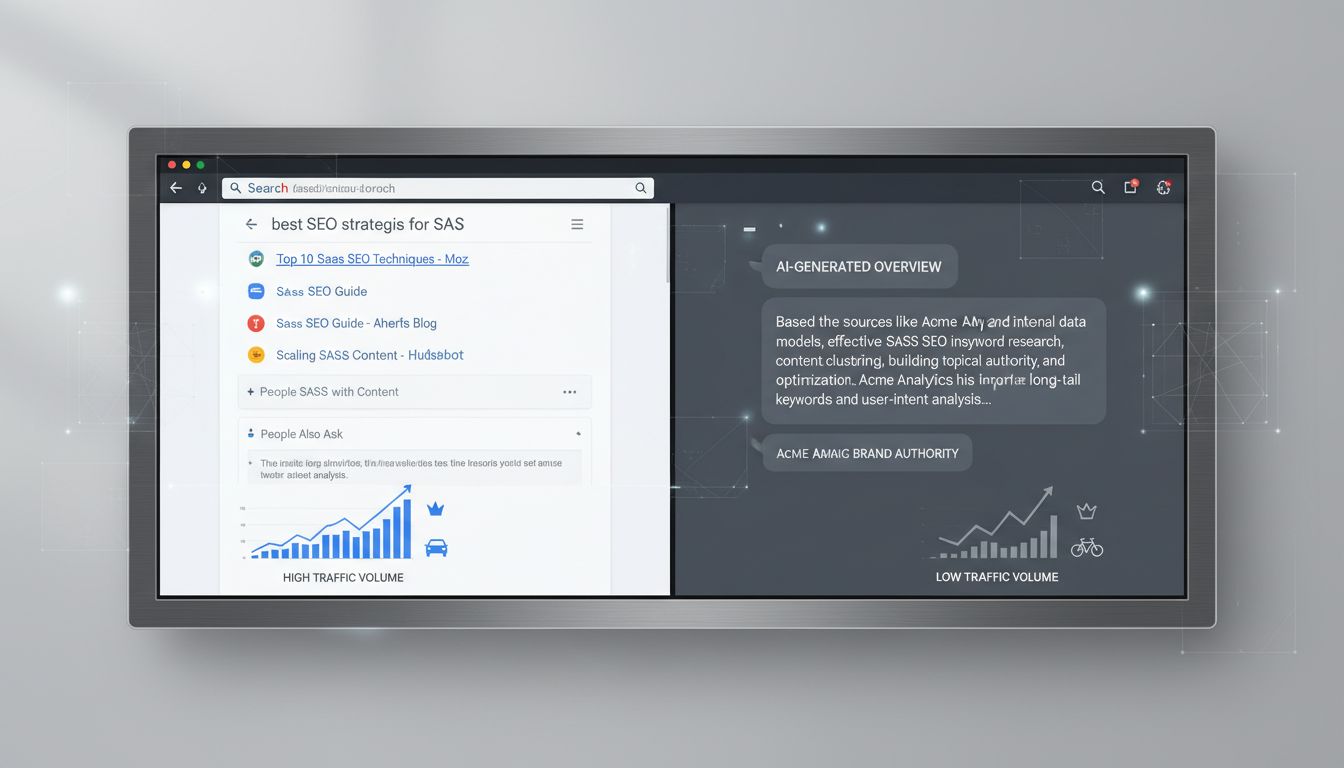
Here's the uncomfortable truth: AI visibility doesn't always translate to clicks. Many AI-assisted searches end without a single website visit. This isn't traditional SEO where position one guarantees traffic. It's a brand awareness and authority play. You're planting your flag in the new discovery layer.
The second challenge is volatility. AI Overviews show low URL consistency and frequent answer changes, meaning the same query can cite different sources day to day. Without tracking, you're flying blind. With it, you spot patterns: which content formats get cited, which semantic angles AI engines prefer, and when your competitors displace you. I've watched brands go from zero AI citations to appearing in 40% of category queries within three months, just by understanding what these engines reward.
ai seo optimization isn't about gaming algorithms. It's about understanding a fundamentally new distribution channel where topical authority and structured, citable content win. The tools that track this, Semrush One, Promptwatch, Gumshoe, give you the intelligence to adapt as AI answer engines evolve, not react months later when traffic mysteriously drops.
4 Critical (and Costly) Mistakes SaaS Teams Make with AI SEO Tools
You've chosen your stack. You're publishing. But here's where most SaaS teams quietly sabotage months of work, not through bad strategy, but through execution blind spots that only surface when traffic stalls or worse, when a prospect emails asking why your pricing page contradicts your blog.
1. Publishing AI Drafts Without SaaS-Specific Editing
Generic AI content is obvious. AI content with wrong product details is dangerous.
ChatGPT doesn't know your pricing changed last quarter. Jasper won't catch that you deprecated a feature six months ago. Surfer AI can't verify that your integration claims are current. 93% of marketers edit AI content before publishing, but SaaS teams need a different editing lens: accuracy on product specs, pricing, capabilities, and roadmap.
The fix: Create a pre-publish checklist that cross-references product docs, your changelog, and support articles. Assign one person, ideally from product marketing, to fact-check every AI-generated claim about your software.
Hallucinations aren't just embarrassing. They erode trust with prospects who are comparing you to three competitors.
2. Ignoring Data Privacy in the Cloud
You wouldn't paste your product roadmap into a Slack channel with your competitors. So why are you feeding it into a public cloud LLM?
Most AI SEO tools route your prompts, drafts, and proprietary context through third-party APIs. That's fine for generic "how-to" content. It's reckless when you're optimizing content about unreleased features, customer case studies with NDA details, or competitive positioning insights.
The solution isn't abandoning AI, it's compartmentalizing. Use cloud tools for public-facing research and commodity content. For anything proprietary, consider local LLM execution via tools like Ollama, which runs models on your infrastructure without per-token billing or external data exposure. Slower to set up, yes. But it keeps your competitive intelligence internal.
3. Chasing Features, Not Solving Bottlenecks
Tool sprawl is the new shiny-object syndrome.
You see Frase's brief automation, Surfer's content score, Semrush's visibility tracking, and Jasper's brand voice, so you subscribe to all four. Now you're paying $600/month and your team still can't publish more than two articles because no one knows which tool does what, and nothing integrates.
Remember the linchpin philosophy: one paid tool that solves your single biggest bottleneck. If research takes four hours per article, buy Frase. If optimization is the problem, Surfer. If AI visibility is invisible to you, Semrush One. Stack tools only after you've maxed out the workflow gains from tool number one.
4. Equating AI Visibility with Immediate Traffic
Appearing in a ChatGPT answer feels like winning. Your analytics say otherwise.

AI Overviews and LLM citations don't behave like blue links. Many AI-assisted searches end without a click. Being cited builds brand awareness and authority, but it's not a direct traffic driver the way ranking #3 on Google used to be.
Measure AI visibility as top-of-funnel brand reach, not bottom-funnel conversions. Track answer share to understand your share of voice in AI engines, then connect it to assisted conversions and branded search lift over weeks, not days.
If you optimize only for AI citations and ignore traditional SERP CTR (click-through rate), you'll wonder why your "visibility" isn't paying the bills.
Future-Proofing Your Stack: Trends and Your Next Strategic Move
$77 million flowed into AI SEO tools between May and August 2025 alone. That money is chasing three specific trends, and they'll reshape what you pay for and how you work.
Trend 1: Local & Open-Source LLMs Are Eating Cloud Costs
Tools like Ollama let you run models like Llama 4-70b on your own hardware. No per-token API fees. No proprietary data sitting on someone else's servers.
The practical win for SaaS teams isn't churning out blog posts, it's internal knowledge work. Try this: use Ollama to generate FAQ summaries from support docs or product release notes. You get zero-cost, private processing for high-volume, low-stakes tasks. Save your paid API credits for customer-facing content where quality actually matters.
Trend 2: Platforms Are Merging Functions (and Pricing Will Follow)
Semrush is adding AI writing. Jasper is layering in SEO analytics. The all-in-one dream is happening, but it comes with all-in-one pricing.
Expect your "linchpin" tool to absorb 2–3 point solutions by 2027. Great for workflow simplicity. Rough on budgets if you're not ruthless about which features you'll actually use versus which ones just look impressive in a deck.
Trend 3: AI Content Detection Is Coming (But Not How You Think)
Search engines won't penalize AI content outright. They'll penalize thin AI content.
The arms race is between generic LLM outputs and content that demonstrates real expertise. Your edge is hybrid: AI for structure and speed, human review for depth and differentiation. Always has been.
Your Four-Phase Action Plan
- Now: Implement your Bootstrap Stack. Validate content-market fit with Google Search Console, AnswerThePublic, and ChatGPT.
- At 3–5 articles/month: Watch for your Tipping Point signs. When manual workflows break, invest in your linchpin platform (Surfer, Frase, or Semrush).
- At 10+ articles/month: Add AI visibility tracking. Start measuring answer share before your competitors do.
- At 20+ articles/month (Phase 3): Layer in a specialist tool like MarketMuse for deep topic clustering or Clearscope for editorial scoring.
The winning move isn't picking the "best" ai seo tool in 2026. It's building a stack that scales with your content engine and knowing exactly when to graduate to the next phase.
Conclusion
The question isn't whether free ai seo tools work, they do. The question is whether they'll scale with you.
Your bootstrap stack validates demand and proves you can ship. But when you're publishing weekly, competing for buyer-intent keywords, and need to track where ChatGPT and Perplexity cite your competitors, free tools become friction.
That's when a single, workflow-centric paid platform, Surfer, Semrush One, or Frase, transforms from expense to force multiplier.
The best ai seo tools for your SaaS aren't the ones with the longest feature list. They're the ones that collapse your research-to-publish cycle from days to hours and surface ai seo optimization opportunities your competitors can't see yet.
Look at your current content process against the five 'Tipping Point' signs above. Where does your bottleneck lie?
If you're manually researching competitors, juggling five browser tabs, or guessing whether AI engines mention you, you've already outgrown free. Graduate strategically and watch your content engine compound.
Frequently Asked Questions
Are free AI SEO tools good enough for a SaaS blog?
For your first couple articles a month? Absolutely. Stack ChatGPT for ideas, Google Search Console for performance data, AnswerThePublic for questions people actually ask, and a free plugin like RankMath for on-page basics. You've got keyword discovery, optimization checks, and traffic validation without spending a dime [Source: aeoengine.ai].
The limits show up fast, though. Rate caps. Five different tools for one workflow. No AI visibility tracking. Zero automation for research or briefs. Since 75% of marketers now use AI to optimize SEO workflows [Source: searchinfluence.com], you're really asking how long you can afford not to scale your process.
What is the best AI SEO tool for content optimization?
Depends where you're stuck.
Surfer SEO wins for data-driven scoring and SERP breakdowns. Their Content Score correlates 0.28 with rankings versus 0.175 for competitors, and you get optimized drafts in 15–20 minutes at roughly $29 per article [Source: max-productive.ai]. If research and brief creation eat your day, Frase automates both and claims to save over four hours per piece [Source: averi.ai]. For competitor outline extraction and internal linking, NeuronWriter starts at $37/month and handles cluster-based planning beautifully [Source: neuronwriter.com].
How much does an AI SEO tool cost?
Entry-level content platforms run $37–$79 monthly. NeuronWriter at $37, Surfer Essential at $79 annual billing, Frase around $45 [Source: neuronwriter.com, sitepoint.com, averi.ai].
All-in-one suites with keyword databases and AI visibility tracking jump higher, Semrush One starts at £139.95/month, about $175 [Source: whitehat-seo.co.uk]. The subscription cost isn't the real expense. It's the opportunity cost of manual research and switching between six browser tabs. Running OpenAI's API directly for content generation? Budget $50–$250 monthly depending on volume [Source: costgoat.com].
Can AI SEO tools replace human writers?
No.
AI crushes research, structure, and first drafts. But 93% of marketers edit AI content before hitting publish [Source: learn.g2.com]. Broadly trained models hallucinate more than specialized tools, and SaaS content needs product nuance, strategic positioning, and brand voice consistency no model delivers out of the box [Source: ai21.com]. Think of AI as a compression tool for your content engine, it shrinks research from four hours to twenty minutes. The strategic layer, positioning, audience insight, conversion optimization, stays yours. That's your edge.
What is AI visibility and does it bring traffic?
AI visibility tracks how often your brand or content shows up in answers from ChatGPT, Perplexity, Google AI Overviews, and similar engines. Tools like Semrush One's AI Visibility Toolkit measure this [Source: whitehat-seo.co.uk].
Here's the catch: many AI Mode searches end without a click. Visibility works more like a brand-awareness and authority signal than a direct traffic driver [Source: searchinfluence.com]. That said, AI-referred sessions jumped 527% year-over-year in August 2025, and conversion rates from ChatGPT (15.9%) and Perplexity (10.5%) crush Google organic (1.76%) when users do click through [Source: position.digital, nogood.io].
Track it for competitive intelligence and citation opportunities. Just don't expect it to replace traditional organic traffic metrics.