July 17th, 2026
How to Use an AI SEO Content Generator to Scale Organic Traffic
 WD
WDWarren Day
You've probably already tried using AI for SEO. Maybe you drafted some articles with ChatGPT or Jasper. And yet... traffic's flat. You're still manually stitching together keyword research, briefs, AI drafts, and edits, and the whole loop just doesn't scale.
The potential is real, though. Flyhomes hit 10,737% traffic growth in three months, and AI can cut content production timelines by 80% [Source: TheDigitalBloom.com]. But the March 2024 Core Update wiped out over 95% of some sites' organic traffic overnight [Source: Roiamplified.com].
That gap between promise and reality comes down to one thing: scaling with an ai seo content generator requires a production pipeline, not just a tool. AI is a drafting engine. It needs to run inside a human-controlled editorial framework, or it goes sideways fast.
This guide walks through the exact blueprint we use at Spectre. How to pick the right seo ai tools, build a keyword strategy AI can actually execute, set up a pipeline with real quality gates, and track what moves the needle. We're talking about surfer seo, seo writing ai, the best ai seo tools (including free ai seo tools and the best free ai writing tools), and how ai content writing tools fit into a system that actually works.
Not theory. The real thing.
What You Need Before You Start: Prerequisites for Scaling
Before you pick a single tool, get these five things in place. Without them, you're building on sand.
Define your content strategy and goals. "Scaling" means nothing without specifics. Are you publishing 20 posts a month instead of 5? Building landing pages for 500 long-tail keywords? AI generates content, not direction. Your strategy has to come first.
Audit your technical SEO health. AI-generated pages won't rank if Google can't crawl your site. Run a basic audit, check for indexation issues, broken internal links, and page speed problems. Tools like Ahrefs Site Audit or Screaming Frog will surface the blockers. Fix those first.
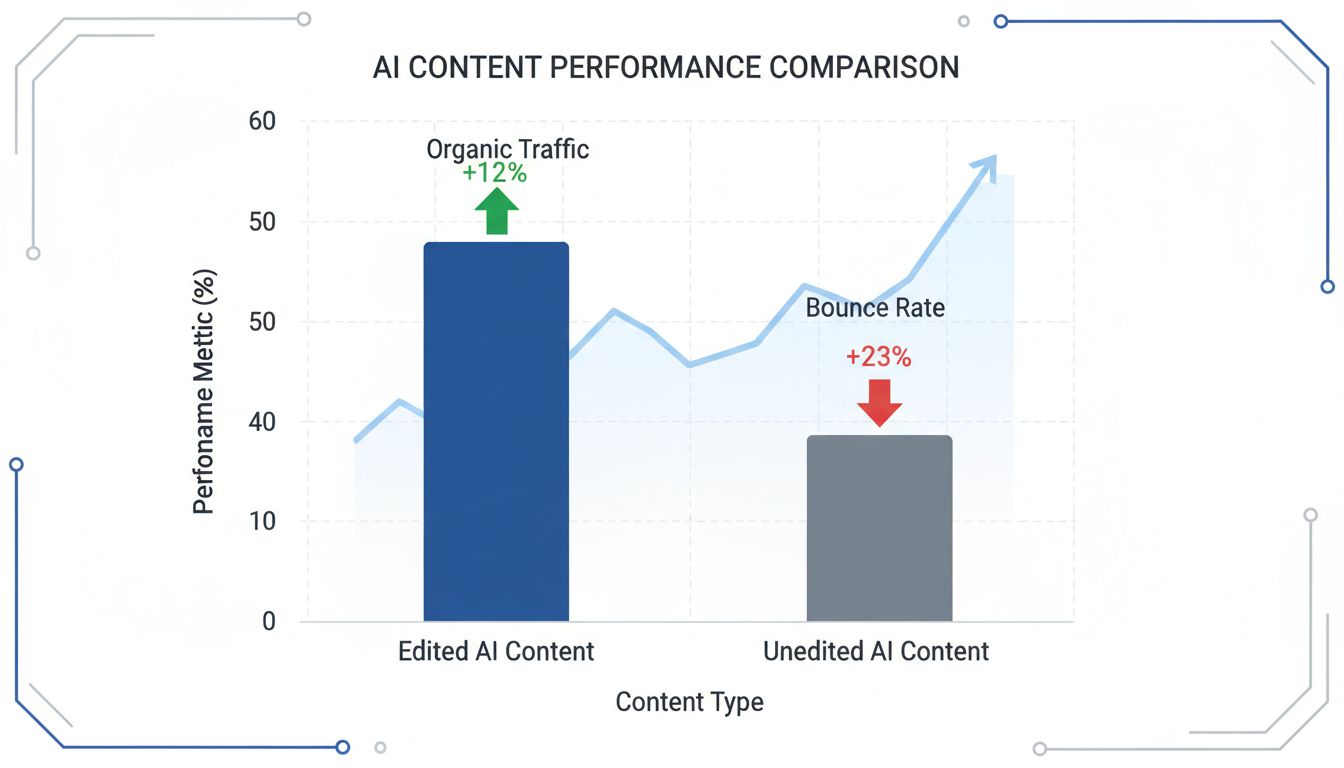
Commit to human editorial resources. This one's non-negotiable. Teams that edit AI content see 12% more organic traffic than those who publish raw output. Decide who's editing, a founder, a marketer, a freelance editor, and block the time. Scaling without editing is just the fastest route to a Google penalty.
Set a realistic tool budget. Your budget shapes your whole framework. Are you willing to pay £100-£300/month for an integrated platform like Spectre that handles research, generation, and publishing? Or are you stitching together free tools and accepting the manual overhead? Be honest about what you'll actually maintain.
Accept the constraints of your domain authority. AI doesn't magically overcome a low Domain Rating. If your DR is 15, targeting "best running shoes" is pointless, no matter how good your ai seo content generator output is. Your keyword strategy has to start with targets your site can realistically compete for.
Choose Your Core AI SEO Content Generator (A Framework, Not a List)
Which tool should you actually use? That depends entirely on three things, and none of them show up in a "best ai seo tools" roundup.
Tools fall into three broad categories:
- All-in-one platforms (like Spectre) that handle keyword research, drafting, optimization, and publishing in one workflow. You're buying a complete content production pipeline.
- SEO optimizers (like Surfer SEO) that take a draft and enhance it for ranking potential. They analyze SERPs and give you a data-driven editing checklist.
- Raw AI writers (like ChatGPT or Jasper) that give you maximum flexibility for drafting but leave all the strategy, research, and seo ai tools work to you.
Your decision hinges on a few honest questions.
Scale vs. Control Do you need to automate everything from keyword to published post? An all-in-one platform handles that. Want to hand-craft every prompt and edit every comma? A raw ai content writing tool gives you that control, but you're stitching the workflow together yourself.
Most teams end up somewhere in the middle: an AI drafting engine paired with an seo writing ai layer for the final polish.
Budget Reality If your budget is near zero, you start with the best free AI writing tools. ChatGPT's free tier is a legitimate starting point. For free ai seo tools, Google Search Console covers a lot of ground, and some freemium tools offer limited analyses.
The trade-off is manual labour. Free tools mean you're the integration layer. Paid tools like Jasper, which has 99.99% API uptime, buy you reliability and time.
Integration Needs Will this tool live inside your CMS, or is it a standalone app? If your developers can use an API, you can automate publishing. If not, you need a clean export or a direct WordPress/Webflow plugin.
Always check the integration documentation before you commit. Vendor marketing pages overpromise. A lot.
The Critical Test: Look Beyond the Hype Validate every vendor claim. Does their case study match independent research? Does their approach align with Google's stated guidance on appropriate AI use?
A tool that encourages keyword stuffing or mass generation of thin pages is a liability. Not an asset.
Pick the category that matches your primary constraint. Then find the specific tool that proves it works in the real world, not just in a sales demo.
Develop a Keyword Strategy That AI Can Execute
What's the actual bottleneck with AI content? Usually it's not the AI. It's that people feed it a single keyword and wonder why the output is mediocre.
Your AI content generator needs more than a word. It needs a strategy it can follow.
Start by dropping single keywords entirely and moving to topic clusters. AI is genuinely good at producing related content across a theme. Feed it semantically linked groups like "content marketing" and "content calendar" together. Tools like Ahrefs' Content Gap or SEMrush's Topic Research can pull these clusters straight from competitor analysis.
Then prioritise based on your domain rating. A DR 20 site is not ranking for "best mortgage." Use your SEO tool's keyword difficulty filter to find terms you can realistically win, and start with long-tail, low-competition queries where AI-generated content can get traction quickly.
The real control point is your content brief. This is where human strategy becomes something the AI can actually execute. It can't devise the strategy itself, it only follows instructions.
Your brief needs to include:
- Primary and secondary keywords (the cluster)
- Target word count and header structure (H2/H3 breakdown)
- Competitor URLs to analyse and outperform
- Specific questions to answer, especially those appearing in "People Also Ask"
- Tone of voice and key points that must be covered
Here's a minimal brief template that works:
Primary Keyword: "best running shoes for flat feet"
Secondary: ["flat feet running", "arch support shoes", "overpronation"]
Word Count: 1,800
Tone: Helpful, expert, practical

Headers:
- H2: What to Look for in Running Shoes for Flat Feet
- H3: Arch Support vs. Motion Control
- H3: Top 5 Models for 2024 (Table)
- H2: FAQ: Common Questions Answered
- H3: Can I use inserts instead?
- H3: How often should I replace them?

Competitors to Analyse:
- https://example.com/running-shoe-guide
- https://example.com/flat-feet-review

Must Cover: Pronation explanation, specific brand recommendations with pros/cons, sizing advice.
Wire in SERP feature targets too. 88.1% of queries triggering AI Overviews are informational, so structure content to answer questions directly. A dedicated FAQ section using exact phrasing from "People Also Ask" is not optional if you want those features.
Treat your first batch of AI content as a live experiment. Measure which clusters and brief structures generate rankings fastest. Then use that data to refine your next briefs.
That closed loop is what actually scales, not the best free ai writing tools, not the fanciest free ai seo tools, not even seo writing ai with the best reviews. The loop. Brief, publish, measure, improve. Tools like Surfer SEO fit into that process, but they don't replace it.
Build Your AI SEO Content Production Pipeline
You have your keyword clusters and structured briefs. Now you need a repeatable workflow that turns those inputs into ranking content.
Most teams fail here because they treat each article as a one-off project. You need an assembly line.
Here's the five-stage production pipeline I've built and refined across client work and within Spectre. Treat this as your operating manual.
1. Research & Brief Creation
Start with your validated keyword cluster from the previous section. Use your SEO tool (Ahrefs, Semrush) to pull the latest SERP data for the primary keyword. Analyse the top five results: what questions do they answer? What subheadings do they use? What's missing?
Feed this analysis into your brief template. A complete brief includes: primary and secondary keywords, target word count, search intent, competitor analysis notes, target H2/H3 headings, and any required data points or citations.
Don't move forward until this document is locked.
Verification: Your brief should allow a competent writer (human or AI) to produce a first draft without asking clarifying questions.
2. AI Generation & Drafting
Input your finished brief into your chosen ai seo content generator. Use the specific "blog post" or "long-form" mode if available. I instruct the AI to follow the brief precisely, using the provided headings as the article skeleton.
Generate the draft. For critical pieces, I often run the same brief through twice to get two variant drafts, then cherry-pick the best sections from each.
This output is a raw draft, not a final post. It's your raw material.
Common Mistake: Expecting publish-ready perfection from this stage. You'll get generic prose and potential factual inaccuracies. That's normal.
3. Human Editing & Quality Gate
This stage is non-optional. A human editor must take the AI draft and transform it. This isn't just proofreading. It involves:
- Fact-checking every claim and statistic.
- Injecting real expertise, personal anecdotes, or unique insights the AI can't provide.
- Rewriting generic passages to match your brand's specific voice.
- Ensuring logical flow and argument strength.
Teams that edit and optimize AI content see 12% more organic traffic than those who publish without review. The editor is your quality control.
4. SEO Optimization & Final Polish
Once the edited draft is factually correct and reads well, run it through an SEO optimization tool like Surfer SEO or Frase. These are among the best ai seo tools for this job, they compare your content against top-ranking pages and flag gaps: keyword usage, content length, semantic term inclusion.
Then manually polish the on-page elements. Craft a meta title and description (under 150 characters), add descriptive alt text to images, and insert 2-3 relevant internal links to existing site content.
That's your final pre-flight check.
5. Publishing & Post-Launch
Publish the polished article to your CMS. Immediately after, take three actions:
- Submit the URL to Google Search Console for indexing (if your site isn't crawled daily).
- Update your internal linking structure to include at least one link to this new page from a relevant, high-authority page.
- Schedule any planned social media or email promotion.
Indexing isn't instant. SE Ranking found 70.95% of AI-generated pages were indexed within the first 36 days. Your job is to make sure the page is technically sound and well-connected so it gets there faster.
Whether you're using seo ai tools, seo writing ai, or any of the best free ai writing tools and free ai seo tools out there, none of it matters if the process is inconsistent. The brief drives the AI, the human ensures quality, and the SEO polish maximizes the chance to rank.
Execute these five stages for every piece. That's what turns chaotic content creation into something predictable.
The Critical Quality Gate: Why Editing AI Content is Non-Optional
Raw AI output is not a finished product. It's a first draft written by someone who's never worked a day in your industry.
Think of your AI content generator as a brilliant but naive junior writer. It can produce coherent drafts at scale. But it doesn't have your expertise, your judgment, or your brand voice.
Publishing its raw output is a real risk with real consequences.
Teams that edit and optimize AI content see 12% more organic traffic than those who publish without review. Unedited AI content suffers a 23% higher bounce rate. That's not a minor gap, that's the difference between ranking and getting penalized.
The March 2024 Core Update made this impossible to ignore. Sites that leaned too hard on pure, unedited AI content lost over 95% of their organic traffic overnight. Google's algorithms now detect and demote content that lacks human oversight and genuine expertise.
Your editing process isn't about rewriting every sentence. It's a targeted quality gate with four checks you can't skip.
1. Fact Accuracy & Citations AI confidently states falsehoods. Verify every claim, statistic, and date. Add authoritative, primary sources. For "Your Money or Your Life" (YMYL) topics, finance, health, legal, this step is mandatory. AI cannot create expertise; you have to inject it.
2. Tone & Brand Voice Alignment AI defaults to generic corporate-speak. Read the draft out loud. Does it sound like your company? Adjust phrasing, add the colloquialisms your audience actually uses, and make sure the emotional tone lands right.
3. Injecting E-E-A-T Signals Google's E-E-A-T framework (Experience, Expertise, Authoritativeness, Trustworthiness) requires signals AI cannot fabricate. Add a paragraph about your firsthand experience with the problem. Quote a real team member. Include original data from your customers.
4. Logical Flow & Readability AI often writes collections of paragraphs, not narratives. Make sure each section leads logically to the next. Break up long walls of text. Add transitions that actually guide the reader through your argument.
Tools like Grammarly and Originality.ai help, but treat them as assistants. The FTC found some detection tools have accuracy as low as 53%, so human judgment is still your final safeguard.
Scale your publishing based on available editing time, not your ai seo content generator's output speed. A pipeline that produces 100 articles a day is worthless if you can only properly edit ten.
Whether you're running seo writing ai, experimenting with free ai seo tools, or paying for the best ai seo tools like Surfer SEO, none of it matters if unedited drafts are going live. The seo ai tools and best free ai writing tools on the market are only as good as the human reviewing their output. This gate isn't a bottleneck. It's what separates valuable content from spam.
Optimize for Today's SERPs: AI Overviews, LLMs, and Featured Snippets
Are you actually showing up where search is happening now? Not in the ten blue links, in AI Overviews, featured snippets, and the answers LLMs pull directly from your pages.
If you're not structuring for that, you're invisible in the most valuable real estate on the SERP.
Start by analyzing the SERP features for your target keyword. Open Google, search it, and note every "People Also Ask" question, featured snippet, and related search. These aren't suggestions. They're explicit instructions from Google on what to write.
In Spectre, this SERP analysis runs automatically during brief creation, mapping out the exact question-answer pairs you need to cover.
Structure your headings as direct answers to those questions. If the SERP shows "What is the best time to post on LinkedIn?", your H2 should be "The Best Time to Post on LinkedIn Is..." with a concise answer in the first paragraph. That signal makes it trivial for AI systems to extract your content.
Keep a single H1, then a logical H2/H3 hierarchy. Crawlers parse that tree to understand context.
Add a dedicated FAQ section near the top, with FAQPage schema markup. Pull the questions verbatim from the "People Also Ask" box, don't invent them. According to Semrush research, 88.1% of queries triggering AI Overviews are informational, so your FAQ should mirror that intent exactly.
Optimize for scannability. Short paragraphs, bulleted lists for steps or features, bold key terms. This isn't just for human readers, it creates clear text boundaries that AI models use to identify and extract discrete pieces of information.
A Surfer SEO case study showed rewriting an article with this kind of data-driven optimization increased its traffic 5x in four months. Tools built around seo ai tools and seo writing ai workflows are increasingly built around this logic for a reason.
Here's the uncomfortable part: you're writing for zero-click search now. Similarweb reported searches ending without a click rose from 56% in 2024 to 69% by May 2025.
Your goal shifts. You're not trying to win the click, you're trying to become the source Google's AI extracts for its answer.
The trade-off is real. Write the 2,000-word guide, but make sure the answer to "How much does X cost?" lives in a distinct, well-formatted paragraph or table a crawler can lift cleanly.
Deep content for readers. Clear snippets for AI. That's what wins right now, whether you're using an ai seo content generator, best ai seo tools like Surfer SEO, free ai seo tools, or best free ai writing tools with manual structuring on top.
Scale and Automate (Without Becoming a Content Farm)
Your pipeline is working. Now the question is how to increase output without turning into a content farm, or triggering Google's spam filters.
The goal is to automate the process, not just crank up raw volume.
Start with the repetitive stages. Use APIs for bulk keyword research and clustering. Generate content briefs automatically from templates using your target keyword and SERP data. Batch-publish approved articles directly to your CMS. A platform like Spectre handles that entire chain, turning a keyword list into scheduled posts without anyone copying and pasting anything.
Set volume targets based on editorial capacity, not AI speed. AI can cut content production timelines by around 80%, but your real bottleneck is human review.
A sustainable pace for a small team is probably 10 thoroughly edited posts per week, not 100 raw AI drafts per day. The content farm pattern, some farms produce over 94,000 articles daily, is something Google now explicitly targets with manual actions for "scaled content abuse." That's not a number you want to race toward.
Quality stays consistent through systemisation. Templated briefs that enforce structure and require specific data points. A standardised editing checklist for every piece, fact verification, brand voice, snippet optimisation. Same process every time, regardless of volume.
Then build a feedback loop. Use performance data from your first 20-30 published articles to refine your briefs and AI prompts. Which structures earn more featured snippets? Which intents actually convert?
Let the data steer your automation, not just a desire for more pages. Whether you're running an ai seo content generator, using seo ai tools like surfer seo, pulling from best ai seo tools, free ai seo tools, best free ai writing tools, or building seo writing ai workflows from scratch, the same rule applies.
Scale the system. The output follows.
Common Mistakes & Pitfalls: What Causes AI SEO to Fail
So what actually kills an AI SEO project? Usually not the tools. Usually the team using them.
I've watched teams burn through months of budget on these exact mistakes. Here's what to avoid.
1. Publishing AI output without human editing. This is the single biggest reason AI SEO projects crash. The March 2024 Core Update hit some sites so hard they lost over 95% of organic traffic overnight, sites that had leaned too hard on unedited AI content. Source: roiamplified.com.
AI is a drafting assistant, not a publisher. Teams that actually edit and optimize their AI content see 12% more organic traffic than those who don't. Source: adai.news. A human needs to review every piece for accuracy, brand voice, and anything the AI couldn't have known.
2. Ignoring your domain authority constraints. Your ai seo content generator can write a perfect article targeting "best running shoes." But if your Domain Rating is 25, you're not outranking Nike. AI tools don't know your site's actual authority limits. You have to filter your keyword targets through competitive reality, not ambition.
3. Assuming pages will auto-index. Publishing doesn't mean Google finds it. Without internal linking, XML sitemap updates, and crawl budget management, pages just sit there. SE Ranking's experiment showed 70.95% of AI-generated pages indexed within 36 days, but that required a structured site. Source: seranking.com. Don't publish into a void.
4. Trusting AI detection tools as gospel. Detection accuracy is all over the place. The FTC found one company's actual accuracy was 53% against their claimed 99%. Source: thestacc.com. Use these as a quality flag, not a verdict. Your real safeguard is human editorial judgment.
5. Scaling volume without editorial controls. Producing thousands of pages a day without a review process is how content farms operate. Google's spam-related content removal actions increased 312% in 2026 compared to 2023, and this behavior was squarely in the crosshairs. Source: amraandelma.com. Whether you're using seo ai tools, seo writing ai workflows, or the best ai seo tools you can find, the content still needs a process around it.
6. Forgetting structure for AI-driven search. No clear H2/H3 headers, no FAQ schema, no scannable bullet points, you're leaving AI Overview appearances on the table. Semrush analysis found 88.1% of queries triggering AI Overviews are informational. Source: thedigitalbloom.com. That's exactly the content category most free ai seo tools and best free ai writing tools are built to produce. Structure it like you want it extracted.
7. Not measuring and iterating. Publishing and forgetting is just waste. Track which article structures get featured snippets, which intents convert, which topics drive engagement. Use that data to sharpen your briefs and AI prompts. Tools like Surfer SEO make this easier to build into the workflow systematically.
Your system should get smarter with each batch, not just bigger.
Results vary a lot. What separates the teams that win is execution quality, the editorial framework around the AI, not just the tool itself.
Measure Success and Iterate Your System
So your ai seo content generator is running. Pages are going out. Now what?
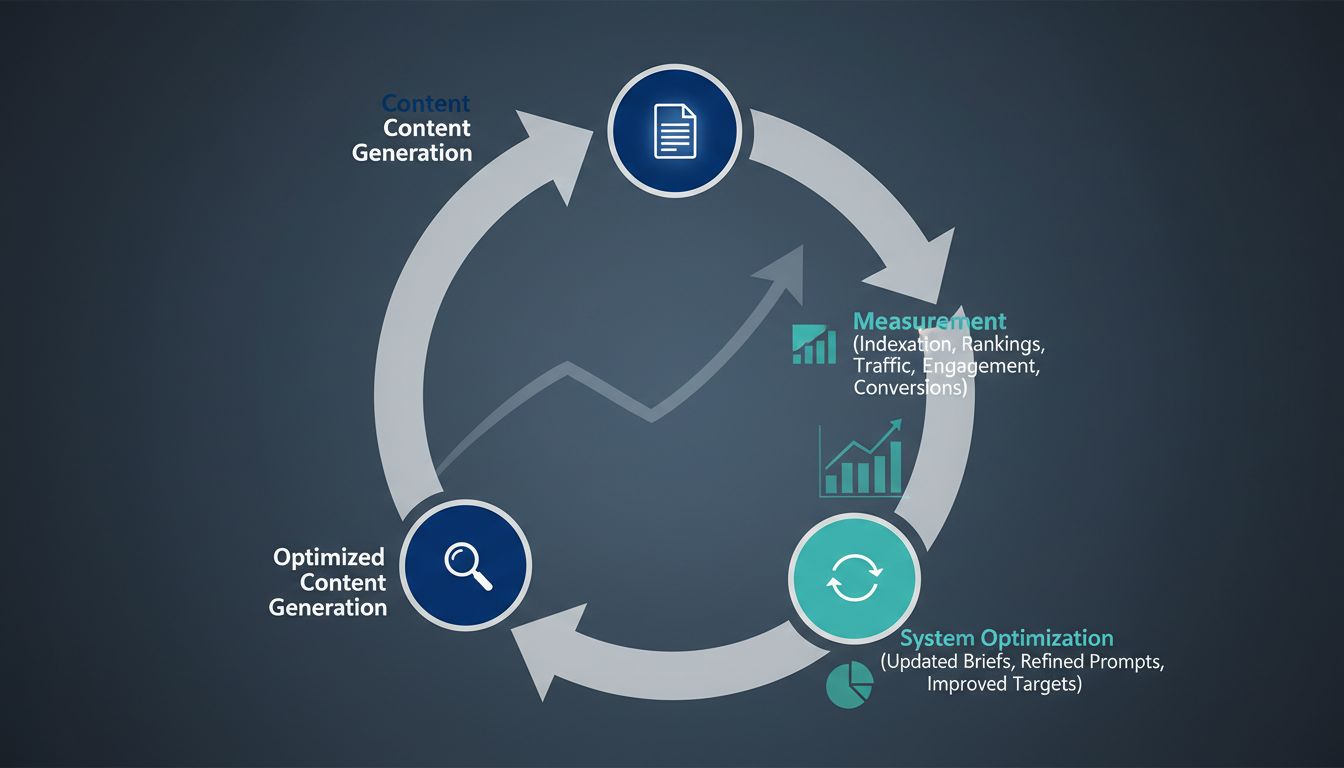
This is where the real system starts. Not publishing, measuring. Figuring out what's actually working and feeding that back in.
Track these five metrics weekly. Don't get lost in vanity data.
- Indexation rate: Are pages being crawled? Use Google Search Console to verify. SE Ranking's experiment found 70.95% of AI-generated pages were indexed within 36 days, use that as a benchmark for your own timeline. [Source: SE Ranking Blog]
- Ranking distribution: Don't just count keywords. Segment them by position: top 3, top 10, top 50. That's how you see where content is actually gaining traction.
- Organic traffic & sessions: This is the whole point. Look for month-over-month growth, not daily spikes.
- Engagement metrics: Time on page and bounce rate. Teams that edit AI content see a 23% lower bounce rate than those who publish raw output. [Source: AdAI News]
- Conversions: Track sign-ups, leads, or revenue from organic search. SEO leads close at 14.6% vs. 1.7% for outbound leads, that gap is worth measuring. [Source: The Digital Bloom]
Build a simple dashboard with those five numbers. Check it every Monday.
Then analyse. Which keyword clusters are driving the most traffic? Which article formats, listicles, how-tos, guides, rank fastest? Which brief templates produce the highest time-on-page?
Feed those answers back into your system.
Update your brief templates toward the structures that win. Adjust your keyword research to double down on what's performing. Refine your AI prompts based on what actually keeps people reading.
That's the loop: generate → measure → learn → improve.
Set realistic expectations here. Most case studies show real impact in 3–9 months. Flyhomes hit 10,737% growth in 3 months, but that involved scaling to 425,000 pages, that's not a typical starting point. [Source: The Digital Bloom] Your first goal is consistent, incremental growth.
Whether you're running seo writing ai workflows, dialing in seo ai tools, using Surfer SEO to guide optimization, or just experimenting with the best free ai writing tools you can find, none of it compounds without this step. The teams using the best ai seo tools aren't ahead because of the tools. They're ahead because they measure, learn, and adjust.
That's what turns free ai seo tools and ai content writing tools into something that actually grows.
Conclusion
Finding the right ai seo content generator isn't the hard part. Building a system around it is.
The AI drafts. You direct it with a strategic brief, edit it with actual expertise, and optimize it so it shows up in AI Overviews and featured snippets. Then you measure what happened and adjust. That's the whole thing.
That loop is what separates teams seeing real growth from teams collecting traffic penalties.
Start by auditing your workflow against the five-stage pipeline. Find the weakest link, the brief, the editing, the measurement, and fix that first. Platforms like Spectre can handle keyword research, brief creation, and publishing. But the editorial judgment you bring to it? That's what Google's algorithms actually reward.
Whether you're using seo writing ai workflows, seo ai tools, Surfer SEO, the best free ai writing tools you can find, or any combination of free ai seo tools and ai content writing tools, none of it compounds without the human layer on top.
The best ai seo tools don't win on their own. The people running them do.