May 5th, 2026
How to Write Good SEO Content: A Practical Framework for SaaS Sites
 WD
WDWarren Day
You've been asked to "improve SEO" for your B2B SaaS company. Blog traffic is growing, but those visitors aren't converting to qualified leads or signups. You've read the generic advice about how to write good SEO content, and you still don't have a system that connects search rankings to actual pipeline growth.
Here's what I've seen across 15 years building software and content systems: effective SaaS SEO isn't keyword chasing. It's engineering a scalable content system that aligns your product's capabilities with high-intent search moments across your buyer's journey.
Most SaaS content fails for one of two reasons. It targets educational queries from people who'll never become customers, or it treats SEO as a marketing checklist rather than a technical system.
There's a four-step framework I've implemented for startups and enterprise clients alike: map your product to actual problems, choose high-impact content types, build and automate your content engine, then measure pipeline impact, not just traffic.
You'll learn which tools actually move the needle and how to think like an engineer about content systems.
More importantly: shifting from traffic metrics to pipeline velocity and customer acquisition cost is the difference between SEO as a vanity project and SEO as a real growth channel.
Before You Start: Assemble Your SEO Stack
Good SEO for SaaS isn't guesswork. It's engineering. You need the right tools to diagnose problems, measure impact, and build systems that scale. Before you write a single word, assemble this stack.
Start with the free essentials: Google Search Console (GSC) and Google Analytics 4 (GA4). GSC shows you what queries you're ranking for and which pages Google struggles to crawl. GA4 tracks user behaviour and conversions.
Set them up properly. Connect them, configure conversion events, make sure your domain property is verified. This is your baseline data.
For keyword research and competitive analysis, you need a paid tool. I've built systems with both Ahrefs and Semrush. Ahrefs has better backlink data and a cleaner interface for technical audits. Semrush offers more integrated content optimisation features. Choose one. The cost ($100-200/month) pays for itself in efficiency gains alone.
Your CMS matters too. HubSpot's native SEO recommendations and GSC integration reduce friction. WordPress with Yoast or Rank Math works if you're budget-constrained. Either way, the goal is less manual optimisation work, not more.
Your minimum viable SEO stack:
- Keyword & Competitor Research: Ahrefs or Semrush
- Analytics & Search Data: Google Analytics 4 + Google Search Console
- Content Management: HubSpot CMS or WordPress (with Yoast/Rank Math)
- Technical Audits: Screaming Frog SEO Spider (free for 500 URLs)
Don't overcomplicate it. Free tools are fine for validation, but if you're serious about how to write good SEO content at scale, you need the data depth and automation that paid platforms provide. Invest here first.
Step 1: Map Your Product to Problems, Not Features to Keywords
Most SaaS teams start keyword research by asking "what features do we have?" So you get keywords like "AI-powered analytics dashboard" or "automated workflow builder." These rarely match what your buyers are actually searching for.
Shift your thinking. Your feature is the solution. But your customer is searching for the problem.
Open Ahrefs or Semrush and don't search for your product name. Search for the job they're trying to get done. If you sell project management software, search "how to manage remote team productivity", not "kanban board software." If you sell CRM, search "how to track sales pipeline", not "contact management system."
Commercial-intent keywords, phrases like "tool vs competitor," "how to track [metric]," or "best software for [use case]", drive somewhere between 22% and 58% of organic visits to commercial sites. These searchers are closer to buying.
Here's a concrete example. Your feature is "automated reporting." Don't target "automated reporting software." Target:
- Problem-aware: "how to create KPI reports" (TOF)
- Solution-aware: "best analytics software for startups" (MOF)
- Product-aware: "HubSpot reporting vs [your tool]" (BOF)
Your Domain Rating sets realistic targets too. With a DR of 20, forget ranking for "best CRM software." You're competing with Salesforce. Target "best CRM for early-stage SaaS startups" or "affordable CRM for agencies under 10 people" instead. Less competitive, and you're reaching your actual ICP.
I use the Ahrefs API to scale this. Instead of manually searching each problem, I feed customer support ticket themes into a script that queries the API for related keywords, filters by KD under 15, and clusters them by intent. What would take hours in the dashboard takes minutes.
Then verify the mapping. Search your target phrase in an incognito window. Are the top results competitors solving similar problems? If you see generic blogs or unrelated tools, the intent is off. Adjust.
One common mistake: appending "SaaS" to everything. "SaaS marketing automation" has volume but mixes enterprise buyers with hobbyists. "Marketing automation for B2B SaaS companies" has lower volume and higher conversion probability. Fit beats volume. That's the whole idea behind how to write good SEO content that actually converts.
Step 2: Choose High-Impact Content Types (Prioritize BOF)
Most SaaS teams default to blog posts because that's what everyone does. That's a traffic play, not a pipeline play. You need to match content types to funnel intent, then prioritize ruthlessly.
Think of your content portfolio like a product roadmap. Each piece has a specific job in the buyer journey, with measurable conversion benchmarks attached.
Top-of-Funnel (TOF): Educational and Awareness Content
This is your "what is" and "how-to" content. Things like "What is Marketing Automation?" or "How to Calculate Customer Lifetime Value." Broad informational searches, long buyer timelines.
Target 1,800–3,000 words per post. Articles in this range tend to perform better in search results, and long-form content (2,000+ words) generates 56% more leads than shorter posts.
Expect conversion rates of 1–5% to a lead. The buyer isn't ready to evaluate solutions yet. It's a long-term investment in domain authority, not a pipeline move.
Middle-of-Funnel (MOF): Use-Case and Consideration Content
Here you connect problems to solutions. Content that shows how your product handles specific scenarios, "How [Your Product] Automates Lead Scoring for B2B SaaS" or "Use Case: Managing Remote Team Projects."
The user already understands their problem and is researching options. Your job is to show fit without doing a hard sell. Less about search volume, more about relevance to people who are close to buying.
Bottom-of-Funnel (BOF): Decision and Conversion Content
This is where pipeline comes from. Start here. Prioritize content that serves buyers in the final decision stage.
- Comparison/Alternatives Pages: "[Your Product] vs. [Main Competitor]" or "Top 5 Alternatives to [Incumbent Tool]." Comparison pages convert 3.2 times higher than standard feature pages. Buyers searching these terms have a shortlist and are ready to choose.
- Product & Integration Pages: Deep-dives on core features, pricing, and key integrations (e.g., "HubSpot Integration").
- ROI Calculators & Case Studies: Tools and stories that prove tangible business value.
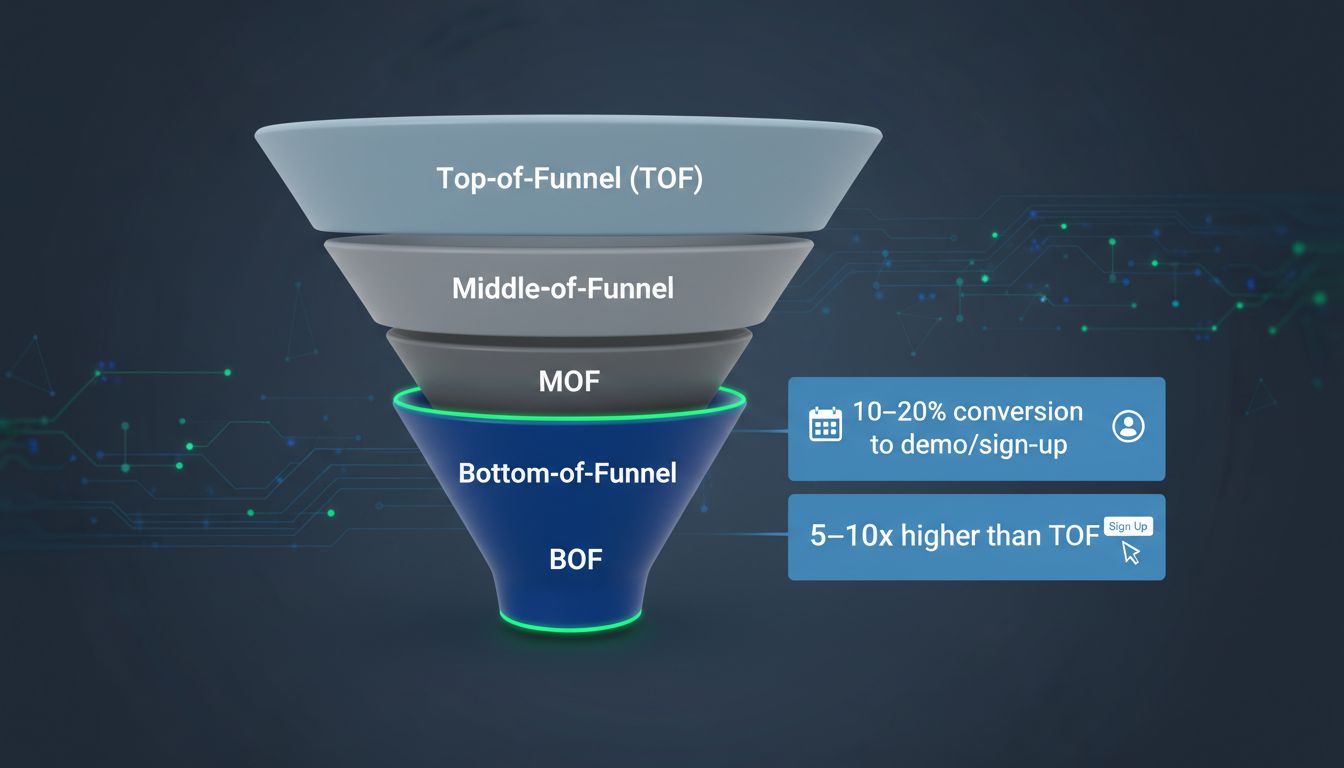
BOF content typically converts at 10–20% to a demo request or sign-up. That's a 5–10x lift over TOF. Don't wait to build authority before creating these pages.
A well-optimized comparison page for a niche competitor can rank and convert within weeks, delivering immediate pipeline while your TOF pillars are still maturing. That's one of the more underrated parts of how to write good SEO content: you don't have to earn your way to the bottom of the funnel. You can start there.
Your action: This quarter, build 1-2 high-quality BOF comparison pages before you write another "ultimate guide."
Step 3: Build, Optimize, and Automate Your Content
Writing SEO-Optimized Content

Start with length. Articles between 1,800 and 3,000 words tend to perform better in search results [Source: https://byter.com/long-form-seo-strategy/]. That's not arbitrary, it's roughly the word count you need to actually answer a complex B2B question without skipping the hard parts.
Get your primary keyword into the first 100 words, then structure everything with clear H2s and H3s. I use Surfer or Clearscope to check my drafts against top-ranking pages, but the right way to think about these tools: treat them like linters. They flag missing semantic terms, suggest heading structures, show where your content density is off. Don't do everything they say, but use them to catch gaps your competitor analysis missed.
The most common mistake is writing 3,000 words of filler to hit a word count target. Every paragraph should either educate, demonstrate, or persuade. If a section doesn't move the reader closer to solving their problem, cut it.
That's a big part of how to write good SEO content, knowing what to leave out.
The Non-Negotiable SaaS Technical SEO Checklist
Technical SEO isn't optional. It's the foundation your content ranks on. Here's the developer-taskable checklist I give engineering teams:
- Page speed: Target 1–2 second loads. A 100 ms delay can reduce conversions by 7% [Source: https://serotonin.co.uk/news/why-page-speed-matters-for-conversion-rate-optimisation]. Run Lighthouse audits monthly.
- Canonical tags: SaaS sites constantly create duplicate content. Your
/free-trialand/pricing?plan=freepages often serve identical content. Pick one canonical version or Google will split ranking signals. - Internal linking: Every new piece should link to your pillar pages. Use exact-match anchor text for your commercial keywords. This isn't just navigation, it's telling Google which pages matter most.
- Crawl budget management: This is where most SaaS teams waste Google's attention. Your documentation, changelog, and app subdomains can eat 80% of your crawl budget if not controlled. Use robots.txt to block non-essential sections and prioritize marketing pages.
Run Screaming Frog weekly to find duplicate content from free vs. paid plan variants. I've seen SaaS sites with 200+ duplicate URLs from parameter variations alone, each one diluting authority that should be concentrating on your commercial pages.
Automating SEO Tasks with Code and Tools
Manual SEO doesn't scale. Here's how I automate the repetitive parts:
Generate schema markup with Claude Code: Instead of manually coding JSON-LD, I prompt: "Generate software application schema markup for a project management SaaS with pricing tier details." Production-ready code in seconds.
Programmatic keyword clustering: Use the Ahrefs or Semrush APIs to pull keyword data, then cluster by search intent with simple Python scripts. What would take days of spreadsheet work takes minutes.
Build internal linking architectures: A simple script that analyzes your sitemap and suggests internal links based on semantic similarity. Start with basic keyword matching, then move to embeddings for smarter connections.
The goal isn't full automation. It's cutting the 80% of repetitive work so your team can focus on strategy. Large media companies have been doing this for years with custom CMS integrations. Your SaaS team can get similar efficiency with off-the-shelf APIs and a few hundred lines of code.
Step 4: Measure Pipeline Impact, Not Just Traffic
Stop measuring sessions. Track pipeline velocity and customer acquisition cost instead. I've seen SaaS teams throw a party over 10,000 monthly organic visitors that generate three demos. That's not a win.
Set up GA4 to track revenue events, not just pageviews.
-
Create custom events for demo requests, trial sign-ups, and pricing page views. Use GA4's event builder or Google Tag Manager. Name them descriptively:
demo_request,trial_signup,pricing_view. -
Map these events to conversions in GA4 admin. Mark each as a conversion. This lets you segment reports by "converting users" versus "browsers."
-
Add UTM parameters to all internal CTAs. When someone clicks from a blog post to your pricing page, append
?utm_source=organic&utm_medium=blog&utm_campaign=article-title. This preserves attribution through the funnel.
Benchmark against real SaaS metrics.
SEO visitor-to-lead averages ~2.1%. Freemium conversion runs 3–5%; free trials convert at 4–6%. Source: ChartMogul. If you're below those ranges, your content-to-product fit is off.
Calculate ROI using LTV:CAC ratios. Industry average is ~3:1, but organic cohorts regularly hit ~5:1. Source: Discovered Labs. That 66% efficiency gain is why SEO delivers 702% ROI for B2B SaaS.
Build a dashboard that connects rankings to revenue.
| Metric | Source | Target |
|---|---|---|
| Non-brand organic sessions | GA4 | MoM growth |
| Top 10 commercial keywords | GSC | Increase count |
| Visitor → Demo request | GA4 | >2% |
| Demo → SQL | CRM | >40% |
| Organic CAC | Finance | < Paid CAC |
New content peaks at 3–12 months. Source: Cactus Marketing. The payback window is 3–9 months.
If you're not tracking pipeline metrics from day one, you'll never prove SEO's value to your board. That's true no matter how good you are at figuring out how to write good SEO content, the work disappears without the numbers to back it up.
Your 90-Day SEO Content Execution Playbook
Stop planning and start building. Treat this like an engineering roadmap.
Weeks 1-2: Audit & Launch Your First BOF Page
Week 1: Technical Foundation
- Day 1: Run a Screaming Frog crawl of your entire domain. Export the "Duplicate Title Tags" and "Duplicate Meta Descriptions" reports.
- Day 2: In Google Search Console, check the "Indexing > Pages" report. Identify any "Crawled - currently not indexed" pages that shouldn't be there.
- Day 3: Use Ahrefs' Site Audit or your chosen tool to generate a prioritized list of technical fixes. Start with anything marked "Error."
- Day 4-5: In Ahrefs' Keywords Explorer, filter for your product category + "vs" or "alternative." Pick one long-tail, low-competition (KD 0-10) comparison keyword. This is your first target.
Week 2: Build & Publish
- Day 1-3: Write your "[Your Tool] vs [Competitor]" page. Target 1,800+ words. Use Surfer or Clearscope to make sure you're matching top-ranking content signals.
- Day 4: Implement. Add clear CTAs for a demo or free trial. Set up a dedicated Mixpanel or GA4 funnel to track conversions from this page only.
- Day 5: Publish. Submit the URL to GSC. Create 3-5 internal links from relevant blog posts and your features page.
Trust Caveat: This page will not generate pipeline tomorrow.
New content takes 3–12 months to reach peak ranking. You're planting a seed.
Weeks 3-8: Build One Pillar & Cluster
Weeks 3-4: Pillar Research & Creation
- Week 3: Choose one core problem your product solves (e.g., "project management for remote teams"). Use Ahrefs to find 15-20 semantically related subtopics.
- Week 4: Write the pillar guide. This is a 3,000+ word resource. Structure it with clear H2/H3s. Include original data if you have it, that's a real differentiator.
Weeks 5-8: Supporting Cluster Content
- Week 5: Write and publish one middle-of-funnel (MOF) piece. Example: "How [Your Tool] Solves [Specific Pillar Subtopic]."
- Week 6: Write and publish one bottom-of-funnel (BOF) piece. Example: "Best Tools for [Pillar Subtopic]" (including your product).
- Week 7-8: Interlink everything. Each cluster piece links to the pillar. The pillar links back to each cluster piece and to your comparison page from Week 2.
Weeks 9-12: Promote, Measure & Plan Q2
Week 9: Basic Outreach
- Use a tool like Respona to find 20-30 bloggers or journalists who've covered your pillar topic.
- Send a short, personalized email highlighting your pillar's unique data or angle. Don't ask for a link. Offer it as a resource.
Week 10: Performance Analysis
- Check the Mixpanel funnel for your Week 2 comparison page. Any demo requests?
- In GSC, check the "Search results" report for your pillar and cluster pages. Are they getting impressions?
- In Ahrefs, track ranking positions for your primary target keywords.
Week 11-12: Iterate & Plan
- Based on early data, decide: another comparison page, or deepen the existing cluster?
- Plan your Q2 content. Double down on whatever shows early traction.
- Keep the economics in mind: SEO payback is typically 3–9 months, and cost-per-lead runs 50-70% lower than paid after 12-18 months. You're building infrastructure.
Part of knowing how to write good SEO content is accepting that the payoff is slow. But after one quarter you'll have shipped one high-converting page, one authority-building pillar, and a supporting cluster. That's not nothing, that's a system.
Common Mistakes and How to Fix Them
Everyone makes SEO mistakes. I've made plenty building content systems. The difference between successful and stagnant programs is how fast you catch them.
Mistake 1: Chasing search volume instead of buyer intent
Your keyword tool shows "project management software" gets 50,000 monthly searches. You write a generic guide that ranks on page 3 and converts at 0.5%.
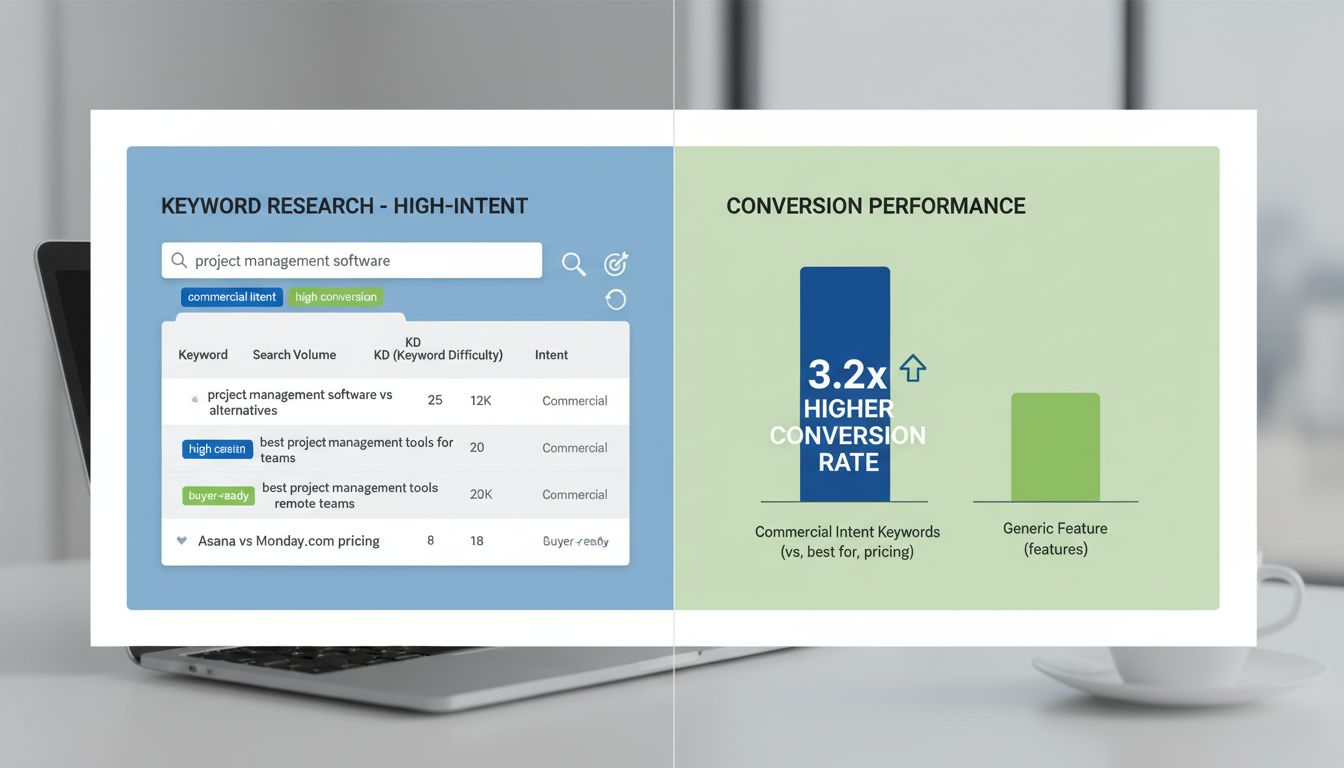
Fix: Use Ahrefs' Keyword Explorer or Semrush's Keyword Magic Tool with commercial intent filters. Prioritize terms with "vs," "alternative," "best for," or "pricing" modifiers. These convert 3.2 times higher than standard feature pages [Source: Oliver Munro].
Mistake 2: Neglecting technical SEO
You publish great content but it never ranks. Google can't crawl your pages properly.
Fix: Run quarterly audits with Screaming Frog (free for 500 URLs) or Sitebulb for larger sites. Check for crawl errors, broken redirects, and canonicalization issues.
I've seen sites where 39% of crawl budget was wasted on documentation pages. Fixing that doubled rankings in 60 days.
Mistake 3: Producing thin content
Your 800-word post gets indexed but never moves past page 5.
Fix: Aim for 1,800–3,000 words minimum. Articles in this range tend to perform better in search results [Source: Byter Digital]. Depth beats brevity, include original research, data visualizations, or practical examples your competitors don't have.
Mistake 4: Ignoring page speed
Your content ranks but visitors bounce immediately. A 100ms delay can reduce conversions by 7% [Source: Serotonin].
Fix: Run Lighthouse audits through Chrome DevTools. Prioritize Largest Contentful Paint (LCP) under 2.5 seconds and Cumulative Layout Shift (CLS) under 0.1. Compress images with WebP, defer non-critical JavaScript, and implement lazy loading.
Mistake 5: duplicate content from product variants
Your SaaS generates duplicate pages: /free-trial, /pricing?plan=pro, /features?tier=enterprise. Each one dilutes authority.
Fix: Implement canonical tags pointing to the primary version. Use robots.txt to block crawl of parameter variations, or set up URL parameter handling in Google Search Console.
Troubleshooting checklist when content isn't ranking:
- Is it indexed? Check Google Search Console > Coverage
- Does it have backlinks? Even 1–2 quality links from DR 50+ sites can move the needle
- Is the page speed under 3 seconds? Use PageSpeed Insights
- Are you targeting realistic keywords? Match keyword difficulty to your domain authority
- Have you built internal links? Link from 3–5 relevant pages with descriptive anchor text
Knowing how to write good SEO content matters, but if there are technical issues underneath it, the content won't rank regardless. Fix crawl issues, speed, and duplicate content first, then worry about production volume.
Conclusion
Stop chasing generic keywords. Good SEO content for SaaS is about matching your product to high-intent search moments across the buyer's journey. It's a technical discipline, not a marketing afterthought.
Start by mapping your features to real customer problems, not search volume. Prioritize bottom-of-funnel content like comparison pages, they convert at 10–20% while building authority. [Source: olivermunro.com]
Run the technical checklist. Crawl waste and duplication will quietly kill your momentum before you even notice it's happening.
Then measure what actually matters: MQLs, SQLs, CAC. Not traffic.
This works because it's constrained by reality: your domain rating, your product's actual value, the economics of SaaS growth. SEO delivers a 702% ROI for B2B SaaS companies, with break-even around seven months. [Source: olivermunro.com]
The compounding returns start when you stop writing blog posts and start building a content engine.
Start this week: Run a free Screaming Frog crawl to audit your site. Then pick one comparison keyword ("Tool A vs Tool B") and create your first high-converting BOF page. That's how you build a saas seo framework that creates content that ranks and converts.
Frequently Asked Questions
How do I map my SaaS product features to SEO keywords?
Start with the problems your product solves, not the features. Then use something like Ahrefs or Semrush to find queries with commercial intent, "vs", "alternative", "best", that map to those problems.
Also check your Domain Rating before targeting anything. If you're a new domain, go after low-competition keywords (KD 0-10) where you can realistically rank in 4-8 weeks. Trying to outrank established players early is just a good way to write a lot of content for no reason.
What's the best content type for generating SaaS leads?
Bottom-of-funnel comparison pages. They convert at 3.2x the rate of standard feature pages [Source: olivermunro.com].
Tool comparisons, alternatives lists, product-specific landing pages, these target decision-stage intent, which is where the pipeline actually comes from. They typically convert 10-20% of visitors to leads. Top-of-funnel educational content is more like 1-5%.
How long should my SaaS blog posts be?
Somewhere between 1,800 and 3,000 words for core content. Long-form content (2,000+ words) generates 56% more leads and tends to rank better [Source: olivermunro.com].
Blogs averaging 2,000+ words saw organic traffic growth 293.3% higher than blogs averaging under 1,000 [Source: promodo.com]. That's a pretty wide gap for something as simple as not cutting your posts short.
What technical SEO issues are unique to SaaS websites?
A few things come up constantly. Duplicate content from trial and pricing page variants (like /free-trial vs. /pricing?plan=free), crawl waste from app subdomains or documentation sites, and session IDs showing up in URLs.
Fix it with canonical tags, robots.txt directives, and regular audits using Screaming Frog. I've seen SaaS sites burn 39% of their crawl budget on documentation pages that should've been on a separate subdomain the whole time.
How do I measure if my SEO content is actually working for my business?
Not with traffic. Track MQLs, trial sign-ups, and CAC.
Set up conversion events in GA4 and benchmark against actual SaaS numbers: SEO visitor-to-lead runs around 2.1%, and a healthy LTV:CAC for organic cohorts is around 5:1 [Source: discoveredlabs.com]. And if you're wondering whether to prioritize SEO over PPC, SEO-sourced leads convert from MQL to SQL at 51%, versus 26% for PPC [Source: olivermunro.com]. That's a meaningful difference when you're thinking about how to write good seo content that actually moves pipeline.