March 23rd, 2026
SEO Automation in 2026: The Complete Guide for Scaling SaaS Content
 WD
WDWarren Day
You're staring at Q2 targets that demand 3x the organic traffic, but your content team is already maxed out. The math doesn't work.
Manual keyword research eats Mondays. Content briefs take half a day each. Publishing cadence? Two posts per week if you're lucky. Meanwhile, your board wants proof that SEO can scale like paid ads.
So you search "seo automation" hoping for a lifeline, some combination of tools and AI that can finally break the bottleneck without torching your domain authority in the process.
Here's what most articles won't tell you: seo automation in 2026 isn't a silver bullet. It's not about plugging in ChatGPT and watching traffic charts go vertical. The SaaS companies seeing 702% ROI from SEO aren't the ones who automated everything. They're the ones who automated strategically.
The real opportunity? Building a governed, multi-layered system that amplifies human judgment at every stage. Discovery tools that surface opportunity. Creation workflows that maintain quality at scale. Optimization systems that catch technical decay before it kills rankings. Programmatic engines that can spin up thousands of pages without triggering a manual penalty. We call this an Automation Stack, and it's how you grow without replacing your team with robots.
Because the flip side is real: low-quality programmatic content has caused 73% traffic drops for companies that scaled too fast without guardrails.
This guide gives you the framework those companies missed. You'll learn the four-layer Automation Stack that separates sustainable growth from catastrophic sprawl. We'll map specific tools to your growth stage, walk through a 90-day phased rollout, and show you the quality gates that prevent AI penalties while letting you scale 10x. No hype. Just the system that works when resources are tight and targets are aggressive.
What is SEO Automation? Beyond Just Tools and AI
Seo automation is the strategic use of software, workflows, and governed processes to eliminate repetitive manual work across keyword research, content production, technical optimization, and performance monitoring.
It's not a single tool. It's an interconnected system that lets your team execute at 10x scale without proportionally scaling headcount.
What automation in SEO actually means:
- Automatically discovering and clustering thousands of keyword opportunities instead of manually sorting spreadsheets
- Generating content briefs, meta tags, and schema markup at scale with predefined quality rules
- Monitoring site health, tracking rankings, and flagging technical issues without daily manual checks
- Deploying hundreds or thousands of programmatic pages governed by templates and data validation
Here's what it's not: seo automation isn't autopilot. It won't replace your strategy, creative judgment, or brand voice. It's not a spam generator that floods Google with low-quality pages (that's how you lose 73% of your traffic). And it's definitely not a "set-it-and-forget-it" solution that absolves you from governance.
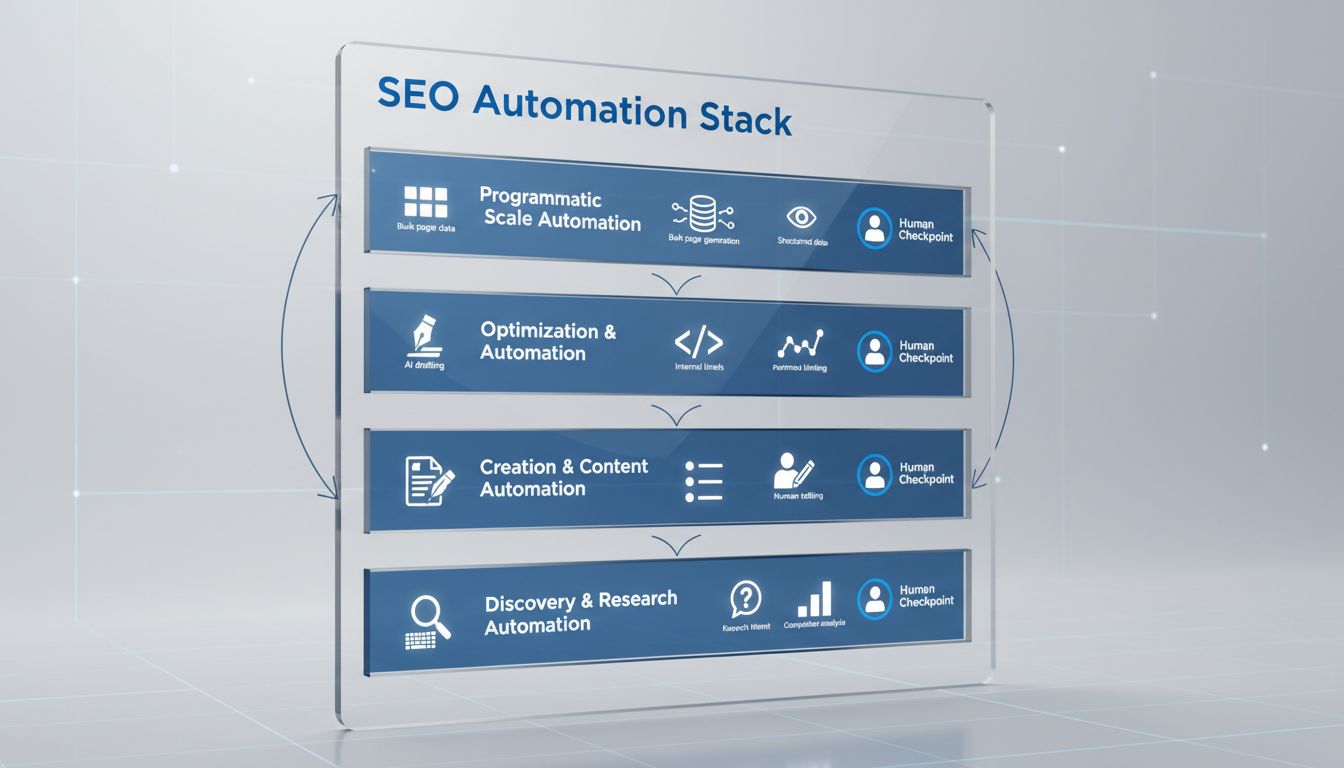
The companies winning with seo automation in 2026 treat it as a layered stack. Discovery automation feeds Creation automation, which connects to Optimization automation, which enables Scale automation. Each layer has specific tools, clear quality gates, and defined human checkpoints. Miss one, and the entire system collapses under its own weight.
That four-layer framework (Discovery, Creation, Optimization, Scale) is what the rest of this guide unpacks. Each layer solves a distinct bottleneck that keeps most SEO teams stuck in manual mode.
Why 2026 is the Inflection Point for SaaS SEO Automation
The search landscape changed faster than most SaaS teams could adapt.
AI Overviews now show up in 47% of searches. AI search traffic jumped 527% year-over-year in early 2025. If your content isn't structured for AI extraction, you're invisible to a massive chunk of potential buyers. Not ranking lower. Actually invisible.
Here's what's really happening: your competitors automated months ago. While you're manually researching keywords and drafting one blog post at a time, faster-moving companies are publishing 50+ optimized pages every month. They're grabbing long-tail feature queries, comparison searches, integration-specific traffic at a pace manual work can't touch.
For SaaS specifically, this hits different than content sites. Automation directly supports product-led growth. Every feature launch needs 10-15 supporting content pieces to capture search demand: announcement pages, use-case guides, integration docs, comparison angles. Manual creation becomes the bottleneck that slows down your entire product marketing cycle.
Can you still do SEO manually in 2026? Sure. But only if you automate the repetitive stuff. Otherwise you're looking at hiring three more writers or watching competitors lock up the SERP positions that actually drive pipeline.
The 4-Layer SEO Automation Stack: A Governance-First Framework
Most guides treat seo automation like a shopping list, throw money at tools and hope they work together. They don't.
What you need is a stack: a layered system where each tier builds on the last, with specific automation goals and mandatory quality gates. Think of it like your product architecture. You wouldn't ship code without CI/CD pipelines and testing. Your seo automation deserves the same rigor.
Here's the framework that prevents the 73% traffic drops we see when teams scale programmatically without governance:
Layer 1: Discovery & Research Automation , Automate keyword clustering, competitor gap analysis, and search intent mapping. Human gate: Strategic prioritization.
Layer 2: Creation & Content Automation , Use AI for drafts and briefs, but never publish unreviewed. Human gate: Fact-checking and brand voice.
Layer 3: Optimization & Technical Automation , Automate schema deployment, internal linking, and performance monitoring. Human gate: Template approval and anomaly review.
Layer 4: Programmatic & Scale Automation , Generate hundreds of pages from structured data. Human gate: Quality sampling and indexation monitoring.
Each layer answers a different part of "What are the 4 types of automation?" in an SEO context. More importantly, each layer has a kill switch. A point where humans can catch disasters before they tank your domain authority.
Layer 1: Discovery & Research Automation
Most teams burn 15 hours a week here. Manually pulling keyword lists, clustering them in spreadsheets, trying to figure out which topics actually move the needle. Discovery automation doesn't eliminate that work, it compresses it into 90 minutes.
Automating Keyword Clustering and Gap Analysis
Ahrefs and Semrush can auto-cluster thousands of keywords into topical groups now, showing you which clusters have low competition and high search volume. Machined.ai takes this further by automatically identifying keyword clusters and mapping them to content briefs. LowFruits specializes in surfacing low-competition long-tail opportunities that larger tools miss entirely.
For SaaS companies, this means you feed in a seed list like "project management software" and get back 50 content pillar ideas, each with supporting subtopics and search volume data. The automation handles volume. You handle the strategic filter, deciding which clusters actually align with your ICP's pain points and buying journey.
Setting Up Continuous Intelligence
The best discovery systems run in the background.
Set up Google Alerts and Ahrefs' Content Explorer alerts to notify you when competitors publish new content or when trending queries emerge in your category. This creates a passive research engine that feeds your content calendar without manual monitoring. Most seo software tools free tiers (like Semrush's limited free account or Ahrefs Webmaster Tools) are sufficient for early-stage teams to start automating alerts and basic clustering. As you scale, paid tools unlock API access and bulk exports.
The Human Override
Here's the catch: keyword research cannot be fully automated. A tool might cluster "task management" and "team collaboration" together, but only a human who understands your product can decide if those represent the same buyer intent or two different ICPs.
For SaaS, this judgment call is critical. Especially when mapping keywords to specific features, integrations, or use cases.
Automation gives you the seo tools list and the data. You provide the context that prevents wasted content spend.
Layer 2: Creation & Content Automation
You've got your keyword clusters and content briefs. Now comes the bottleneck: turning research into publishable pages. This is where most teams either burn out or compromise quality.
The solution isn't handing everything to an LLM and hoping for the best. It's building a governed workflow that uses AI as a drafting engine, not a decision-maker.
Here's the production line that scales without catastrophic quality drops: Brief → AI Draft → Human Edit → Publish. Each stage has specific tools and non-negotiable checkpoints.
Start with Frase ($45–$115/month) or Surfer SEO ($79–$175/month annual) to generate content briefs. These tools analyze top-ranking competitors, extract semantic keywords, and structure outlines based on what actually ranks. You're not guessing what Google wants, you're reverse-engineering it.
Feed that brief into an AI writing tool. Writesonic (from $20/month), Jasper ($59–$89/month), or Copy.ai (free tier available) can generate first drafts in minutes. For programmatic content at scale, Byword.ai ($99–$1,999/month) is purpose-built to generate thousands of pages from structured data.
But here's where most implementations fail: they skip the human edit. AI drafts are riddled with generic phrasing, factual errors, and zero brand voice. Your editor's job isn't to proofread, it's to inject expertise, cut the fluff, and verify every claim.
The Role of ChatGPT & LLMs in Your Stack
"Can ChatGPT do SEO?" is the wrong question.
The right one: "Where does ChatGPT fit in a governed SEO workflow?"
ChatGPT and similar LLMs are components, not replacements. Use them for ideation, outline expansion, and first-draft generation. Don't use them for final copy, technical accuracy, or strategic decisions. The limitation is fundamental: LLMs hallucinate. They'll confidently cite studies that don't exist, invent statistics, and contradict themselves across sections. About two-thirds of AI-generated content ranks within two months, but the one-third that doesn't often fails because of these undetected errors.
Treat ChatGPT like an intern: fast, eager, occasionally brilliant, but requires constant supervision.
Implementing Your AI Governance Policy
Here's the uncomfortable truth: 81% of B2B marketers use generative AI, but only 38% have formal guidelines. That gap is a liability.
Before you scale AI content, implement a SaaS AI Content Governance Framework:
1. Disclosure Protocol: Mark AI-assisted content when reasonable (Google recommends this for transparency).
2. Fact-Checking Gate: Every statistic, claim, and example must be verified against primary sources before publishing.
3. Hallucination Review: Run AI drafts through a second LLM or human check specifically hunting for invented references, contradictory statements, or unsupported claims.
4. Bias Audit: Review for unintended bias, particularly in comparison content or use-case examples that might exclude segments of your ICP.
5. Brand Voice Pass: AI defaults to corporate blandness. Your final edit should sound like your company, not a content farm.
This isn't bureaucracy, it's the difference between scaling safely and triggering a manual action that tanks your domain authority. Google's guidance is clear: AI content is fine if it's helpful. Low-quality AI spam created primarily for rankings is not.
The seo ai tools exist. The governance layer is on you.
Layer 3: Optimization & Technical Automation
Your content is live. Now it needs to stay competitive.
That means continuous optimization across hundreds of pages without burning out your team. Layer 3 automates the technical hygiene and on-page tuning that separate ranking pages from traffic-driving pages. This is where you catch crawl errors before Google does, fix schema markup at scale, and systematically optimize for the new reality of AI-powered search.
On-Page Audit Automation
Tools like Surfer SEO and MarketMuse continuously score your published pages against top-ranking competitors. They flag keyword density gaps, missing semantic terms, and weak internal linking. Then they prioritize fixes by potential traffic impact.
Set up weekly automated audits that feed directly into your content team's task queue. You're not manually checking 200 pages every month. You're reviewing a prioritized list of 15 pages where a 30-minute update could recapture lost rankings.
internal linking at Scale
Manual internal linking breaks down fast when you're publishing 50+ pages a month.
Use tools like Link Whisper or custom scripts to suggest contextual internal links based on keyword overlap and content hierarchy. The automation identifies orphan pages, over-optimized anchor text, and missed pillar-to-cluster connections. Your editor reviews and approves. The system handles the tedious pattern-matching.
schema markup Without the Markup Debt
Structured data is non-negotiable for SaaS. FAQ, HowTo, Product, and Organization schema especially. But manual schema implementation creates debt: pages launch without it, or worse, schema doesn't match visible content and triggers policy violations.
Tools like OTTO SEO and Schema App generate and inject schema at scale based on your page templates. The critical rule: your automation must validate that markup reflects what users actually see on the page. Invisible reviews in your schema? That's a manual action waiting to happen.
Optimizing for AI Overviews
AI Overviews now appear in 47% of searches and reach 2 billion monthly users. If you're not optimizing for citation, you're invisible in half the SERP.
Concrete tactics:
- Structure for extraction: Use clear H2/H3 hierarchies, bulleted lists, and definition-style answers in the first 100 words of key sections.
- FAQ schema that matches visible content: AI Overviews pull heavily from structured FAQ blocks. Your FAQ must be on-page, not hidden in an accordion that never renders in the DOM.
- Create source-worthy data: Original stats, comparison tables, and quoted expert insights increase your odds of being cited. Generic summaries don't get picked.
- Monitor AI Overview appearances: Use tools like BrightEdge or manual tracking to see when you're cited and reverse-engineer what Google extracted.
Technical Monitoring on Autopilot
Core Web Vitals, mobile usability, and crawl health can degrade silently.
Automate alerts for pages dropping below LCP/CLS thresholds, 404 spikes or redirect chains, and indexation drops in GSC. First-page results average 1.65-second load times. If your pages are slower, automation should flag them before rankings slip.
Layer 3 isn't glamorous. But it's the difference between content that ranks once and content that compounds.
Layer 4: Programmatic & Scale Automation
This is where you either 10x your keyword footprint or crater your domain authority. No middle ground.
Programmatic SEO means generating hundreds or thousands of pages from structured datasets. Think Zapier's 25,000+ integration pages, G2's software comparison grids, or Notion's template galleries. Each page targets a unique long-tail query ("Slack Asana integration," "project management software for nonprofits") using a standardized template populated with dynamic data.
The upside? Staggering. Programmatic approaches can deliver 200–500% traffic increases and a 10x jump in ranking keywords within six months. Flyhomes scaled from 10,000 to 425,000 pages in three months using this method.
But here's the part most guides bury: low-quality programmatic content caused a 73% organic traffic drop in one documented case. Google's March 2024 update specifically targeted "scaled content abuse." Pages created primarily to rank, not to serve users.
The Programmatic Toolkit
Purpose-built platforms like Byword.ai ($99–$1,999/mo) are designed specifically for programmatic SEO at scale. They handle templating, data ingestion, and bulk publishing with built-in quality controls.
No-code stacks offer more flexibility: Webflow CMS + Airtable (as your data source) + Zapier (to trigger page creation when new rows are added). This approach gives you full design control and keeps costs predictable for mid-stage teams.
Automation glue tools like Bardeen scrape, normalize, and update datasets across Google Sheets, Airtable, and your CMS. Critical for keeping 5,000 integration pages accurate when APIs change monthly.
Your Programmatic Risk Assessment Matrix
Before you generate page one, run this checklist. It's the difference between Zapier's success and that 73% traffic wipeout.
Indexation Ratio Target: >60%
If Google's only indexing 40% of your programmatic pages, it's a quality signal. You're creating thin content. Audit your template: Does each page offer unique value, or just keyword-swapped boilerplate?
Templating Quality Score
Every programmatic page must pass the "would a human find this useful?" test. Include dynamic elements like user-generated data (reviews, usage stats), unique descriptions (not just auto-filled), and contextual internal links. If your template is 80% identical across pages, you're in the danger zone.
Audit Frequency: Monthly minimum
Programmatic sites decay fast. Use JetOctopus (crawls 250 pages/second) or Deepcrawl to catch duplicate title tags, orphaned pages, and indexation drops before they compound. Set alerts for indexation ratio falling below 60% or error rates exceeding 5%.
Cannibalization Risk Check
When you're creating 10,000 pages, keyword overlap is inevitable. Use Ahrefs' Site Audit or Semrush's Cannibalization Report to identify clusters of pages competing for the same query. Consolidate or differentiate. Never let them fight.
Human Review Gate
Sample 50 random pages monthly. If you wouldn't link to them from your homepage, neither will anyone else.
That's your quality floor.
Programmatic SEO isn't "set and forget." It's "build, monitor, and ruthlessly prune." The companies winning at scale treat it like product development: versioned templates, A/B tests on page structures, and kill switches for underperforming page types.
Building Your Stack: Tool Recommendations by SaaS Growth Stage
The right seo automation tools depend entirely on where you are. A seed-stage founder burning nights and weekends needs different infrastructure than a Series B team managing 50,000 indexed pages.
Over-buying early creates shelfware and burns runway. Under-buying at scale creates manual bottlenecks that kill velocity. Match your stack to your stage.
The Stack-by-Stage Matrix
| Tool | Category | Best For Stage | Key Automation Feature | Starting Price |
|---|---|---|---|---|
| Semrush Free | Research | Seed/Solo | 10 daily keyword lookups, position tracking | Free |
| Google Sheets + Bardeen | Workflow | Seed/Solo | Auto-populate keyword data, scrape SERPs | Free + $10/mo |
| ChatGPT Plus | Content | Seed/Solo | Draft generation with custom instructions | $20/mo |
| Screaming Frog | Technical | Seed–Series A | Site crawls up to 500 URLs (free tier) | Free/$259/yr |
| Ahrefs Lite | Research | Series A | Full keyword + backlink database, API excluded | $129/mo |
| Surfer SEO Scale | Content Optimization | Series A | Content Editor with NLP scoring | $219/mo |
| Byword.ai Starter | Programmatic | Series A–B | Bulk article generation, auto-publishing | $99/mo |
| Semrush One | All-in-One | Series B+ | Unified SEO + AI visibility tracking | $199/mo |
| Ahrefs Enterprise | Research | Series B+ | API access, custom limits, team seats | $1,499/mo |
| JetOctopus | Technical | Series B+ | Crawls 250 pages/second, log file analysis | Custom |
Phase 1: Seed/Solo Founder (Budget: $0–$50/mo)
You're doing everything yourself.
The best seo tools for beginners aren't fancy. They're free or nearly free. Start with Semrush's free tier for keyword ideas, Google Sheets + Bardeen to automate data pulls, and ChatGPT Plus for drafting. Screaming Frog's free version handles technical audits for small sites. These free ai seo tools give you enough runway to validate your content strategy before spending real money.
Top 3 at this stage? Semrush Free for discovery, ChatGPT for creation, and Google Search Console for monitoring. That's your stack.
Phase 2: Series A (Budget: $300–$600/mo)
You've hired a content marketer or fractional SEO. Now you need real horsepower.
Upgrade to Ahrefs Lite ($129/mo) for comprehensive keyword and competitor research. Add Surfer SEO Scale ($219/mo annual) for content optimization at volume. These seo automation tools save hours per article and let your team focus on strategy instead of manual keyword density checks. If you're testing programmatic, Byword.ai Starter ($99/mo) lets you generate and publish bulk content without custom dev work.
Your top 3 become Ahrefs for research, Surfer for optimization, and Byword for scale. This is the seo tools list that most Series A companies converge on, and for good reason.
Phase 3: Series B+ (Budget: $1,500–$3,000+/mo)

You're managing tens of thousands of pages and multiple content streams.
Consolidate with Semrush One or Ahrefs Enterprise for API access and team collaboration. Add JetOctopus for technical monitoring at scale. It crawls faster than Screaming Frog and handles log file analysis, which matters when you're debugging indexation issues across 50,000 URLs. Integrate Webflow CMS or custom pipelines with Airtable for programmatic deployment.
At this stage, your stack isn't just tools. It's infrastructure. You need the best seo automation tools with enterprise-grade APIs, custom limits, and support that responds in hours, not days. The switch from point solutions to platforms happens here.
Your 90-Day Implementation Plan: A Phased Rollout
You don't need to rebuild your entire SEO operation overnight. Here's the exact sequence that works for lean teams, one layer at a time.
Phase 1 (Days 1–30): Foundation & Governance
Week 1: Draft your AI governance policy. One page. Cover three things: required human review checkpoints, disclosure standards for AI-generated content, and who owns quality control. Only 38% of teams have AI guidelines, which means most are flying blind when Google updates hit.
Week 2: Run a baseline audit using Screaming Frog (free up to 500 URLs) or Google Search Console. Flag indexation issues, duplicate titles, and pages with zero traffic in the last 90 days. Export to a spreadsheet.
Week 3: Automate one research task. Set up keyword position tracking in Ahrefs or Semrush for your top 50 target terms. Configure weekly alerts for ranking drops >3 positions.
Week 4: Document your current content workflow. Map every step from idea to publish. Identify the two biggest time sinks, those are your automation targets for Phase 2.
Phase 2 (Days 31–60): Augmented Creation
Week 5–6: Implement AI-assisted writing for five high-priority articles. Use ChatGPT or Jasper for first drafts, but run every piece through your human review gate. Track time saved versus manual writing.
Week 7: Automate on-page optimization checks. Set up Surfer SEO or Frase to score drafts before they go live. Require a minimum content score (e.g., 75/100) as a publishing gate.
Week 8: Launch a pilot programmatic project.
Start small, 20 pages maximum. Pick a template type with clear data sources (integration pages, location pages, or comparison pages). Monitor indexation daily.
Phase 3 (Days 61–90): Systematic Scale
Week 9: Audit your programmatic pilot. Check indexation ratio (target >60%), average time on page, and conversions. Kill it if indexation is below 40%.
Week 10–11: Scale the template that worked. Expand to 100–200 pages if your pilot hit targets. Add schema markup and internal linking automation.
Week 12: Lock in monthly maintenance. Schedule automated technical audits (first Monday), content refresh reviews (mid-month), and programmatic health checks (month-end).
This plan assumes you're working solo or with one other person. It's designed to prove ROI before you ask for more budget.
Common Pitfalls & Your Pre-Emptive Mitigation Checklist
Every SEO disaster follows the same script. Someone trusted automation blindly, skipped a quality check, or forgot the technical basics.
Here's how to not become a cautionary tale.
Pitfall 1: Scaling programmatic pages without quality controls
One company saw a 73% drop in organic traffic from churning out low-quality programmatic content. Google's scaled content abuse policy now explicitly goes after pages built mainly for ranking, not for people.
Your mitigation: Check your indexation ratio weekly. Keep it above 60% minimum, shoot for 80%+. Run duplicate content audits every two weeks while you're scaling. If indexation tanks below 50%, stop generating new pages immediately.
Pitfall 2: Publishing AI-generated content without human review
LLMs make stuff up. They'll fabricate statistics, botch quotes, and state complete nonsense with total confidence. One fake claim can wreck trust with your audience.
Your mitigation: Human-in-the-loop workflow, no exceptions. Every AI draft needs fact-checking, brand voice alignment, and a basic "would I actually trust this?" gut check before it goes live.
Pitfall 3: Ignoring technical fundamentals while scaling content
You can't outrank competitors with 1.65-second load times when your site takes 4 seconds. Core Web Vitals, mobile optimization, proper JavaScript rendering, none of this is optional anymore.
Your mitigation: Run automated technical crawls at least every two months. Set up Search Console alerts for indexing problems. Monitor Core Web Vitals in real-time and treat regressions like the emergencies they are.
Pitfall 4: Structured data that doesn't match visible content
Marking up reviews that aren't shown, or FAQs that don't exist on the page, breaks Google's structured data policies. The penalty? Removal from rich results.
Your mitigation: Use automated schema generation tools with validation built in. Spot-check a sample of pages monthly to confirm the markup matches what users actually see.
Pitfall 5: Optimizing for bots instead of humans
Google's helpful content system punishes content written primarily for search engines. If it reads like you were talking to an algorithm, you were.
Your mitigation: Add a "helpfulness" filter before publish. Ask yourself: Does this answer a real question better than what already ranks? Would someone actually bookmark this? If no to either, rewrite it or kill it.
The Future of SEO Automation: Agents, Integration, and Predictive SEO
The next wave isn't more tools. It's smarter orchestration.
AI agents are already moving past single-task execution. Instead of "write me a blog post," you'll brief an agent to identify a content gap in your SERP coverage, generate a brief with competitive analysis, draft the post, suggest internal links, and flag cannibalization risks all in one workflow. ChatGPT is evolving toward multi-step reasoning, and SEO platforms are racing to catch up with agent-like capabilities.
Deeper platform integration solves the attribution problem we've been fighting for years. Expect seo automation to close the loop between organic traffic and actual revenue. We're talking keyword rankings connected directly to CRM deal stages, MRR, and LTV. When your automation stack talks to HubSpot, Salesforce, and your product analytics, you'll finally answer "which keywords drive expansion revenue?"
Predictive analytics will surface opportunities before they're obvious. Flagging pages at risk of cannibalization, predicting which SERP features you can win, recommending content refreshes based on decay patterns.
But here's what won't change: automation amplifies strategy, it doesn't replace it.
Your edge isn't the stack. It's knowing what your customer needs before the algorithm does.
Conclusion
You now have the blueprint: a four-layer seo automation stack built for SaaS companies that need to scale without wrecking their domain or burning through budget.
Look, this isn't about replacing your team with AI. It's about setting up a system where automation grinds through the repetitive stuff (keyword clustering, technical audits, programmatic pages) while your people handle strategy, quality control, and the judgment calls that prevent a 73% traffic nosedive.
The phased rollout matters more than people think.
You don't need enterprise tools on day one. Start with Discovery automation in weeks 1-30, prove ROI with a pilot cluster, then add Creation and Optimization layers as you scale. Even a lean team can pull this off. We designed it for the fractional SEO consultant and the solo content marketer who's already juggling five other priorities.
Here's what separates winners from cautionary tales: governance. Every layer needs a human checkpoint. Every programmatic launch needs an indexation target. Every AI-generated draft needs someone with actual subject-matter expertise reviewing it before it goes live.
Your move: Start Phase 1 this week. Download our SaaS AI Content Governance Framework checklist, audit your top-performing piece with Surfer or Frase, and pick one manual process to automate. Then share your biggest seo automation challenge with us on LinkedIn. We'll help you work through it.