July 18th, 2026
How to Create a B2B Content Marketing Strategy That Drives Organic Growth
 WD
WDWarren Day
What's the actual difference between a b2b content marketing strategy that works and one that doesn't?
It's not effort. Most teams are publishing. The problem is they're publishing without a system.
You've written blogs. Traffic flatlined. Nothing shows up in your CRM. And you've seen the stat about SEO delivering 748% ROI for B2B companies, or content marketing generating three times more leads than outbound at 62% less cost, and thought "...why isn't that happening for us?"
Here's why: you're running a marketing checklist, not a production system.
Hire a freelancer, pick some keywords, publish when you remember to. The result is a pile of articles that get some traffic and convert nobody. Vanity metrics, no pipeline.
A B2B content marketing strategy that actually drives organic growth is a scalable production system. Audience intelligence, topic architecture, technical SEO, CRM automation, all integrated, designed to compound traffic and pipeline over 12-36 months.
Think about how you'd build software. You wouldn't ship features without a technical spec, version control, a CI/CD pipeline, and observability metrics. But that's exactly what most teams do with content. They skip the architecture, ignore the technical foundation, then wonder why nothing scales.
I've spent 15 years as a senior software engineer and technical founder, building systems for startups, scale-ups, and major media companies. I've seen how large publishers run content engines that rank at scale. I also built Spectre, an AI-powered SEO content automation platform, because I got tired of the manual, fragmented workflows that kill ROI for technical teams. This guide comes from that intersection.
I don't talk about "synergy" or "leveraging touchpoints." I talk about systems, protocols, and integrations.
I'm assuming you're running a B2B SaaS or service company with 10-100 employees. You've hit a ceiling with paid channels. You need a sustainable lead pipeline. You know basic SEO but haven't connected persona mapping, topic architecture, and CRM automation into one measurable system.
This is an engineer's blueprint. We're building a minimal viable content engine that integrates with your tech stack and scales predictably, within the reality of a sub-50 Domain Rating.
Here's what the system is actually designed to fix:
- The scatter problem: Your content doesn't connect to a central topic architecture, so search engines see isolated pages, not authority.
- The intent gap: You're writing for your product, not for the specific questions your buying committee asks at each stage of their journey.
- The technical debt: Your site has crawl errors, slow rendering, or poor internal linking that silently throttles your rankings.
- The measurement black box: You track traffic, but you can't trace a blog post to a closed-won deal in your CRM.
- The scaling bottleneck: Every new piece of content requires manual effort from keyword research to publishing, preventing consistent output.
Compound growth is real. But it requires compound inputs. One blog post won't move the needle. A system of interconnected, optimized assets feeding qualified traffic into automated nurture sequences will.
This guide runs in three phases, same as building any complex system: foundation, execution, scale.
Phase 1: Build Your Foundation. Before you write a word, you need to audit your existing technical and content debt. We'll run a brutally honest audit using crawlers and analytics. Then map your actual buying committee (not a generic persona) to specific search intents. Then architect your pillar-cluster topics, the single most important structural decision for long-term SEO authority.
Phase 2: Execute Your Production and Distribution Engine. Strategy to operation. You'll build a lean, quarterly editorial calendar around output you can actually sustain. We'll implement on-page and technical SEO protocols most blogs skip entirely. Then deploy a multi-channel distribution system that turns published content into active lead generation, not passive hope.
Phase 3: Measure, Integrate, and Scale Your System. This is where marketing plans fail and production systems prove their value. Content integrated directly with your CRM for automatic lead capture and scoring. A tiered metrics framework connecting top-funnel traffic to pipeline revenue. A concrete 90/180/365-day roadmap that tells you what to build and when to expect results.
Throughout, I'll flag the mistakes I've seen engineers and founders make. We'll also work within real domain authority constraints. If your Domain Rating is below 50, going after head terms like "CRM software" is a waste of time. We'll target keywords you can actually win.
The tools are specific: Ahrefs for keyword research, Screaming Frog for technical audits, HubSpot or Salesforce for CRM integration. This isn't theoretical.
By the end, you'll have a blueprint for a system that produces predictable, scalable organic growth once it's built. The difference between manually pushing a car and building an engine.
Some of the best b2b marketing campaigns aren't campaigns at all, they're systems running quietly in the background, compounding over time. That's what we're building.
Before You Start: Prerequisites and Tool Stack
Before you write a single word, get these three things in place. Missing any of them will stall you immediately.
1. Administrative access to your tech stack:
- Google Analytics 4 and Google Search Console
- Your CMS (WordPress, HubSpot CMS, etc.)
- Your CRM (HubSpot, Salesforce, ActiveCampaign)
2. A consolidated core tool stack.
Tool sprawl kills execution. Five systems, that's it:
- Keyword & SEO Research: Semrush or Ahrefs.
- Content Operations: A project tracker like Notion or Asana for your editorial calendar.
- Content Creation & Optimisation: This is where Spectre fits. It automates keyword research, SERP analysis, and AI-powered article writing, acting as the engine of your production line.
- Distribution & CRM: HubSpot or your existing CRM for lead capture.
- Measurement: GA4, Search Console, and your CRM's pipeline reports.
3. Budget and time commitment.
Expect £150-400/month for tools. Block 10-15 hours weekly for execution.
The alternative is stagnant traffic and no leads. SEO delivers 748% ROI for B2B companies, but only if you actually build the system. That's the whole point of a real b2b content marketing strategy versus a checklist. The best b2b marketing campaigns don't run on vibes and a shared Google Doc.
Phase 1: Build Your B2B Content Marketing Strategy Foundation
Most strategies fail here. Not because the ideas are bad, but because people start writing before they've figured out what they're actually building.
This isn't just "plan some content." You're engineering a system that compounds traffic and leads over 12-36 months. Rush the foundation, and the whole thing misfires later when you're already deep in production.
Think of this phase like gathering requirements before writing any code. Your 90-day deliverable isn't blog posts. It's an audit report, a persona and intent map, a pillar-topic list, and a technical fix list.
That groundwork is why SEO delivers 748% ROI for B2B companies. The system works when the foundation is solid. The best b2b marketing campaigns are built this way, not written on instinct and momentum.
Step 1: Conduct a Brutally Honest Content & Technical Audit
You cannot build a new system on broken foundations.
Start by auditing what you already have. This isn't marketing fluff, it's a technical triage that shows what's draining your crawl budget and blocking revenue.
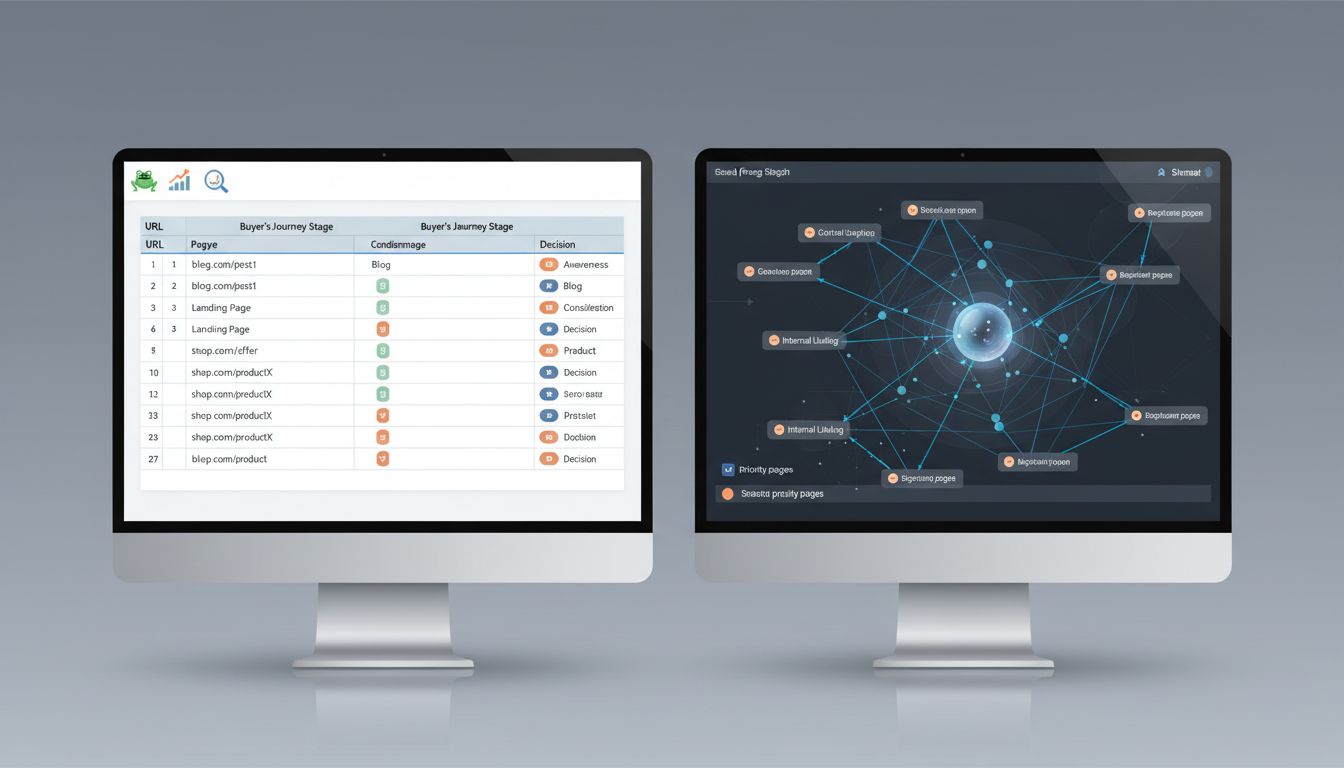
First, create a content inventory. Export all URLs from your sitemap or crawl with Screaming Frog. Categorise each page by type (blog, landing page, product) and map it to a buyer's journey stage: awareness, consideration, or decision.
The goal is to see your content the way a search engine does, a collection of pages competing for finite crawl budget.
Next, analyse performance in Google Analytics 4. Identify:
- High-traffic, low-conversion pages: These are your top-of-funnel workhorses that need stronger CTAs or lead capture.
- Low-traffic, high-conversion pages: These have commercial intent but poor visibility, they're your first priority for optimisation and internal linking.
Now the technical part. In Screaming Frog, check for:
- Indexation errors: Pages blocked by
noindextags or incorrect canonical URLs. - Duplicate content and missing metadata: Thin, duplicated pages or pages without unique
<title>and<meta description>tags. - Page speed and Core Web Vitals: URLs flagged by Google Search Console for poor LCP, FID, or CLS.
- Internal linking structure: Orphaned pages with zero internal links, invisible to both users and crawlers.
The most common mistake is skipping this step entirely.
Neglecting technical SEO means your new content gets published into a broken architecture where it may never get indexed. I've seen low-value thin pages consume crawl budget while high-potential commercial pages go undiscovered.
Your output is a prioritised spreadsheet. Assign each issue a severity: P0 (critical, fix within 48 hours, like a 5xx server error), P1 (high importance, fix this sprint), or P2 (optimisation).
Your first 90-day goal is clearing every P0 item. This groundwork is why SEO delivers 748% ROI in b2b content marketing strategy, the system compounds when the technical foundation is solid, and the best b2b marketing campaigns are built on exactly that.
Step 2: Map Your Buying Committee and Search Intent
Most B2B content fails because it targets a single, generic "decision-maker."
In reality, your sale involves a committee. Stop writing for a persona and start writing for the three core roles: the Champion (researcher), the User (operator), and the Economic Buyer (executive).
For each role, define their distinct pain points, preferred content formats, and the specific keywords they use at each buying stage. Your Champion might search "how to automate X workflow." Your Economic Buyer needs "ROI of enterprise automation software." Same product, completely different content.
Map your target keywords by intent:
- Informational: "How to," "guide" (top of funnel)
- Commercial: "vs.," "best" (middle funnel)
- Transactional: "buy," "pricing," "demo" (bottom funnel)
Then enrich that map with real data from your CRM. Which content did closed-won leads actually engage with before becoming an opportunity?
That's the part that turns guesswork into a targeting system.
| Role | Core Pain Point | Sample Keyword/Intent | Ideal Content Format |
|---|---|---|---|
| Champion (IT Manager) | Manual processes are slow and error-prone. | "how to automate data entry" (Informational) | Detailed technical guide, webinar |
| User (Operations Lead) | Needs a tool their team will actually adopt. | "best task management software 2025" (Commercial) | Case study, product comparison |
| Economic Buyer (VP Ops) | Needs to justify budget with clear ROI. | "enterprise workflow automation ROI calculator" (Transactional) | ROI case study, executive brief |
This matrix is your content brief. Every piece you create has a defined audience and a clear path to influencing a real, complex sale, which is exactly what separates a b2b content marketing strategy that works from one that just produces content for content's sake. The best b2b marketing campaigns are built around this kind of committee-level thinking, not a single buyer persona someone made up in a workshop.
Step 3: Architect Your Pillar-Cluster Topics
Your content matrix defines who you're writing for and why. Now you need the structural blueprint that makes SEO authority compound over time. That's pillar-cluster architecture.
Start by picking 3-5 pillar topics. These are your core commercial themes.
- Tie directly to revenue. If you sell a CRM, pillars are "Sales Pipeline Management," "Lead Qualification," or "B2B Sales Reporting."
- Validate with data. Run each pillar through Ahrefs or Semrush. You need sufficient search volume (aim for ~1K+ monthly) and commercial intent.
- Assess winnability. Be brutally honest about your Domain Rating (DR). With a DR ~30, you cannot win "what is CRM." Target mid-funnel, commercial investigation terms like "best sales pipeline software" or "lead scoring models for B2B."
Next, build clusters. For each pillar, brainstorm 15-30 subtopics using your keyword tool's "Phrase Match" and "Questions" reports.
Analyze competitors ranking for your pillars to see their cluster structure. That's where you'll find the gaps worth going after, and honestly where a lot of the best b2b marketing campaigns in a given niche get their edge.
Prioritize clusters that map directly to the questions from your buying committee matrix and have lower keyword difficulty.
The creation rule isn't complicated. Your pillar page is the comprehensive, link-worthy guide (3,000+ words). Long-form content earns 77.2% more backlinks on average. Each cluster article (1,500+ words) answers one specific subtopic.
Every cluster article links to the pillar with descriptive anchor text (e.g., "Learn more in our complete guide to sales pipeline management"). The pillar links out to each relevant cluster.
This internal linking web signals topical authority to Google. A collection of articles becomes a system where traffic to one page lifts rankings for all the related ones. That compounding effect is a big part of what separates a b2b content marketing strategy that actually builds momentum from one that just produces isolated posts nobody finds.
Phase 2: Execute and Optimize Your Production and Distribution Engine
So the blueprint is done. Now what?
Now you build the system that turns it into consistent output. Not one-off pieces you're proud of for a week. A repeatable engine.
There are three things to get right: a lean editorial calendar that enforces cadence, a production workflow that integrates AI, and a distribution system that actually gets your content in front of people. Companies with active blogs generate 67% more monthly leads, but only if they're publishing consistently, not whenever someone gets around to it.
Your goal is predictable throughput.
A typical cadence for a team your size looks like two blog posts per week, one case study per month, and one webinar per quarter. That rhythm creates compounding traffic without burning your team out.
This is where a b2b content marketing strategy either holds or falls apart. The best b2b marketing campaigns aren't always the most creative ones. They're the ones that kept showing up on a schedule while everyone else posted in bursts and went quiet.
Step 4: Build a Lean, Quarterly Editorial Calendar
What separates a b2b content marketing strategy that compounds from one that stalls? Usually it's not the ideas. It's whether anyone knows what gets published, and when.
A quarterly editorial calendar fixes that. It's what prevents the "let's just write something this week" spiral.
Start with a simple allocation rule: 70% of your quarterly output goes to supporting your pillar clusters (blog posts, long-form guides). 20% goes to decision-stage content like case studies and comparison pages. The last 10% is for experimentation, original research or new video formats.
Companies with active blogs generate 67% more monthly leads than those without. But consistency is what compounds that advantage. Sporadic publishing doesn't.
Map your next 13 weeks. For each content piece, assign:
- A primary target keyword
- The specific persona and buying stage it serves
- The responsible owner (writer, SME, editor)
- Clear due dates for draft, review, and publish
Block time for subject matter expert interviews directly in the calendar. This isn't optional. It's the core of E-E-A-T. Your SMEs provide the unique insights and data that generic content just doesn't have.
This is where a tool like Spectre helps. Use it to generate a research-backed first draft from your keyword and persona brief. It handles structure and SEO fundamentals. Your SME then injects real expertise, proprietary data, and the "why" behind the theory. An editor polishes for brand voice and optimization.
The best b2b marketing campaigns aren't always the most creative ones. They're the ones that kept showing up on a schedule while everyone else posted in bursts and went quiet.
Your output here is a live, shared calendar in Notion, Asana, or a dedicated platform like Relato. Everyone sees the pipeline, dependencies are clear, and your cadence, whether that's two blogs a week or one webinar a quarter, becomes something you can actually predict.
Step 5: Implement On-Page and Technical SEO Protocols

Your content is scheduled. Now you need to build each piece to rank. Don't trust your CMS defaults.
On-page checklist (copy this into your content briefs):
- Title tag: Primary keyword within first 60 characters
- Meta description: 155-160 characters with value proposition
- URL slug: Clean, contains target keyword
- Headings: H1 covers topic; H2/H3 create logical structure
- Keyword placement: Natural inclusion in first 100 words
- Images: Descriptive alt text (not "image-01.jpg")
- internal linking: Minimum 2-3 links to relevant pillar/cluster pages
- CTA: Clear next step relevant to search intent
For semantic SEO, use tools like SurferSEO or Clearscope to find related terms and entities. Don't keyword stuff. Google now evaluates topical authority through semantic relationships, not keyword density.
Technical validation (post-publish):
Run Screaming Frog to check indexing status. Verify new pages are in your XML sitemap, submit URLs to Google Search Console, and monitor Core Web Vitals. Slow pages won't rank no matter how good the content is.
EEAT implementation:
Include author bios with credentials. Cite original research or data, long-form content earns 77.2% more backlinks. Link to authoritative sources.
This isn't about pleasing algorithms. It's about building actual authority that readers trust. Those two things happen to overlap a lot.
The most common mistake in any b2b content marketing strategy isn't bad writing. It's publishing and then forgetting.
Set a calendar reminder to check Google Search Console 72 hours after publishing. If pages aren't indexed, you've wasted production time on content nobody can find. The best b2b marketing campaigns don't just create good content, they make sure it actually gets seen.
Step 6: Deploy a Multi-Channel Distribution System
Publishing content is half the job. Distribution is what makes it work.
Stop the "publish and pray" approach. Build a system that pushes each piece through multiple channels.
1. Master LinkedIn as your primary B2B channel. Post article summaries with two or three key takeaways. Use carousel PDFs for guide sections. Most importantly, activate your team with an employee advocacy tool like Oktopost or Hootsuite. A single post from your CEO's network reaches more relevant people than your company page ever will.
2. Build a repurposing engine. One asset should generate five pieces of content. Here's the formula I use: 1 webinar = a LinkedIn carousel, 3-5 short video clips, a blog recap, 10 social quote graphics, and a gated replay page. This maximises ROI per production hour. 46% of B2B marketers plan budget increases, with 61% targeting more video investment.
3. Earn links through original research, not outreach. Run a simple survey of your customers or pull from your product data. Publish it as a "State of the Industry" report. Journalists and bloggers cite original data. Not another "5 tips" article.
4. Integrate new content into your email nurture sequences. When you publish a cluster page on a specific pain point, automatically add it to the nurture track for leads who downloaded a related guide. This keeps your CRM warm with value, not sales pitches.
Any b2b content marketing strategy lives or dies at the distribution stage. The best b2b marketing campaigns don't just get the content right, they make sure people actually see it.
Phase 3: Measure, Integrate, and Scale Your System
Your engine is built and running. Now you close the loop, prove the economic value and make it scale predictably.
Stop measuring vanity traffic. Start tracking content's direct contribution to pipeline.
The goal is connecting every piece of content to a specific lifecycle stage in your CRM. A lead downloading a top-funnel guide becomes a "subscriber." Engaging with three decision-stage case studies should trigger an automated workflow that flags them as a Marketing Qualified Lead (MQL) for sales.
This means integrating your CMS with your CRM (HubSpot, ActiveCampaign, Salesforce) and setting up lead scoring rules. Use something like Activepieces to automate the data flow. When a contact views a "comparison" page, their lead score goes up 10 points. When they hit the threshold, they become an MQL.
Most teams fail here by only tracking top-line sessions.
You need a tiered metrics framework instead: traffic and rankings for awareness, MQL conversion rates for consideration, and pipeline value plus Customer Acquisition Cost (CAC) at the bottom. Content marketing generates three times more leads than outbound marketing and costs 62% less per lead, but you only know that if you're actually measuring it.
The roadmap runs across 90, 180, and 365 days. First quarter is integration and baseline measurement. By month six, you should see the first MQLs coming from your new clusters. At the one-year mark, you'll have enough data to calculate your content-driven CAC and ROI, which is what justifies scaling into new topic areas.
That's the part that turns a b2b content marketing strategy into something the business actually wants to fund. The best b2b marketing campaigns aren't just well-executed. They're provably worth it.
Step 7: Integrate Content with CRM Lead Capture and Scoring
Your content is ranking and getting read. Now it needs to pay rent.
This is where your content connects directly to revenue. Without this step, you're running a traffic machine, not a lead engine.
Think of your CRM as the central nervous system of the whole operation. Every reader action, every download, view, click, should build a profile and push that person toward a sales conversation. Your job is to wire content directly into that system.
Gate the Right Content, Not All of It
Your first decision is what to put behind a form. The rule is simple: gate bottom-of-funnel, high-intent content. Leave everything else open.
Gate these assets:
- Original research reports (e.g., "The State of B2B SaaS Security 2026")
- Detailed comparison guides (e.g., "HubSpot vs. Salesforce vs. ActiveCampaign: A Technical Deep Dive")
- Implementation blueprints or ROI calculators
- Webinar replays for a high-value topic
- Case study PDFs with detailed financial results
Keep these assets completely open:
- All blog posts and how-to guides
- Top-of-funnel explainers and glossary pages
- Pillar pages (you want these to rank and attract links)
- Short-form videos and infographics
The logic is commercial intent. Someone downloading a 50-page technical comparison guide is actively evaluating vendors. Someone reading a "What is CI/CD?" blog post is just learning.
Gating the latter will kill your traffic and SEO. Gating the former filters for serious prospects.
Common mistake: Gating mid-funnel content like generic white papers. You get emails, but they're from students and competitors, not buyers. If the content doesn't help someone make a buying decision, don't gate it.
Automate the Sync from Form to CRM Record
Once someone fills a form, that data needs to flow into your CRM instantly. Manual CSV imports are a failure point.
1. Use native integrations first. If you're on HubSpot CMS and HubSpot CRM, the form submission creates a contact automatically, tagged with the source URL and form name. Same for Salesforce with Pardot or Marketing Cloud. Most reliable path, full stop.
2. For other stacks, use a workflow automation tool. Zapier, Make (formerly Integromat), or Activepieces are your glue. Set up a Zap: "When a form is submitted on [Your CMS] → Create/Update contact in [Your CRM]."
Here's the detail most tutorials miss: map your form fields to the correct CRM field types. Your "Job Title" form field shouldn't map to a generic "Notes" field in Salesforce, it should map to the Title field on the Contact object. Incorrect mapping breaks segmentation and lead scoring later.
3. Pass UTM parameters and content context. Your automation should add tags or custom properties to the CRM contact. At minimum, pass:
content_asset_name: "2026_enterprise_security_report"content_topic: "security-compliance"funnel_stage: "decision"
This turns a raw email address into a segmented lead. You now know they care about security topics and they're at the decision stage.
Build a Practical, Points-Based Lead Scoring Model
Lead scoring quantifies intent. You assign points for actions that signal buying readiness. When a contact hits a threshold, they become a Marketing Qualified Lead (MQL) and get routed to sales.
Don't overcomplicate this. Start with a simple additive model based on content interaction and firmographic fit.
Example Lead Scoring Model:
| Action | Points | Why It Matters |
|---|---|---|
| Visits pricing page | +20 | Strong commercial intent |
| Downloads gated comparison guide | +15 | Evaluating solutions |
| Attends a live webinar | +10 | High engagement, interested in expertise |
| Downloads a case study | +5 | Validating social proof |
| Views a product feature blog post | +2 | Researching capabilities |
| Fills out a "Contact Us" form | +25 | Explicit request for sales contact |
| Job Title contains "Director", "VP", "Head of" | +10 | Fits ideal buyer persona |
| Company Size (from data enrichment) > 200 employees | +10 | Fits Ideal Customer Profile (ICP) |
Set your thresholds:
- MQL (Marketing Qualified Lead): 25 points. Automatically notify the sales team and create a task.
- SQL (Sales Qualified Lead): 50+ points and/or explicit "Contact Us" request. This is a hot lead.
Implementing the score: You can do this in your CRM's workflow engine (HubSpot, Salesforce Automation) or in your marketing automation platform. The logic is: "When contact does [Action A], add [X] points to their lead score field."
The friction point here is data freshness. Scores based on cookie-tracked website visits go stale. I prefer to base scores primarily on form submissions and CRM engagement (email opens, clicks), that data is reliable and lives where you can actually use it.
Create Automated Nurture Sequences Based on Content Consumption
Not every visitor becomes an MQL right away. For those who show early interest, say, downloading a top-funnel ebook, you need a nurture sequence to move them along.
Build a simple "Content Pathway" nurture:
- Trigger: Contact downloads "Beginner's Guide to API Security."
- Day 1: Auto-send a "Thank you" email with a link to a related blog post, "5 Common API Security Mistakes."
- Day 5: Send an email featuring a mid-funnel asset: "Case Study: How [Client] Secured Their API Platform."
- Day 12: Invite them to an upcoming webinar, "Deep Dive: Building a Secure API Gateway."
Each email should include a clear CTA and track clicks. If they click through to the case study, your automation adds +5 to their lead score. This sequence runs in tools like HubSpot, ActiveCampaign, or a combination of your CRM and a dedicated email platform.
The nurture content has to be logically sequential. Don't send a bottom-funnel pricing guide to someone who just downloaded a top-funnel primer, you'll scare them off. Map your nurture tracks to your pillar-cluster topics.
Visualize the Flow: From Anonymous Visitor to SQL
Here's the complete system flow, from the moment a visitor lands on your site.
graph TD
A[Anonymous Visitor] --> B[Reads Ungated Blog Post]
B --> C{Shows Buying Intent?}
C -->|No| D[Remains in Audience Pool<br>for Retargeting]
C -->|Yes| E[Submits Form for Gated Asset]
E --> F[CRM: Contact Created<br>Tagged with Topic & Asset]
F --> G[Automation: Lead Score Updated]
G --> H{Lead Score >= 25?}
H -->|No| I[Trigger Nurture Sequence<br>with Mid-Funnel Content]
I --> J[Track Engagement<br>Add Points for Clicks]
J --> H
H -->|Yes| K[MQL: Notify Sales Team<br>Create Task in CRM]
K --> L[Sales Qualifies Lead]
L --> M[SQL: Opportunity Created]
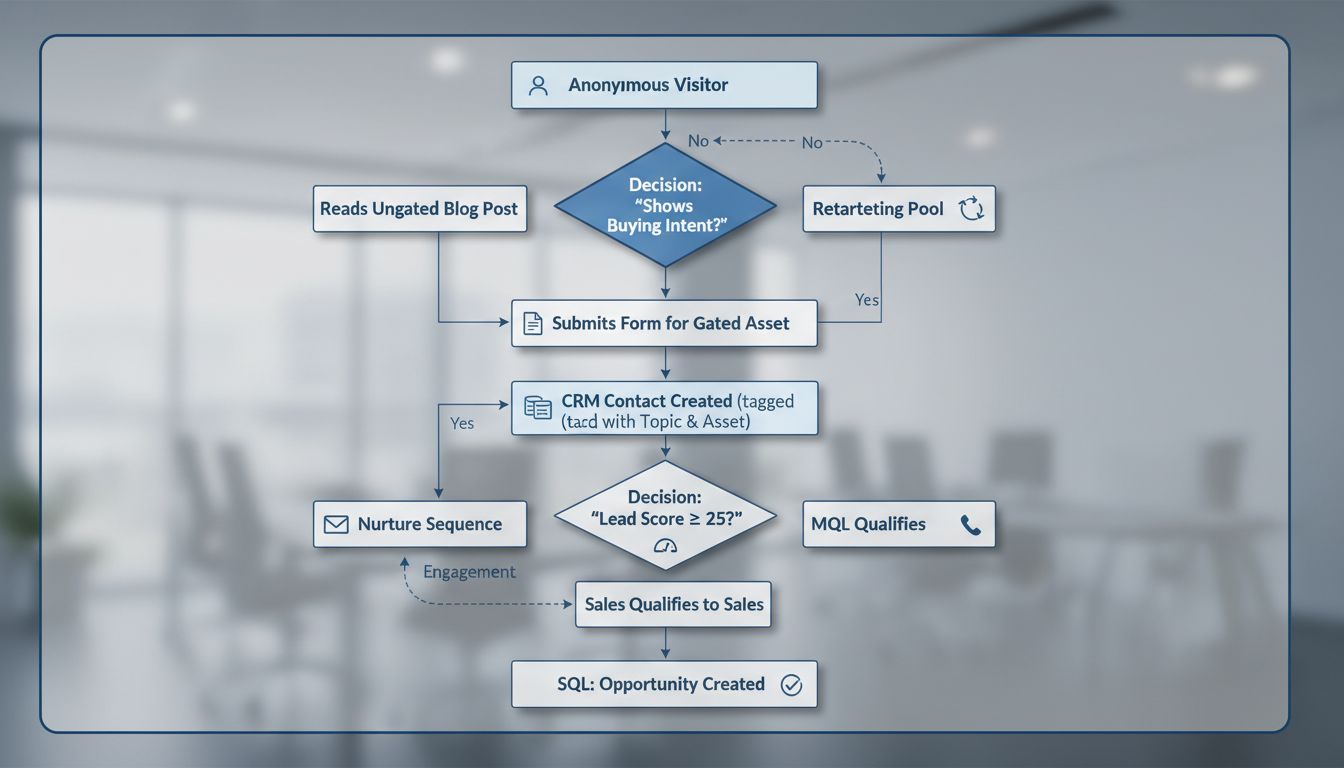
Each stage has a clear entry criterion, action, and exit state. It's a lead processing pipeline, not just a marketing workflow.
The Technical Friction Points (Where It Usually Breaks)
Having built these systems, here are the failure modes worth knowing about:
- Form-to-CRM field mapping errors: Creates dirty data that breaks segmentation. Test every new form with a dummy entry and verify the CRM record looks right.
- Cookie-based scoring decay: A lead's score drops if you base it on session data that expires. Supplement with firmographic and email engagement data, it's persistent.
- Nurture sequence blindness: If your sequences aren't tied to lead score, you'll spam a contact who's already become an MQL. Add a rule: "If lead score > 24, remove from all nurture tracks."
- Sales and marketing misalignment on MQL definition: If sales gets notified for a 25-point lead who just downloaded an ebook, they'll ignore future alerts. Agree on the scoring model together. Content marketing leads cost 62% less than outbound leads, so sales should treat them seriously.
Your Implementation Checklist
- Audit your gated assets. Are you gating bottom-funnel content only? Ungate anything else.
- Audit your forms. Do they have clear, mapped fields (Email, First Name, Job Title, Company)?
- Set up the automation. Form submission → CRM contact creation. Test it.
- Define your lead scoring model. Keep it under 10 rules to start. Implement it in your CRM.
- Build one nurture sequence. Pick one top-funnel gated asset and map a 3-email nurture track for it.
- Create an MQL notification workflow. When score hits threshold, email the sales team and create a task.
The outcome here is a closed loop. You can trace a closed-won deal back to the blog post that attracted the visitor, the gated guide they downloaded, and the nurture emails they clicked.
That's how you prove a b2b content marketing strategy isn't a branding exercise. That's what separates the best b2b marketing campaigns from the ones that just look good in a deck, they're measurable, traceable, and provably worth funding.
Step 8: Track Performance with a Tiered Metrics Framework
Your CRM integration proves content generates leads. Now you need to prove it generates revenue.
Stop measuring vanity metrics like page views. Implement a tiered framework that connects content activity to pipeline value.
Create a simple dashboard that tracks these three layers monthly:
| KPI Layer | Key Metrics | How to Measure | Target/Goal |
|---|---|---|---|
| Top-Funnel (Awareness) | Organic traffic, target keyword rankings, branded search volume, share of voice. | Google Search Console, Semrush/Ahrefs rank tracker. | Month-over-month growth in ranking keywords & non-branded traffic. |
| Mid-Funnel (Consideration) | Marketing Qualified Leads (MQLs) from content, content engagement rate, target account engagement. | CRM campaign attribution (e.g., HubSpot), GA4 scroll depth/event tracking. | Increase in MQLs MoM; decrease in bounce rate for key pages. |
| Bottom-Funnel (Decision) | Opportunities/pipeline value attributed to content, win rate, Customer Acquisition Cost (CAC). | CRM opportunity source reporting (e.g., Salesforce campaigns). | Measurable pipeline value; CAC lower than paid channels. |
Build this in Google Looker Studio, your CRM's dashboard, or a unified analytics platform like HockeyStack.
The goal is visibility: one glance should tell you whether top-funnel growth is turning into mid-funnel leads and bottom-funnel revenue. If you can't see that connection instantly, the dashboard isn't working.
Most teams only track the top layer.
The contrarian move in any solid b2b content marketing strategy is to obsess over the traffic-to-MQL conversion rate for each pillar page. If a page gets 1,000 visits but zero leads, it's an awareness piece, not a demand generator.
Treat them differently. That's also the gap between teams running average programs and the best b2b marketing campaigns, the latter can actually point to pipeline numbers, not just traffic charts.
Step 9: Execute the 90/180/365-Day Roadmap
Your content engine isn't a sprint. It's a staged construction project.
Follow this phased implementation to build momentum without burning out.
| Timeframe | Focus | Key Deliverables |
|---|---|---|
| First 90 Days | Foundation & Blueprint | Complete technical/content audit. Map buying committee. Define 3-5 pillar topics. Fix critical SEO (indexing, speed). Publish 1 pillar page + 3-5 cluster articles. Set up GA4, GSC, and CRM form capture. |
| Days 90-180 | Momentum & Learning | Establish publishing cadence (e.g., 2 blogs/week). Launch first gated asset (webinar/guide) with automated nurture sequence. Begin link-building outreach. Analyse first 90 days of performance data; refine keyword targets. |
| Days 180-365 | Scale & Optimization | Commission original research. Expand pillar topics with new clusters. Implement advanced CRM lead scoring. Measure direct pipeline contribution. Double down on high-ROI formats (e.g., video if it works). |
The economic reality isn't negotiable: content is a compounding asset.
Expect pure investment for the first 6 months, break-even around month 7, and meaningful, increasing ROI in years 1-3 Source: averi.ai.
This isn't a marketing cost. It's capital expenditure on a lead-generation machine, and it's what separates teams executing a real b2b content marketing strategy from the ones still chasing traffic numbers. The best b2b marketing campaigns didn't get there by treating content like an expense.
Common Pitfalls & How to Avoid Them: An Engineer's Debug Guide
Your content engine is a system. Systems have predictable failure modes. Here's how to debug the common ones before they kill your ROI.
Pitfall 1: No Clear Goals (System Failure: No Success Criteria) You're publishing content but can't measure what it's actually doing for the business. According to the Content Marketing Institute, this is the top reason strategies underperform. Debug: Before you write a word, set quarterly OKRs. Something like: "Increase MQLs from content by 15% in Q3." Every piece you brief should map to one of these.
Pitfall 2: Ignoring Technical SEO (System Failure: Broken Foundation) Good content trapped in a broken CMS doesn't rank. Crawl errors, slow Core Web Vitals, poor mobile rendering, these kill you before you've even started. Debug: Run a Screaming Frog audit every quarter. Treat critical errors (4xx/5xx status codes, broken internal links) like P0 bugs. Fix them within two weeks.
Pitfall 3: Tool Sprawl (System Failure: Unmanageable Complexity) Logging into 12 platforms to research, write, optimize, and distribute is not a strategy. Context switching just eats your time. Debug: Commit to your core stack (Ahrefs, your CMS, your CRM). Use something like Activepieces or Zapier to connect them. Don't add more point solutions.
Pitfall 4: Skipping Decision-Stage Content (System Failure: Leaky Funnel) Endless top-of-funnel blog posts with nothing to convert a ready-to-buy visitor. This is the most common content gap, and it has the highest pipeline impact. Debug: For every pillar topic, mandate one bottom-funnel cluster piece. A case study, a comparison guide, a pricing breakdown. It's the landing page for your qualified traffic.
Pitfall 5: Poor internal linking (System Failure: Weak Authority Flow) You've built pillar-cluster architecture but haven't connected the wires. Google can't see your topical authority, and link equity goes nowhere. Debug: Make internal linking a mandatory checklist item in your editorial process. When publishing a cluster page, link it to its pillar with relevant anchor text, and link back from the pillar too.
Pitfall 6: Relying Solely on Generative AI (System Failure: Low EEAT) AI-generated content is often generic, lacks original insight, and fails EEAT signals. Search engines are only getting better at spotting low-value automation. Debug: Use AI as a drafting assistant, not the author. Every piece needs a subject matter expert to review it and add something real, proprietary data, a specific anecdote, actual analysis.
Future-Proofing Against AI Overviews & Zero-Click Search Google's AI Overviews and featured snippets are designed to answer queries without a click. Your defense is becoming the source they can't summarize away. Debug: Double down on EEAT. Publish original research that becomes the cited source. Use formats like embedded video or interactive calculators that give users a reason to stay, things that can't be reduced to a two-sentence answer.
Conclusion
Your B2B content marketing strategy isn't a marketing plan. It's a production system.
Build the foundation with persona mapping and topic architecture. Execute with technical precision. Connect it to your CRM so you can actually see pipeline impact.
The compound returns kick in when you stop treating content like a creative project and start treating it like an engine.
Pick one pillar topic. Map its clusters around a commercial keyword. Run a Screaming Frog audit. Do those three things in the next 7 days and you have momentum.
If you want a system that handles the heavy lifting of research, writing, and optimization, take a look at Spectre. The best b2b marketing campaigns aren't accidents, they're built.