May 13th, 2026
SEO vs SEM: Which Strategy Drives Better Results for SaaS Founders
 WD
WDWarren Day
For SaaS founders staring down the quarterly marketing budget, the seo vs sem debate isn't just theoretical. It's the difference between compounding growth and a leaky lead bucket that drains cash. You suspect SEO is better long-term, but SEM's promised speed is hard to ignore.
Here's the reality: you have maybe ten hours a week for marketing. Traditional SEO, the manual keyword research, the endless content creation, the technical audits, requires a full-time specialist you can't afford.
So you default to Google Ads. And watch your CAC creep up month after month.
The real question for most SaaS companies in 2026 isn't which one wins. It's whether you can overcome SEO's execution bottleneck with automation. "Manual SEO" is a fantasy for resource-constrained founders. The actual choice is between paid ads and automated, systems-first SEO.
SEO delivers a 14.75x ROAS versus PPC's 11.70x (2026 benchmarks), but only if you can consistently produce quality content at scale.
This article breaks down the capital efficiency, time investment, and scalability of both approaches. We'll also get into the seo and sem tools that matter, what the seo smm sem overlap actually looks like in practice, and how to build a content engine that works while you sleep.
A Founder's Reality Check: SEO, SEM vs. the Content Bottleneck
Most founders pick SEM because SEO feels too slow. That's usually the wrong call.
Manual SEO is the traditional playbook: hire a writer or agency, brief them on keywords, wait for drafts, edit, publish, hope it ranks. The long-term value is real, organic search drives 40-60% of website traffic for established SaaS companies. But the bottleneck is you. Slow, expensive, unscalable.
You're trading your limited time for unpredictable future returns.
Paid SEM (Google Ads, LinkedIn, YouTube) is the opposite trade-off: predictable spend, immediate traffic. You set a budget, launch a campaign, clicks arrive within hours. It feels like velocity.
The catch is the meter never stops running. Turn off the ads and the traffic vanishes. You're buying visibility, not building anything.
The real conflict isn't actually seo vs sem. It's between manual, human-limited execution and system-driven scalability. Most founders can see that SEO wins on capital efficiency, they just can't get past the production bottleneck.
That's where the third path comes in: automated SEO.
Not spammy AI content. A systems-first approach that uses software to handle keyword research, content creation, and publishing at scale. The seo and sem tools that matter here aren't the ones running your ad bids, they're the ones eliminating the manual work entirely.
At Spectre, that's exactly what we built. The goal isn't to replace strategy. It's to automate execution, so founders and small teams can run a content engine at the scale previously reserved for big media companies.
The question stops being "can we afford SEO?" and becomes "how much organic traffic can our system generate?", which is a much better problem to have, and one that connects directly to how seo smm sem all fit together as a system rather than a set of separate channel bets.
Decision Axis #1: Efficiency of Capital (Cost & ROAS)
For SaaS founders, capital efficiency isn't abstract. It's survival.
Every pound spent on acquisition has to work harder when you're running on pre-seed or Series A constraints. The numbers are pretty stark: organic CAC for SaaS sits between $100 and $290, which is 30-50% cheaper than paid CAC according to SaaS marketing benchmarks. When your average paid CAC runs $350-$500, that gap compounds fast across your whole pipeline.
The ROAS comparison is even more lopsided. SEO delivers 8.75x based on First Page Sage's analysis, versus 1.70x for PPC. That's not a marginal edge, it's roughly fivefold. If your customer LTV clears £2,000, the math basically makes the decision for you.
SEM's real advantage is predictability. You set a budget, activate campaigns, see leads within days. For testing product-market fit or filling an immediate pipeline gap, that kind of controlled spend is genuinely useful. But you're paying a premium for that speed, average B2B SaaS cost per click hit $3.33 in 2026, with cost per acquisition around $87 for search. And the moment you stop paying, the traffic stops.
SEO asks you to commit capital now for returns that show up later. Positive ROI typically takes 9 to 18 months with structured content investment as documented in SaaS SEO case studies. That's where most founders hesitate.
But look at the TimeZ Marketing case study: a 90-day SEO sprint delivered $349,640 in closed revenue from organic demos, with cost per organic lead at just $38. The spend created an asset. It kept generating pipeline months after the initial investment.
The seo vs sem question really comes down to time horizon. Need predictable spend and leads this quarter? SEM gives you that. Building a company that needs to scale acquisition without linearly scaling ad spend? SEO's compounding returns are the only way that math works. Your CAC doesn't just stay lower, it actually decreases as domain authority builds and content starts ranking for more terms.
That's what makes seo and sem tools so different in practice. The seo smm sem stack isn't just a channel mix, it's a choice about what kind of asset you're building.
Decision Axis #2: Efficiency of Time (Speed & Effort)
If capital efficiency asks "what's the cost?", time efficiency asks "how long until I see it working?"
This is where the seo vs sem debate breaks down for most founders.
Paid search is fast. Campaign live in hours, targeted traffic within days. You're paying for immediacy, a predictable relationship between spend and visits. For a founder who needs to prove channel viability this quarter, that's genuinely appealing.
The standard counter-argument is that SEO takes 3-6 months to show results. And honestly, that's true for manual SEO.
The bottleneck isn't Google's crawl budget. It's your own production capacity. Researching keywords, briefing writers, editing drafts, optimising for E-E-A-T, publishing at scale, it's slow and it grinds people down. Most founders don't abandon SEO because it doesn't work. They abandon it because they can't outlast the production timeline before someone asks for results.
Here's where the calculus shifts. The real question isn't "manual SEO vs. SEM." It's "automated SEO vs. SEM."
When you automate the research, writing, and publishing workflow, you collapse the timeline. A platform like Spectre doesn't make Google rank pages faster, it eliminates the 80% of grunt work that creates the 3-6 month lag in the first place. You go from publishing one article a week to a dozen, systematically targeting keyword clusters across your funnel. The case study showing a 215% traffic increase in 90 days stops being exceptional. It becomes repeatable.
This leads to the question everyone's asking: will AI replace SEO experts?
Not exactly. AI replaces manual content writers and junior execs following checklists. The strategic work, understanding search intent, mapping content to a commercial funnel, reading SERP features, building topical authority, that moves up the stack. The expert shifts from producer to systems architect.
That's what we built Spectre for. Not to remove the need for SEO strategy, but to remove the time bottleneck that makes SEM look like the only viable option for time-poor founders. The seo and sem tools in your stack serve different purposes, but they don't have to be in competition. With the right seo smm sem setup, you get the capital efficiency of SEO without giving up speed to insight.
Decision Axis #3: Quality of Output (Traffic & Lead Value)
Capital and time efficiency matter. But they're meaningless if the traffic doesn't convert.
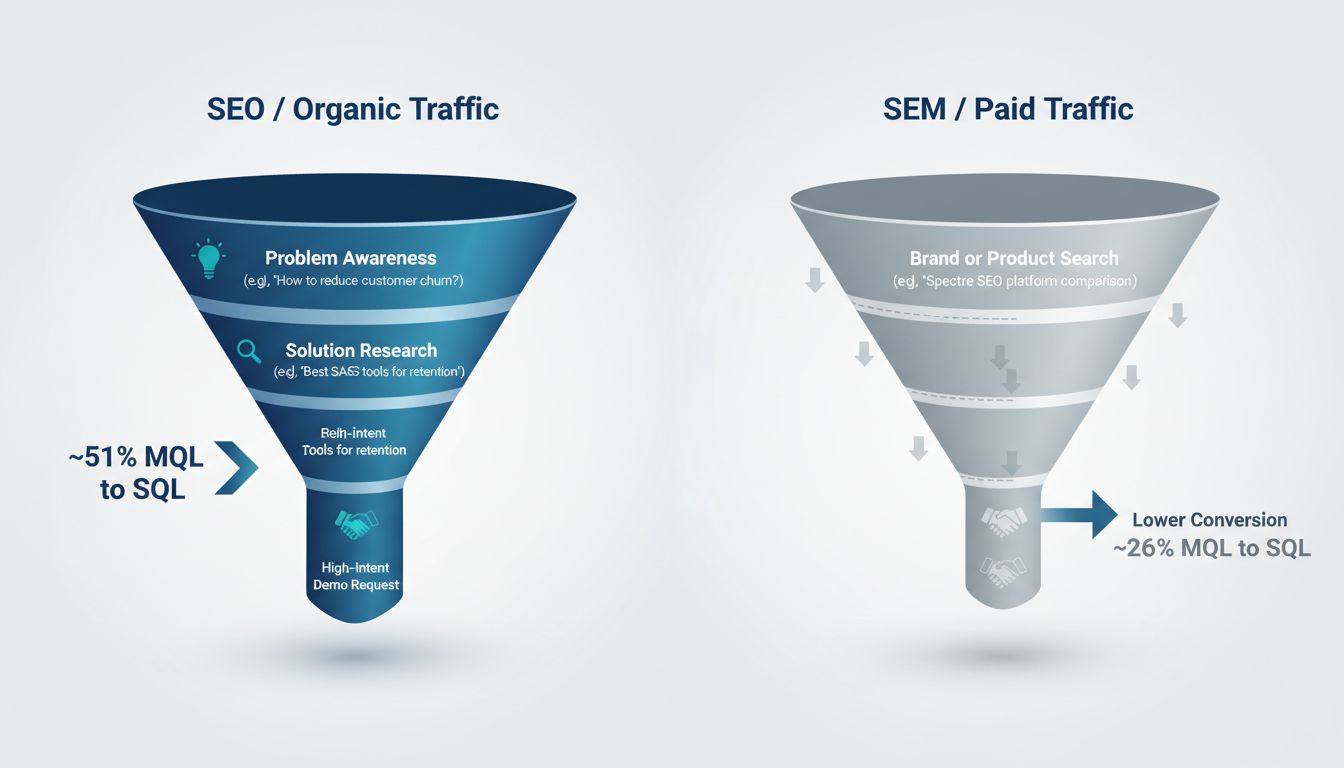
The numbers here are pretty stark. According to Understory Agency, SEO-generated MQLs convert to SQL at ~51% versus ~26% for PPC MQLs in B2B SaaS. That's close to double the funnel efficiency.
When you trace it back, it's about intent. SEM captures demand, someone searching your exact product name. SEO captures discovery, someone researching a problem your product solves, often months before they're ready to buy. You're building trust while they're still learning.
SEM's lead quality is fragile by design. You're paying for clicks, which pushes you toward broad match keywords and aggressive bidding. That pulls in comparison shoppers, high bounce rates, unqualified traffic. Your cost per lead inflates quietly.
TimeZ Marketing's case studies show SEO-sourced demos convert at 26% versus 14% for PPC, with average contract values running 45% higher. That gap compounds.
The counter-argument right now is Google's AI Overviews. And it's a real one, but only if your SEO strategy is built on ranking for things like "what is CRM." That traffic is gone. Or going.
The right response is to shift your SEO targets toward commercial-intent pages: comparison pages, alternative lists, implementation guides. The kind of content that answers "how do I buy this" rather than "what is this." Harder to summarise in a snippet. Closer to a decision.
Most founders miss this because they don't have the seo and sem tools to analyse SERP features at scale. You need to know which keywords are vulnerable to AI Overviews and which are still solid commercial opportunities in the seo vs sem equation. Without that data, you're writing content and hoping.
That's exactly the kind of signal a good seo smm sem setup should surface automatically, before you've wasted six months on the wrong targets.
Image Prompt: An illustrated funnel graphic showing two paths. The left path, labelled "SEO/Organic," starts wide with "Problem Awareness" and narrows through "Solution Research" to "High-Intent Demo," with conversion rate percentages shown at each stage (~51% MQL-to-SQL). The right path, labelled "SEM/Paid," starts narrow at "Brand Search" and shows a leaky funnel with a lower final conversion rate (~26% MQL-to-SQL).
The Scalability Test: What Happens When You 10X?
Scaling breaks everything, and how fast depends entirely on which channel you're running.
Manual SEO scales linearly with human effort. Want to publish 10x more content? You need 10x more writers, editors, and SEO managers. Quality control falls apart, editorial voice fragments, and the cost per article stays stubbornly fixed. I've seen this in media companies where editorial teams balloon just to maintain output, the coordination overhead ends up killing the agility they were trying to build.
Paid SEM scales with diminishing returns. As you increase spend, you exhaust the efficient keyword pockets first, then you're forced into more competitive auctions where CPCs spike. Average B2B SaaS CPCs already sit at $3.33, and that climbs fast. Each incremental pound buys less traffic, and you're capped by available search volume for your target terms anyway.

Automated SEO with systems like Spectre works differently. The unit cost goes down as you scale, because the research, writing, and optimisation workflows are systematised. Once you've validated a content template that converts, say, a comparison page format that drives demos, you can replicate it across hundreds of keyword variations without proportional human effort.
The bottleneck stops being "can we write?" and becomes "are we targeting the right search intent?"
That's how programmatic SEO delivers results like John Doherty's Credo generating over $250 million in leads from 6,500+ hyper-targeted pages. The system handles the repetitive work. Humans focus on strategy and refinement.
Is SEO dead in the seo vs sem debate? Not even close, it's just changing shape. The SEO that's dying is the one treating content creation as a linear human task. The version thriving in 2026 builds content engines instead, and that's where the right seo and sem tools make the difference. The whole seo smm sem equation shifts when you stop thinking about content as something you write and start thinking about it as something you deploy.
Your 90-Day Action Plan: A Founder's Playbook
Stop debating. Pick one of these paths based on your real constraint, capital or time, then follow the daily tasks.
Path A: SEO-First (Prioritising Capital Efficiency)
Days 1-30: Foundation & Setup
- Technical Audit: Run Screaming Frog. Fix critical issues (broken links, missing meta tags, slow pages). Non-negotiable.
- Keyword Clustering: Use Ahrefs or SEMrush to find 50-100 low-competition, high-intent keywords. Cluster them into 3-5 core topic "pillars." Don't target "CRM", target "best CRM for startups under 10 users."
- Attribution Setup: In GA4, enable Google Signals and activate the Model Comparison tool. Set your attribution model to Data-driven. This is how you prove SEO's incremental value later.
Days 31-60: Content Engine Launch
- Build Your Pipeline: We built Spectre to automate this phase. Connect it to your keyword research. Let it generate your first 10-15 pillar articles and supporting cluster content, optimised for EEAT.
- Publish & Interlink: Schedule content. Manually build internal links from cluster pages to your pillar. This tells Google your site's topical authority structure.
Days 61-90: Amplify & Measure
- Promote & Build Links: Share each piece on relevant communities (Indie Hackers, LinkedIn). Use something like Hunter.io to pitch 1-2 key pieces for backlinks from industry blogs.
- Review GA4: Check the Model Comparison report. Look for assisted conversions from organic search. Early signs of traction should start showing, the 215% traffic increase in 90 days from case studies doesn't happen by accident.
Path B: SEM-First (Prioritising Immediate Impact)
Month 1: Hyper-Focused Test
- Budget: Allocate £1,500-£3,000 for a 30-day test. No more.
- Campaigns: Create 3 ad groups: exact-match competitor keywords ("[Competitor] alternative"), your category + "for startups," and retargeting visitors who saw pricing but didn't convert.
- Landing Pages: Build dedicated, copy-heavy landing pages for each ad group. No generic homepage links.
Month 2-3: Optimise or Kill
- Analyse: After 30 days, cut any campaign with a CPA above £150. Double down on the one with the lowest cost per demo.
- Reinvest: Take what's working in your ad copy and apply it to your core website messaging.
The Hybrid Path (Recommended)
Use SEM as a research lab for your SEO engine.
- Week 1-2: Run small-scale Google Ads tests (£500 budget) on 3-4 different value propositions. See which messaging gets the highest CTR.
- Week 3-4: Feed the winning messaging into Spectre. Generate 5-10 content variants, blog posts, landing pages, built around that proven messaging.
- Month 2-3: Scale the winning content formula through your automated SEO pipeline, using the same GA4 attribution setup to track the compounding organic impact.
The whole seo vs sem debate assumes you have to pick a side forever. You don't. The goal is a disciplined 90-day sprint that gives you unambiguous data on what actually works for your product and market. The right seo and sem tools make that sprint cheaper and faster, and once you see what converts, the seo smm sem equation starts to sort itself out pretty quickly.
FAQ: SEO vs SEM for SaaS Founders (2026)
Q: Is Google Ads SEO or SEM? A: Google Ads is pure SEM. Pay-per-click, renting traffic, not building anything you own. SEO is the organic side, you earn traffic by creating content search engines actually want to rank.
Q: What are the 4 main types of SEO? A: Technical (site speed, crawlability), on-page (content, meta tags), content (blog posts, guides), and off-page (backlinks, brand mentions). For SaaS, technical and content SEO are the non-negotiable starting points.
Q: What is the major advantage of SEM over SEO? A: Speed. SEM delivers predictable traffic the moment you turn it on. SEO requires patience, the compounding effect takes time to kick in.
Q: Is SEO dead or evolving in 2026? A: Evolving, pretty dramatically. Google's 2025 core updates now penalise thin or purely AI-generated content and reward genuine expertise. The game has shifted from keyword stuffing to topical authority and E-E-A-T signals that are hard to fake.
Q: Which delivers better quality leads? A: SEO, consistently. Data shows SEO-generated MQLs convert to SQL at around 51%, nearly double the ~26% rate for paid ads. Organic visitors are further along in their research and more skeptical of being sold to (which paradoxically makes them easier to close).
Q: Is YouTube Ads considered SEM? A: Yes. It's paid social advertising under the broader PPC umbrella. Not traditional search marketing, but it's a paid channel used to capture demand, which makes it a tactical piece of a blended SEM strategy.
Q: Should I do SEO or SEM first? A: For capital-constrained founders, SEO-first builds a durable moat. Use the 90-Day Action Plan to establish a baseline, then layer in SEM to accelerate the keywords you've already proven convert. That's where the seo vs sem debate stops being theoretical, and where the right seo and sem tools start actually earning their keep. Once you see what converts organically, the seo smm sem equation sorts itself out pretty fast.
The Verdict: It's Not 'SEO vs. SEM', It's 'How You Do SEO'
The data is pretty clear. For SaaS founders, SEO wins on capital efficiency, lead quality, and durable growth. The real question isn't seo vs sem, it's which version of SEO you're actually running.
Pick automated SEO (Spectre) if: You're capital-constrained, time-poor, and need growth that compounds without you babysitting it. The 8.75x ROAS and 51% MQL-to-SQL conversion rates SEO delivers [Source: First Page Sage, Understory Agency] are real, but only if you can actually produce content at scale. Manual content creation is the bottleneck for most founders. This is probably you. (It's about 80% of the people reading this.)
Pick Paid SEM if: You have a launch in the next 30 days, budget but no bandwidth, or you need to go after a competitor's branded keyword right now. Useful as a tactical accelerator. Not a foundation.
Pick Manual SEO if: You have a real editorial team and your brand needs a voice that AI genuinely can't replicate yet. This is a pretty narrow edge case for early-stage SaaS.
The seo and sem tools debate, the seo smm sem channel comparisons, none of that matters if you're still manually producing three posts a month and wondering why it's not compounding.
Stop debating the system. Build one.
Conclusion

The gap isn't really seo vs sem. It's manual effort versus something that actually scales.
SEO's capital efficiency (14.75x ROAS) and lead quality (51% MQL-to-SQL conversion) are proven. The only reason SEM ever looked tempting was the time cost. Automation removes that.
Your next move isn't a debate. Run a 90-day automated SEO sprint with a tool like Spectre alongside a 30-day SEM blitz. Measure CAC, ROAS, lead quality.
The data decides. And it keeps saying the same thing: systematised SEO compounds, paid channels just... keep billing you.
The whole seo and sem tools conversation, the seo smm sem channel comparisons, none of it matters if you're still stuck at three manual posts a month. Pick a system. Run it.
Spectre automates the SEO bottleneck. That's the test worth running.
Frequently Asked Questions
What is the main difference between SEO and SEM?
SEO is earned visibility. You build it through content and technical site health, and it keeps working after you stop actively touching it.
SEM is paid visibility through platforms like Google Ads. The moment you pause spending, the traffic stops. That's the real difference in the seo vs sem debate, one compounds, one bills.
Is Google Ads SEO or SEM?
Google Ads is SEM. It's the paid side: pay-per-click campaigns, paid search placements, immediate visibility in exchange for budget.
Some marketers use SEM to mean both organic and paid together, but in practice, SEM means paid search. That's it.
Is SEO dead or evolving in 2026?
Evolving. Not dying.
AI Overviews and zero-click searches have made informational SEO more competitive, sure. But commercial-intent SEO is actually worth more now than it was. The shift is toward automated, intent-focused content systems that work at scale, which is the whole reason Spectre exists.
What are the 4 types of SEO?
Technical SEO (site speed, crawlability, structured data), On-page SEO (content, headings, meta tags), Content SEO (search-optimized articles that actually answer things), and Off-page SEO (backlinks, brand mentions, social signals).
For SaaS founders, technical and content SEO give you the fastest returns, especially when you're not doing it all by hand.
Is YouTube Ads SEM?
Yes. YouTube Ads are paid advertising inside the broader PPC ecosystem, running on the same auction-based bidding logic as search campaigns.
Not traditional search, but it lives in the same world. Usually managed in Google Ads alongside search campaigns anyway.
What is the 80/20 rule for SEO?
80% of your results come from 20% of your efforts.
For SaaS founders that usually means: fix your technical foundation, build out commercial-intent content, stop chasing every keyword. The seo and sem tools conversation, the seo smm sem channel comparisons, they only matter after you've locked in that 20%.
Tools like Spectre help you find it and actually execute on it, without the manual grind.